I tested the optional digital inputs using USB and optical S/PDIF data; the TosLink input accepted data sampled at rates up to 192kHz. Apple's USB Prober utility identified the Processor as "Ayre X-8 USB-2" from "Ayre Acoustics, Inc.," and indicated that the USB port operated in the optimal isochronous asynchronous mode. The AudioMIDI utility revealed that the KX-8's USB port accepted 32-bit integer data sampled at all rates from 44.1kHz to 384kHz.
While the first sample of the KX-8's digital inputs were noninverting from all the outputs, the second sample inverted absolute polarity. With the volume control set to the maximum, the first sample's output levels with a full-scale 1kHz signal were 4.65V, balanced, 2.36V, unbalanced, and 4.71V, single-ended headphone. Peculiarly, the second sample's maximum output levels with full-scale digital data were 3dB higher than the first sample's. (The setup menu doesn't have any options for setting an input's maximum level or polarity.)
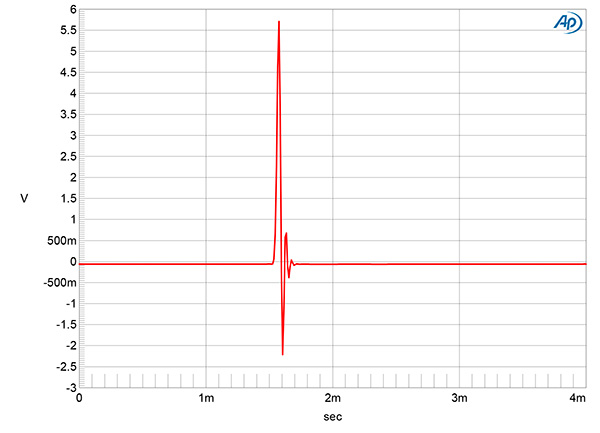
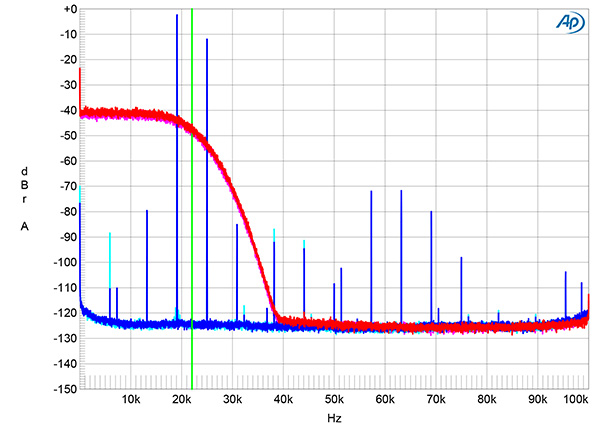
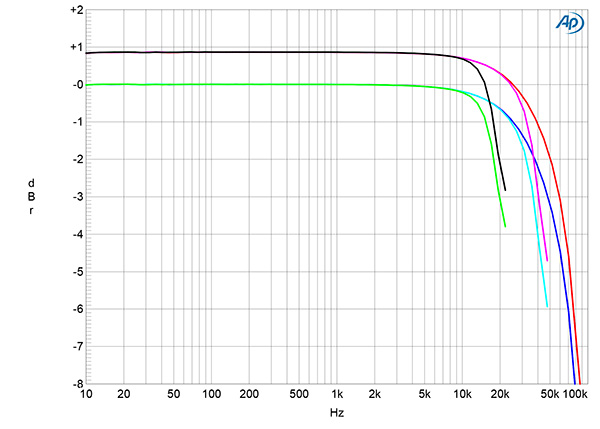
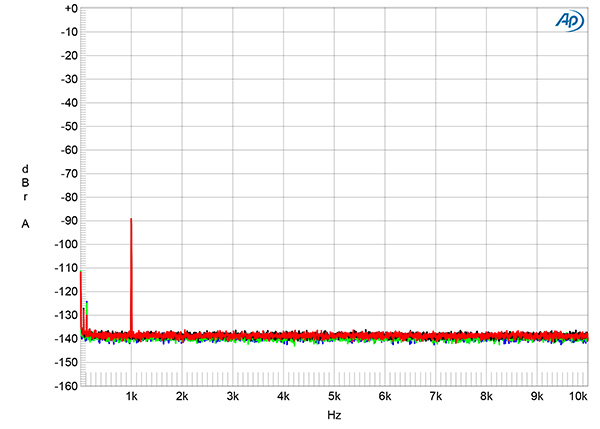
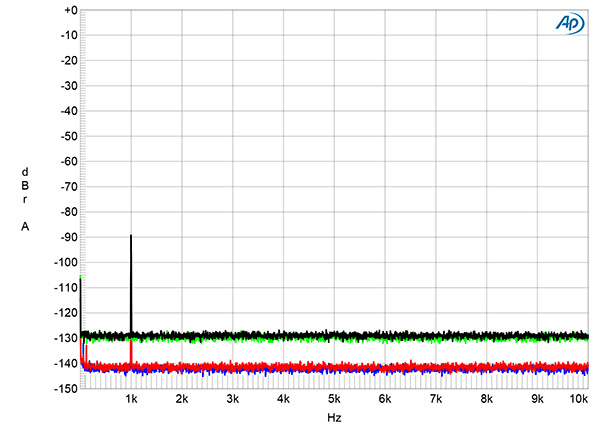
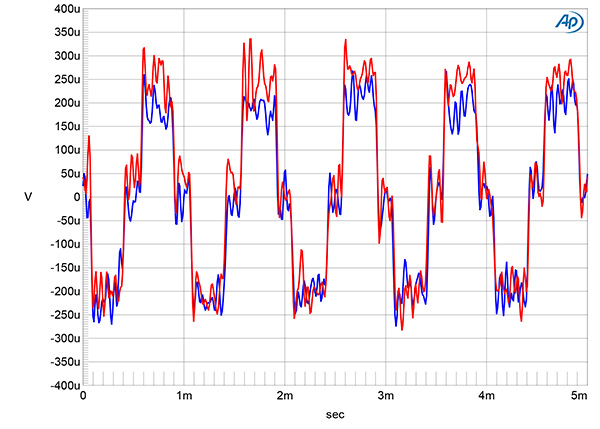
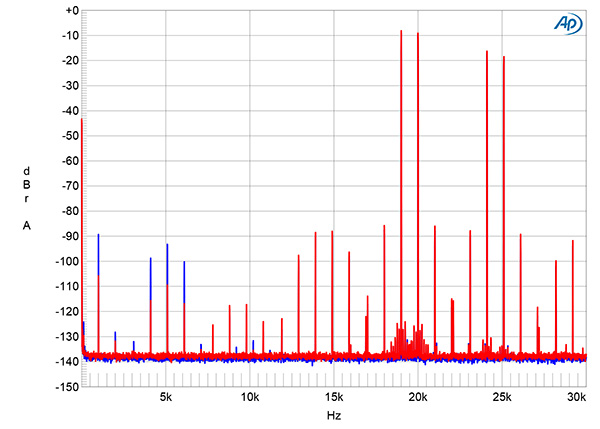
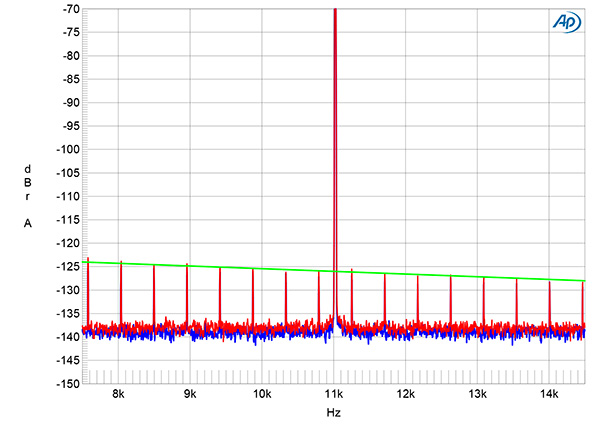
Fig.8 Ayre Acoustics KX-8, digital inputs, impulse response (one sample at 0dBFS, 44.1kHz data, 4ms time window).
Fig.9 Ayre Acoustics KX-8, digital inputs, wideband spectrum of white noise at –4dBFS (left channel red, right magenta) and 19.1kHz tone at 0dBFS (left blue, right cyan) into 100k ohms with data sampled at 44.1kHz (20dB/vertical div.).
Fig.8 shows the KX-8's impulse response with data sampled at 44.1kHz. It is typical of a very short minimum-phase reconstruction filter and is identical to that of the Listen filter used in the other Ayre digital products I've measured. The magenta and red traces in fig.9 show the Ayre's wideband spectrum with 44.1kHz white noise data at –4dBFS. As expected from the impulse response, a gentle rolloff starts around 15kHz with full stopband attenuation not reached until 38kHz. With this slow rolloff, the image at 25kHz of a 19.1kHz tone at 0dBFS (cyan, blue traces) is suppressed by just 10dB; while other aliased products are present, these all lie below –70dB.
Fig.10 Ayre Acoustics KX-8, digital inputs, frequency response at –12dBFS into 100k ohms with data sampled at: 44.1kHz (left channel green, right gray), 96kHz (left cyan, right magenta), and 192kHz (left blue, right red) (1dB/vertical div.).
The KX-8's frequency response with 44.1kHz data (fig.10, green and gray traces) is flat up to 10kHz but down by 2dB at 20kHz. With data sampled at 96kHz (cyan, magenta) and 192kHz (blue, red), the response is –3dB at 40kHz and 60kHz, respectively. Note that the channel imbalance seen with the analog inputs is also present in this graph. Channel separation with the digital inputs was excellent, as it had been with the analog inputs.
Fig.11 Ayre Acoustics KX-8, digital inputs, volume control set to maximum, spectrum with noise and spuriae of dithered 1kHz tone at –90dBFS with 16-bit data (left channel green, right gray) and 24-bit data (left blue, right red) (20dB/vertical div.).
Fig.12 Ayre Acoustics KX-8, digital inputs, volume control set to –12dB, spectrum with noise and spuriae of dithered 1kHz tone at –90dBFS with 16-bit data (left channel green, right gray) and 24-bit data (left blue, right red) (20dB/vertical div.).
Fig.13 Ayre Acoustics KX-8, digital inputs, waveform of undithered 1kHz sinewave at –90.31dBFS, 16-bit data (left channel blue, right red).
When I examined the spectra with 16- and 24-bit dithered data representing a 1kHz tone at –90dBFS and the volume control set to its maximum, the increase in bit depth didn't lower the noisefloor (fig.11). Repeating this test with the volume control set to –12dB, the increase in bit depth reduced the level of the noisefloor by 12dB (fig.12), which suggests a measured resolution of 18 bits. When I played undithered data representing a tone at exactly –90.31dBFS, which consists of data at –1LSB, digital zero, and +1LSB, the waveform was symmetrical, and the three DC voltage levels described by the data were clearly defined (fig.13). With undithered 24-bit data, the KX-8 put out a relatively clean sinewave (not shown).
Fig.14 Ayre Acoustics KX-8, digital inputs, HF intermodulation spectrum, DC–30kHz, 19+20kHz at 0dBFS into 100k ohms, 24-bit, 44.1kHz data (left channel blue, right red; linear frequency scale).
The distortion via the digital inputs was still primarily third harmonic at a similar level. Intermodulation distortion with 24-bit data representing an equal mix of 19 and 20kHz tones, each at –6dBFS, was low in level (fig.14), though, as expected from the slow rolloff reconstruction filter, many aliasing products were present.
Fig.15 Ayre Acoustics KX-8, sample 1, 16-bit TosLink data, high-resolution jitter spectrum of analog output signal, 11.025kHz at –6dBFS, sampled at 44.1kHz with LSB toggled at 229Hz (left channel blue, right red). Center frequency of trace, 11.025kHz; frequency range, ±3.5kHz.
The first sample of the KX-8 offered excellent rejection of word-clock jitter with all its digital inputs (fig.15). The odd-order harmonics of the undithered low-frequency, LSB-level squarewave all lay at the correct levels. However, the second sample did very much worse on this test, with a highish level of low-frequency random noise jitter and power supply–related products present. (I checked that the inputs were correctly set to Music mode.)
As long as its volume control is set to –12dB or lower, the Ayre Acoustics KX-8's digital inputs behaved very similarly to those of the original Ayre Acoustics EX-8 Integrated Hub integrated amplifier I reviewed in February 2019. However, I was bothered by the differences between the two samples' maximum output levels, polarity, and rejection of jitter. I initially wondered if these might have been due to the second sample's Network modules being those used by the QX-5 Twenty, according to Roon and MConnect. However, Apple's USB Prober app still identified the USB port as "Ayre X-8 USB-2," so it is possible that the differences in measured behavior were due to the DAC module.
Other than the channel imbalance, the KX-8 measured performance as a line preamplifier and headphone amplifier was very good for a design that doesn't use global feedback, especially at lower volume control settings.—John Atkinson