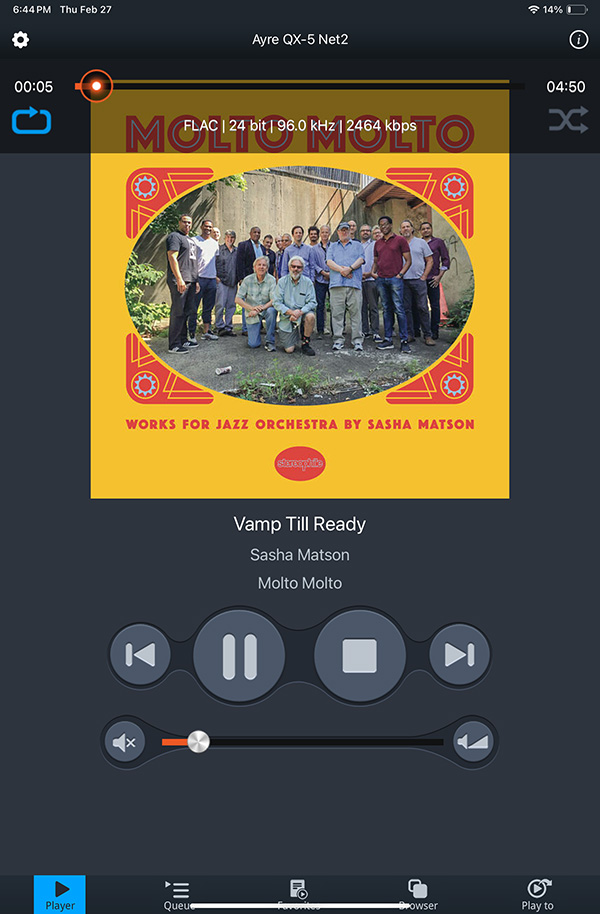
 The balance was also a touch warmer, but more significantly, there was an improved sense of what the late Art Dudley used to call "force." For example, on "Vamp Till Ready," the first movement of Sasha Matson's Symphony No.3 for Jazz Orchestra from the album Molto Molto (24/96 WAV file, Stereophile STPH-023), the presentation with the MBL driving the Parasound amplifiers directly was, for want of a better phrase, polite. With the KX-8 in the chain, at the same volume level, the kickdrum and double bass were more effective at driving the music along. Similarly, Christopher O'Riley's breakneck-paced piano in the final Allegro Vivace movement of the Mendelssohn Sextet in D Major on Encore sounded closer to exceeding the speed limit than I was used to.
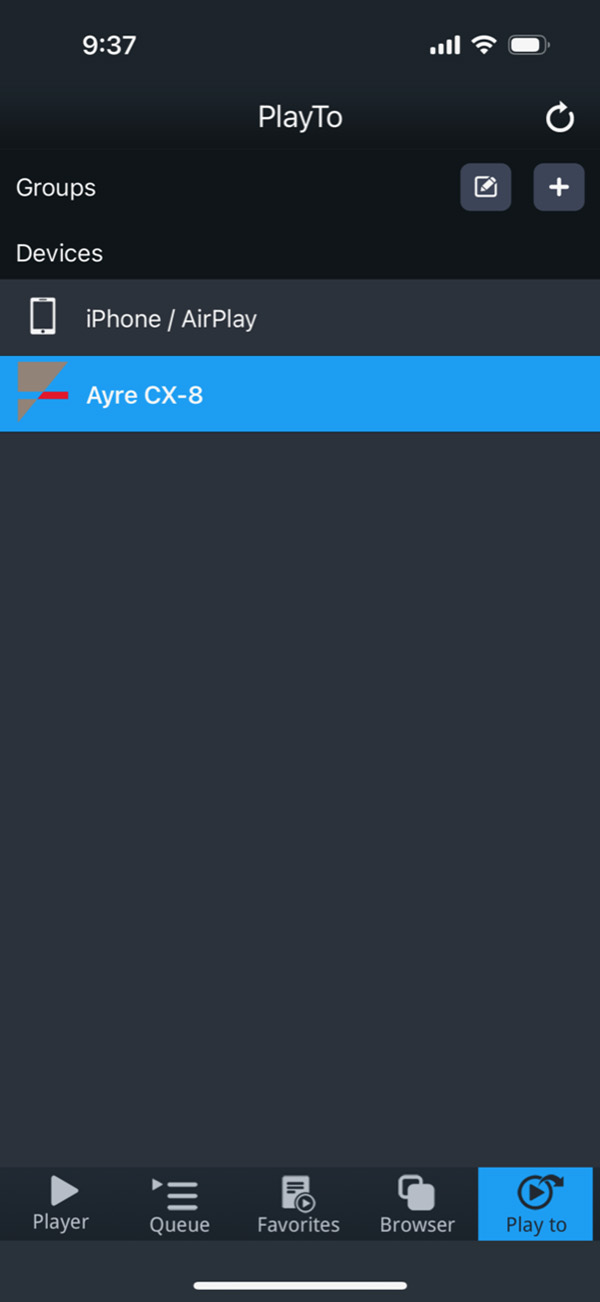 Once I had a handle on the KX-8's performance as a line preamplifier, I auditioned its digital inputs. I used my Ayre C-5xeMP transport to send it AES3 data, making sure the input was being operated in Music mode rather than Video mode. I discovered that despite it being described as such, the KX-8 was not yet Roon Ready. I therefore used the MConnect app installed on my iPad mini to send network data to the KX-8's Ethernet input. This was a straightforward process. I went to the submenu at the bottom of the main MConnect app page, pressed "Play To," and selected "KX-8 Net2" under Devices. (When you play a track, the title of the work, the artist's name, and the sample rate temporarily appear on the KX-8's display.)
The balance was initially a little brighter than it had been with the MBL processor, but this impression faded somewhat as I listened. As with the original version of the EX-8 Integrated Hub, which I reviewed in January 2019, voices were projected slightly forward but with a natural tonality. Only with recordings that were themselves on the bright side, like Clifford Curzon's 1962 performance of Brahms's Piano Concerto No.1 (16/44.1 FLAC, Decca Legends/Qobuz), did I wish the balance of KX-8's DAC was a little more laid-back. The MBL worked better with the Curzon Brahms, but it is fair to note that the N31 in Roon Ready form costs $19,980.
Once I had a handle on the KX-8's performance as a line preamplifier, I auditioned its digital inputs. I used my Ayre C-5xeMP transport to send it AES3 data, making sure the input was being operated in Music mode rather than Video mode. I discovered that despite it being described as such, the KX-8 was not yet Roon Ready. I therefore used the MConnect app installed on my iPad mini to send network data to the KX-8's Ethernet input. This was a straightforward process. I went to the submenu at the bottom of the main MConnect app page, pressed "Play To," and selected "KX-8 Net2" under Devices. (When you play a track, the title of the work, the artist's name, and the sample rate temporarily appear on the KX-8's display.)
The balance was initially a little brighter than it had been with the MBL processor, but this impression faded somewhat as I listened. As with the original version of the EX-8 Integrated Hub, which I reviewed in January 2019, voices were projected slightly forward but with a natural tonality. Only with recordings that were themselves on the bright side, like Clifford Curzon's 1962 performance of Brahms's Piano Concerto No.1 (16/44.1 FLAC, Decca Legends/Qobuz), did I wish the balance of KX-8's DAC was a little more laid-back. The MBL worked better with the Curzon Brahms, but it is fair to note that the N31 in Roon Ready form costs $19,980.
 Image depth with the KX-8's digital inputs was very similar to what I had experienced with the analog input. A recent if very much belated discovery was The Chicago Sessions 1995–96, veteran jazz trumpet/flugelhorn player Clark Terry's 2007 album with the DePaul University Big Band (16/44.1 FLAC, Reference Recordings RR-111/Qobuz). Engineer Keith O. Johnson had placed the various soloists in front of the band, the drums far back. On the Quincy Jones composition "Jessica's Day," both Terry's flugelhorn and the drums moved a little forward in the soundstage compared with the MBL connected to the KX-8's analog inputs, but the band was still immersed in an impressive dome of ambience.
 Headphone Sound
I plugged the Ultimate Ears in-ear monitors I use with my PonoPlayer's balanced outputs into the KX-8's balanced headphone outputs, but there was too much gain even with the volume control set way low. I continued my headphone listening with my single-ended Audeze LCD-X 'phones. As always when I write about headphone sound, I started my auditioning with some of the binaural recordings I have made over the years using a portable recorder with a pair of electret lavalier microphones suspended in front of my ears. With conventional recordings, headphones present the soundstage inside the listener's head, between the ears. Binaural recordings move the soundstage outside the head, and with Audeze cans driven by the KX-8, a recording I made of the Concorde at an English air show in 1980 had the plane starting way to the far right of my head, then above and in front of my head to the far left. The imaging precision was as excellent as I had hoped.
Satisfied that I had a handle on the KX-8's sound with headphones, I unplugged the headphones, turned on the power amplifiers, and started playing a file with Roon sending the data to the MBL processor. No sound! When you plug a pair of headphones into the front-panel jacks, a headphone symbol appears on the KX-8's display and the line outputs are muted. This disappears when you unplug the headphones. It disappeared as it should, but the line outputs remained muted.
 I checked that the MBL N31 was outputting a signal. It was. I turned off the KX-8 and disconnected the power cord. I repowered the preamp, went to the settings menu, and performed a factory reset. I then reinstalled the control firmware from a FAT32-formatted USB stick and checked that the inputs I'd been using were enabled. There was still no signal from the balanced or single-ended outputs. There was the correct output from both the unbalanced and balanced headphone outputs, so all I could think of is that the control circuitry that detects the presence or absence of headphones had failed.
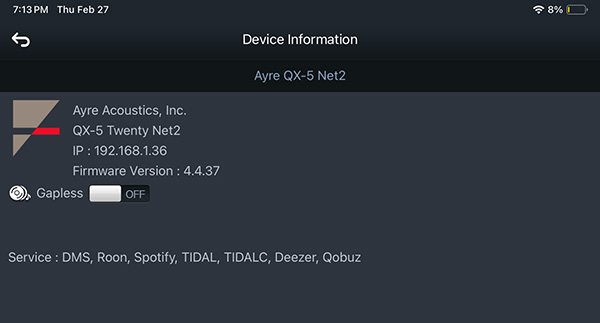
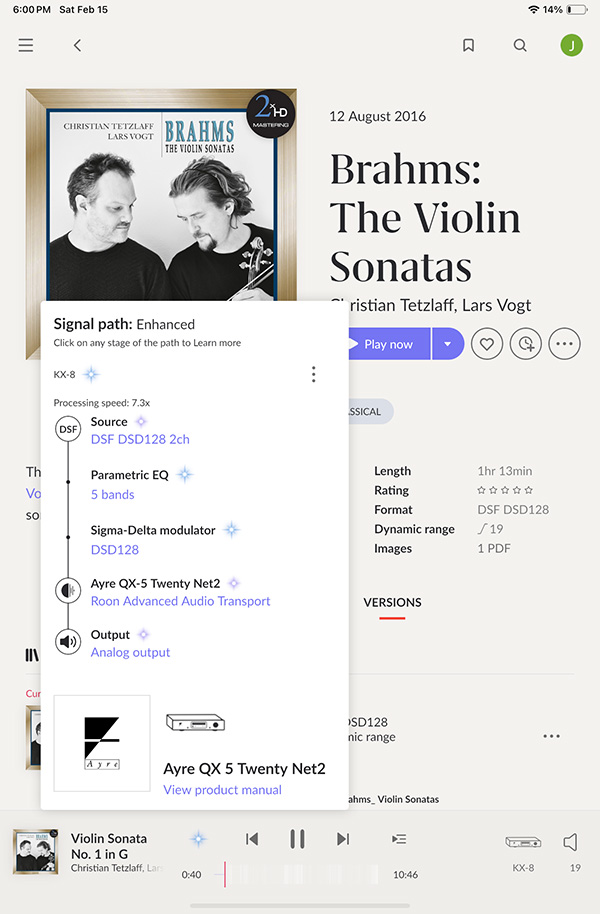
I let Ayre know about the problem and they promptly sent a new sample. (The original KX-8 had the serial number 31B0101; the replacement's serial number was 31B0106.) Before I installed the new preamplifier in the system, I got it on the test bench to make sure it was working correctly. It was—see the Measurements sidebar—with one major difference. Roon now recognized the network-connected KX-8 as a Roon Ready device, identifying it as an "Ayre QX-5 Twenty Net2." Similarly, MConnect recognized the new sample as "Ayre QX-5 Net2," though my MacBook identified the USB module as "Ayre X-8 USB-2," the same as the first sample.
I checked that the MBL N31 was outputting a signal. It was. I turned off the KX-8 and disconnected the power cord. I repowered the preamp, went to the settings menu, and performed a factory reset. I then reinstalled the control firmware from a FAT32-formatted USB stick and checked that the inputs I'd been using were enabled. There was still no signal from the balanced or single-ended outputs. There was the correct output from both the unbalanced and balanced headphone outputs, so all I could think of is that the control circuitry that detects the presence or absence of headphones had failed.
I let Ayre know about the problem and they promptly sent a new sample. (The original KX-8 had the serial number 31B0101; the replacement's serial number was 31B0106.) Before I installed the new preamplifier in the system, I got it on the test bench to make sure it was working correctly. It was—see the Measurements sidebar—with one major difference. Roon now recognized the network-connected KX-8 as a Roon Ready device, identifying it as an "Ayre QX-5 Twenty Net2." Similarly, MConnect recognized the new sample as "Ayre QX-5 Net2," though my MacBook identified the USB module as "Ayre X-8 USB-2," the same as the first sample.
 Sound returns
After I used the new KX-8 for a few days as a line preamplifier and satisfied myself that its sound quality was as good as that of the original sample, I started listening with Roon-sourced network data. The new sample's presentation of recorded detail was still good, but the balance seemed more forward than that I experienced with the mConnect app sending data to the original KX-8. I reverted to MConnect sending network data to the new sample, but the sound was the same as it had been with Roon. While this character didn't interfere with my enjoyment of music, it still wasn't an optimal match with bright recordings like the Curzon Brahms.
Assuming that my experience with the original sample was representative of production units, the optional digital modules offer excellent sound quality. (The X-8 Net2 Ethernet module should be Roon Ready by the time you read this review.) As a line preamplifier, the KX-8 may not be quite as transparent as Ayre's many-times-as-expensive KX-R Twenty, but I enjoyed my time using it. It offered an addictive sense of music flow, especially when used with Ayre's VX-8 amplifier, with which it formed a synergistic partnership. I suspect that much of my enjoyment of music with the KX-8 was due to the fact that I tended to use the volume control set below –12dB, which the CVGT volume control will maximize S/N ratio with the analog inputs and resolution with the digital inputs. Recommended.