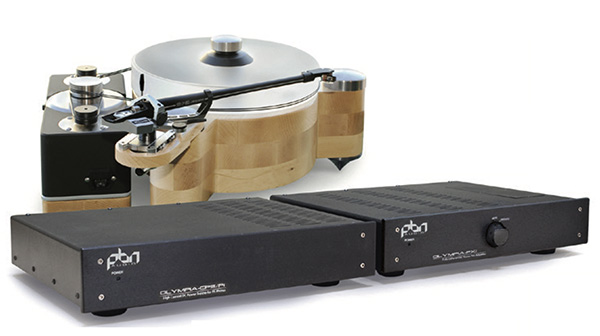
 PBN Olympia-PXi: $22,000
"Yeah, she's ugly, but she sure can cook, baby!"—Jimmy Soul on the fade-out of his single "If You Wanna Be Happy (Get an Ugly Girl to Marry You)."
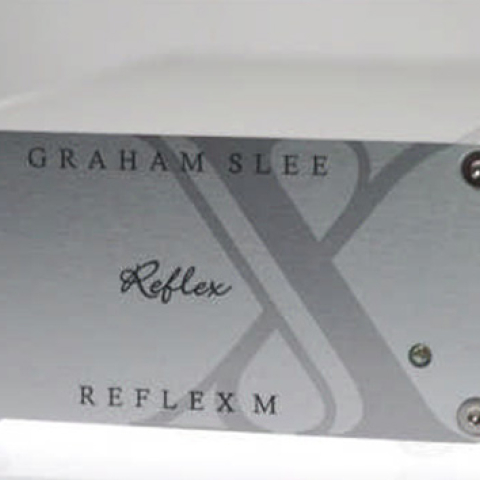
Yes, PBN's two-chassis Olympia-PXi is the butt-ugly phono preamp I mentioned at the beginning. If you don't think it's butt ugly, you have to admit that it's pretty damn homely—but it sure can cook!
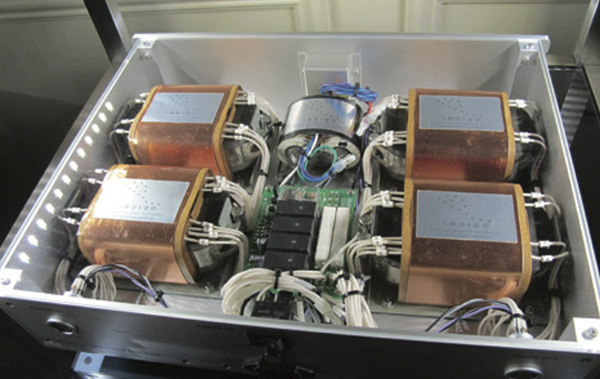
Or, as the instruction manual proudly states, "We put the BLING inside the box as we feel that is where it belongs." Of course, you can have the bling inside
and out, though that would probably raise the price far past the Olympia-PXi's $22,000—but if you're after pure hair-raising sound . . . well, the Olympia delivered.
Peter B. Noerbaek's PBN Audio has been around for more than a decade (footnote 2), keeping a low profile but turning heads with high-quality sound and, in the case of his sculpted wooden turntables, a highly refined aesthetic. The latter is not in evidence here, but no matter. The input stage of this tour de force of a phono preamp is all-JFET class-A all the time, even on the board regulators. Noerbaek claims that while bipolar transistors offer low noise, they contribute to irritatingly grainy sound. There was
nothing grainy or irritating about what I heard from the Olympia-PXi.
There are 96 cascoded, closely matched JFETS in the Olympia-PXi's first gain stage, with input gain selectable via jumpers between 30 and 40dB. An RC network between the input and output stages provides the high-frequency rolloff of the RIAA curve, while the output stage provides the RIAA's bass boost as well as 24dB of gain, for a total system gain of 60 or 70dB (+6dB in fully balanced operation). The output stage uses a complementary MOSFET source follower. PBN recommends running the Olympia-PXi at its highest gain setting, so that's what I did. You open a small hatch on the top plate to access jumper pins that allow you to select among loadings of 50, 100, 200, 500, 1000, and 47k ohms. And for setup options, that's it. A single large knob on the front panel offers a choice of Mute and Operate.
The difference between the $20,000 Olympia-PX and the Olympia-PXi that I review this month has to do with the complexity of the PXi's power supply, which includes more very-low-noise Caddock MK132V resistors. I didn't listen to both versions, so I don't know what the extra cost gets you in terms of sound. I can tell you that the PXi's outboard power supply alone weighs more than 40lb, and probably rivals the supplies found in many power amplifiers.
As for the claimed specs, the Olympia-PXi's maximum output voltage is a whopping 14V RMS, with distortion at 3V output (way more than will be practically delivered) of 0.001% at 1kHz and 0.0015% at 10kHz. The claimed RIAA accuracy is 0.1%.
The inputs and outputs are XLR only. For this review I had on hand Dan D'Agostino Master Audio Systems' balanced
Momentum preamplifier, so I did my listening in fully balanced mode, though that required the use of Balanced Audio Technology RCA-to-XLR adapters for the input.
Strap Yourself In! The only other phono preamp of my experience that has approached the dynamic slam produced by the PBN Olympia-PXi has been
Boulder Amplifiers' 2008. However—and this is based on years-old aural memories—I think the PBN's overall sound was more refined, transparent, texturally supple, and harmonically enriched.
The grip the PBN had on the music, from top to bottom of the spectrum, was immediately obvious and almost physically demanding to experience—but in a relaxed and very pleasing way. Dynamics were limitless. The terms
bass extension and
bass control took on new meanings—and nothing that I heard was offset by such mechanical artifacts as over-etched transients, excessive edge definition, or overdamped bass. Audiophiles who think this kind of sound comes at the expense of musicality should listen to the Olympia-PXi.
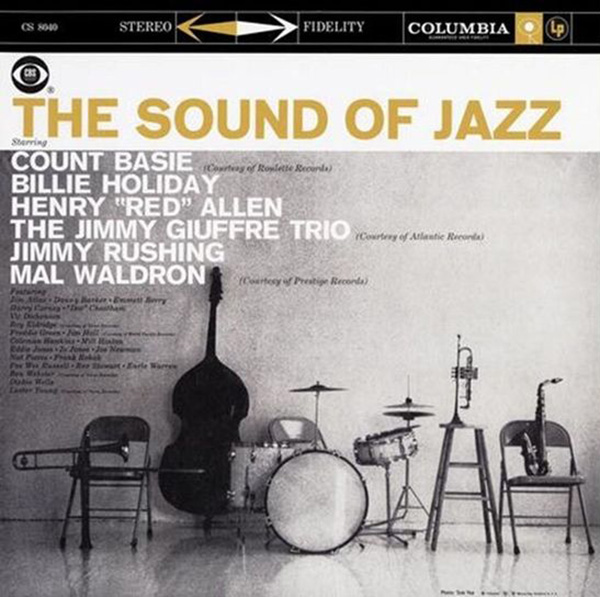
The stereo master tape of
The Sound of Jazz (Columbia CS 8040) is gone, so a clean original LP is the stereo master. Recorded in Columbia's legendary 30th Street Studio on December 5, 1957, just days before the TV broadcast for which it was made, and featuring Count Basie, Billie Holiday, Red Allen, Jimmy Giuffre Trio, Jimmy Rushing, and Mal Waldron, the staging is wide and deep, the ambience pronounced. The imaging and spatial stability produced by this preamp was edge-of-the-seat amazing. Image three-dimensionality was View-Master–like. I've played this record for many years, but I'd never before heard the wall of the studio behind the musicians (who were recorded live to two-track with copious amounts of microphone leakage) sound so "there," or so solid, or placed so convincingly, well behind the players.
More important, despite its grip and control, the PBN was also able to express instrumental liquidity and textural subtlety—not quite as smoothly or as gracefully as the Phasemation EA-1000 managed, but close enough, especially considering its many other impressive feats, which made the Phasemation sound somewhat mild-mannered in comparison. If the recording was warm, the Olympia-PXi delivered it that way. If it was cool, I heard cool. It quickly established transparency and got out of the way.
Read my
November 2011 review of the Liberty Audio B2B-1 phono preamplifier ($1749), which is also manufactured by PBN. Roughly speaking, the Olympia-PXi is the B2B-1 on megasteroids plus mood-enhancing narcotics. Before listening, strap yourself into your listening seat.
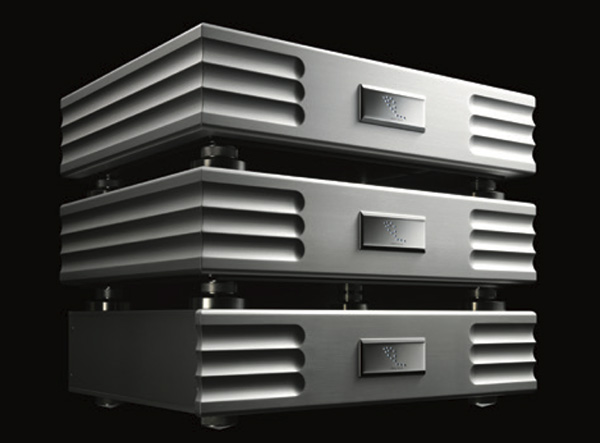 Qualia & Company Indigo phono preamplifier: $63,000
When I first saw this stunning-looking, superbly built line of products from Japan a few years ago (footnote 3), at T.H.E. Show in Las Vegas, no one from Qualia was in the room. However, its innards so closely resembled Lyra's discontinued line of Connoisseur electronics that I assumed Qualia had licensed the circuits, and wrote it up as such—only to find out, when my show report was published, how wrong I was.
Yet I believe there's some sort of connection between this design and the Connoisseur, the details of which remain obscured in the mysterious depths of Japanese social and business culture, as does the identity of the person or people who designed this $63,000 phono preamplifier.
The three-box Indigo, each case milled from a solid block of aluminum, easily wins the award for Best-Looking Phono Preamp, inside and out, in perhaps all of modern audio history. It's not hyperbole to say that the attention to details of construction and the fit'n'finish of the three cases are unprecedented. But the specifications and design details provided fall way short of what you should expect for $63,000, and the Indigo offers zero configurability, and only one singled-ended (RCA) input per channel.
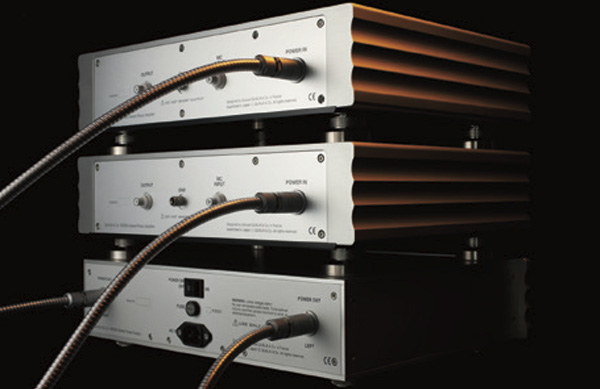
The Indigo's claimed frequency response is extremely wideband: 1Hz–100kHz, ±0.2dB, typically +0.1/–3dB. The gain is fixed at 69dB. The output impedance is a usefully low 50 ohms, and the input impedance is fixed at 10k ohms.
That's it—over and out. Qualia provides no distortion or signal/noise figures, or anything else, other than a power consumption of 42W. Regardless of your cartridge's internal impedance, or the manufacturer's loading recommendation, it will see a load of 10k ohms. I find that "feature," or lack thereof, difficult to justify for the price.
If you read the Indigo's description at the Qualia website (not accessible in 2025), you'll find a lot of words but few useful details. The prose claims "current mode amplification," which is hardly the norm, but doesn't further explain. Not surprisingly, a great deal of digital ink is spilled on the value of having three separate chassis milled from solid aluminum billets. While the value of an outboard power supply is obvious, and separate chassis for the left and right channels will maximize channel separation, that specification is not provided. Otherwise, we're told that "high quality parts" are used, such as film-type capacitors, custom metal-foil "nude" resistors, Schottky diodes, and C-core transformers—all of which are fairly commonplace in far less expensive designs. There's not a word about signal amplification, or how the RIAA EQ is implemented. Between these curious omissions, the emphasis on peripheral features, the lack of useful and commonly provided specs, and the Indigo's inflexibility of configuration, this is one confounding piece of expensive kit.
Given that lack of configurability, a one-sheet would have been sufficient for the instructions. Instead, the Indigo's manual supplies pages of overstuffed cautionary instructions that make it seem as if this is an easily damaged design, and includes diagrams that belabor the obvious, even to a novice: "Caution! Disconnect/connect the RCA interconnect cable while keeping it straight and without turning the plug. Connecting/disconnecting while turning the plug may rotate the terminal on the Main Unit causing disconnection. Be sure to connect/disconnect the cable while keeping it straight." Really?
 Sound:
 I'd heard Peter Mares's original Lyra Connoisseur in the 1990s, and then the later Lyras. Whether or not there was a connection between those products and the Qualia, I began listening to the Indigo with a great deal of excitement and anticipation. I was pumped.
The review sample had clearly been around—there was a long scratch in one faceplate, and dimples where the feet of one box sat on the one below. Still, I assumed that it was performing as designed; I used both the low-output Transfiguration Proteus and the higher-output Lyra Etna cartridges, and got the same results with both.
There was nothing wrong with the sound produced by this $63,000 phono preamp, nor was there anything special about it. Listening to the Phasemation EA-1000 or the PBN Olympia-PXi, I knew almost instantly what its designers had been going for. Each had a different intent, and both of them were valid.
Here, I had no idea. Yes, the Indigo's tonal balance was essentially neutral, which is good, but transients, from top to bottom, were soft—well, softer than the tubed Phasemation's, which weren't all that soft. The Qualia's bottom end was soft and not particularly well focused, the top end likewise. Imaging and soundstaging were okay, but not in the same league as those of the Phasemation or PBN, or even of
Parasound's Halo JC 3, or some other moderately priced phono preamps.
The sound produced by the Qualia was polite, not at all offensive, and linear in the midband, but the overall picture was not at all in focus.
I let others listen to the Indigo, allowing them to luxuriate in its looks, feel, and price, but without indicating my reaction in any way. The general reaction, going from my reference the Ypsilon VPS-100 to the Qualia while listening to familiar recordings, was "What happened?"
Footnote 2: PBN Audio, 380 Vernon Way, El Cajon, CA 92020. Tel: (619) 440-8237. Web:
www.pbnaudio.com
Footnote 3: Qualia. US sales agent: Immedia, Berkeley, CA 94710 (2014). Web: qualia-highend.com (2014); website no longer accessible (2025).