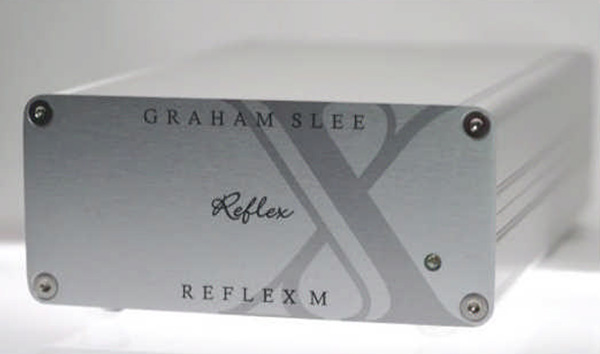
Graham Slee Reflex M moving-magnet phono preamplifier
The latest product from Graham Slee is the Reflex M ($1240). Like the company's previous designs, the lightweight Reflex M is housed in a small aluminum case and is powered by an outboard 24V DC power supply. RIAA equalization is applied actively within the negative feedback loop. See Graham Slee's website for specifications and more about this model's design rationale (footnote 1). I had on hand an older Graham Slee phono preamp, the Era Gold Mk.V—when I'd first listened to it, in January 2004, its highly accomplished sound took me by surprise. After refamiliarizing myself with the Era Gold's sound, I listened to the Reflex M and was surprised all over again. Interestingly, the Era Gold Mk.V sounded very similar to the PTE MMMC, which says good things about both—but the Reflex M managed to sound better than either. I played the really well-recorded So Clear: The John Renbourn Sampler, Volume Two (LP, Transatlantic TRA SAM 28), and the Reflex M smoked the older Slee in every meaningful way. The Reflex M's image solidity and three-dimensionality and microdynamics were clearly superior, as was top-end extension—and I don't mean that it sounded "bright." It was fast, clean, three-dimensionally solid, way more transparent than the Era Gold Mk.V, and made for mighty inviting listening—even through the Prince of Price No Limit's megabuck system.
Though the Reflex M has zero loading flexibility, as long as it meets the needs of your current MM or high-output moving-coil cartridge, it's really easy to recommend. But was the Reflex M better than, or as good as, the Lejonklou Kinki3 and Slipsik5.1 MM-only phono preamps I reviewed so positively last October? I can't say—I don't have them here. My recollections of the Lejonklous' sounds tell me that both sounded somewhat silkier and sweeter, but I can't be sure.
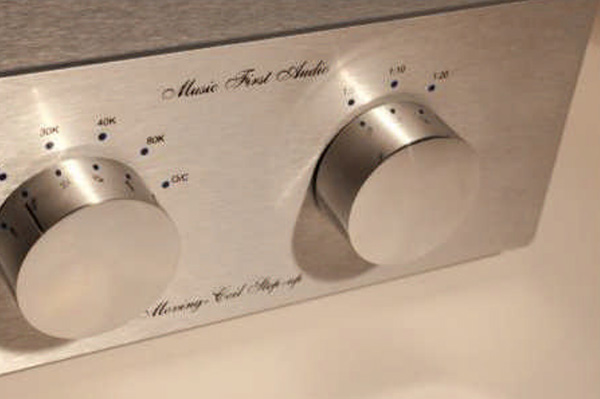 Music First step-up transformer
This British-made step-up transformer ($2895; footnote 2) came highly recommended for its use of Stevens & Billington TX103 transformers, which an audiophile friend described to me as "legendary." (Read about them at www.stevens-billington.co.uk/page103.htm.) Virtually flat response from about 5Hz to beyond 100kHz is claimed for the transformers, which are copper wire wound around a core of 80% nickel, and are encased in mu metal. The turns ratio and loading are selected with Swiss-made ELNA silver-contact rotary switches. Internal connections are made with 0.6mm single-strand, silver- and Teflon-coated wire. All is encased in an attractive case of high-quality aluminum. Depending on your cartridge's output and how much voltage gain you need, you can choose among three turns ratios: 1:5, 1:10, and 1:20, which respectively correspond to 14, 20, and 26dB of gain. Considering that most MM phono preamps produce between 40 and 44dB of gain, this should suffice for even the lowest-output MCs. In addition, a six-position switch lets you choose among loadings of 10k, 20k, 30k, 40k, and 80k ohms, or Open Circuit (O/C). Of course, those numbers don't represent the actual loads a cartridge will see. (A chart in the online manual gives you the actual figures.) In the O/C position, the cartridge sees the transformer's load (almost always 47k ohms) divided by the turns ratio divided by 10, squared. So the 1:10 ratio (20dB) in the O/C position would be a 470 ohm load. The 10k setting would produce 82 ohms. You can see how flexible and useful the transformer is, particularly if you run a number of cartridges with varying gain and loading requirements.
The instructions claim that the Music First transformer needs about 100 hours of break-in. Following Music First's suggestion, I connected a CD player output to the transformer's output, and the transformer's input to a line-level input of an NAD receiver I had in the garage, and put a music CD on repeat mode for 100 hours. Then I listened.
The Music First's three-position ground switch was very useful in dealing with the vagaries of cartridge ground configurations. Using well-shielded interconnects, I had no problems, and heard a great deal of quiet.
I would have thought the Music First an essentially neutral, exceptionally fine-sounding step-up transformer had I not had the Ypsilon MC-16 sitting next to it for comparison. (After I reviewed the Ypsilon MC10, which offers 20dB of voltage gain, in August 2009, I bought both the MC10 and the MC16, which offers 24dB of gain but otherwise sounds the same.) While the Music First's gain was as advertised and its quiet commendable, the difference in degree of transparency was profound. Among the records I used to make this judgment was one I've written about a few times: Cassandra Wilson's Blue Light 'Til Dawn, an all-analog recording and mix finally heard in all its AAA glory in a recent reissue (2 LPs, Blue Note/Pure Pleasure 7 81357 1). The recording has spectacular transparency, three-dimensionality, and high-frequency extension; Wilson's cover of Van Morrison's "Tupelo Honey" includes percussion, a really hot-sounding snare drum, and some loose change rattling around. Switching to the Music First transformer flattened somewhat the depth in which snare and coins appeared in space; more significant was the obvious muting of the snare's transient attack and extension, and I heard that regardless of the gain or loading setting.
 I heard the same thing when comparing Chesky's old reissue of Gershwin's Rhapsody in Blue and An American in Paris, with pianist Earl Wild, Arthur Fiedler, and the Boston Pops (RCA Living Stereo/Chesky LSC-2367)—a Mohr/Layton production with spectacular sound. This edition was mixed down from the three-track master. Unfortunately, the pressing quality was short of the dead quiet we now get, but even with a bit of what sounds like nonfill, this is a benchmark recording, and it sounded far more open, transparent, extended on top, and three-dimensional through the Ypsilon MC16 step-up. (My skeptical audiophile friend who declared the Stevens & Billington transformer to be "legendary" visited and I ran the comparison for him. He heard what I heard.)
Then I remembered my visit to Ypsilon Electronics in Athens, and my conversation about core materials with Ypsilon's Demetris Backlavas. Among the things he said was, "Nickel cores have a character that I ended up not liking anymore." I second that conclusion. That said, the Music First offers a great deal of flexibility—and had I not had the Ypsilon to compare it with, my reaction would have been different. It's not that the Music First isn't a good-sounding, impeccably built product, but that the Ypsilon sounds so much more open and transparent. Talk about lifting the proverbial veils. It was the same difference I heard when I compared the Ypsilon with the Allnic H-3000V phono preamplifier that I reviewed in March 2011, which uses 78% nickel-cored transformers.
The Ypsilon step-up costs $2800, and its input impedance can be easily adjusted, if necessary, with resistor loading plugs. But you can't vary the turns ratio—if, like me, you have 0.2mV- and 0.5mV-output cartridges, you'll need two Ypsilons, the MC10 (20dB of voltage gain), the MC16 (24dB), or the MC20 (26dB).
If you use a step-up now and you can afford to drop $2800 on a new one, try the appropriate Ypsilon. I think you'll find its openness and transparency to be something special.
I heard the same thing when comparing Chesky's old reissue of Gershwin's Rhapsody in Blue and An American in Paris, with pianist Earl Wild, Arthur Fiedler, and the Boston Pops (RCA Living Stereo/Chesky LSC-2367)—a Mohr/Layton production with spectacular sound. This edition was mixed down from the three-track master. Unfortunately, the pressing quality was short of the dead quiet we now get, but even with a bit of what sounds like nonfill, this is a benchmark recording, and it sounded far more open, transparent, extended on top, and three-dimensional through the Ypsilon MC16 step-up. (My skeptical audiophile friend who declared the Stevens & Billington transformer to be "legendary" visited and I ran the comparison for him. He heard what I heard.)
Then I remembered my visit to Ypsilon Electronics in Athens, and my conversation about core materials with Ypsilon's Demetris Backlavas. Among the things he said was, "Nickel cores have a character that I ended up not liking anymore." I second that conclusion. That said, the Music First offers a great deal of flexibility—and had I not had the Ypsilon to compare it with, my reaction would have been different. It's not that the Music First isn't a good-sounding, impeccably built product, but that the Ypsilon sounds so much more open and transparent. Talk about lifting the proverbial veils. It was the same difference I heard when I compared the Ypsilon with the Allnic H-3000V phono preamplifier that I reviewed in March 2011, which uses 78% nickel-cored transformers.
The Ypsilon step-up costs $2800, and its input impedance can be easily adjusted, if necessary, with resistor loading plugs. But you can't vary the turns ratio—if, like me, you have 0.2mV- and 0.5mV-output cartridges, you'll need two Ypsilons, the MC10 (20dB of voltage gain), the MC16 (24dB), or the MC20 (26dB).
If you use a step-up now and you can afford to drop $2800 on a new one, try the appropriate Ypsilon. I think you'll find its openness and transparency to be something special.
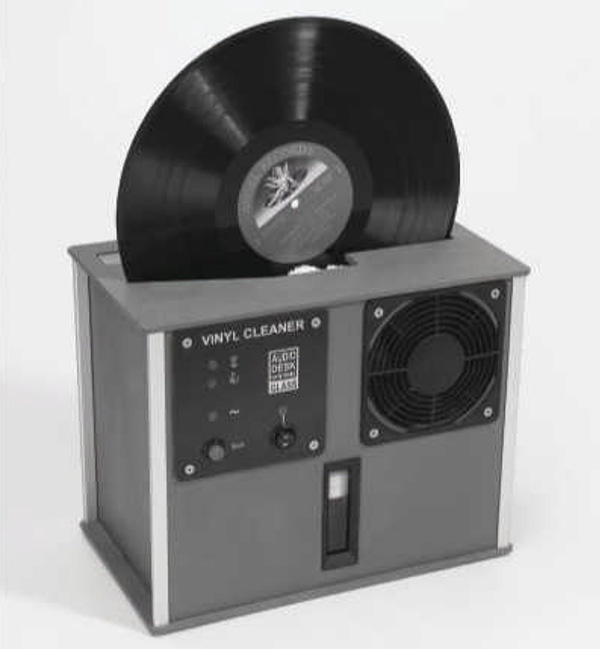 Audio Desk Systeme Vinyl Cleaner
Getting a review sample of this unique ultrasonic record-cleaning machine took me years; apparently, Audiodesksysteme Gläss, a small German manufacturer (footnote 3), couldn't keep up with demand. I've also heard from a few sources that reliability was not high in the company's early days, but that now all that's been sorted out, as has manufacturing capacity. This compact cleaner can be thought of as a very high-tech, automatic version of the Spin Clean Record Washer ($79.95), which I reviewed in my February 2010 column. Like the hand-cranked Spin Clean, the Audio Desk Systeme Vinyl Cleaner ($3895) uses a vat full of fluid that can clean many records before it needs to be replaced, and the LP sits vertically in the vat as both sides are simultaneously cleaned. But before Audiodesksysteme and their importer, Ultra Systems, have heart attacks, rest assured—those are the only similarities!
The Audio Desk is fully automatic and, unlike any other record-cleaning machines I know of, it uses ultrasound and a process called cavitation (ie, the forming of bubbles) to clean records, much as an ultrasonic jewelry cleaner does for jewels. If you've ever seen a tarnished piece of ornate silverwork go into such a machine and come out gleaming, even in its tiniest nooks and crannies, you know how well it works.
Slip an LP into the Audio Desk's slot, which is lined with soft rubber lips; on the left side, the slot widens into a vat. Push the Start button and the record begins to slowly rotate (it sometimes required a nudge). Fluid stored in a chamber below begins to fill the vat as four bidirectional microfiber drums adjust their proximity to the disc, then begin to rotate themselves, to spread cleaning fluid on the record.
Meanwhile, the ultrasonic condenser fires up, producing soundwaves whose amplitude is high enough to break the liquid's surface tension, causing it to tear apart and leave behind millions of microscopic vacuum bubbles that compress or implode, creating tiny liquid jets small enough to clean inside even the narrowest LP groove (think of the jewelry cleaner).
This micro-agitation process washes any contaminants on the record surface into the cleaning fluid. The fluid then drains off through a filter, and the rotation of the LP slows almost to a stop as two powerful fans completely dry the disc. Remove the disc by carefully lifting it vertically, to keep it from rubbing against the rollers, or you'll end up with wet spots. (That happened only a few times.) Your LP is clean and dry and ready to play. The entire process, monitored by front-panel LEDs, takes six minutes.
The designer, Reiner Gläss, contends that record-cleaning machines that use surface suction (Nitty Gritty, VPI, Clearaudio) or point suction (Keith Monks, Loricraft) rely on brushes to loosen dirt and contaminants buried in the groove, and that brushes simply can't do the job. Worse, he contends, they often press dirt deeper into the groove. Surface-suction vacuuming, he contends, often smears dirt across the record surface, while the friction caused by rubbing builds up static electricity. Although point suction is somewhat less prone to static buildup, such devices can clean only one side at a time, and still rely on brushing to loosen particles embedded in the groove.
 The Audio Desk Systeme was the most effective, easy-to-use record-cleaning machine I've ever tried. I cleaned records that I'd already vacuum-cleaned but were still noisy, and the noise went away. Two examples: my original UK pressing of the Beatles' Let It Be and my most treasured classical album, an original pressing of Fritz Reiner and the Chicago Symphony's recording of Strauss's Also sprach Zarathustra (RCA Living Stereo LSC-1806). The latter looked clean when I bought it but was hopelessly noisy. Repeated cleanings over the decades since, using more sophisticated fluids and machines, have made it quieter—but finally, after treatment with the Audio Desk, it's just about completely silent. The machine is, too.
The six-minute cleaning cycle is not a problem because it's entirely automatic. I went on a record-cleaning spree, managing a personal best of 120 LPs cleaned in two weeks. Not having to stand there and clean one side, then turn the disc over to clean the other side, made all the difference.
Downsides? You're limited to Audio Desk's fluid, an alcohol-free, biodegradable concentrate said to have excellent antistatic properties (it does). You add a 20ml bottle ($14.95 each, or $75 for a six-pack) to a gallon of distilled or, much better, reverse-osmosis–purified water (eg, Aquafina, or from your own reverse-osmosis system). That's good for at least 50 records until you have to start topping it up (a flashing LED tells you when to do that). Mix up a second batch and add as needed.
The microfiber cleaning barrels ($99.95 each) need to be replaced every 500 to 1000 LPs, depending on how dirty they were to begin with; the fluid should be drained and replaced, and the filter rinsed, every 100 to 200 records. I'm out of space, so I can't answer skeptics' other obvious questions, other than to say that really dirty, crusty records should be pre-cleaned. I use MicroCare's Premiér! or an Orbitrac, and I still keep Enzymatic fluid around to deal with moldy records.
I've never had so much fun cleaning LPs. I bought the review sample.
The Audio Desk Systeme was the most effective, easy-to-use record-cleaning machine I've ever tried. I cleaned records that I'd already vacuum-cleaned but were still noisy, and the noise went away. Two examples: my original UK pressing of the Beatles' Let It Be and my most treasured classical album, an original pressing of Fritz Reiner and the Chicago Symphony's recording of Strauss's Also sprach Zarathustra (RCA Living Stereo LSC-1806). The latter looked clean when I bought it but was hopelessly noisy. Repeated cleanings over the decades since, using more sophisticated fluids and machines, have made it quieter—but finally, after treatment with the Audio Desk, it's just about completely silent. The machine is, too.
The six-minute cleaning cycle is not a problem because it's entirely automatic. I went on a record-cleaning spree, managing a personal best of 120 LPs cleaned in two weeks. Not having to stand there and clean one side, then turn the disc over to clean the other side, made all the difference.
Downsides? You're limited to Audio Desk's fluid, an alcohol-free, biodegradable concentrate said to have excellent antistatic properties (it does). You add a 20ml bottle ($14.95 each, or $75 for a six-pack) to a gallon of distilled or, much better, reverse-osmosis–purified water (eg, Aquafina, or from your own reverse-osmosis system). That's good for at least 50 records until you have to start topping it up (a flashing LED tells you when to do that). Mix up a second batch and add as needed.
The microfiber cleaning barrels ($99.95 each) need to be replaced every 500 to 1000 LPs, depending on how dirty they were to begin with; the fluid should be drained and replaced, and the filter rinsed, every 100 to 200 records. I'm out of space, so I can't answer skeptics' other obvious questions, other than to say that really dirty, crusty records should be pre-cleaned. I use MicroCare's Premiér! or an Orbitrac, and I still keep Enzymatic fluid around to deal with moldy records.
I've never had so much fun cleaning LPs. I bought the review sample.
Sidebar: In Heavy Rotation 1) Tchaikovsky & Nielsen, Souvenir Part I: Music for Strings (The Trondheim Soloists), 2L 180gm LP 2) Nina Simone, At the Village Gate, Colpix/Pure Pleasure 180gm LP 3) Sleigh Bells, Reign of Terror, Mom+Pop 180gm LP 4) Talk Talk, Laughing Stock, Badabing LP 5) Leonard Cohen, Old Ideas, Columbia 180gm LP 6) Miles Davis, In Person at the Blackhawk, San Francisco: Friday and Saturday Nights, Columbia/Impex 180gm LPs (2) 7) Lyle Lovett, Release Me, Lost Highway 180gm LPs (2) 8) Jóhann Jóhannsson, Virõulegu Forsetar, Touch LPs (2) 9) Ray Charles, Genius+Soul=Jazz, Impulse!/Analogue Productions 180gm LP Visit www.analogplanet.com for full reviews.
Footnote 1: Graham Slee Projects Limited, 1 Monks Way, Monk Bretton, Barnsley, Yorkshire S71 2JD, UK. Tel: (44) (0)1909-568739, (0)7947-107188, (0)1226-244908. Web: www.hifisystemcomponents.com/ Footnote 2: Music First Audio, Hastings, East Sussex, England, UK. Tel: (44) (0)1424-858260. E-mail: info@mfaudio.co.uk. Web: www.mfaudio.co.uk
Footnote 3: Audiodesksysteme Gläss, Seestrasse 1, D 89551 Königsbronn, Germany. Tel./Fax: (49) 07328-7138. Web: www.audiodesksysteme.de. US distributor: Ultra Systems, 127 Union Square, New Hope, PA 18938. Tel: (800) 724-3305, (215) 862-6570. Fax: (215) 862-4871. Web: www.ultrasystem.com
The latest product from Graham Slee is the Reflex M ($1240). Like the company's previous designs, the lightweight Reflex M is housed in a small aluminum case and is powered by an outboard 24V DC power supply. RIAA equalization is applied actively within the negative feedback loop. See Graham Slee's website for specifications and more about this model's design rationale (footnote 1). I had on hand an older Graham Slee phono preamp, the Era Gold Mk.V—when I'd first listened to it, in January 2004, its highly accomplished sound took me by surprise. After refamiliarizing myself with the Era Gold's sound, I listened to the Reflex M and was surprised all over again. Interestingly, the Era Gold Mk.V sounded very similar to the PTE MMMC, which says good things about both—but the Reflex M managed to sound better than either. I played the really well-recorded So Clear: The John Renbourn Sampler, Volume Two (LP, Transatlantic TRA SAM 28), and the Reflex M smoked the older Slee in every meaningful way. The Reflex M's image solidity and three-dimensionality and microdynamics were clearly superior, as was top-end extension—and I don't mean that it sounded "bright." It was fast, clean, three-dimensionally solid, way more transparent than the Era Gold Mk.V, and made for mighty inviting listening—even through the Prince of Price No Limit's megabuck system.
Music First step-up transformerThis British-made step-up transformer ($2895; footnote 2) came highly recommended for its use of Stevens & Billington TX103 transformers, which an audiophile friend described to me as "legendary." (Read about them at www.stevens-billington.co.uk/page103.htm.) Virtually flat response from about 5Hz to beyond 100kHz is claimed for the transformers, which are copper wire wound around a core of 80% nickel, and are encased in mu metal. The turns ratio and loading are selected with Swiss-made ELNA silver-contact rotary switches. Internal connections are made with 0.6mm single-strand, silver- and Teflon-coated wire. All is encased in an attractive case of high-quality aluminum. Depending on your cartridge's output and how much voltage gain you need, you can choose among three turns ratios: 1:5, 1:10, and 1:20, which respectively correspond to 14, 20, and 26dB of gain. Considering that most MM phono preamps produce between 40 and 44dB of gain, this should suffice for even the lowest-output MCs. In addition, a six-position switch lets you choose among loadings of 10k, 20k, 30k, 40k, and 80k ohms, or Open Circuit (O/C). Of course, those numbers don't represent the actual loads a cartridge will see. (A chart in the online manual gives you the actual figures.) In the O/C position, the cartridge sees the transformer's load (almost always 47k ohms) divided by the turns ratio divided by 10, squared. So the 1:10 ratio (20dB) in the O/C position would be a 470 ohm load. The 10k setting would produce 82 ohms. You can see how flexible and useful the transformer is, particularly if you run a number of cartridges with varying gain and loading requirements.
I heard the same thing when comparing Chesky's old reissue of Gershwin's Rhapsody in Blue and An American in Paris, with pianist Earl Wild, Arthur Fiedler, and the Boston Pops (RCA Living Stereo/Chesky LSC-2367)—a Mohr/Layton production with spectacular sound. This edition was mixed down from the three-track master. Unfortunately, the pressing quality was short of the dead quiet we now get, but even with a bit of what sounds like nonfill, this is a benchmark recording, and it sounded far more open, transparent, extended on top, and three-dimensional through the Ypsilon MC16 step-up. (My skeptical audiophile friend who declared the Stevens & Billington transformer to be "legendary" visited and I ran the comparison for him. He heard what I heard.)
Then I remembered my visit to Ypsilon Electronics in Athens, and my conversation about core materials with Ypsilon's Demetris Backlavas. Among the things he said was, "Nickel cores have a character that I ended up not liking anymore." I second that conclusion. That said, the Music First offers a great deal of flexibility—and had I not had the Ypsilon to compare it with, my reaction would have been different. It's not that the Music First isn't a good-sounding, impeccably built product, but that the Ypsilon sounds so much more open and transparent. Talk about lifting the proverbial veils. It was the same difference I heard when I compared the Ypsilon with the Allnic H-3000V phono preamplifier that I reviewed in March 2011, which uses 78% nickel-cored transformers.
The Ypsilon step-up costs $2800, and its input impedance can be easily adjusted, if necessary, with resistor loading plugs. But you can't vary the turns ratio—if, like me, you have 0.2mV- and 0.5mV-output cartridges, you'll need two Ypsilons, the MC10 (20dB of voltage gain), the MC16 (24dB), or the MC20 (26dB).
Audio Desk Systeme Vinyl CleanerGetting a review sample of this unique ultrasonic record-cleaning machine took me years; apparently, Audiodesksysteme Gläss, a small German manufacturer (footnote 3), couldn't keep up with demand. I've also heard from a few sources that reliability was not high in the company's early days, but that now all that's been sorted out, as has manufacturing capacity. This compact cleaner can be thought of as a very high-tech, automatic version of the Spin Clean Record Washer ($79.95), which I reviewed in my February 2010 column. Like the hand-cranked Spin Clean, the Audio Desk Systeme Vinyl Cleaner ($3895) uses a vat full of fluid that can clean many records before it needs to be replaced, and the LP sits vertically in the vat as both sides are simultaneously cleaned. But before Audiodesksysteme and their importer, Ultra Systems, have heart attacks, rest assured—those are the only similarities!
The Audio Desk Systeme was the most effective, easy-to-use record-cleaning machine I've ever tried. I cleaned records that I'd already vacuum-cleaned but were still noisy, and the noise went away. Two examples: my original UK pressing of the Beatles' Let It Be and my most treasured classical album, an original pressing of Fritz Reiner and the Chicago Symphony's recording of Strauss's Also sprach Zarathustra (RCA Living Stereo LSC-1806). The latter looked clean when I bought it but was hopelessly noisy. Repeated cleanings over the decades since, using more sophisticated fluids and machines, have made it quieter—but finally, after treatment with the Audio Desk, it's just about completely silent. The machine is, too.
Sidebar: In Heavy Rotation 1) Tchaikovsky & Nielsen, Souvenir Part I: Music for Strings (The Trondheim Soloists), 2L 180gm LP 2) Nina Simone, At the Village Gate, Colpix/Pure Pleasure 180gm LP 3) Sleigh Bells, Reign of Terror, Mom+Pop 180gm LP 4) Talk Talk, Laughing Stock, Badabing LP 5) Leonard Cohen, Old Ideas, Columbia 180gm LP 6) Miles Davis, In Person at the Blackhawk, San Francisco: Friday and Saturday Nights, Columbia/Impex 180gm LPs (2) 7) Lyle Lovett, Release Me, Lost Highway 180gm LPs (2) 8) Jóhann Jóhannsson, Virõulegu Forsetar, Touch LPs (2) 9) Ray Charles, Genius+Soul=Jazz, Impulse!/Analogue Productions 180gm LP Visit www.analogplanet.com for full reviews.
Footnote 1: Graham Slee Projects Limited, 1 Monks Way, Monk Bretton, Barnsley, Yorkshire S71 2JD, UK. Tel: (44) (0)1909-568739, (0)7947-107188, (0)1226-244908. Web: www.hifisystemcomponents.com/ Footnote 2: Music First Audio, Hastings, East Sussex, England, UK. Tel: (44) (0)1424-858260. E-mail: info@mfaudio.co.uk. Web: www.mfaudio.co.uk