The vinyl revival was bound to produce a backlash. On February 10 2012, Science Friday, a weekly NPR program, ran a segment titled "Why Vinyl Sounds Better than CD, or Not." Both guests said "or Not" without really explaining why. The show made me even more crazy than usual.
Scott Metcalfe, Director of Recording Arts and Science at the Peabody Institute, Johns Hopkins University, essentially said that because he's a recording engineer, he knows what recordings really sound like. Sean Olive, Director of Acoustic Research at Harman International, basically said that he knows better because he's a scientist.
The first listener to call in was a young girl who said she preferred vinyl. It was a setup—host Ira Flatow dismissed her, saying, "Well, she works in a record store, so of course."
The implied question in the segment's title is bogus: "better" is in the ear of the beholder (footnote 1). "More accurate" might appear to be in the probes of test gear, but even that's not really true. It depends on what you measure: Which format has the wider bandwidth? Which doesn't rely on brick-wall filters? Which has limited 16-bit resolution, and which has inherently infinite resolution? Which has more noise? Which has better speed stability? Which has the wider dynamic range, if you take into account sounds that extend lower than the noise floor?
Beyond the measurements themselves is the issue of how you weight them, and how your brain perceives them. Why do so many people report feeling tense and distracted while listening to CDs, but calm and relaxed while listening to vinyl? Why is the LP's perceived noise floor lower than the CD's? Why does good vinyl playback sound more believable—more like live music?
All of these would have been fascinating topics for discussion—not to mention research—but no one who prefers vinyl was asked to participate. Metcalfe might not enjoy a conversation with fellow engineer and vinyl enthusiast Roy Halee, who I'm sure has recorded a few more great albums—unless Metcalfe can beat Graceland, Bridge Over Troubled Water, Highway 61 Revisited, and The Notorious Byrd Brothers.
While Metcalfe and Olive were happy to acknowledge that MP3s made from 16-bit CD files are sonically degraded, that begged the question of whether CDs sourced from analog tape are sonically inferior to, say, digital files of resolutions of 24-bit/96kHz or higher made from those same analog sources, or CDs sourced from higher-resolution files.
Metcalfe and Olive seemed to assume that vinyl technology stopped improving in 1985, when they stopped listening to LPs, but that digital was essentially perfect when invented. Asked about the common occurrence of numerous remasterings of the same title, the digital duo parroted the tired old party line: the earlier versions weren't mastered from the original source, or too much noise reduction was used—say anything but that digital converters and filters have improved over the past 30 years, because to admit that would be to admit that the format wasn't born perfect, and therefore was not inherently superior to analog.
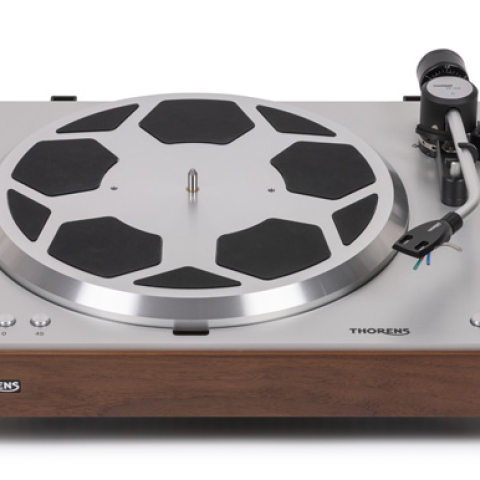
To prove their his point, Flatow played a scratchy Led Zeppelin LP on an unnamed turntable and compared it to a CD edition of the same album. Anyone who's compared Led Zep's CD box with good vinyl knows that, even on a modest analog rig, the vinyl kills the CDs. But while I felt the show was disgraceful and dishonest, the air of desperation and defensiveness it exuded left me oddly satisfied.
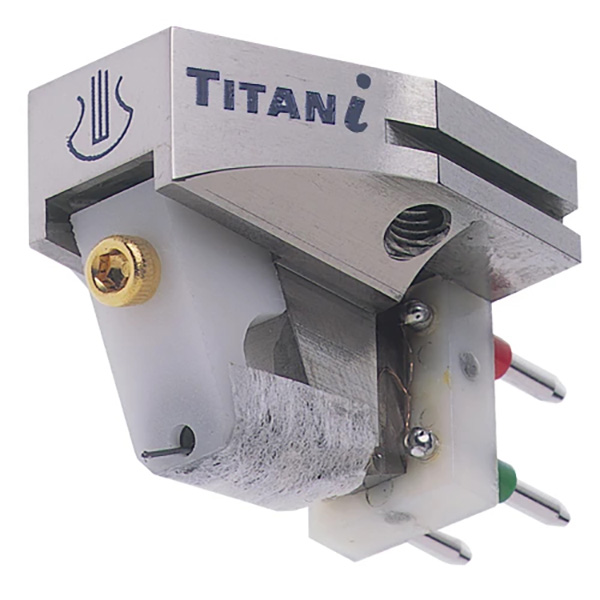
Everything I have ever written about the Lyra Titan i being tipped up on top was incorrect. This moving-coil cartridge does not have a tipped-up top end. I'll explain that, and why it's important that I do so now. When I reviewed the Titan i in June 2003 and March 2007, I did not yet have a digital USB microscope. Nor had I read Jon M. Risch and Bruce R. Maier's "More Than One Vertical Tracking Angle," a superb, even groundbreaking article published in Audio magazine in March 1981, when vinyl was king. Space doesn't permit going into great detail here about this, but basically, Risch and Maier concluded, based on measurements and listening they performed (and which are described in that 1981 article), that stylus rake angle (SRA) is more critical than vertical tracking angle (VTA), and that an SRA of 92° was ideal for almost any LP you might own.
To shift SRA by 1° requires raising or lowering the back of a 9" tonearm by a full 4mm (0.157") at the pivot point. I would argue that fanatics who hear big sonic differences when they adjust VTA by a minuscule amount to compensate for variations in record thickness are really hearing the far more audible shift in azimuth caused by the change in the headshell's offset angle.
In any case, back in 2003, I set up the Titan i based on Lyra's instruction sheet, which suggests that you start out with the armtube parallel to the record surface. Back then, the conventional wisdom was that, based on listening, you'd typically end up with the armtube slightly down at the back, which is where it ended up for my review. It sounded better the more I lowered it, but I was hesitant to lower it too far. But that was then, and even loaded down to 100 ohms, the Lyra had a tipped-up high-frequency tonal balance.
By the time the Ortofon A90 and its severe-profile Replicant stylus arrived, I had the digital USB microscope and had read "More Than One Vertical Tracking Angle." Properly set up at 92°, the A90 was the most tonally neutral cartridge I'd ever heard, and it became my reference.
Thanks to the USB microscope, here's what I've found: The stylus shank of my sample of Lyra's Titan i is inserted a full 4° forward of perpendicular to the LP, which produces an SRA of 94° when the tonearm is parallel to the record surface. To achieve an SRA of 92°, the rear of the arm must be lowered a full 8mm (0.315")! Who'd have thought? Not me. It doesn't look good, but it sounds much better. True, had the shank been perpendicular, the arm would have had to be raised 8mm, and probably no one would have done that without the assurance of a digital microscope.
Remember: Too high an SRA = bright. Too low an SRA = a dull top end with boomy and/or excessive bass. With the rear of the tonearm 8mm lower than the front, the Titan i does not sound tipped-up on top. Its sound is superbly balanced, though some will still probably find it too revealing and analytical.
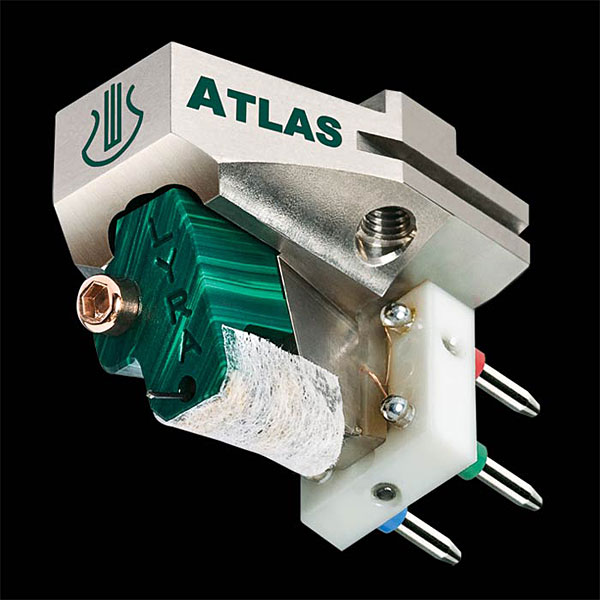 Lyra Atlas MC phono cartridge: First listen
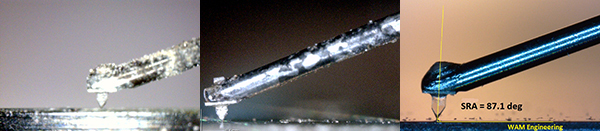
When I trained the USB microscope on Lyra's new top model, the Atlas ($9500), with the tonearm parallel to the record surface, I found that the stylus shank was down 3° from perpendicular, at 87°! To achieve 92° required raising the back of the arm 16mm (0.630") from its initial setting. That's a lot, and far more than anyone would have guessed or, probably, tried, especially considering that the conventional wisdom advises down from parallel.
It also means that there's a 7° difference in SRA between the Atlas and the Titan i. Without a microscope, how can you know how to set up your sample? And please don't think I'm picking on Lyra, who make some of the highest-precision, highest-tech cartridges around. However, like many other, if not most, cartridge makers, Lyra buys preassembled stylus/cantilever assemblies from outside suppliers, in this case Ogura. Something else to consider: Since I first wrote about digital USB microscopes (all credit to Wally Malewicz, who turned me on to them and how to use them, as well as that old Audio article), a few readers have sent me their pictures of other cartridge brands, and what's out there is sometimes not pretty.
You can also be sure that if the SRA can vary so widely, so can the azimuth angle. This means that aligning the cantilever perpendicular to the record surface has about as much chance of being the correct azimuth setting as setting the correct VTA has of determining correct SRA, which is far more important!
It's not possible to ensure perfect stylus alignment in every sample, but when a cartridge costs thousands of dollars, it should come reasonably close. I reported my findings to Joe Harley of AudioQuest, Lyra's US distributor at this time, and sent him microscope images of the Titan i and Atlas. Lyra's Stig Bjorge and Jonathan Carr, both expressed concern about the lack of SRA consistency, and said they would commit themselves to tightening the quality control of Lyra parts made by outside vendors. They're sending me another sample of the Atlas. Meanwhile, the one I have is now correctly set up.
My review of the replacement Lyra Atlas can be found here.
Sidebar: In Heavy Rotation 1) Cassandra Wilson: Blue Light 'til Dawn, Capitol/Pure Pleasure 180gm LPs (2) 2) Grateful Dead: Reckoning, Arista/Analogue Productions 180gm LPs (2) 3) Wayne Shorter: Ju Ju, Blue Note/Music Matters 45rpm 180gm LPs (2) 4) Ravel: Daphnis et Chloé (Monteux/LSO), London/ORG 45rpm 180gm LPs (2) 5) Mumford and Sons: Sigh No More, Glassnote 180gm LP 6) Carole King: Music, Ode/Mobile Fidelity Sound Lab 180gm LP 7) Sade: Diamond Life, Epic/Audio Fidelity 180gm LP 8) Gentle Giant: Acquiring the Taste, Classic Reissues 180gm LP 9) Original Soundtrack: Breakfast at Tiffany's, RCA/Speakers Corner 180gm LP
Footnote 1: In my Richard C. Heyser Memorial Lecture to the Audio Engineering Society in October 2011, I mentioned the fact that, as Meridian's Bob Stuart has explained, the LP's RIAA equalization results in the LP having better resolution than CD where it is most important—in the presence region, where the ear is most sensitive—but not as good where it doesn't matter, in the top or bottom octaves.—John Atkinson
Under the digital microscope: The Lyra Atlas (left), Titan i (middle), and the Atlas showing an SRA of 87.1° (right).
We interrupt this column to bring you an important messageEverything I have ever written about the Lyra Titan i being tipped up on top was incorrect. This moving-coil cartridge does not have a tipped-up top end. I'll explain that, and why it's important that I do so now. When I reviewed the Titan i in June 2003 and March 2007, I did not yet have a digital USB microscope. Nor had I read Jon M. Risch and Bruce R. Maier's "More Than One Vertical Tracking Angle," a superb, even groundbreaking article published in Audio magazine in March 1981, when vinyl was king. Space doesn't permit going into great detail here about this, but basically, Risch and Maier concluded, based on measurements and listening they performed (and which are described in that 1981 article), that stylus rake angle (SRA) is more critical than vertical tracking angle (VTA), and that an SRA of 92° was ideal for almost any LP you might own.
Lyra Atlas MC phono cartridge: First listenWhen I trained the USB microscope on Lyra's new top model, the Atlas ($9500), with the tonearm parallel to the record surface, I found that the stylus shank was down 3° from perpendicular, at 87°! To achieve 92° required raising the back of the arm 16mm (0.630") from its initial setting. That's a lot, and far more than anyone would have guessed or, probably, tried, especially considering that the conventional wisdom advises down from parallel.
Sidebar: In Heavy Rotation 1) Cassandra Wilson: Blue Light 'til Dawn, Capitol/Pure Pleasure 180gm LPs (2) 2) Grateful Dead: Reckoning, Arista/Analogue Productions 180gm LPs (2) 3) Wayne Shorter: Ju Ju, Blue Note/Music Matters 45rpm 180gm LPs (2) 4) Ravel: Daphnis et Chloé (Monteux/LSO), London/ORG 45rpm 180gm LPs (2) 5) Mumford and Sons: Sigh No More, Glassnote 180gm LP 6) Carole King: Music, Ode/Mobile Fidelity Sound Lab 180gm LP 7) Sade: Diamond Life, Epic/Audio Fidelity 180gm LP 8) Gentle Giant: Acquiring the Taste, Classic Reissues 180gm LP 9) Original Soundtrack: Breakfast at Tiffany's, RCA/Speakers Corner 180gm LP
Footnote 1: In my Richard C. Heyser Memorial Lecture to the Audio Engineering Society in October 2011, I mentioned the fact that, as Meridian's Bob Stuart has explained, the LP's RIAA equalization results in the LP having better resolution than CD where it is most important—in the presence region, where the ear is most sensitive—but not as good where it doesn't matter, in the top or bottom octaves.—John Atkinson