Michael Fremer by Jeff Wong
Other than for archiving and iPod use, is there any good reason to digitize vinyl playback? Pure Vinyl's Rob Robinson thinks so. His software offers RIAA and dozens of digital-domain equalization curves that he claims are inherently superior to any analog-domain filtering. Once recorded "flat," the high-resolution files can be conveniently played back using any curve (even, sometimes, the correct one!).
Yes, there are almost daily program updates, and viruses, corruption, program crashes, and hard-drive failures can wipe out your entire music collection. But let's not go there. Theoretically, digital-domain phono equalization has perfect frequency response, as well as being free of noise. Component tolerances and/or drift from specified values of the RIAA network's resistors and capacitors don't exist in the digital domain.
Of course, such "perfection" begs the $64,000 question: Once converted back to analog, is the signal transparent to the source, or is some essential analog quality lost along the way?
"Of course it can be transparent," say the digital apologists. "At a depth of 24 bits, no problem."
"Impossible!" say the frightened Luddites. "Once converted to digital, it's inherently different. You can't put Humpty Dumpty back together again."
Wadax, based in Spain and Switzerland, has been around since the 1970s, and off my radar screen for almost their entire history. They've now introduced the PRE1, a superbly engineered and built "universal" digital preamplifier ($32,500 with optional phono stage, as reviewed; stock version costs $27,800) that combines A/D conversion for analog sources with D/A conversion for digital ones.
Before A/D conversion of its phono input at 24-bit/96kHz, Wadax's linear, gain-adjustable NanoVolt amplifier steps up the voltage from either a moving-magnet or a moving-coil input. Gain for both MM and MC cartridges is adjustable in three steps, the ideal being maximum possible gain without triggering the Analog Overload warning light. The digitized analog goes next to Wadax's proprietary MusIC chip, which contains digitally programmed filters, time domain reconstruction, and linearization, to apply the RIAA equalization. After reconversion to analog, that signal is available via output set 1 or set 2, in single-ended or balanced mode.
Wadax is in the process of creating a database of phono-cartridge models that will allow the curve to be tailored to compensate for a specific cartridge's response anomalies. Given sample-to-sample variations in performance within even a single expensive model, such compensation will be provided only for those characteristics common to
all samples of a given model.
But Wadax has also come up with a Custom Mapping option that uses a proprietary test lacquer to "map" the performance of the buyer's own combination of turntable, tonearm, cartridge, and phono cable. Either the dealer or the customer plays the disc, and captures the results on a digital recorder. The data are then sent via the Internet to Wadax, which crunches the numbers and returns to the customer a program for his Wadax PRE1 that combines RIAA equalization with corrections to the frequency and phase responses, among other things, including compensations for any channel imbalance and even the effect of tonearm resonances.
The company claims that their Custom Mapping process measures and quantifies more than 100 primary parameters, and many more secondary ones. Left sketchy was
precisely how many parameters are actually adjusted by the correction software. One claimed result of the process is that the compensated input also presents an ideal load for the cartridge.
According to Wadax's Javier Guadalajara, more than 6.4GB of data per second move between the musIC chip and the PRE1's high-speed memory, performing all necessary calculations with 128-bit mathematical accuracy. He added that the system's analysis works with 1.2Hz resolution, which is important for such things as tonearm resonances and low-bass mechanical effects that affect the full audioband.
Guadalajara says that the measurements, particularly the time-related ones, require the use of very sophisticated sonar- and radar-based techniques to prevent the data masking induced by short-term variations in turntable speed. As an aside, he told me that the musIC chip includes a signal-processing "toolbox" that can also be used to correct speakers and electronic circuits, and that because the parameters of the PRE1's A/D, D/A, and amplification circuits are known, they, too, can be corrected by the process.
 The Physical Plant
Even an acknowledged digiphobe (that's me!) should find all of the above intriguing, but what about the PRE1 itself?
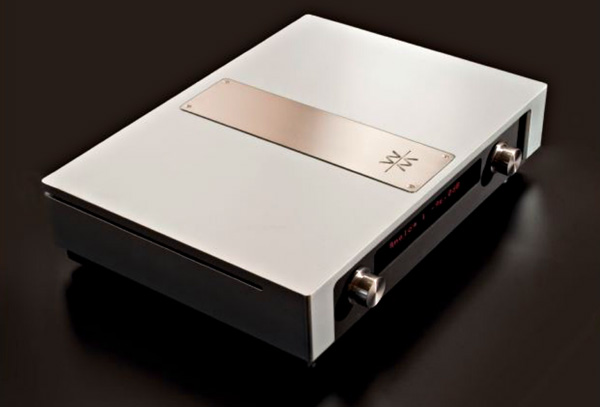
Depending on the setting of an internal switch, the PRE1 can operate in one of six modes: as a line-level preamplifier, a preamp with a DAC, a preamp with phono stage, a standalone DAC, a standalone phono stage with a step-up amplifier, or an A/D converter. While it would have been possible to have reviewed it configured as a phono preamp with its line-level output sent to an analog preamp, I chose to use it as a fully functional preamp with A/D and D/A converters and phono stage, since that's how I think it will be most often used.
The PRE1's elegant, award-winning industrial design is by the Spanish firm Ochoa y Diaz-Llanos (ochoaydiazllanos.com). Wadax's massive Mechalock clamshell chassis, milled from two 95lb blocks of specially formulated aluminum alloy, provides control of both electromagnetic interference and mechanical resonances. (The PRE1 itself weighs 44lb.) A five-step process finishes the chassis with neoprene microspheres to reduce microresonances. Every circuit-board screw is precisely torqued, depending on the size and material of screw and its placement, using custom-calibrated tools. Whew!
Take a look inside and you immediately realize the seriousness of this ultra-high-tech product. The circuit boards are packed with more than 1500 surface-mount parts, some proprietary, including the two 480-pin MusIC chips, both mounted on an eight-layer board along with some 500 other parts.
The PRE1's chromed rear panel has one BNC and four S/PDIF digital inputs, which can accept up to 24-bit/192kHz signals, a TosLink input capable of up to 24/96, and a 24/48 USB port. There are two line-level, single-ended analog inputs, but one is disabled with the addition of the phono option, leaving but one for your cassette deck, FM tuner, or an additional phono stage
Also on the back are two sets of analog outputs, single-ended and balanced. Depending on how the PRE1 is configured, one set can output the corrected and one the uncorrected phono signal—or, if you have two cartridges, both can be measured and one output assigned to each. There's also a BNC word-clock output.
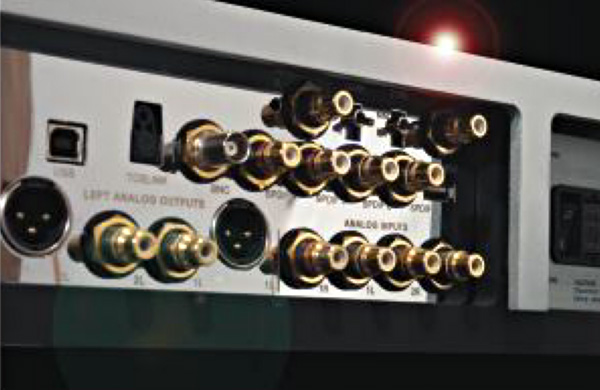
Unfortunately, as delivered, my review sample did not include any digital output facilities for archiving digitized recordings, but shortly before deadline, Wadax announced a new Generation 4 digital board that has both inputs and outputs. Units purchased by distributors, retailers, or end-users within 90 days of the board's release date of December 1, 2011, will be upgraded at no additional cost. Older units can be upgraded for an unspecified charge.
Too bad about that timing—it would have been interesting to bring to the January 2012 Consumer Electronics Show files from digitized vinyl playback that had been corrected in the digital domain and that had been processed with a pure analog system. That way I could get feedback from the attendees who look forward each year to the hi-rez digital recordings I make of LPs played on my
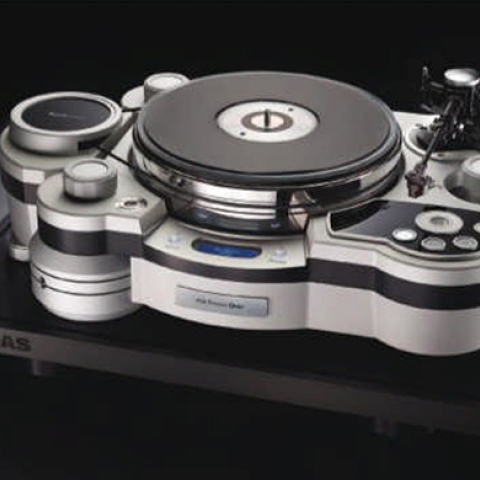
Continuum Audio Labs setup of Caliburn turntable, Cobra tonearm, and Castellon stand.
In addition to beefing up the input stage's immunity to jitter, the Gen4 board incorporates an AES/EBU input and a PureADC-mode BNC output jack that can be used to store send digitized analog sources, including the Custom Mapped phono input, at 24/96 resolution into any digital recorder equipped with an S/PDIF input.
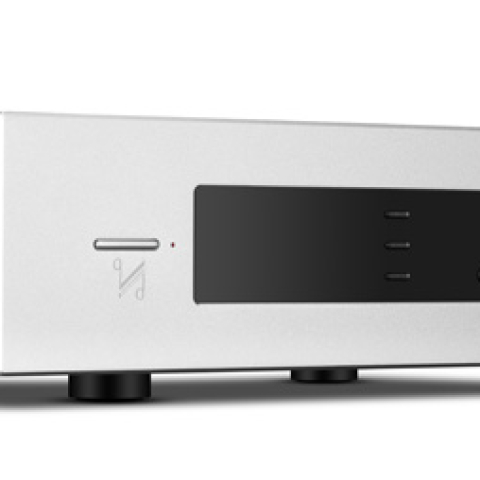
On the PRE1's front panel, volume and input-selector knobs flank a large LED screen with a red dot-matrix display. The only disadvantage of such minimal design is that if you lose the remote control, you'll have to access the rear panel to reach the power switch. The remote itself is handsome, and unusually narrow and elegant looking, with inlaid pushbuttons for direct input selection, polarity inversion (for both the analog and digital inputs), Volume, Balance, and Mute. Wadax's attention to detail includes a magnetically secured battery cover so seamlessly integrated into the remote's undersurface that you might miss it. Wadax gives up nothing to Bang & Olufsen in terms of industrial design and execution—and that's saying a lot.
The PRE1's instruction manual is a loose-leaf binder that communicates a desire on Wadax's part to provide the buyer with a luxurious experience. It's what one should expect—and what one doesn't always get—with a high-performance audio product costing $32,500.
Out of the Box
The PRE1 has two sets of outputs. One set of outputs gives you the "standard" RIAA curve, the second set an "improved" RIAA curve. How can there be an "improved" curve?
According to Javier Guadalajara, the standard curve's implementation is based strictly on amplitude—phase is not taken into account. However, his measurements of various cutter-head systems have produced a consistent set of time-domain (phase) errors that he felt could and should be corrected. That version of the RIAA curve is available at the Improved pair of outputs. However, the ultimate way to experience Wadax's approach to LP playback is to have it customized for your analog front end. That's what I did.
Setting Up the Phono Input
On delivery day, Javier Guadalajara and Wadax's US importer, Rick Brown, arrived with a PRE1 and the test lacquer. The Wadax sat on an HRS rack, on a set of the newest footers from Stillpoint. I connected the Caliburn Cobra tonearm's RCA plugs to the phono input and S/PDIF outputs of my
Meridian Sooloos music server, a vintage Audio Alchemy DDS•Pro CD transport and my BPT-modified
Alesis Masterlink hard-disk recorder to the PRE1, and listened to some analog and some digital recordings, using the Standard RIAA curve output (obviously, digital inputs bypass this part of the signal processing).
I listened briefly to uncorrected digitized LPs; the Wadax was sonically undistinguished compared to the Ypsilon VPS-100 phono preamp into either the
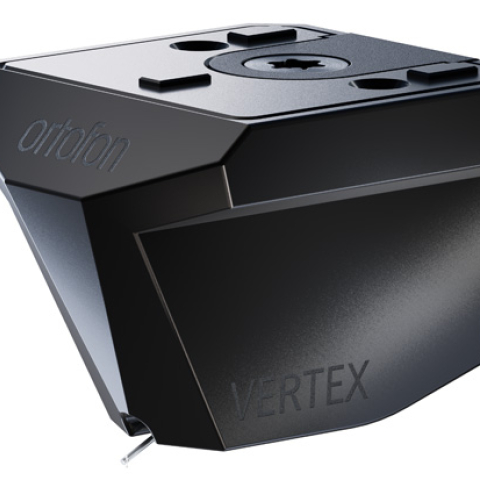
darTZeel NHB-18NS or Ypsilon PST-100 Mk.II preamplifier. Then it was time to "map" my system's analog front end by playing the test lacquer with the Ortofon A90 cartridge, the PRE1's analog output feeding a handheld digital recorder.
Guadalajara then spent a few hours analyzing and crunching data on his laptop, stored the corrections on a USB flash drive, and inserted that into the USB port on the back of the PRE1. This automatically routes the data to and reprograms one of the musIC chips.
In the real world, the buyer or dealer would play the lacquer and record the data, which would then be sent to Wadax in Europe via the Internet. The file containing the corrective information would be sent back the same way, to be uploaded to a USB drive for installation in the PRE1.
While Guadalajara crunched his numbers, I used the Sooloos to check out the sound of the PRE1's DAC. As this is "Analog Corner," I'll say only that the DAC produced texturally supple, solid, grainless, finely articulated three-dimensional images similar to those produced by the
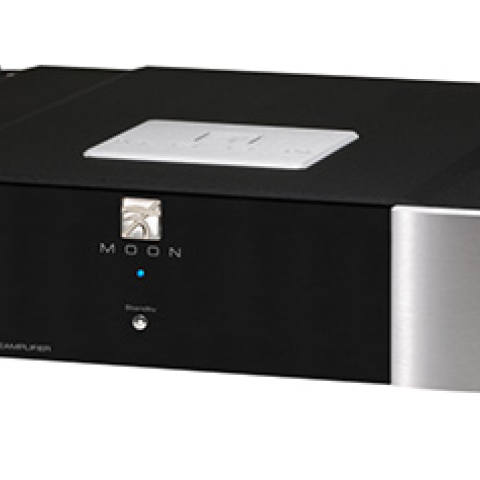
Simaudio Moon Evolution 650D DAC-transport into an analog preamplifier—but even more smooth, graceful, and especially, transparent. The Wadax DAC's bass performance was similarly texturally solid, supple, nimble, and well controlled; again, the Wadax was marginally superior to the 650D in these areas. Well-recorded high-resolution files produced almost velvety-rich yet detailed images on a pleasingly spacious and airy soundstage, and didn't sound at all "digital" in the pejorative sense.
However, the backgrounds produced by the PRE1 were noticeably "blacker" than I can recall having heard from my system, perhaps in part because of the integration into a single component of DAC and preamp, which obviated the need for analog interconnects. Only the dCS Scarlatti system I
reviewed in August 2009, via its variable output, produced such aural blackness. Toggling back and forth between the Wadax and the Simaudio 650D into the
MBL 6010D analog preamp—which itself is very quiet—made clear just how black and rich those Wadax backdrops were.
 Custom-Mapped Analog
Once the mapping information had been uploaded, the first record I played was Analogue Productions' two-disc 45rpm edition of Stan Getz and João Gilberto's
Getz/Gilberto (Verve/Analogue Productions AVRJ 8432-45), which I'd just played unmapped.
Compared to pure analog playback, the unmapped playback was far less compelling in terms of transparency, delicacy, image three-dimensionality, and especially palpability, and seemed harmonically undernourished compared to the riches offered by the Ypsilon VPS-100 phono preamp (although, as with its digital playback, the Wadax's backgrounds were pitch black). Then I listened using Custom Mapping. The biggest and most immediately audible differences were in image solidity, soundstage depth, and transients that struck an ideal balance between speed and delicacy. But what drew from me an immediate "Oh wow!" (not that I claim to have heard what Steve Jobs saw!) was the sonic picture's overall coherence and its obvious tonal neutrality. Nothing stuck out. Gilberto's finger-plucked guitar was notably front and center, each pluck precise and palpable. His voice was equally well focused, precisely placed in three-dimensional space and tonally well balanced, with a transparent, physical quality to consonants (such as p) that rendered them more lifelike. The interplay between Gilberto and pianist Antonio Carlos Jobim was as cleanly rendered as I've heard it.
Astrud Gilberto's voice was appropriately feathery, but not quite as dramatic and upfront as I'm used to—which could have been because the PRE1's phono stage had ironed flat the cartridge's high-frequency nonlinearities. The same was true of Getz's tenor sax—it sounded dense and physical, with an ideal balance of reed and brass. And when Jobim took his piano solo, the certainty and delicacy of the hammers hitting the strings and the freedom from breakup produced from me another "Oh wow!"
Getz/Gilberto may have sounded a bit dark compared to what I'm used to hearing from this album, but I'd be hard-pressed to say that the cymbals and drums didn't sound correct, or that the saxophone sounded muted. I don't think
anyone reading this would have known they were listening to "digital" ("Oh wow!"), especially because the PRE1's major sin was of omission: instrumental decays seemed consistently too short and less than fully realized. Recordings with notable reverberation—particularly music recorded live in big halls—seemed drier than expected.
Javier Guadalajara and Rick Brown were happy with the results. They didn't hype me, but they did hang around for a few hours as I played DJ, spinning records I thought would be revealing, including the remarkable
Clarinet Summit, by Jimmy Hamilton, Alvin Batiste, John Carter, and David Murray (LP, India Navigation 1062); and organist Larry Young's
Unity (LP, Blue Note/Music Matters 4221).
 More Drive, Please
When
MBL's Radialstrahler 101E Mk.II loudspeakers arrived for review, it became apparent that while the Wadax PRE1 had enough output to drive
MBL's Reference 9011 monoblocks in digital input mode, that wasn't the case with vinyl.
A simple programming update via the PRE1's USB port should have produced greater output, but I was unable to get that to work—so a second PRE1 arrived that did. Even so, I'd say that the Wadax isn't a good match for systems with the MBL 101E Mk.II, or for any super-insensitive speaker. While the sound was as I've described and the backgrounds were still black, when no music was playing I heard more noise than I wanted to.
Begging the Question
I was listening to a top-notch turntable, tonearm, and cartridge. The Ortofon A90 is among the most tonally neutral cartridges I've yet heard—which is why I bought it. It would have been interesting to install a noticeably bright and/or etched cartridge, or maybe even a budget model, and Custom Mapped
that to hear if superb analog/digital playback can be achieved on the cartridge cheap—or to have gone another step down, installed an inexpensive cartridge in a modestly priced turntable, and listened to what
that produced.
I was comparing the $28,000 Ypsilon phono preamp (add nearly $3000 for the step-up transformer), the $28,000 darTZeel preamp, and the $8000 Simaudio Moon Evolution 650D DAC-transport—total cost almost $68,000 (plus however much you want to spend on analog and digital cables)—to a $32,500 all-in-one preamp, phono stage, and DAC. For pure digital playback, in many ways the PRE1 came out on top. If there was a downside to its digital performance, it was a slight softness and lack of sparkle and vitality in the highest highs—and if you like tube warmth, the Wadax didn't deliver.
But if you like a smooth, rich, artifact-free extreme top end, you'll love the PRE1. The lower octaves were fully realized in every way. As I write this I've got the Meridian Sooloos swimming (it's like the iPod's Shuffle mode), and McCartney's bass in "Something," from the 24-bit remastering of the Beatles'
Abbey Road, sounds as rich, full, and well controlled as I've ever heard it digitally reproduced.
For straight-up all-analog playback of LPs, I'll still take the Ypsilon VPS-100 phono stage, and I think you would too. In two areas it was clearly noticeably superior to the Wadax instead of being merely different: in instrumental harmonic complexity, and, especially the decays of instruments' sounds—the way notes trail off. The Wadax had the black for sure, but notes dropped into it prematurely.
What Would Ludwig Say?
A superbly conducted and performed, limited-edition set of Beethoven's symphonies recently arrived: Paavo Järvi conducting the Deutsche Kammerphilharmonie Bremen, recorded in DSD at the 2009 Salzburg Festival. The multitrack digital tapes were remixed to analog tape specifically for this set, which is pressed on nine high-quality, 180gm LPs and sumptuously packaged.
I grew up on the 1960s-era Beethoven cycles of Herbert von Karajan (DGG) and Otto Klemperer (EMI), and Järvi's takes on these warhorses are paced more quickly without giving up any of the grandeur. Even if you know these symphonies by heart, these performances will thrill you. The recording goes for clarity of line and instrumental balance over ambience, but it's not overly spotlit, and the multimiking is expertly stitched into a close but coherent perspective.
I went back and forth between the all-analog through the Ypsilon VPS-100 phono stage and digitized analog through the PRE1, and while the Ypsilon prevailed in ways subtle and significant, the digitized version through the Wadax was too close for comfort. I doubt anyone would know which was digital and which was pure analog. I don't say that lightly.
With the exception of those who've spent large sums on their LP playback chains, it's likely that many vinyl fans will find that swapping out their phono and line preamps for the Wadax will produce a significant step up in analog sound.
Did I just write that?
Sidebar: In Heavy Rotation
1) Beethoven, Symphonies 1–9 (Paavo Järvi, Deutsche Kammerphilharmonie Bremen), 180gm LPs (9)
2) Johnny Cash,
The Fabulous Johnny Cash, Columbia/Impex 180gm LP
3) Art Blakey and the Jazz Messengers,
Like Someone in Love, Blue Note/Music Matters 180gm 45rpm LPs (2)
4) Ella Fitzgerald and Louis Armstrong,
Ella and Louis, Verve/Analogue Productions 180gm 45rpm LPs (2)
5) James Taylor,
JT, Columbia/Mobile Fidelity Sound Lab 180gm LP
6) Mendelssohn, Symphony 3 (Peter Maag, London Symphony), London/ORG 180gm 45rpm LPs (2)
7) Gil Evans Orchestra,
Great Jazz Standards, World Pacific/Pure Pleasure 180gm mono LP
8) Herb Ellis,
Nothing But the Blues, Verve/Speakers Corner 180gm LP
9) Steve Earle,
I'll Never Get Out of This World Alive, New West 180gm LP
10) Various Artists,
The Secret Museum of Mankind, Vol.1: Central Asia 1925–48, Outernational LPs (2)
Footnote 1: Wadax, S.A., Francisco remiro, 2 Ed D3, 28028 Madrid, Spain. Tel: (34) 91-355-02-17. Web:
www.wadax.eu. US distributor: Wadax US. Tel: (612) 817-1599. Web:
www.wadax.us,
www.rbhifi1.com.