Asked why the U-380's DAC does not decode DSD or MQA, he said, "We saw DSD sort of blooming up but then fade away again. All but one digital audio workstation worldwide is PCM. Because almost everything you get these days is PCM converted to DSD (footnote 1), it makes absolutely no sense. [In addition,] a mixed mode DAC really isn't optimal because the filtering needed for DSD is so different. Similarly, we don't do MQA because it requires an XMOS receiver, which affects the quality of non-MQA signals." Taking this into account, I took advantage of an option in my Roon music playback software to automatically convert DSD to PCM. Similarly, to address the U-380's 192kHz sample-rate conversion ceiling, I set Roon to downconvert DXD (352.8 and 384kHz) to either 176.4 or 192kHz.
Though the U-380 has RCA preamplifier outputs, Børresen told me it wasn't designed to be used as a standalone preamp. "It can be used as such, but our C-380 is better performing and more flexible," he clarified via WhatsApp. "The preamp outputs are intended for active subs or for audiophiles who wish to biamp."
At conversation's end, Michael promised that when he paid a visit in a few weeks, he'd bring a suitcase filled with tweaks and accessories. "In my experience, the performance of a lot of good electronics is compromised by a lack of proper support, cabling, power treatment, and setup. But it's impossible to make a product that is fully finished in this regard without greatly increasing the price. That's why 'accessories' are important necessities for the High End. For example, an amplifier produces noise internally, and you need a path for it to escape. When you put a rubber foot on an amplifier, the noise stays inside, and it can sound mushy. The sound isn't transparent, and bass energy keeps bouncing back and forth inside the product. Nothing should be put directly on a shelf without supports underneath it."
Layout, setup, review strategy, and all that jazz
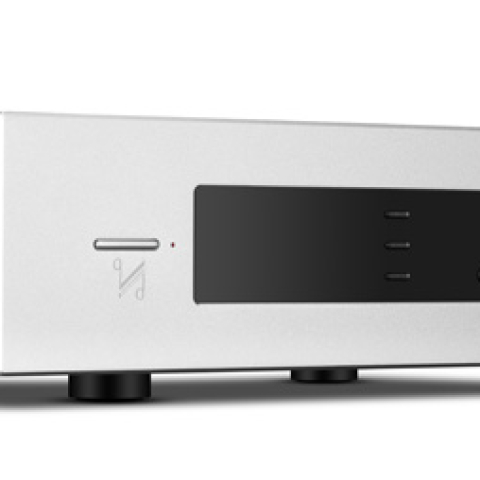
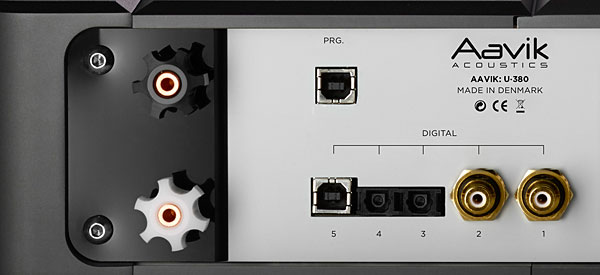
The U-380's front panel has three small raised buttons situated above its large volume control knob. The first adjusts mute, gain, cartridge loading and balance settings; the second is for power on/standby; and the third selects the source. To the left of the knob are gain settings—gain is adjustable in 18 steps, which are illumined but impossible to read from a distance—and to the right, source options. Small white LEDs—a novelty in the age of red, green, and blue—indicate setting choices. Most functions, including volume, input, cartridge loading, and mute, are also adjustable via a small Apple remote.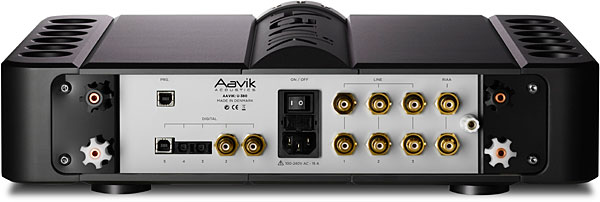 In addition to extremely easy-to-grasp speaker outputs suitable for both spade and 4mm banana connectors, sensibly located at the left and right sides of the rear panel, the back includes RS-232 (for firmware updates and remote control) and trigger sockets; five digital inputs (asynchronous USB, two TosLink optical S/PDIF, and two BNC S/PDIF); a power switch/IEC input; three single-ended (RCA) line inputs; and a fully balanced RCA phono input with floating ground. A phono cable with a separate ground wire is recommended.
I placed the U-380 on a spare shelf of my Grand Prix Audio Monza rack, at a height conducive to cable switching. A Nordost Valhalla 2 USB cable connected my file/streaming source, the Roon Nucleus + with outboard Small Green Computer/HDPlex linear power supply. Single-ended Nordost Odin 2 analog interconnects connected my reference Rossini DAC/Clock combo ($31,498); the cost of this combo greatly exceeds that of the U-380, especially if you connect it with top-of-the-line cabling. The same Nordost Titanium Sort Kones that I use under my reference dCS Rossini DAC/clock combo and Krell K-300i integrated found a home under the U-380. Supports under the Nucleus + were initially Stillpoints Ultra SS filters. More on that follows.
For power treatment, I took the lead from Børresen, who contributed to the design of Nordost's QBase (QB8) AC distributor. Rather than use the AudioQuest Niagara 5000 power conditioner, I plugged all components, including two daisy-chained Nordost QX4 power purifiers, into a QBase-Mark II 20 amp AC distributor—the U-380 was connected to the "Primary Earth" outlet—and plugged the QB8 directly into the wall.
Børresen discouraged a comparison of the U-380's preamp section to other preamps; indeed, doing so was not an option because all outputs on the U-380 are single-ended, and my D'Agostino Progression monoblocks only accept XLR. Instead, I compared the U-380's DAC to my reference dCS Rossini DAC/clock combo. I also compared the U-380 to my reference integrated amplifier, the class-AB Krell K-300i ($7000, or $8000 with DAC), which costs five times less than the U-380. I also took note of how the U-380 integrated stacked up against my reference Rossini DAC/clock and the class-AB D'Agostino Progression monoblocks ($38,000/pair).
In addition to extremely easy-to-grasp speaker outputs suitable for both spade and 4mm banana connectors, sensibly located at the left and right sides of the rear panel, the back includes RS-232 (for firmware updates and remote control) and trigger sockets; five digital inputs (asynchronous USB, two TosLink optical S/PDIF, and two BNC S/PDIF); a power switch/IEC input; three single-ended (RCA) line inputs; and a fully balanced RCA phono input with floating ground. A phono cable with a separate ground wire is recommended.
I placed the U-380 on a spare shelf of my Grand Prix Audio Monza rack, at a height conducive to cable switching. A Nordost Valhalla 2 USB cable connected my file/streaming source, the Roon Nucleus + with outboard Small Green Computer/HDPlex linear power supply. Single-ended Nordost Odin 2 analog interconnects connected my reference Rossini DAC/Clock combo ($31,498); the cost of this combo greatly exceeds that of the U-380, especially if you connect it with top-of-the-line cabling. The same Nordost Titanium Sort Kones that I use under my reference dCS Rossini DAC/clock combo and Krell K-300i integrated found a home under the U-380. Supports under the Nucleus + were initially Stillpoints Ultra SS filters. More on that follows.
For power treatment, I took the lead from Børresen, who contributed to the design of Nordost's QBase (QB8) AC distributor. Rather than use the AudioQuest Niagara 5000 power conditioner, I plugged all components, including two daisy-chained Nordost QX4 power purifiers, into a QBase-Mark II 20 amp AC distributor—the U-380 was connected to the "Primary Earth" outlet—and plugged the QB8 directly into the wall.
Børresen discouraged a comparison of the U-380's preamp section to other preamps; indeed, doing so was not an option because all outputs on the U-380 are single-ended, and my D'Agostino Progression monoblocks only accept XLR. Instead, I compared the U-380's DAC to my reference dCS Rossini DAC/clock combo. I also compared the U-380 to my reference integrated amplifier, the class-AB Krell K-300i ($7000, or $8000 with DAC), which costs five times less than the U-380. I also took note of how the U-380 integrated stacked up against my reference Rossini DAC/clock and the class-AB D'Agostino Progression monoblocks ($38,000/pair).
 Since I don't have room for a phono setup, I tried the U-380 with the analog setup of my musician/audiophile friend Gary Forbes. By coincidence, when my husband and I joined Børresen for dinner in Port Townsend, Forbes and his medical team were conducting a new-colleague interview in the same restaurant. At interview's end, I was able to introduce the two men. As you'll discover when you read Forbes's assessment of the phono section, which was completed before Børresen visited, their conversation was very upbeat.
On to the music
Since I don't have room for a phono setup, I tried the U-380 with the analog setup of my musician/audiophile friend Gary Forbes. By coincidence, when my husband and I joined Børresen for dinner in Port Townsend, Forbes and his medical team were conducting a new-colleague interview in the same restaurant. At interview's end, I was able to introduce the two men. As you'll discover when you read Forbes's assessment of the phono section, which was completed before Børresen visited, their conversation was very upbeat.
On to the music
It didn't take long to ascertain that the Aavik U-380 outputs the best class-D sound I've heard in my music room. On David Byrne's bass-heavy "I Dance Like This," from his much-too-short album American Utopia (Qobuz 24/96 FLAC, footnote 2), bass was prodigious and absolutely solid, with different complex lines easily distinguishable. Moving up the scale, Byrne's low vocal range had a worn earthiness all its own, high-pitched instruments could be heard clearly through the raucous mix, and the top was alive yet non-fatiguing. Taken as a whole, the sound was musically satisfying, visceral as hell, and totally unsuited for Aunt Tillie's invitation-only tea socials at the Wilmington Garden Club. Save for just a touch of the toned-down dryness often associated with class-D, it sounded just as I expect artist and recording engineer intended. Next, to very different music, mezzo Marianne Crebassa singing Debussy's far more subtle and refined Chansons de Bilitis, with Fazil Say's piano as the sole accompaniment, from Secrets (24/96 WAV, Erato 564483). God, do I love these songs; I must have eight different versions in a folder for easy comparison. The sound was extremely transparent; timbres were neutral, alive, and colorful; and dynamics were plentiful. "Very beautiful; I love this," I scribbled in my notes. "The soundstage may be less wide and open than my reference, but the sound is gorgeous." Peter McGrath's live recording of clarinetist Richard Stoltzman and the Tashi Quartet performing what Stoltzman introduced as "a movement from one of the most perfect pieces ever written, and of course it happens to be for clarinet," the Larghetto from Mozart Clarinet Quintet (24/44.1 MQA, decoded by Roon to 24/88.2) could serve as a model for how MQA can revivify early digital recordings. Again, gorgeous sound, quite open, and perfect for music played so sublimely. Switching gears to Lou Harrison's colorful, percussion-rich Concerto for Violin with Percussion Orchestra, with violinist Tim Fain and Angel Gil-Ordóñez leading the PostClassical Ensemble (24/48 WAV, Naxos 8.559825/HDtracks), bass was again excellent, multiple colors were on display, and dynamics were huge. I especially loved the fullness of the low drumbeat beneath Fain's violin.
Three more nonclassical tracks: 1) Anette Askvik's "Liberty," from her eponymous album (Tidal 16/44.1 FLAC), showed her voice extremely present and delivered the message, "When the power of love overcomes the love of power, the world will know peace," loud and clear; 2) "John Taylor's Month Away," from King Creosote and Jon Hopkins's Diamond Mine (Jubilee Edition) (Tidal 16/44.1 FLAC), where appreciation was tempered by the realization that the electro-acoustic listening experience wasn't as immersive as through my reference; and 3) Cassandra Wilson's rendition of Robert Johnson's classic "Come On in my Kitchen" from Blue Light 'Til Dawn (Tidal 16/44.1 FLAC), where I was so enamored by the sound that I momentarily turned off my critical mind. (Hey, for a born critic, that's a big deal.)
Footnote 1: Channel Classics and NativeDSD.com would dispute this statement. Footnote 2: Thanks to Herb Reichert for another stellar music tip. Please keep them coming, Herb.
The U-380's front panel has three small raised buttons situated above its large volume control knob. The first adjusts mute, gain, cartridge loading and balance settings; the second is for power on/standby; and the third selects the source. To the left of the knob are gain settings—gain is adjustable in 18 steps, which are illumined but impossible to read from a distance—and to the right, source options. Small white LEDs—a novelty in the age of red, green, and blue—indicate setting choices. Most functions, including volume, input, cartridge loading, and mute, are also adjustable via a small Apple remote.
In addition to extremely easy-to-grasp speaker outputs suitable for both spade and 4mm banana connectors, sensibly located at the left and right sides of the rear panel, the back includes RS-232 (for firmware updates and remote control) and trigger sockets; five digital inputs (asynchronous USB, two TosLink optical S/PDIF, and two BNC S/PDIF); a power switch/IEC input; three single-ended (RCA) line inputs; and a fully balanced RCA phono input with floating ground. A phono cable with a separate ground wire is recommended.
I placed the U-380 on a spare shelf of my Grand Prix Audio Monza rack, at a height conducive to cable switching. A Nordost Valhalla 2 USB cable connected my file/streaming source, the Roon Nucleus + with outboard Small Green Computer/HDPlex linear power supply. Single-ended Nordost Odin 2 analog interconnects connected my reference Rossini DAC/Clock combo ($31,498); the cost of this combo greatly exceeds that of the U-380, especially if you connect it with top-of-the-line cabling. The same Nordost Titanium Sort Kones that I use under my reference dCS Rossini DAC/clock combo and Krell K-300i integrated found a home under the U-380. Supports under the Nucleus + were initially Stillpoints Ultra SS filters. More on that follows.
Since I don't have room for a phono setup, I tried the U-380 with the analog setup of my musician/audiophile friend Gary Forbes. By coincidence, when my husband and I joined Børresen for dinner in Port Townsend, Forbes and his medical team were conducting a new-colleague interview in the same restaurant. At interview's end, I was able to introduce the two men. As you'll discover when you read Forbes's assessment of the phono section, which was completed before Børresen visited, their conversation was very upbeat.
It didn't take long to ascertain that the Aavik U-380 outputs the best class-D sound I've heard in my music room. On David Byrne's bass-heavy "I Dance Like This," from his much-too-short album American Utopia (Qobuz 24/96 FLAC, footnote 2), bass was prodigious and absolutely solid, with different complex lines easily distinguishable. Moving up the scale, Byrne's low vocal range had a worn earthiness all its own, high-pitched instruments could be heard clearly through the raucous mix, and the top was alive yet non-fatiguing. Taken as a whole, the sound was musically satisfying, visceral as hell, and totally unsuited for Aunt Tillie's invitation-only tea socials at the Wilmington Garden Club. Save for just a touch of the toned-down dryness often associated with class-D, it sounded just as I expect artist and recording engineer intended. Next, to very different music, mezzo Marianne Crebassa singing Debussy's far more subtle and refined Chansons de Bilitis, with Fazil Say's piano as the sole accompaniment, from Secrets (24/96 WAV, Erato 564483). God, do I love these songs; I must have eight different versions in a folder for easy comparison. The sound was extremely transparent; timbres were neutral, alive, and colorful; and dynamics were plentiful. "Very beautiful; I love this," I scribbled in my notes. "The soundstage may be less wide and open than my reference, but the sound is gorgeous." Peter McGrath's live recording of clarinetist Richard Stoltzman and the Tashi Quartet performing what Stoltzman introduced as "a movement from one of the most perfect pieces ever written, and of course it happens to be for clarinet," the Larghetto from Mozart Clarinet Quintet (24/44.1 MQA, decoded by Roon to 24/88.2) could serve as a model for how MQA can revivify early digital recordings. Again, gorgeous sound, quite open, and perfect for music played so sublimely. Switching gears to Lou Harrison's colorful, percussion-rich Concerto for Violin with Percussion Orchestra, with violinist Tim Fain and Angel Gil-Ordóñez leading the PostClassical Ensemble (24/48 WAV, Naxos 8.559825/HDtracks), bass was again excellent, multiple colors were on display, and dynamics were huge. I especially loved the fullness of the low drumbeat beneath Fain's violin.
Footnote 1: Channel Classics and NativeDSD.com would dispute this statement. Footnote 2: Thanks to Herb Reichert for another stellar music tip. Please keep them coming, Herb.