Given the YBA's rising distortion at high frequencies, I was concerned that it would generate intermodulation products when asked to put out high levels of high frequencies. This didn't turn out to be an issue into higher-impedance loads, as revealed by fig.8, which shows the audio-band spectrum of the amplifier's output when reproducing a 1:1 mix of 19 and 20kHz sinewaves at 40W into 8 ohms. Though the 18 and 21kHz sidebands lie at -57dB and -53dB, respectively, the audible 1kHz IM product (the difference tone) is 66dB down from the level of either fundamental. At high powers into 4 ohms (fig.9), these IM products rise in level by 10dB and are joined by higher-order spuriae, but the overall level is still not bad. 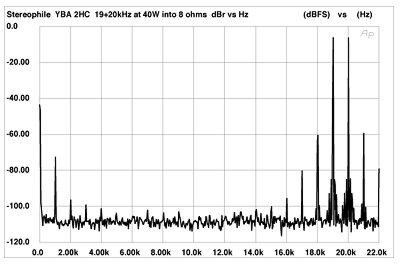 Fig.8 YBA 2 HC, HF intermodulation spectrum, DC-22kHz, 19+20kHz at 40W into 8 ohms (linear frequency scale).
 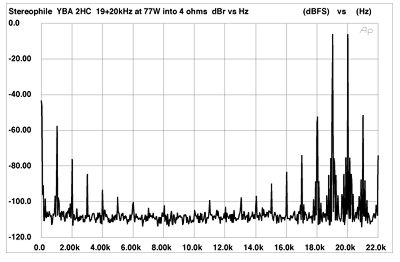 Fig.9 YBA 2 HC, HF intermodulation spectrum, DC-22kHz, 19+20kHz at 77W into 4 ohms (linear frequency scale).
The YBA 2 HC's maximum power delivery (fig.10) indicates that the amplifier will deliver a fair amount of power, more than its specification would suggest: 110W into 8 ohms (20.4dBW, footnote 1) and 190W into 4 ohms (19.8dBW) at the 1% THD point. Into 2 ohms, the 5A fuse in series with the YBA's output blew at 201.7W (17dBW), a power level with a THD+noise content of 0.77%. Getting there.
Fig.9 YBA 2 HC, HF intermodulation spectrum, DC-22kHz, 19+20kHz at 77W into 4 ohms (linear frequency scale).
The YBA 2 HC's maximum power delivery (fig.10) indicates that the amplifier will deliver a fair amount of power, more than its specification would suggest: 110W into 8 ohms (20.4dBW, footnote 1) and 190W into 4 ohms (19.8dBW) at the 1% THD point. Into 2 ohms, the 5A fuse in series with the YBA's output blew at 201.7W (17dBW), a power level with a THD+noise content of 0.77%. Getting there. 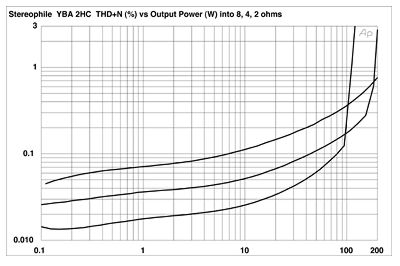 Fig.10 YBA 2 HC, distortion vs output power into (from bottom to top): 8 ohms, 4 ohms, and 2 ohms. I wanted to examine some aspects of the YBA 2 HC's measured performance in more detail, but at this point in the testing, after replacing the 5A output fuse, I inadvertently destroyed one of the amplifier's channels. I reloaded the Audio Precision's IM test procedure but unfortunately forgot that the test load was still set to 2 ohms. In the 30 seconds it took me to realize that I was driving the amplifier's channel A into clipping into 2 ohms with a combination of 19 and 20kHz tones, the AC fuse in the rear-panel IEC connector blew, accompanied by the unforgettable smell of torched electronic components. When I replaced the fuse, it blew again; a quick check with a multimeter revealed that at least one of the channel A output devices was now behaving like a straight piece of wire without gain.
Other than to curse Murphy's Law for ensuring that the transistors had given their lives for the survival of the output fuse, there wasn't a lot I could do. The amplifier was not at fault—the combination of high frequencies, high levels, and a 2 ohm load isn't something that occurs in the wild. Luckily I had finished all my auditioning, but the mishap reminded me that this is why high-power amplifier testing is always best left to the very end of the loan period.—John Atkinson Footnote 1: The reference for Stereophile's dBW ratings is the voltage that gives rise to 1W into 8 ohms power. This is equivalent to 2W into 4 ohms and 4W into 2 ohms. A perfect amplifier would therefore have the same dBW rating into any load—an easy paradigm to grasp. Note that we don't hold the wall voltage constant in our measurements, because we believe this is more accurately reflective of the situation in our readers' homes.—John Atkinson
Fig.10 YBA 2 HC, distortion vs output power into (from bottom to top): 8 ohms, 4 ohms, and 2 ohms. I wanted to examine some aspects of the YBA 2 HC's measured performance in more detail, but at this point in the testing, after replacing the 5A output fuse, I inadvertently destroyed one of the amplifier's channels. I reloaded the Audio Precision's IM test procedure but unfortunately forgot that the test load was still set to 2 ohms. In the 30 seconds it took me to realize that I was driving the amplifier's channel A into clipping into 2 ohms with a combination of 19 and 20kHz tones, the AC fuse in the rear-panel IEC connector blew, accompanied by the unforgettable smell of torched electronic components. When I replaced the fuse, it blew again; a quick check with a multimeter revealed that at least one of the channel A output devices was now behaving like a straight piece of wire without gain.
Other than to curse Murphy's Law for ensuring that the transistors had given their lives for the survival of the output fuse, there wasn't a lot I could do. The amplifier was not at fault—the combination of high frequencies, high levels, and a 2 ohm load isn't something that occurs in the wild. Luckily I had finished all my auditioning, but the mishap reminded me that this is why high-power amplifier testing is always best left to the very end of the loan period.—John Atkinson Footnote 1: The reference for Stereophile's dBW ratings is the voltage that gives rise to 1W into 8 ohms power. This is equivalent to 2W into 4 ohms and 4W into 2 ohms. A perfect amplifier would therefore have the same dBW rating into any load—an easy paradigm to grasp. Note that we don't hold the wall voltage constant in our measurements, because we believe this is more accurately reflective of the situation in our readers' homes.—John Atkinson
Fig.8 YBA 2 HC, HF intermodulation spectrum, DC-22kHz, 19+20kHz at 40W into 8 ohms (linear frequency scale). Fig.9 YBA 2 HC, HF intermodulation spectrum, DC-22kHz, 19+20kHz at 77W into 4 ohms (linear frequency scale). Fig.10 YBA 2 HC, distortion vs output power into (from bottom to top): 8 ohms, 4 ohms, and 2 ohms. I wanted to examine some aspects of the YBA 2 HC's measured performance in more detail, but at this point in the testing, after replacing the 5A output fuse, I inadvertently destroyed one of the amplifier's channels. I reloaded the Audio Precision's IM test procedure but unfortunately forgot that the test load was still set to 2 ohms. In the 30 seconds it took me to realize that I was driving the amplifier's channel A into clipping into 2 ohms with a combination of 19 and 20kHz tones, the AC fuse in the rear-panel IEC connector blew, accompanied by the unforgettable smell of torched electronic components. When I replaced the fuse, it blew again; a quick check with a multimeter revealed that at least one of the channel A output devices was now behaving like a straight piece of wire without gain.