Sidebar 3: Measurements
I used DRA Labs' MLSSA system and a calibrated DPA 4006 microphone to measure the Vanatoo Transparent One Encore's frequency response in the farfield, and an Earthworks QTC-40 microphone for the nearfield responses. Except where noted below, all the testing was done using the speaker's 3.5mm analog input.
As the Transparent One has digital inputs, I used Apple's USB Prober utility to examine the USB input. This identified the speaker as "Vanatoo T1E" from "Vanatoo," with the serial number string "CTUA170405." The USB port operated in the isochronous adaptive mode, which allows the source to control the clocking of the data. This is generally felt to be less optimal than the isochronous asynchronous mode, where the DAC acts as the master clock. Apple's AudioMIDI utility revealed that, via USB, the Vanatoo accepted 16- and 24-bit sampled at all rates up to 96kHz; its TosLink and coaxial S/PDIF inputs accepted PCM data sampled up to 96kHz.
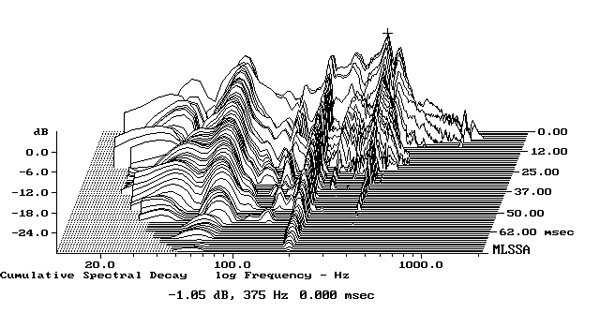
The analog input impedance appeared to be close to 10k ohms. Like other active loudspeakers using digital-domain crossovers, there was a delay when the Vanatoo was fed an analog signal, of around 5.4ms. There is no convention for specifying the sensitivity of a powered speaker, but when I set the speaker's volume control to its maximum and fed the speaker's analog input pink noise at 300mV, the resultant SPL was 90.7dB(B) at 50" on the tweeter axis. Pink noise at –20dBFS fed to the optical digital input gave an SPL of 89.1dB(B) at the same distance. The Vanatoo has sufficient gain to meet all needs. The enclosure seemed relatively inert with the knuckle-rap test, though when I investigated its vibrational behavior with a plastic-tape accelerometer I found relatively strong resonant modes at 242Hz and 375Hz on the sidewalls and top panel (fig.1).
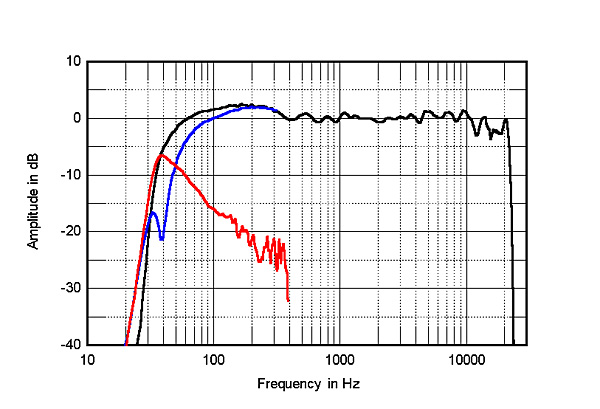 The black trace above 300Hz in fig.2 shows the Transparent One Encore's farfield response, averaged across a 30° horizontal window centered on the tweeter axis. It is superbly flat and even up to 10kHz, with the top audio octave slightly shelved down. The speaker's output drops like a stone above 22kHz, suggesting that the Vanatoo digitizes its analog input with a 48kHz sample rate. When I repeated this test with data sampled at 96kHz fed to the optical S/PDIF input, the response still died above 22kHz; the Vanatoo's DSP appears to be limited to a sample rate of 48kHz. The Treble control offers a boost or cut of up to 10dB at 20kHz; the Bass control offers a boost or cut of up to 8dB at 70Hz. Both controls had a corner frequency of 800Hz.
The plot of the Vanatoo's horizontal dispersion (fig.3) indicates a well-controlled radiation pattern, with evenly spaced contour lines that indicate stable stereo imaging. However, a slight gully develops off-axis at the top of the woofer's passband, which might make the Vanatoo sound a touch bright in small rooms or rooms that are not well-damped. In the vertical plane (fig.4), a suckout in the crossover region appears well above or below the tweeter axis, but the Transparent One Encore's balance will otherwise not change appreciably over quite a wide vertical window.
The black trace above 300Hz in fig.2 shows the Transparent One Encore's farfield response, averaged across a 30° horizontal window centered on the tweeter axis. It is superbly flat and even up to 10kHz, with the top audio octave slightly shelved down. The speaker's output drops like a stone above 22kHz, suggesting that the Vanatoo digitizes its analog input with a 48kHz sample rate. When I repeated this test with data sampled at 96kHz fed to the optical S/PDIF input, the response still died above 22kHz; the Vanatoo's DSP appears to be limited to a sample rate of 48kHz. The Treble control offers a boost or cut of up to 10dB at 20kHz; the Bass control offers a boost or cut of up to 8dB at 70Hz. Both controls had a corner frequency of 800Hz.
The plot of the Vanatoo's horizontal dispersion (fig.3) indicates a well-controlled radiation pattern, with evenly spaced contour lines that indicate stable stereo imaging. However, a slight gully develops off-axis at the top of the woofer's passband, which might make the Vanatoo sound a touch bright in small rooms or rooms that are not well-damped. In the vertical plane (fig.4), a suckout in the crossover region appears well above or below the tweeter axis, but the Transparent One Encore's balance will otherwise not change appreciably over quite a wide vertical window.
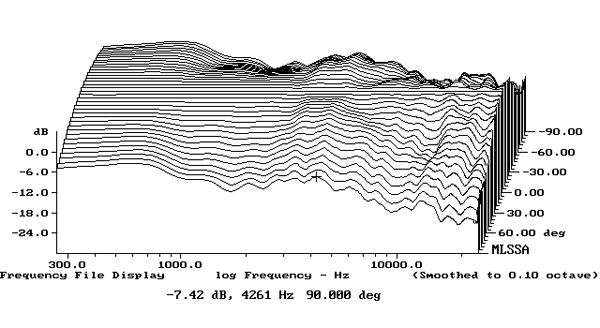
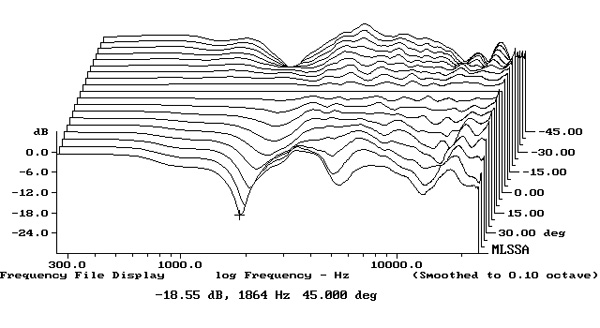
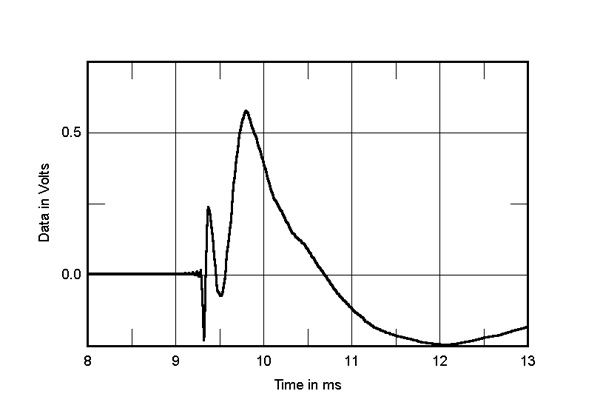
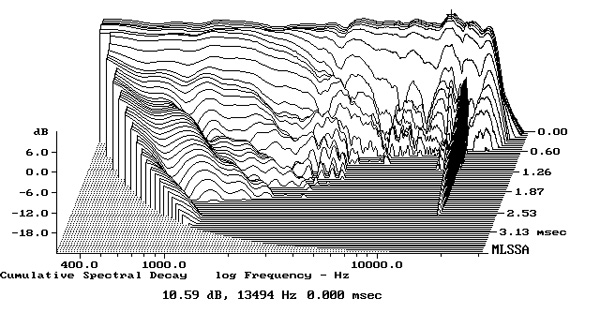
Fig.1 Vanatoo Transparent One Encore, cumulative spectral-decay plot calculated from output of accelerometer fastened to center of top panel (MLS driving voltage to speaker, 300mV; measurement bandwidth, 2kHz).
The output of the Vanatoo's woofer, measured in the nearfield, is shown as the blue trace in fig.2. The minimum-motion notch in its output lies at 39Hz, indicating that this is the tuning frequency of the passive radiator on the rear panel. The passive radiator's output (red trace) peaks between 30 and 90Hz, and both this and the woofer's low-frequency output roll off much more quickly than the 12dB/octave slope that is usual in a reflex design. The complex sum of the nearfield woofer and radiator responses (fig.2, black trace below 300Hz) therefore rolls off with a sixth-order, 36dB/octave slope below the tuning frequency, presumably to protect the small woofer against overload.
Fig.2 Vanatoo Transparent One Encore, anechoic response on tweeter axis at 50", averaged across 30° horizontal window and corrected for microphone response, with the nearfield woofer (blue) and port (red) responses and their complex sum (black), respectively plotted below 300Hz, 400Hz, and 300Hz.
Fig.3 Vanatoo Transparent One Encore, lateral response family at 50", normalized to response on tweeter axis, from back to front: differences in response 90–5° off axis, reference response, differences in response 5–90° off axis.
Fig.4 Vanatoo Transparent One Encore, vertical response family at 50", normalized to response on tweeter axis, from back to front: differences in response 45–5° off axis, reference response, differences in response 5–45° off axis.
In the time domain, the Vanatoo's step response (fig.5) reveals that the tweeter is connected in inverted acoustic polarity, the woofer in positive polarity. The decay of the tweeter's step smoothly blends into the start of the woofer's step, implying optimal crossover design, but the speaker's DSP is not used to render their outputs time-coincident. You can just see in this graph the acausal ringing of the A/D converter's anti-aliasing filter before the start of the tweeter's negative-going step. The Vanatoo's cumulative spectral-decay plot (fig.6) was superbly clean.
Fig.5 Vanatoo Transparent One Encore, step response on tweeter axis at 50" (5ms time window, 30kHz bandwidth).
Fig.6 Vanatoo Transparent One Encore, cumulative spectral-decay plot on tweeter axis at 50" (0.15ms risetime).
Vanatoo's Transparent One Encore offers excellent measured performance.—John Atkinson