Sidebar 3: Measurements
I measured the PS Audio Stellar M700 with my Audio Precision SYS2722 system (see the January 2008 "As We See It"). Before performing any tests of an amplifier, I usually precondition it by running it at one-third the clipping power into 8 ohms for an hour. As the Stellar M700 has a class-D output stage, this was not necessary. But I did take the temperature of its case: the top panel was slightly warm, at 80°F (30°C). The voltage gain into 8 ohms was 30.5dB for both the balanced and unbalanced inputs, and the M700 preserved absolute polarity (ie, was non-inverting) for both inputs, meaning that the XLR jack is wired with pin 2 hot.
The unbalanced input impedance was close to the specified 50k ohms, measuring 47k ohms at low and middle frequencies, and dropping inconsequentially to 35k ohms at the top of the audioband. The balanced input impedance was twice the unbalanced impedance, as expected. The output impedance (including 6' of speaker cable) was low, at 0.1 ohm at 20Hz and 1kHz. However, the output impedance was actually negative at the top of the audioband, perhaps due to the behavior of the necessary low-pass filter. The action of this filter can be seen in fig.1, which rolls off the output very sharply above 50kHz, with the actual frequency of the response "knee" dependent on the load impedance. The variation in frequency response into our standard simulated loudspeaker was small, at less than ±0.1dB (fig.1, gray trace), but there is an implication of an ultrasonic resonance developing with loads of higher impedance. This gave rise to a small degree of overshoot and one cycle of damped ringing with a 10kHz squarewave (fig.2).
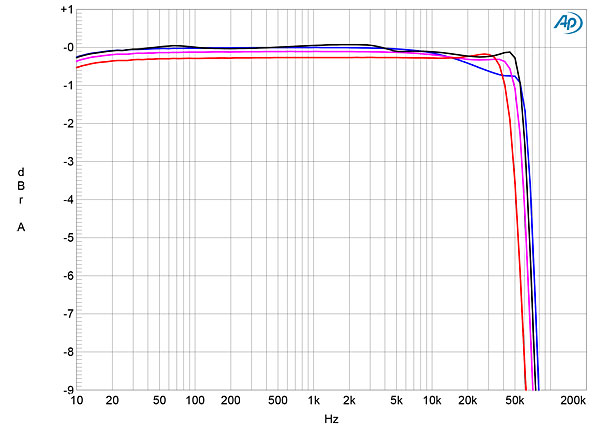
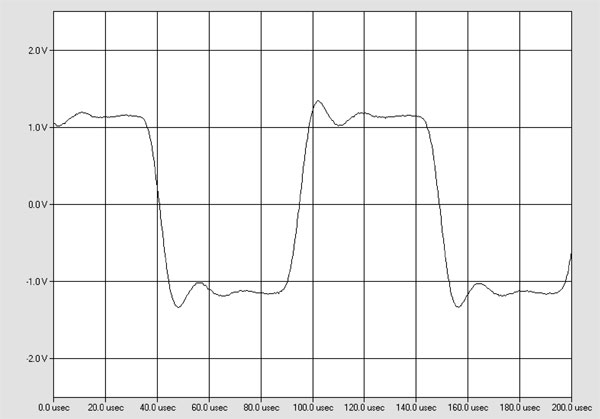
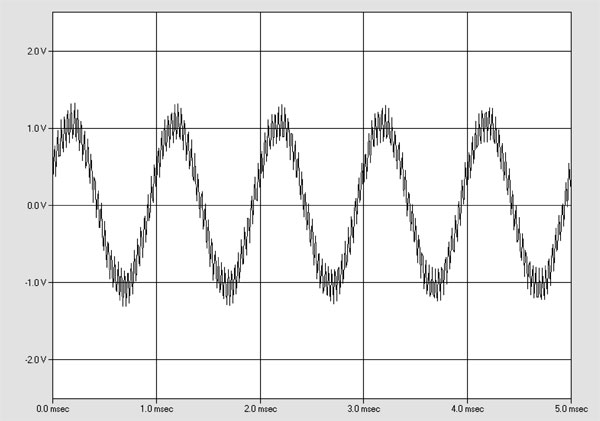
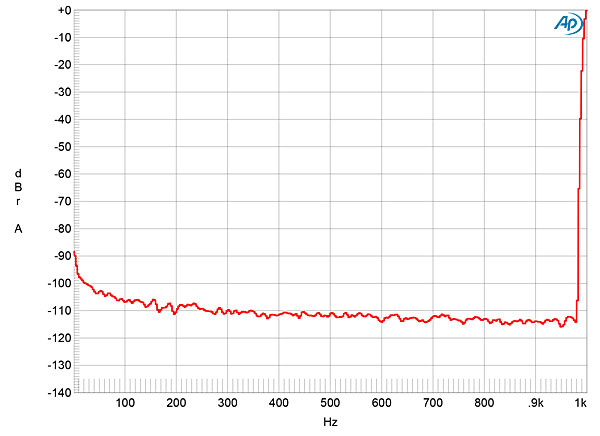
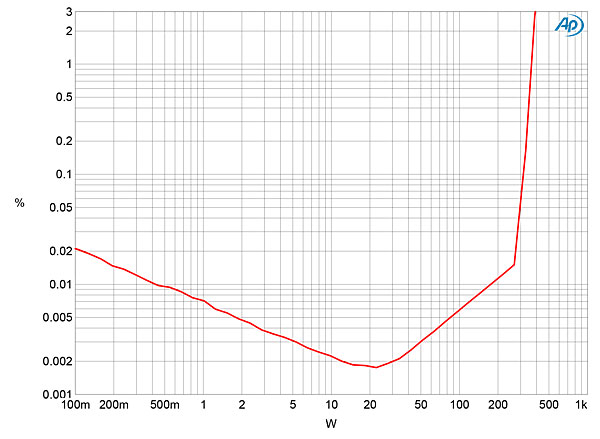
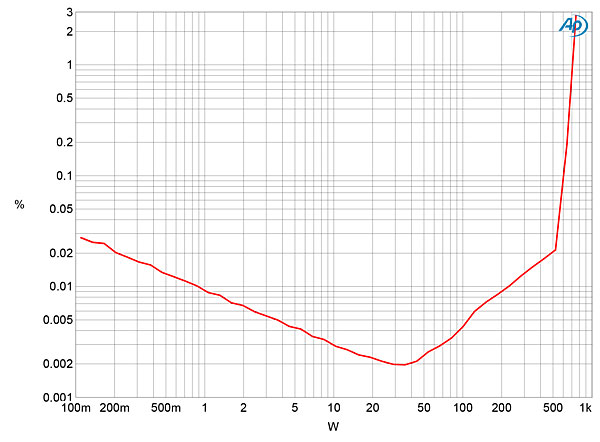
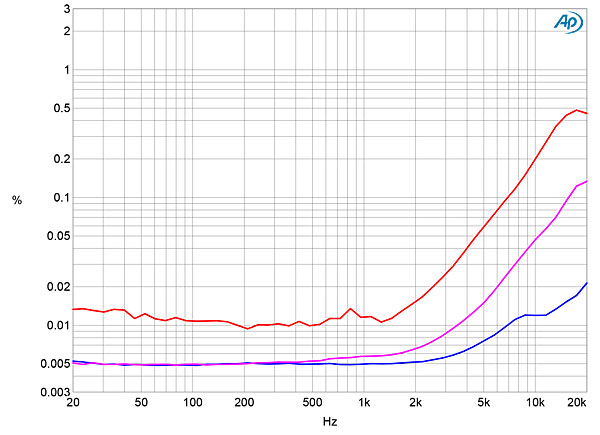
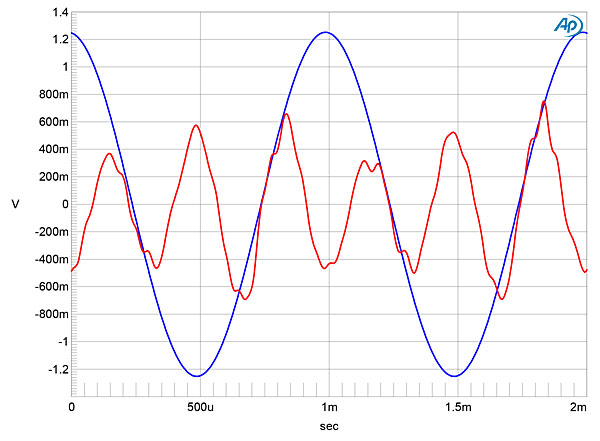
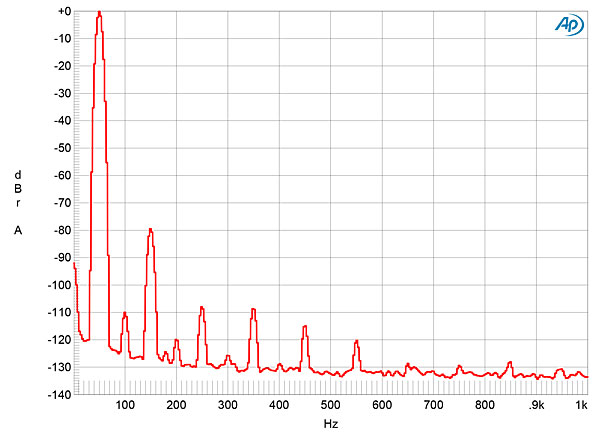
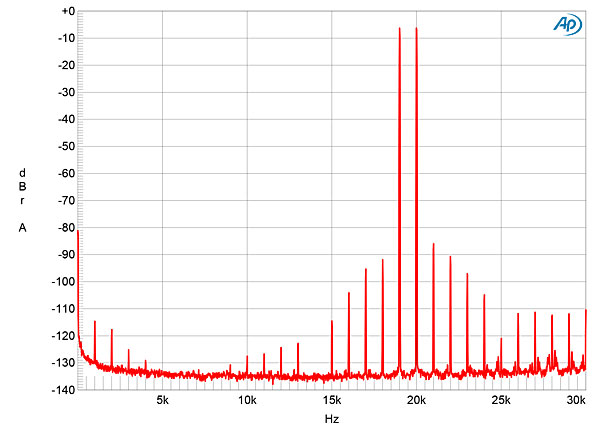
Fig.1 PS Audio Stellar M700, frequency response at 2.83V into: simulated loudspeaker load (gray), 8 ohms (blue), 4 ohms (magenta), 2 ohms (red) (0.5dB/vertical div.).
Fig.2 PS Audio Stellar M700, small-signal, 10kHz squarewave into 8 ohms with AP AUX-0025 low-pass filter.
As the M700 is a class-D design, all measurements were taken with Audio Precision's auxiliary AUX-0025 passive low-pass filter, which eliminates noise above 200kHz that might otherwise overload the SYS2722's input circuitry. Without the filter, 877mV of ultrasonic noise was present at the speaker terminals, with a center frequency of 465kHz. (This is very similar to the Peachtree Audio nova300, which Art Dudley reviewed in June 2017 and which also uses an ICEpower module.) This noise can be seen riding on the waveform of a 1kHz sinewave when I didn't use the filter (fig.3). With the Audio Precision filter, the Stellar M700 produced relatively low levels of noise in the audioband, with no trace of AC-supply harmonics (fig.4). The unweighted, wideband signal/noise ratio was 66dB, improving to a respectable 81.7dB when the measurement bandwidth was restricted to the audioband, and to 84dB when A-weighted.
Fig.3 PS Audio Stellar M700, small-signal 1kHz waveform into 8 ohms without AP AUX-0025 low-pass filter.
Fig.4 PS Audio Stellar M700, spectrum of 1kHz sinewave, DC–1kHz, at 1W into 8 ohms (linear frequency scale).
We define clipping as when the percentage of THD+noise in the amplifier's output reaches 1%, and fig.5 indicates that the M700 slightly exceeds its specified power of 350W into 8 ohms (25.44dBW). Into 4 ohms (fig.6), the M700 clips at precisely the specified 700W (25.44dBW). Fig.7 plots the THD+N percentage against frequency at a level at which I could be sure I was looking at distortion rather than noise: 20V, which is equivalent to 50W into 8 ohms, 100W into 4 ohms, and 200W into 2 ohms. The THD is very low at low and middle frequencies into 8 and 4 ohms, but does rise into 2 ohms and at high frequencies. The distortion signature primarily comprises the relatively benign third harmonic (fig.8) and lies at just –80dB (0.01%), even at 200W into 4 ohms (fig.9). Intermodulation distortion at the same high power was also very low (fig.10).
Fig.5 PS Audio Stellar M700, distortion (%) vs 1kHz continuous output power into 8 ohms.
Fig.6 PS Audio Stellar M700, distortion (%) vs 1kHz continuous output power into 4 ohms.
Fig.7 PS Audio Stellar M700, THD+N (%) vs frequency at 20V into: 8 ohms (blue), 4 ohms (magenta), 2 ohms (red).
Fig.8 PS Audio Stellar M700, 1kHz waveform at 100W into 8 ohms, 0.0063% THD+N (blue); distortion and noise waveform with fundamental notched out (red, not to scale).
Fig.9 PS Audio Stellar M700, spectrum of 50Hz sinewave, DC–1kHz, at 200W into 4 ohms (linear frequency scale).
Fig.10 PS Audio Stellar M700, HF intermodulation spectrum, DC–30kHz, 19+20kHz at 200W peak into 4 ohms (linear frequency scale).
PS Audio's Stellar M700 packs a lot of power into a small, cool-running case, and offers respectable measured performance.—John Atkinson