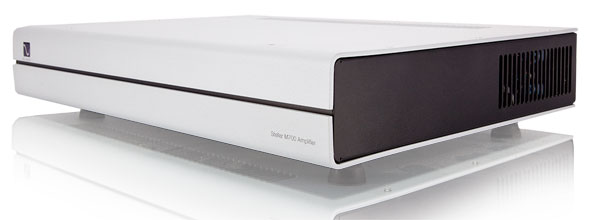
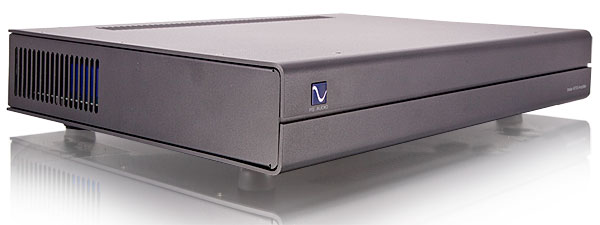
The Stellar M700 had very little sound of its own, and nothing that I could describe as a distinct class-D character. It just sounded like, well, a really good amplifier: clean, transparent, detailed, and, within the constraints of the rest of the system and the recording itself, providing faithful reproductions of the recordings.
The word that occurred to me when I first heard the M700 was smooth—an easy-on-the-ears quality that encouraged extended listening sessions. The sound of tube amplifiers is often described as smooth, and tubelike wouldn't be entirely inappropriate as a description of the M700's sound. Paul McGowan told me that the voicing of the M700 involved comparisons with PS Audio's flagship amplifier, the BHK Signature 300, whose input circuitry uses tubes. While I wouldn't mistake the sound of the M700 for, say, that of my tubed McIntosh Laboratory MC275LE, there was at least a hint of the sound of tubes in the M700's sonic character.
Another adjective that occurred to me was balanced, which is also a characteristic of my speakers, Monitor Audio's Platinum PL300 IIs. By this I mean that the Stellar M700 didn't emphasize any part of the audioband—its sound was neither too bright nor too soft—and that it revealed musical detail without sounding clinical: that is, the sound was neither too forward nor too laid-back. The various percussion instruments in Ana Caram's "Viola Fora de Moda," from the Chesky Records Jazz Sampler & Audiophile Test Compact Disc, Vol.1 (Chesky JD37), rang out freely, but without being too in my face—and when Caram begins to sing, her voice was very much present, with no undue emphasis of sibilants. Low bass in heavily scored orchestral music, such as Dance of the Tumblers, wasn't as clean and extended as through the Theta Prometheus, but this was evident only in direct comparisons. The M700s were able to drive the Monitor Platinums to volume levels as high as I could tolerate without amplifier or speakers ever sounding distressed.
 Comparisons
Audio Alchemy's DPA-1M might be considered a natural competitor to the Stellar M700: like the PS Audio, it has a class-D output stage, it's relatively compact and light, and it has an impressive audiophile pedigree. Alas, the review samples of the DPA-1M were long gone by the time the Stellar M700s arrived, so I couldn't do a direct comparison—and, in the interim, my system had changed significantly: PS Audio PerfectWave CD transport replaced by PSA's DirectStream Memory Player; the DirectStream DAC updated to the latest Huron operating system; and the Wilson Audio Specialties Sabrina speakers replaced by the Monitor Audio Platinum PL300 IIs. But I did still have the same pair of Theta Digital Prometheus monoblocks that had served as references for my review of the Audio Alchemy. The Prometheus is another class-D amplifier, but for its $12,000/pair price it delivers a higher level of sound quality. In his review, Larry Greenhill described the Prometheus's sound as being "totally addictive," and strongly recommended its inclusion in Class A of "Recommended Components" (where it now resides). In level-matched comparisons between the DPA-1Ms and the Prometheuses, I found the Thetas' sound to have more fine-grained detail, more air as well as more body, low bass that went deeper, more startling high-level dynamics, and more three-dimensionality. Nonetheless, the differences, while significant, required careful listening to identify.
With the PS Audios sitting side by side, each on its own stand, and playing a variety of familiar music, again with levels matched, I felt that their sound approached that of the Thetas even more closely than had the Audio Alchemys. The Thetas retained their superiority in the areas mentioned in discussing the AAs, but now the differences were very small indeed. The Thetas' margin of superiority was further narrowed when I inserted IsoAcoustics Orea Audio Equipment Isolators between the PS Audios and the stands.
 At $3990/pair, the Audio Alchemy DPA-1M represents good value. However, the PS Audio Stellar M700, at $2998/pair, has as high or higher specified power output than the DPA-1M (350W vs 325W into 8 ohms, 700W vs 400W into 4 ohms), and so offers even more bang for the buck.
Conclusions
At $3990/pair, the Audio Alchemy DPA-1M represents good value. However, the PS Audio Stellar M700, at $2998/pair, has as high or higher specified power output than the DPA-1M (350W vs 325W into 8 ohms, 700W vs 400W into 4 ohms), and so offers even more bang for the buck.
Conclusions
DirectStream DAC, DirectStream Memory Player, DirectStream Junior DAC, Sprout integrated amplifier, BHK 250 stereo amplifier, BHK Mono 300 amplifier, BHK Signature preamplifier—PS Audio has been on a roll. That roll continues with the Stellar M700 power amplifier. I have had nothing but good experience with PS Audio products; still, with the Stellar M700, my expectations were exceeded. Having little sound of its own, the M700 delivered well-balanced reproduction that was always faithful to the music.
Set up side by side rather than stacked, and sitting on IsoAcoustics Orea Audio Equipment Isolators, the Stellar M700s came ever so close to matching the sound of my high-end reference monoblocks, Theta Digital's Prometheuses—which are ranked Class A in "Recommended Components" and, at $12,000/pair, cost four times as much as the PS Audios. The Stellar M700 is an outstanding bargain.
ComparisonsAudio Alchemy's DPA-1M might be considered a natural competitor to the Stellar M700: like the PS Audio, it has a class-D output stage, it's relatively compact and light, and it has an impressive audiophile pedigree. Alas, the review samples of the DPA-1M were long gone by the time the Stellar M700s arrived, so I couldn't do a direct comparison—and, in the interim, my system had changed significantly: PS Audio PerfectWave CD transport replaced by PSA's DirectStream Memory Player; the DirectStream DAC updated to the latest Huron operating system; and the Wilson Audio Specialties Sabrina speakers replaced by the Monitor Audio Platinum PL300 IIs. But I did still have the same pair of Theta Digital Prometheus monoblocks that had served as references for my review of the Audio Alchemy. The Prometheus is another class-D amplifier, but for its $12,000/pair price it delivers a higher level of sound quality. In his review, Larry Greenhill described the Prometheus's sound as being "totally addictive," and strongly recommended its inclusion in Class A of "Recommended Components" (where it now resides). In level-matched comparisons between the DPA-1Ms and the Prometheuses, I found the Thetas' sound to have more fine-grained detail, more air as well as more body, low bass that went deeper, more startling high-level dynamics, and more three-dimensionality. Nonetheless, the differences, while significant, required careful listening to identify.
At $3990/pair, the Audio Alchemy DPA-1M represents good value. However, the PS Audio Stellar M700, at $2998/pair, has as high or higher specified power output than the DPA-1M (350W vs 325W into 8 ohms, 700W vs 400W into 4 ohms), and so offers even more bang for the buck.
ConclusionsDirectStream DAC, DirectStream Memory Player, DirectStream Junior DAC, Sprout integrated amplifier, BHK 250 stereo amplifier, BHK Mono 300 amplifier, BHK Signature preamplifier—PS Audio has been on a roll. That roll continues with the Stellar M700 power amplifier. I have had nothing but good experience with PS Audio products; still, with the Stellar M700, my expectations were exceeded. Having little sound of its own, the M700 delivered well-balanced reproduction that was always faithful to the music.