

To examine the behavior of the Devialet Astra's digital inputs, I used optical S/PDIF data, as well as network data played with Roon and USB data sourced from my MacBook Pro via the amplifier's USB-C port. The TosLink input locked to data sampled at 192kHz, and the AudioMIDI utility revealed that the Astra's USB port accepted 16- and 24-bit integer data sampled at all rates from 44.1kHz to 384kHz. Apple's USB Prober utility identified the processor as "Devialet Astra" from "Devialet" and indicated that the USB port operated in the optimal isochronous asynchronous mode.
The digital inputs preserved absolute polarity and with the volume control set to the maximum, the output level with a 1kHz tone at –30dBFS was 11.35V from the loudspeaker output into 8 ohms. This is 10.1dB below the clipping voltage into 8 ohms. Setting the volume control to "+0.0dB," the output into 8 ohms with a full-scale 1kHz tone was just below clipping. The Astra's digital input gain architecture is optimal. I continued the digital input testing at this volume control setting to avoid overloading the amplifier's output stage.
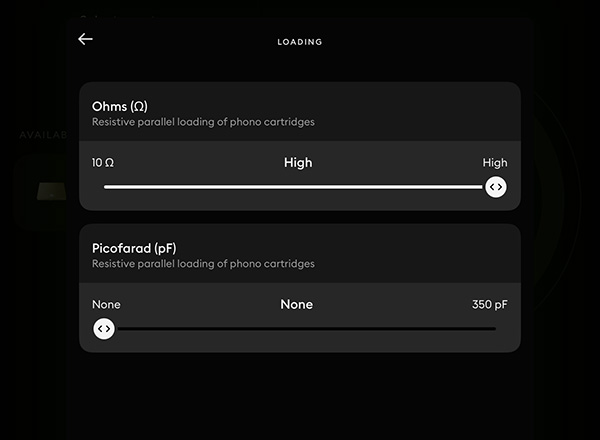 I performed the Devialet's phono input testing with a wire connecting one of the ground terminals on the amplifier's rear panel to the Audio Precision's chassis ground. The Astra's phono input settings can be automatically optimized for many different cartridges. If a cartridge is not selected, the phono input's resistive and capacitive loads, gain, and equalization can be set manually with the Devialet app. With the input capacitance set to "0pF," the input impedance set to "High" was 45k ohms from 20Hz to 20kHz. Set to "200," the input impedance was 201 ohms and set to "50," it was 52 ohms, both values consistent from 20Hz to 20kHz.
With the volume control set to the maximum and the gain set to "10mVrms Output Level," the gain was 70.9dB from the loudspeaker output into 8 ohms. Set to "5.0mVrms Output Level," the gain was 75.9dB, and set to "1.0mVrms Output Level" it was 89.9dB. These gains are respectively appropriate for moving magnet, high-output moving coil, and low-output moving coil cartridges. I examined the phono input's performance at the loudspeaker output with the volume control set to "+0.0dB" to avoid overloading the amplifier's output stage.
I performed the Devialet's phono input testing with a wire connecting one of the ground terminals on the amplifier's rear panel to the Audio Precision's chassis ground. The Astra's phono input settings can be automatically optimized for many different cartridges. If a cartridge is not selected, the phono input's resistive and capacitive loads, gain, and equalization can be set manually with the Devialet app. With the input capacitance set to "0pF," the input impedance set to "High" was 45k ohms from 20Hz to 20kHz. Set to "200," the input impedance was 201 ohms and set to "50," it was 52 ohms, both values consistent from 20Hz to 20kHz.
With the volume control set to the maximum and the gain set to "10mVrms Output Level," the gain was 70.9dB from the loudspeaker output into 8 ohms. Set to "5.0mVrms Output Level," the gain was 75.9dB, and set to "1.0mVrms Output Level" it was 89.9dB. These gains are respectively appropriate for moving magnet, high-output moving coil, and low-output moving coil cartridges. I examined the phono input's performance at the loudspeaker output with the volume control set to "+0.0dB" to avoid overloading the amplifier's output stage.
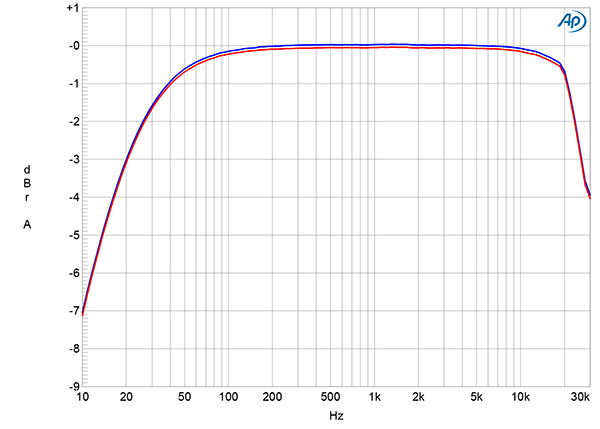
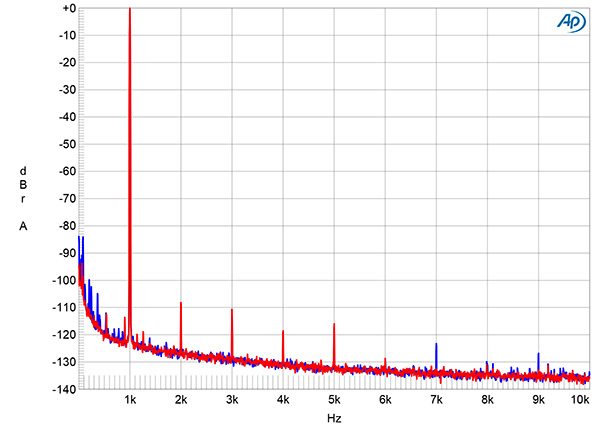
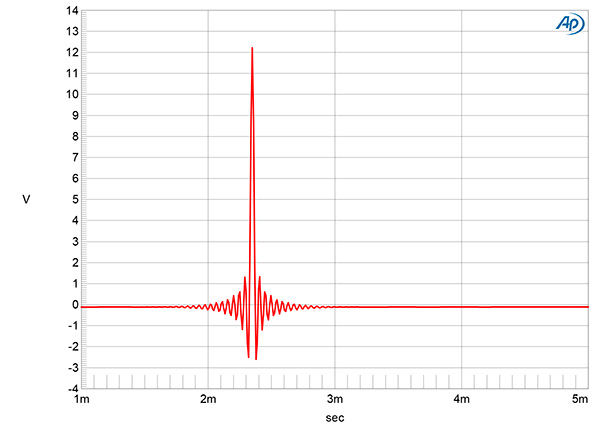
Fig.11 Devialet Astra, digital inputs, impulse response (one sample at 0dBFS, 44.1kHz sampling, 4ms time window).
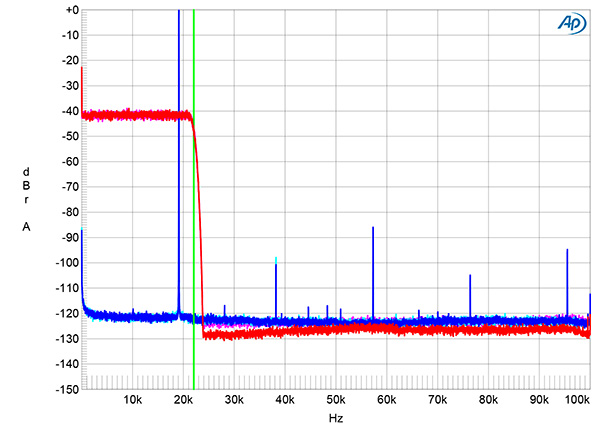
Fig.12 Devialet Astra, digital inputs, wideband spectrum of white noise at –4dBFS (left channel red, right magenta) and 19.1kHz tone at 0dBFS (left blue, right cyan) with data sampled at 44.1kHz (20dB/vertical div.).
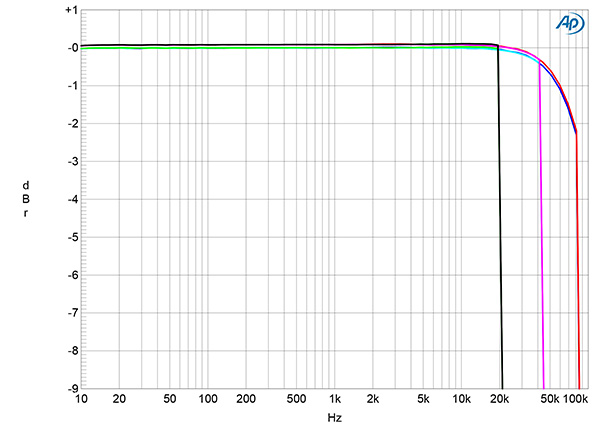
Fig.13 Devialet Astra, digital inputs, frequency response at –12dBFS with data sampled at: 44.1kHz (left channel green, right gray), 96kHz (left cyan, right magenta), and 192kHz (left blue, right red) (1dB/vertical div.).
The Devialet Astra's reconstruction filter is a long linear-phase type, with symmetrical ringing before and after the single sample at 0dBFS (fig.11). The magenta and red traces in fig.12 show the filter's ultrasonic rolloff with white noise data sampled at 44.1kHz. The traces reach full stop-band attenuation at 24kHz, just above half the sample rate, which is indicated by the vertical green line. The aliased image at 25kHz of a 19.1kHz tone at 0dBFS (cyan, blue) is completely suppressed and the tone's third harmonic is the highest in level, at close to –90dB (0.003%). The digital inputs' frequency response with data sampled at 44.1kHz, 96kHz, and 192kHz, taken at the loudspeaker outputs without the Audio Precision ultrasonic low-pass filter (fig.13), was flat in the audioband with a sharp rolloff just below half of each sample rate.
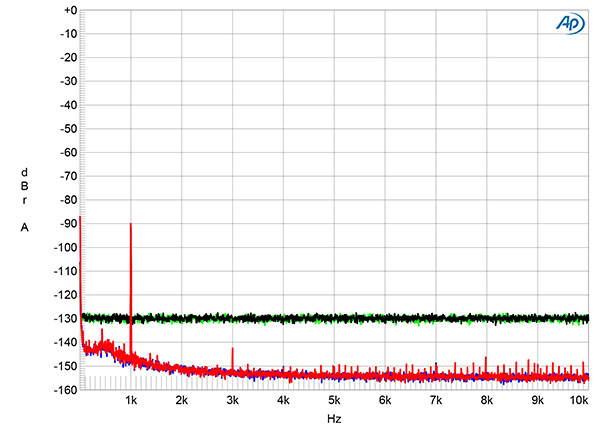
Fig.14 Devialet Astra, digital inputs, spectrum with noise and spuriae of dithered 1kHz tone at –90dBFS with: 16-bit data (left channel green, right gray), 24-bit data (left blue, right red) (20dB/vertical div.).
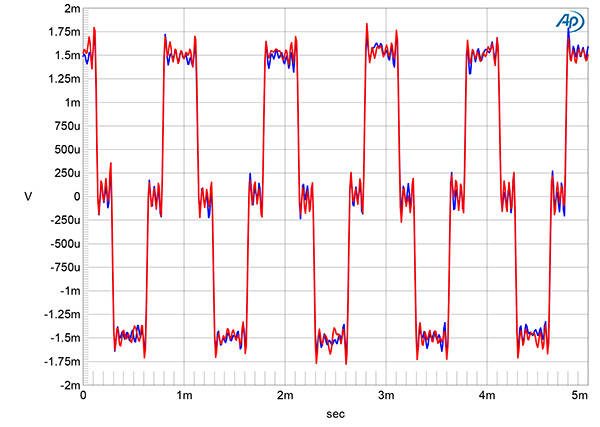
Fig.15 Devialet Astra, digital inputs, waveform of undithered 1kHz sinewave at –90.31dBFS, 16-bit data (left channel blue, right red).
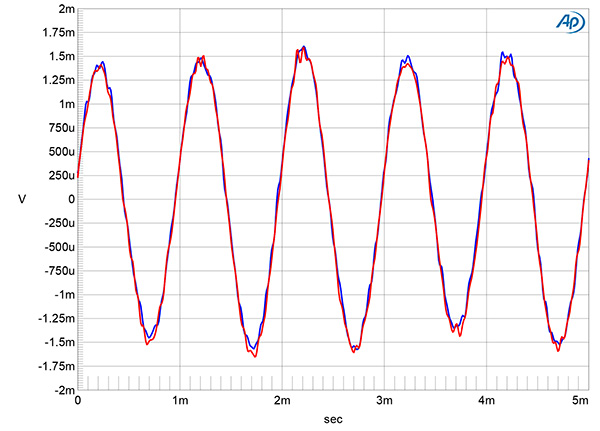
Fig.16 Devialet Astra, digital inputs, waveform of undithered 1kHz sinewave at –90.31dBFS, 24-bit data (left channel blue, right red).
An increase in bit depth from 16 to 24, with dithered data representing a 1kHz tone at –90dBFS and the volume control set to "+0.0dB," dropped the Devialet Astra's noisefloor above 1kHz by 24dB (fig.14), which implies a superb measured resolution of 20 bits. With undithered data representing a tone at exactly –90.31dBFS, the waveform was symmetrical, with negligible DC offset, and the three DC voltage levels described by the data were clearly defined (fig.15). With undithered 24-bit data (fig.16), the Devialet Astra output a clean sinewave.
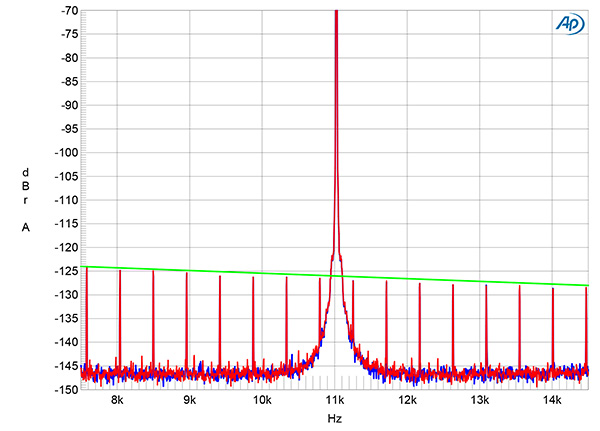
Fig.17 Devialet Astra, high-resolution jitter spectrum of analog output signal, 11.025kHz at –6dBFS, sampled at 44.1kHz with LSB toggled at 229Hz: 16-bit TosLink S/PDIF data (left channel blue, right red). Center frequency of trace, 11.025kHz; frequency range, ±3.5kHz.
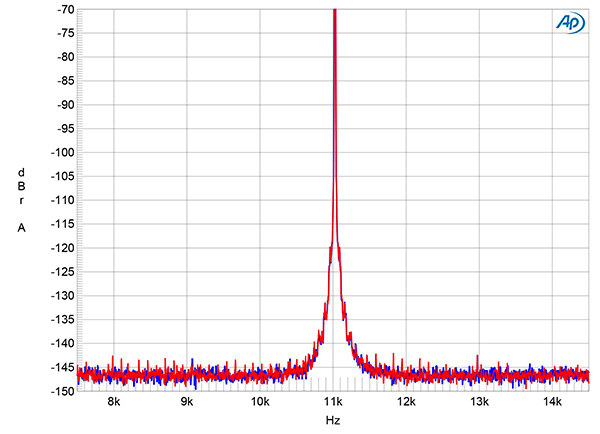
Fig.18 Devialet Astra, high-resolution jitter spectrum of analog output signal, 11.025kHz at –6dBFS, sampled at 44.1kHz with LSB toggled at 229Hz: 24-bit TosLink S/PDIF data (left channel blue, right red). Center frequency of trace, 11.025kHz; frequency range, ±3.5kHz.
When the Devialet Astra was fed 16-bit optical, USB, and network 16-bit J-Test data, the odd-order harmonics of the undithered low-frequency, LSB-level squarewave all lay at the correct levels, shown by the green line in fig.17. The central spectral spike that represents the high-level tone at one-quarter the sample rate was slightly broadened at its base, due to the presence of low-level, low-frequency random noise. This was also present with 24-bit J-Test data (fig.18).
I performed the Devialet's phono input testing with a wire connecting one of the ground terminals on the amplifier's rear panel to the Audio Precision's chassis ground. The Astra's phono input settings can be automatically optimized for many different cartridges. If a cartridge is not selected, the phono input's resistive and capacitive loads, gain, and equalization can be set manually with the Devialet app. With the input capacitance set to "0pF," the input impedance set to "High" was 45k ohms from 20Hz to 20kHz. Set to "200," the input impedance was 201 ohms and set to "50," it was 52 ohms, both values consistent from 20Hz to 20kHz.
Fig.19 Devialet Astra, phono input, response with "RIAA 1976" correction (left channel blue, right red) (1dB/vertical div.).
The phono input preserved absolute polarity. I set the Astra's RIAA equalization to "RIAA 1976," which was what I understood OB had used for his auditioning. The response was accurate, with very close channel matching (fig.19). The high frequencies were down by 1dB at 20kHz and even with the "Bass Reducer" control turned off, the low frequencies were down by 1dB at 40Hz and by 7dB at 10Hz.
The Devialet Astra phono stage's unweighted, wideband S/N ratio, measured with the input shorted to ground, the volume control set to the maximum, and the gain set to "10.0mVrms Output Level," was a superb 86.4dB in both channels ref. 1kHz at the standard MM level of 5mV. Restricting the measurement bandwidth to 22Hz–22kHz increased the ratio by 2dB, while the A-weighted ratio was 93.2dB. The S/N ratios with the gain set to "1.0mVrms Output Level," ref. 1kHz at 500µV, were around 20dB lower, but this is still sufficiently low noise for use with low-output MC cartridges.
Fig.20 Devialet Astra, phono input, spectrum of 1kHz sinewave, DC–10kHz, at 10mV input (left channel blue, right red) (1dB/vertical div.).
I measured the Devialet Astra phono input's overload margins with the volume control set to "–20dB" to make sure I was looking at actual input overload rather than output stage clipping. The margins at 1kHz with the gain set to "10.0mVrms Output Level" were an excellent 19.65dB ref. 1kHz at 5mV and with the gain set to "1.0mVrms Output Level," ref. 500µV. Harmonic distortion (fig.20) and intermodulation distortion via the phono input were as low in level as they had been with the line input.
Paul Miller, editor of Stereophile's sister magazine Hi-Fi News, noted when he measured the amplifier for that magazine's August 2025 issue that the Devialet Astra "easily meets or exceeds ... its performance parameters." Overall, I found that the Astra offered superb measured performance with its line, phono, and digital inputs.—John Atkinson















