It's difficult to put a positive spin on moving. A recent survey ranked it as life's most stressful event, ahead of divorce, losing a job, or becoming a parent. Forty-two percent of respondents said it brought them to tears. Thirteen percent said it was worse than a week in jail.
There's no point in listing the well-documented hassles, humiliations, and expenses involved in changing homes, or point out the ample opportunities for things to go from predictably stressful to memorably horrific. It's the less obvious aspects that strike me as interesting. At the risk of sounding maudlin, I keep coming back to the sudden knowledge that the part of your life spent in your former home is now over and can no longer be rebranded, reimagined, or negotiated with. And then there's the sensation of uprootedness, so similar to grief, that for me manifests as a persistent desire to go home and the subsequent realization that the home I'm yearning to return to is no longer there. The only upside is that this doesn't last forever.
For audiophiles, there's another layer of stress: Moving also means exchanging a familiar sonic environment for an untested one. When I gave up my loft last fall, I was saying goodbye to a listening room that I'd gotten to explore for 13 years. By the end, I knew most of its quirks and had grown to love listening to music in it. It offered the advantages of a really large, open space—first among them the opportunity to play music at near concert volumes and hear it reproduced with dynamics that sometimes approached those of the real thing.
I was also lucky to have found speakers that matched the loft just about perfectly. The Klipsch La Scala AL5s loaded the space in an utterly convincing way and minimized the shortcomings of both the speakers and the room. I experienced the three-and-a-half years I lived with the AL5s as an unbridled lovefest. My audiophile self was profoundly at peace. This fall, helping the freight service guy wheel the boxed-up La Scalas down my hallway and out to his truck felt like a funeral for the happiest chapter of my listening life. Probably not as bad as a week in jail, but still sad.
My new listening space is different in just about every way. It's a 16' × 12' room on the third floor of a Brooklyn row house built in 1907, with parquet floors laid over softwood joists that respond to footfall like a trampoline. Its main function is to be an inviting living room, and it isn't anyone's idea of a perfect listening environment. The right wall is interrupted by two open doorways, the left by three windows. The roughly 9' ceiling is of uneven height. The hi-fi, which sits along one of the short walls, shares the room with a sofa, a dining table and two chairs, two record shelves, a rug, a video projector, lots of framed art, and about a dozen plants. And because I want the room to feel welcoming and warm, I won't be cluttering it with unsightly acoustic treatments. There's lots of work left to be done in figuring out the room's challenges and opportunities.
The La Scalas would have overwhelmed this petite space. But when I began thinking about suitable speakers to replace them, I was stumped. I've always loved the realistic dynamics, startling transients, massive scale, and high sensitivity of good horn speakers ... but horns tend to be large. And I bristled at the prospect of living with a pair of monkey coffins, by which I mean the conventional sort of wooden boxes with their high-excursion woofers, middling sensitivity, and congested dynamics.
Where did this leave me? The smaller horns I considered still seemed too big. I thought about electrostats but was talked out of it by several knowledgeable friends. Same with planars. Then, with relief, I remembered that some of my favorite audio experiences have come from pushing against my preconceptions and being proven mostly wrong.
So I reached out to a friend in Connecticut who has listened to just about everything and eventually settled on speakers from French speaker company Jean-Marie Reynaud. In addition to the large floorstanders he uses in his system, he had a pair of smallish standmounts that were sitting around. And that's how a pair of Reynaud BLISS Jubilés became the first speakers to grace my new, sonically ambiguous dwelling.
 The Jean-Marie Reynaud BLISS Jubilé
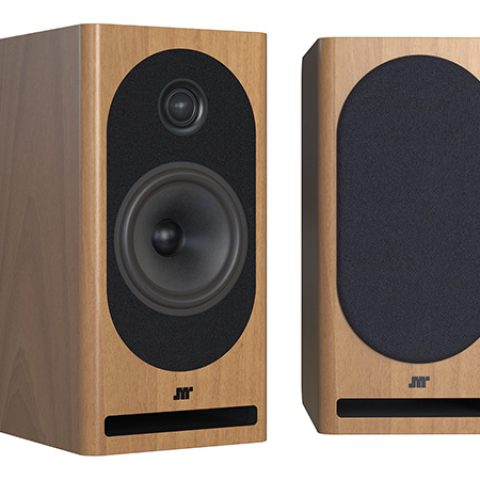
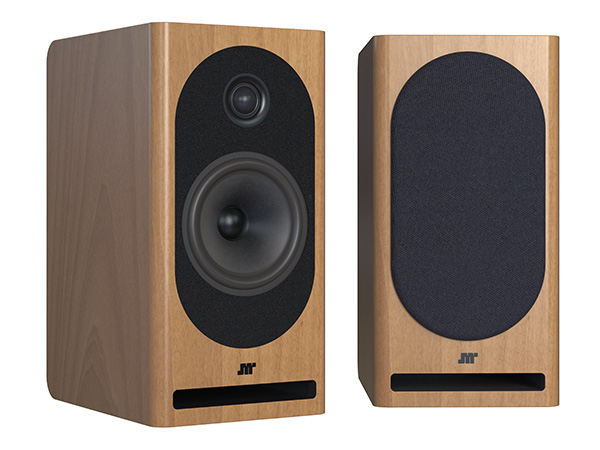
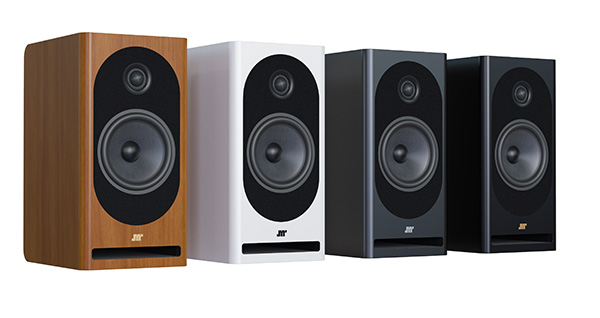
Measuring 16" tall, 8.2" wide, and 11" deep, the Jubilés feature chamfered edges, weigh about 24lb each, and are finished in an anigre veneer with a cherry stain. The 6.69" paper woofer (or as the JMR website poetically calls it, boomer) and silk-dome tweeter are connected with a second-order crossover; the components are claimed to be matched to within 1%. A datasheet lists a sensitivity of 88dB and a minimum impedance of 4 ohms. The speakers are attractive in a way that strikes me as a bit plain if not entirely normcore. Reynaud distributor Mike Pranka told me he favors the term "baby chimp coffins."
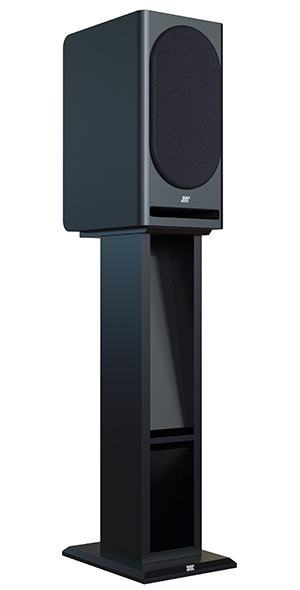
The French speakers are intended to be used with Reynaud's MAGIC STAND II. Besides the aggressive typography, these "engineered wood" stands feature two Helmholtz resonators tuned to different frequencies and asymmetrical surfaces claimed to diffract signals between 100 and 400Hz. According to Pranka, the Jubilés sound best attached to the MSIIs with four dots of an adhesive putty like Blu Tack. The speakers retail for $3000/pair, the stands for $850/pair, or you can get both for $3500. These days, that's about what a haircut and a rotisserie chicken with two sides cost here in Brooklyn.
Positioned where I assumed they'd sound best—about 8' apart and 2.5' from the wall behind them, toed in to nearly face the listening seat—the Jubilés on their stands sounded a bit vague. Pulling them farther out into the room made things worse. After some trial and error, they proved happiest just about where Pranka said they would: 5.5' apart, 15" from the wall behind them, and just barely toed in (or, as the JMR website has it, "pinched together"). About the last parameter, the always-deadpan Pranka wrote: "I don't think they need any toe in, but some (nerds) like a little." He also wrote, "screw imaging."
 Then there's the matter of amplifiers. Pranka said that the BLISS Jubilés seem opinionated about which ones they enjoy interacting with, which turned out to be true. I began with the usually good-natured Manley Mahis, my go-to amps over the past several years, which loved the La Scalas almost as much as I did. In both triode and pentode mode, however, they failed to elicit much cooperation from the Jubilés, sounding disjointed and dull. The California amps and French speakers had about as much chemistry as Jennifer Lopez and Ralph Fiennes in Maid in Manhattan. Or Mark Wahlberg and anyone.
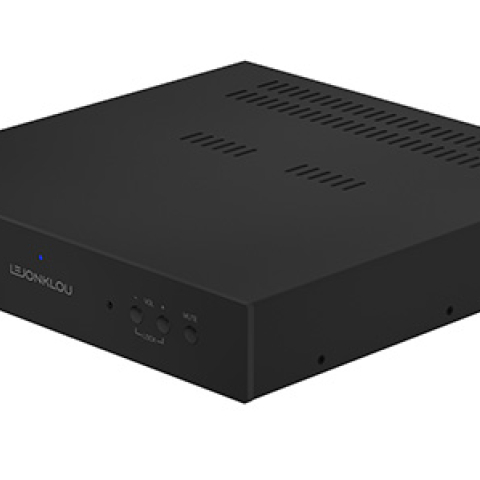
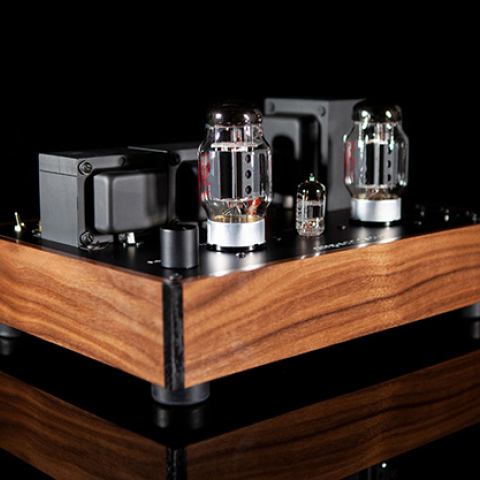
Luckily, after I replaced the Mahis with the Ampsandsound Mogwai SE, it was a whole 'nother megillah. With the speakers in their final positions, the 8Wpc amplifiers let the Jubilés lock in and show what they can do. And if their 88dB/2.83V/1m sensitivity suggests that the speakers might require more watts, I didn't hear them struggle, possibly thanks to that benign impedance. I also tried them with the solid state Lejonklou Boazu 2 integrated amplifier (review forthcoming), which tops out at about 40W into 8 ohms. This combination proved pretty stellar, too, with the Boazu eliciting an admittedly more powerful sound than the Mogwai, but I kept returning to the more pellucid, explicit presentation of the tube amp.
Then there's the matter of amplifiers. Pranka said that the BLISS Jubilés seem opinionated about which ones they enjoy interacting with, which turned out to be true. I began with the usually good-natured Manley Mahis, my go-to amps over the past several years, which loved the La Scalas almost as much as I did. In both triode and pentode mode, however, they failed to elicit much cooperation from the Jubilés, sounding disjointed and dull. The California amps and French speakers had about as much chemistry as Jennifer Lopez and Ralph Fiennes in Maid in Manhattan. Or Mark Wahlberg and anyone.
Luckily, after I replaced the Mahis with the Ampsandsound Mogwai SE, it was a whole 'nother megillah. With the speakers in their final positions, the 8Wpc amplifiers let the Jubilés lock in and show what they can do. And if their 88dB/2.83V/1m sensitivity suggests that the speakers might require more watts, I didn't hear them struggle, possibly thanks to that benign impedance. I also tried them with the solid state Lejonklou Boazu 2 integrated amplifier (review forthcoming), which tops out at about 40W into 8 ohms. This combination proved pretty stellar, too, with the Boazu eliciting an admittedly more powerful sound than the Mogwai, but I kept returning to the more pellucid, explicit presentation of the tube amp.
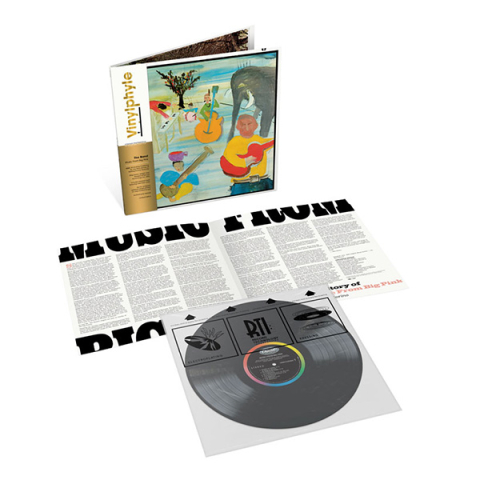
 On "Softly, as in a Morning Sunrise" from 1960's Gettin' Together! on LP (Contemporary S7573), Art Pepper lays down one of my favorite performances of his recording career. He's best known for the excellent Art Pepper Meets the Rhythm Section, recorded three years earlier with nearly the same sidemen from Miles Davis's band. But on the later session, Pepper is a different musician, having absorbed the influences of Ornette Coleman, John Coltrane, and Lee Konitz, and plays with a harmonic sophistication and a discursive, occasionally brittle tone that resembles no one else's. Better yet, on Gettin' Together!, Red Garland is replaced by Wynton Kelly, whose sly, elegant piano lines are a more sympathetic match for Pepper's fleet improvisations.
On the Pepper track, the Jubilés sounded alive, awake, and spritely as a fawn bounding through the woods. They made Kelly and Pepper's twinning lines sound thrillingly propulsive and lent the playing unusual drama and tension. And they kept Jimmy Cobb's tasteful stick work confidently in the pocket. This surefooted sense of timing never flagged.
Despite Pranka's pronouncement, the Jubilés were terrific at imaging, too, which didn't shock me in a standmount monitor. Though my room doesn't allow for a vast soundstage, it did let me hear the speakers' precise placement of the instruments on this early stereo recording, not only laterally but also front to back, which was surprising given their close-to-the-wall placement.
What surprised me even more were the dynamics. While not the equal of the La Scalas or probably any horn speaker in this respect, the Jubilés nonetheless sounded robust and expressive. Yes, I could imagine a more exciting, more muscular presentation, but the music never felt listless or deprived of drama.
Without belaboring the obvious, after living with the La Scalas, the bass response of small standmounted speakers like the Jubilés took some getting used to. A transmission-line design with a front-facing port, the French speaker made bass with excellent speed, tunefulness, and sense of timing, but its sense of impact and scale was a bit polite, and of course there was not much deep bass, with their cutoff specified as 45Hz.
On "Softly, as in a Morning Sunrise" from 1960's Gettin' Together! on LP (Contemporary S7573), Art Pepper lays down one of my favorite performances of his recording career. He's best known for the excellent Art Pepper Meets the Rhythm Section, recorded three years earlier with nearly the same sidemen from Miles Davis's band. But on the later session, Pepper is a different musician, having absorbed the influences of Ornette Coleman, John Coltrane, and Lee Konitz, and plays with a harmonic sophistication and a discursive, occasionally brittle tone that resembles no one else's. Better yet, on Gettin' Together!, Red Garland is replaced by Wynton Kelly, whose sly, elegant piano lines are a more sympathetic match for Pepper's fleet improvisations.
On the Pepper track, the Jubilés sounded alive, awake, and spritely as a fawn bounding through the woods. They made Kelly and Pepper's twinning lines sound thrillingly propulsive and lent the playing unusual drama and tension. And they kept Jimmy Cobb's tasteful stick work confidently in the pocket. This surefooted sense of timing never flagged.
Despite Pranka's pronouncement, the Jubilés were terrific at imaging, too, which didn't shock me in a standmount monitor. Though my room doesn't allow for a vast soundstage, it did let me hear the speakers' precise placement of the instruments on this early stereo recording, not only laterally but also front to back, which was surprising given their close-to-the-wall placement.
What surprised me even more were the dynamics. While not the equal of the La Scalas or probably any horn speaker in this respect, the Jubilés nonetheless sounded robust and expressive. Yes, I could imagine a more exciting, more muscular presentation, but the music never felt listless or deprived of drama.
Without belaboring the obvious, after living with the La Scalas, the bass response of small standmounted speakers like the Jubilés took some getting used to. A transmission-line design with a front-facing port, the French speaker made bass with excellent speed, tunefulness, and sense of timing, but its sense of impact and scale was a bit polite, and of course there was not much deep bass, with their cutoff specified as 45Hz.
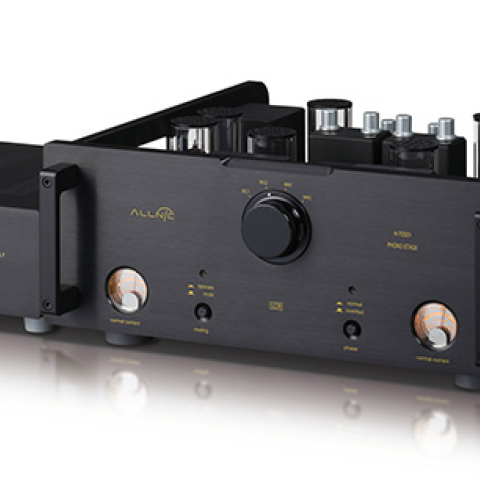
 Where the Jubilés really distinguish themselves from typical small speakers in their price range is their ability to reveal small changes to upstream components, which suggests a flat midrange response and a thoughtful approach to cabinet resonances. I've been listening to the excellent Allnic H-7000 phono stage (review forthcoming). The distributor, John Ketcham of Kevalin Audio, must have sniffed out my mania for old tubes and along with the phono stage sent a box of exotic rectifiers. While auditioning the Jubilés, I changed the rectifier in the Allnic's outboard power supply, replacing a Sylvania JAN 5931 with an ST-shaped brown-base GEC U52. Sure enough, the Jubilés allowed me to easily hear the British tube's superior harmonic density and tone color, which lent the lead guitar on Red Foley and Ernest Tubb's "Too Old to Cut the Mustard," recorded in 1951 in glorious mono, all the amber tone and crunch I wanted. And I bet you, too, would have smiled at the give and take of the singers' voices on this immortal verse:
What did I learn about my new listening room? The Jubilés showed that it is capable of good sound and also—given my predilections—that slightly larger and more rabble-rousing transducers might load the room in an even more satisfying way. Apologies to my new neighbors. If the Lord is willing and the creek don't rise, as Hank Williams used to say, I'll be writing about other speakers in the coming months.
Where the Jubilés really distinguish themselves from typical small speakers in their price range is their ability to reveal small changes to upstream components, which suggests a flat midrange response and a thoughtful approach to cabinet resonances. I've been listening to the excellent Allnic H-7000 phono stage (review forthcoming). The distributor, John Ketcham of Kevalin Audio, must have sniffed out my mania for old tubes and along with the phono stage sent a box of exotic rectifiers. While auditioning the Jubilés, I changed the rectifier in the Allnic's outboard power supply, replacing a Sylvania JAN 5931 with an ST-shaped brown-base GEC U52. Sure enough, the Jubilés allowed me to easily hear the British tube's superior harmonic density and tone color, which lent the lead guitar on Red Foley and Ernest Tubb's "Too Old to Cut the Mustard," recorded in 1951 in glorious mono, all the amber tone and crunch I wanted. And I bet you, too, would have smiled at the give and take of the singers' voices on this immortal verse:
What did I learn about my new listening room? The Jubilés showed that it is capable of good sound and also—given my predilections—that slightly larger and more rabble-rousing transducers might load the room in an even more satisfying way. Apologies to my new neighbors. If the Lord is willing and the creek don't rise, as Hank Williams used to say, I'll be writing about other speakers in the coming months.
Of all the odd, fascinating people I've met in this hobby, perhaps the oddest and most fascinating is Holger Stein of Mülheim, Germany's SteinMusic (footnote 2). We met several years ago at High End Munich and have talked, corresponded, and shared enthusiasms related to music, audio, and other, weirder pursuits. Despite all that, we hadn't enjoyed each other's company outside Munich. So I was stoked when he informed me earlier this winter that he and his wife Gabi were planning to visit New York City—my noisy, dirty, beloved, exasperating home. We met at the end of a long, busy day when Holger and Gabi wanted to stay in Manhattan. Which is how we ended up having dinner at one of those downtown restaurants where people go to be seen; its other location is in Miami. I felt like a lousy host, but it was the only place in the vicinity with a last-minute reservation. We spent about an hour catching up in an infernally dark dining room surrounded by influencers, content strategists, and young, vaguely European women who seem to subsist entirely on cocktails with interesting ice and frisée.
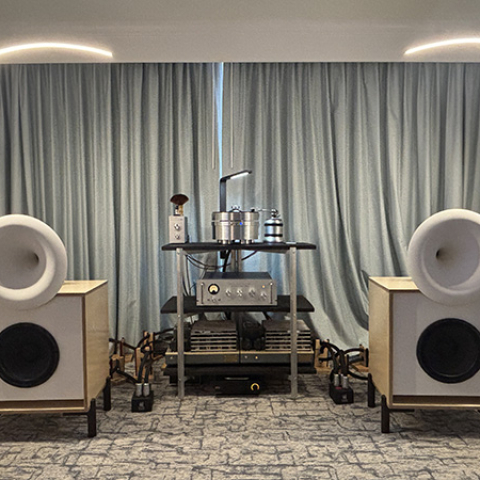
Luckily, the food was serviceable, and we were able to hear each other, and somehow got onto the subject of public listening spaces. Holger and Gabi immediately asked to visit one, and after paying the ridiculous bill we walked a few blocks west to Port Sa'id, an Israeli restaurant outfitted with a pair of custom horn speakers so large that each could function as a human dwelling. More interestingly, adjacent to the dining room is a bar with a smaller sound system that until recently hosted the New York outpost of the Los Angeles record store/listening space operator In Sheep's Clothing (footnote 3). This is where we ended up.
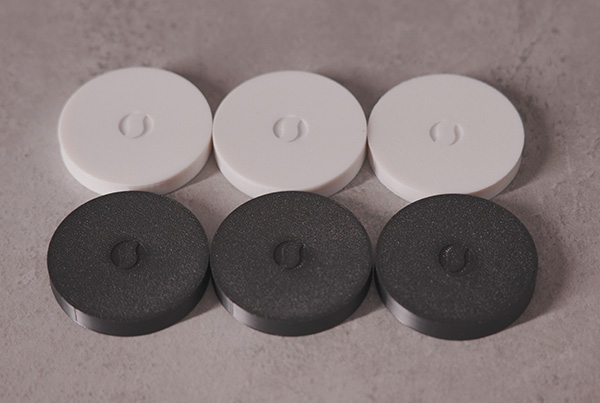
The bar was packed and noisy. The tube amp that had once powered the wall-mounted horn speakers was on the fritz and had been replaced with a possibly solid state device I didn't recognize. The hi-fi sounded loud, muddy, and not even slightly euphonious. That's when whatever it is that makes Holger so delightfully weird kicked in. Rather than ordering a drink, he took two white plastic discs about the size of Eisenhower dollars out of his pocket and instructed me to ask the bartender to place one inside each high-frequency horn. I was so surprised that it didn't occur to me to argue.
The guy behind the bar, who turned out to be Port Sa'id's chef, looked intrigued by Holger and his discs and did what was asked. If he thought he was simply humoring a bald tourist from Germany, he didn't for long. Because the music in the bar suddenly became easier to hear, more melodic, and entirely more coherent, even with all the revelry around it. I shit you not.
Holger then stuck another disc, using a two-sided adhesive pad, on the wall opposite the speakers, and kick me if the music didn't now sound even more vivid and easier to follow. Some of the bar's paying customers were beginning to take notice. Generally speaking, I tend not to go in for high-end audio's magic dots, pimples, crystals, and ointments, and found myself flummoxed by this demonstration. And felt a bit ambivalent when Holger thrust a box of the discs into my hand and asked me to listen to them in my own hi-fi.
The soberly named Acoustic Disc is an official SteinMusic product that costs $142 each. Per Holger's instructions, I placed one on top of each Reynaud BLISS Jubilé and sat down to listen to Patti Smith sing "Redondo Beach," from a pretty beat LP of Horses. Just as in the bar at Port Sa'id, I heard a better sense of focus, clarity, and control, with an easily audible reduction in splashiness and groove noise.
Per Holger's suggestion, I also placed a disc on the wall opposite the speakers, slightly above the tweeter axis, and heard a further clarification. I kept going: With discs stuck to the front wall 3' above each speaker, I heard the soundstage become taller, and heard something similar with a disc placed on each of the sidewalls, too. But in both cases, the music became a bit too controlled for my taste, so I went back to the original three-disc arrangement.
The Acoustic Discs have stuck around in my system, and I genuinely enjoy their clarifying, calming effect, especially with less-than-flawless recordings. At certain times, I'm aware of a very slight reduction in dynamic expression and sense of liveness, but in most situations I find what they bring to the system to be entirely welcome.
I cannot tell you how they work—though not for lack of trying. I spent part of a Sunday afternoon on the phone with Stein trying to tease out how the darn things function. What I can share from our conversation is that they apparently don't rely on traditional acoustic principles like diffusion and absorption but instead operate on a "quantum level." Make of that what you will. But I'm comforted by the fact that Stein has a physics degree and also designs great-sounding speakers, amps, and phono cartridges using more conventional ideas. In any case, we spent a very enjoyable hour discussing the construction of medieval cathedrals, alternative medicine, and sheep. In the meantime, on an experiential level, it just might be a good idea to audition the Acoustic Discs in your home.
Footnote 1: Jean-Marie Reynaud, La Font Close, 16300 Barbezieux-Saint-Hilaire, France. Tel: +33 (0)5 45 78 09 38. Email: jmr@jm-reynaud.com. Web: jm-reynaud.com. US distributor: Toffco, 8116 Gravois Rd., St. Louis, MO 63123. Tel: (314) 454-9966.
Footnote 2: SteinMusic Pro GmbH, Hingbergstrasse 103a, 45468 Mülheim an der Ruhr, Germany. Tel: (49) (0)208-32089. Web: steinmusic.com.
Footnote 3: See Brilliant Corners #8.
The Jean-Marie Reynaud BLISS JubiléMeasuring 16" tall, 8.2" wide, and 11" deep, the Jubilés feature chamfered edges, weigh about 24lb each, and are finished in an anigre veneer with a cherry stain. The 6.69" paper woofer (or as the JMR website poetically calls it, boomer) and silk-dome tweeter are connected with a second-order crossover; the components are claimed to be matched to within 1%. A datasheet lists a sensitivity of 88dB and a minimum impedance of 4 ohms. The speakers are attractive in a way that strikes me as a bit plain if not entirely normcore. Reynaud distributor Mike Pranka told me he favors the term "baby chimp coffins."
Then there's the matter of amplifiers. Pranka said that the BLISS Jubilés seem opinionated about which ones they enjoy interacting with, which turned out to be true. I began with the usually good-natured Manley Mahis, my go-to amps over the past several years, which loved the La Scalas almost as much as I did. In both triode and pentode mode, however, they failed to elicit much cooperation from the Jubilés, sounding disjointed and dull. The California amps and French speakers had about as much chemistry as Jennifer Lopez and Ralph Fiennes in Maid in Manhattan. Or Mark Wahlberg and anyone.
On "Softly, as in a Morning Sunrise" from 1960's Gettin' Together! on LP (Contemporary S7573), Art Pepper lays down one of my favorite performances of his recording career. He's best known for the excellent Art Pepper Meets the Rhythm Section, recorded three years earlier with nearly the same sidemen from Miles Davis's band. But on the later session, Pepper is a different musician, having absorbed the influences of Ornette Coleman, John Coltrane, and Lee Konitz, and plays with a harmonic sophistication and a discursive, occasionally brittle tone that resembles no one else's. Better yet, on Gettin' Together!, Red Garland is replaced by Wynton Kelly, whose sly, elegant piano lines are a more sympathetic match for Pepper's fleet improvisations.
On the Pepper track, the Jubilés sounded alive, awake, and spritely as a fawn bounding through the woods. They made Kelly and Pepper's twinning lines sound thrillingly propulsive and lent the playing unusual drama and tension. And they kept Jimmy Cobb's tasteful stick work confidently in the pocket. This surefooted sense of timing never flagged.
Where the Jubilés really distinguish themselves from typical small speakers in their price range is their ability to reveal small changes to upstream components, which suggests a flat midrange response and a thoughtful approach to cabinet resonances. I've been listening to the excellent Allnic H-7000 phono stage (review forthcoming). The distributor, John Ketcham of Kevalin Audio, must have sniffed out my mania for old tubes and along with the phono stage sent a box of exotic rectifiers. While auditioning the Jubilés, I changed the rectifier in the Allnic's outboard power supply, replacing a Sylvania JAN 5931 with an ST-shaped brown-base GEC U52. Sure enough, the Jubilés allowed me to easily hear the British tube's superior harmonic density and tone color, which lent the lead guitar on Red Foley and Ernest Tubb's "Too Old to Cut the Mustard," recorded in 1951 in glorious mono, all the amber tone and crunch I wanted. And I bet you, too, would have smiled at the give and take of the singers' voices on this immortal verse:
When I was young I had an automobileWhat I'm getting around to saying is that the little French speakers, while sounding really good, are even better at allowing me to sit back, let go of my mental stories, and enjoy my records. The Jubilés manage the all-important task of getting out of the music's way and letting its message come through unharassed. They depict the notes and beats with infectious liveliness and verve but are neutral enough to let me hear what's going on elsewhere in my system. And if the hi-fi can serve it up, they can wrangle more color, texture, richness, and fun than their form factor and parts list might lead you to believe. Given everything they do, the Jubilés' price strikes me as not only fair but compelling.
Now they push you around in chair with wheels
I had to fight the gals off with a stick
Now they say he makes me sick
Photo by Constantin Stein
The SteinMusic Acoustic DiscOf all the odd, fascinating people I've met in this hobby, perhaps the oddest and most fascinating is Holger Stein of Mülheim, Germany's SteinMusic (footnote 2). We met several years ago at High End Munich and have talked, corresponded, and shared enthusiasms related to music, audio, and other, weirder pursuits. Despite all that, we hadn't enjoyed each other's company outside Munich. So I was stoked when he informed me earlier this winter that he and his wife Gabi were planning to visit New York City—my noisy, dirty, beloved, exasperating home. We met at the end of a long, busy day when Holger and Gabi wanted to stay in Manhattan. Which is how we ended up having dinner at one of those downtown restaurants where people go to be seen; its other location is in Miami. I felt like a lousy host, but it was the only place in the vicinity with a last-minute reservation. We spent about an hour catching up in an infernally dark dining room surrounded by influencers, content strategists, and young, vaguely European women who seem to subsist entirely on cocktails with interesting ice and frisée.
Footnote 1: Jean-Marie Reynaud, La Font Close, 16300 Barbezieux-Saint-Hilaire, France. Tel: +33 (0)5 45 78 09 38. Email: jmr@jm-reynaud.com. Web: jm-reynaud.com. US distributor: Toffco, 8116 Gravois Rd., St. Louis, MO 63123. Tel: (314) 454-9966.