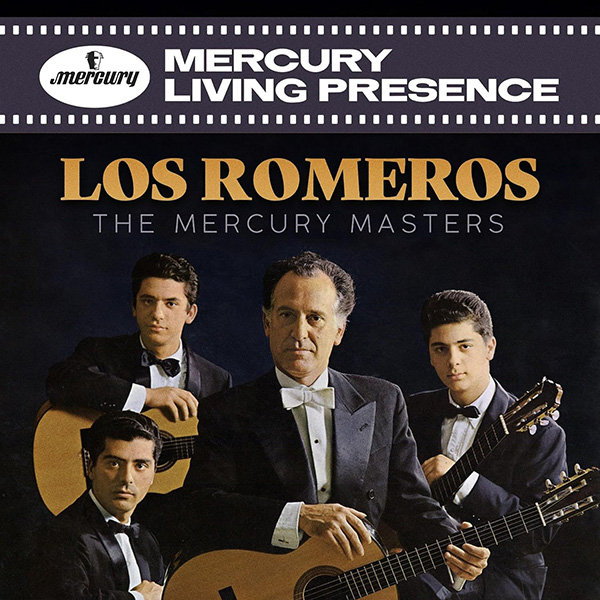
 I put on CD8, two concertos by Joaquín Rodrigo recorded with the San Antonio Symphony in 1967. Concierto andaluz was commissioned by the Romeros' guitar quartet (the three sons plus father Celedonio). The guitars sit dead center in the stereo image, with prominent double basses to the right and first-seat violins to the left. Spread behind the front array, from left to right, are woodwinds and brass. As I heard while making the 3-to-2 channel mix of this recording, every note and its source is clearly located on the soundstage, and the four guitars are distinctly detailed. The 801 D4 Signatures produced this image large and realistic, as if my living room had morphed into San Antonio's Civic Auditorium.
I switched to CD6, World of Flamenco, a 2-LP concept album dreamed up then made real by Pepe Romero. He gathered his father and brothers and rounded up a group of singers, dancers, and percussion players to create an authentic jaleo, a Flamenco improvisational performing group. They rehearsed at the Romero home, then got in front of microphones at Bill Putnam's famous United Recording Studios in Hollywood just after Christmas, 1966.
The music was improvised on the spot, including Celedonio's poetry recitations, which accompany some selections. It was recorded in a way that puts the listener in the room, with the group spread across a wide soundstage. The original LP suffered from dynamic compression and artificial echo, added during disc mastering. For this release, I went back to the unprocessed, edited session tapes, which I believe bring the full spirit and energy of Pepe Romero's creative vision directly to the listener. In my booklet notes, I recommend headphones, but the B&W speakers did such a nice job pushing forth the sound energy and dynamics and correctly reproducing the low-frequency components of the Spanish dancing and foot-tapping that I experienced an in-the-room closeness similar to what I hear through headphones—but more realistic because of the floor-shaking low-frequency energy of dancer Raul Martin, on the left.
I put on CD8, two concertos by Joaquín Rodrigo recorded with the San Antonio Symphony in 1967. Concierto andaluz was commissioned by the Romeros' guitar quartet (the three sons plus father Celedonio). The guitars sit dead center in the stereo image, with prominent double basses to the right and first-seat violins to the left. Spread behind the front array, from left to right, are woodwinds and brass. As I heard while making the 3-to-2 channel mix of this recording, every note and its source is clearly located on the soundstage, and the four guitars are distinctly detailed. The 801 D4 Signatures produced this image large and realistic, as if my living room had morphed into San Antonio's Civic Auditorium.
I switched to CD6, World of Flamenco, a 2-LP concept album dreamed up then made real by Pepe Romero. He gathered his father and brothers and rounded up a group of singers, dancers, and percussion players to create an authentic jaleo, a Flamenco improvisational performing group. They rehearsed at the Romero home, then got in front of microphones at Bill Putnam's famous United Recording Studios in Hollywood just after Christmas, 1966.
The music was improvised on the spot, including Celedonio's poetry recitations, which accompany some selections. It was recorded in a way that puts the listener in the room, with the group spread across a wide soundstage. The original LP suffered from dynamic compression and artificial echo, added during disc mastering. For this release, I went back to the unprocessed, edited session tapes, which I believe bring the full spirit and energy of Pepe Romero's creative vision directly to the listener. In my booklet notes, I recommend headphones, but the B&W speakers did such a nice job pushing forth the sound energy and dynamics and correctly reproducing the low-frequency components of the Spanish dancing and foot-tapping that I experienced an in-the-room closeness similar to what I hear through headphones—but more realistic because of the floor-shaking low-frequency energy of dancer Raul Martin, on the left.
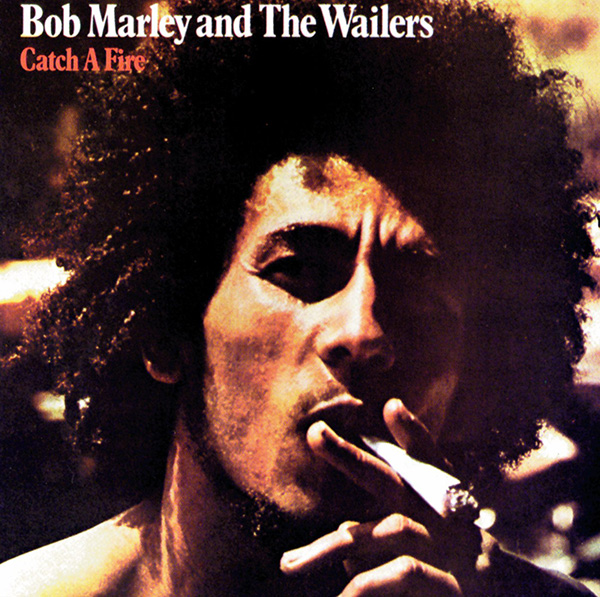 Another day, I streamed from Qobuz the 50th anniversary deluxe reissue of Catch a Fire by Bob Marley & The Wailers (24/96 FLAC, UMG/Qobuz; footnote 7). The first cut, "Concrete Jungle," a reggae classic, features clean, deep bass, recorded so that you can hear both the low-frequency energy and the tone of the electric bass. On the second track, "Slave Driver," the bass is more low-fi: fuzzy and muddy. The 801 D4 Signatures reproduced each as it is, neither flattering nor distorting poor recordings. What is there is what you will hear.
My musical tastes lean toward rock, pop, and jazz from the 1950s through 1980s. Consistent with those tastes—especially with rock and pop—I am realistic in my sonic expectations with my favorite albums. As I zipped around Qobuz and my NAS-streaming library, I wasn't surprised when new sonic flaws were uncovered in my favorite songs. What did surprise me was the emergence of new details, mainly due to the pinpoint-steady placement of instruments and voices, and the height, width, and depth of the soundstage. There was a lot of space in which the music lived, so each sound had room to be heard. This dovetails with Jim Austin's comment in his report from Carlsbad, that the 801 D4 Signatures throw a big, rectilinear soundstage. With classical music, the precision top end aided in fully presenting reverb tails and a strong sense of the recording venue.
Vinyl on the big stage
Another day, I streamed from Qobuz the 50th anniversary deluxe reissue of Catch a Fire by Bob Marley & The Wailers (24/96 FLAC, UMG/Qobuz; footnote 7). The first cut, "Concrete Jungle," a reggae classic, features clean, deep bass, recorded so that you can hear both the low-frequency energy and the tone of the electric bass. On the second track, "Slave Driver," the bass is more low-fi: fuzzy and muddy. The 801 D4 Signatures reproduced each as it is, neither flattering nor distorting poor recordings. What is there is what you will hear.
My musical tastes lean toward rock, pop, and jazz from the 1950s through 1980s. Consistent with those tastes—especially with rock and pop—I am realistic in my sonic expectations with my favorite albums. As I zipped around Qobuz and my NAS-streaming library, I wasn't surprised when new sonic flaws were uncovered in my favorite songs. What did surprise me was the emergence of new details, mainly due to the pinpoint-steady placement of instruments and voices, and the height, width, and depth of the soundstage. There was a lot of space in which the music lived, so each sound had room to be heard. This dovetails with Jim Austin's comment in his report from Carlsbad, that the 801 D4 Signatures throw a big, rectilinear soundstage. With classical music, the precision top end aided in fully presenting reverb tails and a strong sense of the recording venue.
Vinyl on the big stageI wondered if the large, high-resolution soundstage would be friend or enemy to vinyl playback. Let's be honest: However much you enjoy your favorite LPs, you typically have to forgive a bunch of background (and sometimes foreground) noise. My tolerance is limited. I rarely spin beat-up records, and I have little interest in older records full of background hum pressed on plastic that should have been used for something else. I keep my records clean and make sure the platter and stylus are dust-free before a side gets spun. Even then, vinyl is vinyl; it's never noise-free. Applying a large-scale magnifier of details could be fraught.
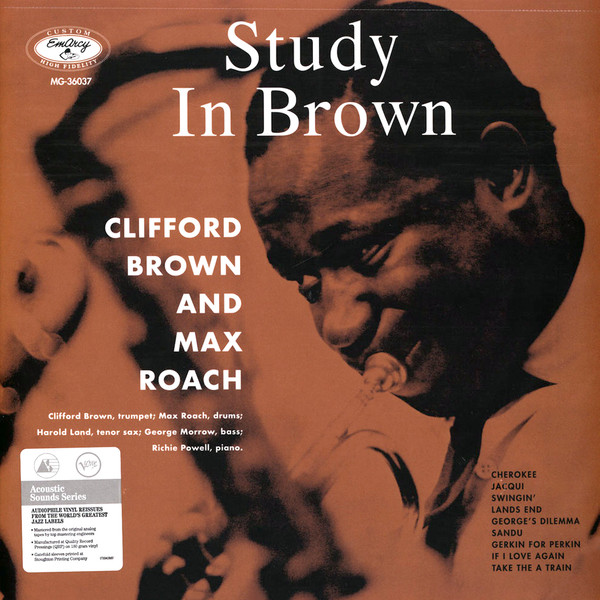 I started out with a new reissue of a mono record: Clifford Brown and Max Roach's Study in Brown (Verve/Analogue Productions B0032412-01). Dammit, the image was focused and well-sorted but leaned left. I tried adjusting the balance control on my Pro-Ject phono preamp, but even with it turned fully to the right, the image remained left of center. After a few minutes of diagnostics, I localized the trouble to the RCA cable between the turntable and preamp. With another cable swapped in, the image returned to center, with the balance control out of the circuit.
Back to the vinyl. Study in Brown is a great example of a mono mix that fits all the sounds, in pleasing balance, in the center of the soundstage. The first cut on side B, "George's Dilemma," features a strong beat by Max Roach and bassline by George Morrow, with Richie Powell's piano sitting behind Clifford Brown's trumpet, and Harold Land's tenor sax playing the melody. Then there's a round robin of solos, including Roach's distinctive work on the cymbals and hi-hat, and a solid Murrow solo low down. All this was rendered fully human-sized by the B&Ws.
I started out with a new reissue of a mono record: Clifford Brown and Max Roach's Study in Brown (Verve/Analogue Productions B0032412-01). Dammit, the image was focused and well-sorted but leaned left. I tried adjusting the balance control on my Pro-Ject phono preamp, but even with it turned fully to the right, the image remained left of center. After a few minutes of diagnostics, I localized the trouble to the RCA cable between the turntable and preamp. With another cable swapped in, the image returned to center, with the balance control out of the circuit.
Back to the vinyl. Study in Brown is a great example of a mono mix that fits all the sounds, in pleasing balance, in the center of the soundstage. The first cut on side B, "George's Dilemma," features a strong beat by Max Roach and bassline by George Morrow, with Richie Powell's piano sitting behind Clifford Brown's trumpet, and Harold Land's tenor sax playing the melody. Then there's a round robin of solos, including Roach's distinctive work on the cymbals and hi-hat, and a solid Murrow solo low down. All this was rendered fully human-sized by the B&Ws.
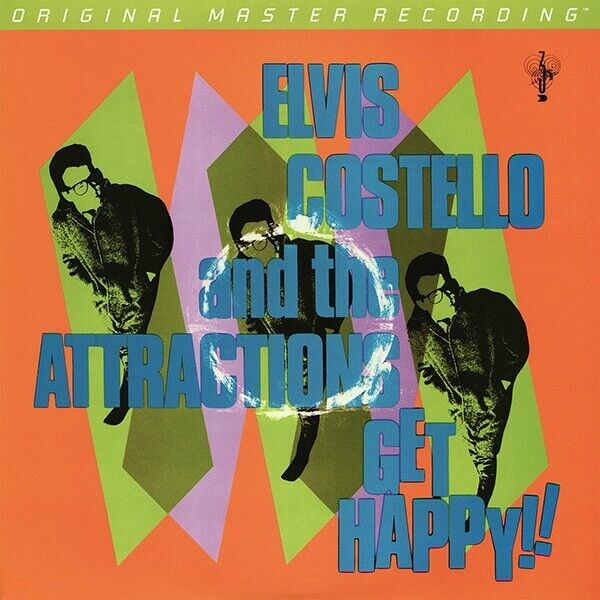 Mobile Fidelity's 2-LP version of Elvis Costello and the Attractions' Get Happy transforms what had been a 20-song, long-sided, relatively low-fi Columbia LP into four sides of 45rpm hi-fi, new-wave energy. On this, their fourth album, the band took a turn toward tightly played, simple arrangements inspired by American 1960s R&B. "Opportunity" is a good example: a steady kickdrum beat dead center, electric organ on the right, guitar (the sound leaning clean and dark) on the left, bass between drums and guitar, vocals in the center. Nick Lowe's production is unadorned—very different from, for instance, what he did with the Pretenders' "Stop Your Sobbing," and some earlier Costello material like "Party Girl." The effect is bracing. MoFi did a nice job with this, and the HD streaming version also sounds great.
I've adopted some references for low-frequency sound reproduction favored by fellow Stereophile reviewers. Jason Victor Serinus has recently been using the second movement of Shostakovich's Symphony No.11, "The Year 1905," performed by Andris Nelsons and the Boston Symphony Orchestra (24/96 FLAC, DG/Qobuz). John Atkinson has been using Taylor Swift's "All Too Well" from Red (Taylor's Version) (Big Machine Records, 24/96 Qobuz stream). These very different pieces of music sound equally immediate and powerful through the B&W 801 D4 Signatures.
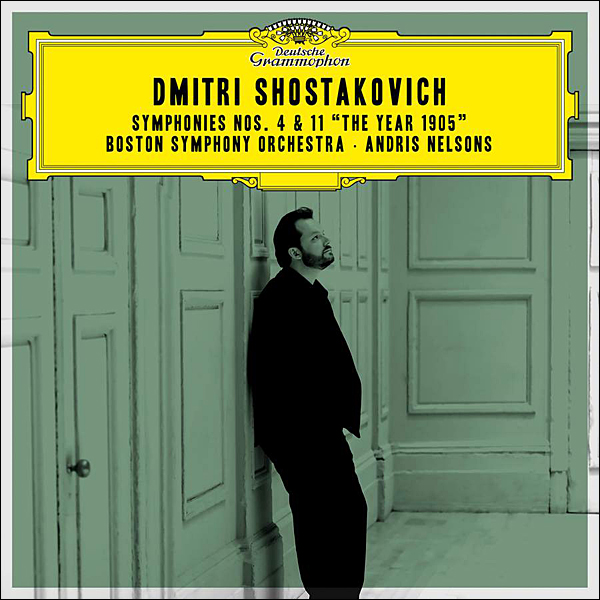 The second movement of Shostakovich's symphony depicts Czar Nicholas II's Cossacks massacring unarmed civilians carrying a petition demanding reforms, which actually happened in front of the Winter Palace in St. Petersburg on "Bloody Sunday," January 9, 1905.9 The 18-minute movement builds slowly, the theme starting with the double basses and moving around the orchestra. At around 13 minutes, the bloodbath ensues, represented by a massive percussion burst lasting several minutes, including a big bass drum, pounded hard. The floor shakes, and I'm sure a pant leg would flutter in front of the woofers, though I never tried it. This is high musical drama despite the somewhat diffuse, distantly miked recording style.
In stark contrast, the Taylor Swift tune is highly produced, even synthetic sounding. But JA discovered a great woofer test buried in this pop tune: at 2:25, when Swift sings "'Cause there we are again in the middle of the night," the pronounced bass line drops an octave, down to subwoofer territory. A full-range speaker should cleanly reproduce the drop and sort out the busy mix. If the speakers tell the truth, Swift's voice will sound nasal and sibilant. The 804 D4 Signatures did all that.
The second movement of Shostakovich's symphony depicts Czar Nicholas II's Cossacks massacring unarmed civilians carrying a petition demanding reforms, which actually happened in front of the Winter Palace in St. Petersburg on "Bloody Sunday," January 9, 1905.9 The 18-minute movement builds slowly, the theme starting with the double basses and moving around the orchestra. At around 13 minutes, the bloodbath ensues, represented by a massive percussion burst lasting several minutes, including a big bass drum, pounded hard. The floor shakes, and I'm sure a pant leg would flutter in front of the woofers, though I never tried it. This is high musical drama despite the somewhat diffuse, distantly miked recording style.
In stark contrast, the Taylor Swift tune is highly produced, even synthetic sounding. But JA discovered a great woofer test buried in this pop tune: at 2:25, when Swift sings "'Cause there we are again in the middle of the night," the pronounced bass line drops an octave, down to subwoofer territory. A full-range speaker should cleanly reproduce the drop and sort out the busy mix. If the speakers tell the truth, Swift's voice will sound nasal and sibilant. The 804 D4 Signatures did all that.
 Conclusions
I thoroughly enjoyed many hours in front of the B&W 801 D4 Signatures, and I'm grateful to the large team that helped make this review happen. These speakers bring forth a huge sound and project a large, detailed stereo image in front, above, beyond, and behind the speakers. This is what I want in full-range, room-filling speakers. They put out a lot of high-frequency energy, so focus on toe-in and seating height during setup to achieve the treble levels you prefer. I recommend that potential buyers audition them with familiar music and spend enough time to get a grip on how accurate and fast they are. It may be somewhat shocking in comparison to older or smaller-format speakers. They are, after all, used as studio monitors, including at Abbey Road. Yet, they buck the stereotype of cold, pointillist magnifiers of all things wrong in a recording. Instead, they present every bit of information captured by the microphones and baked into the mix, all of a piece and with a rich, full sound. They make old favorites new again by revealing previously unheard details. The Bowers & Wilkins 801 D4 Signatures cost a pretty penny, but in the context of how accurately and completely they reproduce all kinds of music, and the huge soundstage they throw, they are competitive with speakers costing much more. If you like your sound big, full-range, and highly detailed, leaving out nothing that's in the recording, you should definitely audition these speakers.
Footnote 7: See open.qobuz.com/album/m8tfugu3bf4ta; there are many other versions of this album streaming on Qobuz. Footnote 8: Visit any audio show, and you'll learn that ping-pong stereo is still popular in certain circles.—Jim Austin Footnote 9: See tinyurl.com/2z5kfwpe.