I first saw Benchmark's AHB2 stereo power amplifier at the 2013 Convention of the Audio Engineering Society, in New York City. On silent display in Benchmark's booth on the convention floor, its compact size and comprehensive features made the amp immediately attractive, and the design was described as a departure from traditional analog and digital amplifiers (footnote 1, more on that later). It was also explained to me that the AHB2 was based on designs by Benchmark's founder, Allen H. Burdick (whose initials it bears). By the time of Burdick's retirement, in 2006, Benchmark didn't yet offer a power amplifier, but the company used a prototype based on his work to evaluate their new digital products, and that amp was soon developed as a commercial product; Burdick died just weeks before the AHB2, now named in his honor, was shown at the 2013 AES convention.
Out of technical curiosity and my own interest as a consumer, I wanted an AHB2 right away, but the model had yet to be launched. Fast-forward to 2015, when I found myself investigating lighter power amps—I can no longer lift my 155-lb McIntosh MC303, or easily maneuver my 65lb Parasound A31. I didn't recall how well the Benchmark AHB2 might suit me, until the amp began making a buzz (only figuratively!); happily, when I asked John Atkinson if I might review the Benchmark, he told me that he already had one that he could drop off.
Description
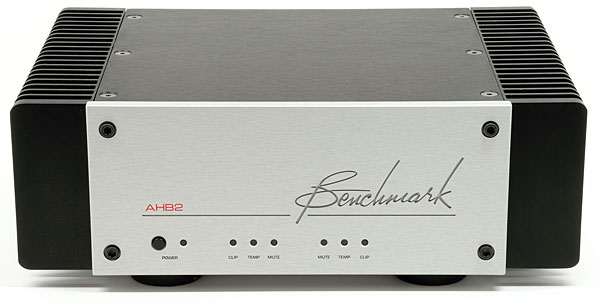
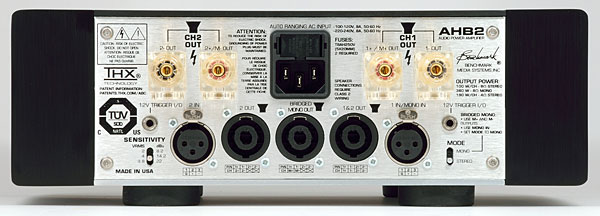
When I unpacked the AHB2, I was impressed with its small size and weight: the non-rack-mount version is 11.04" wide by 3.84" high by 9.34" deep and weighs only 12.5 lbs. I was also impressed with a seriousness of design apparent in its features: The fully balanced AHB2 has, on its rear panel, only XLR jacks for signal input, plus a toggle switch that allows the user to select among three input-sensitivity levels. For output, the Benchmark amp offers a choice of traditional multiway connectors or a stereo pair of Neutrik NL4 sockets. A third Neutrik NL4 is provided for use when the amp is in bridged mode, which is selected with a second toggle switch. On the front panel is a pushbutton on/off switch plus dual-mono indicator lights that indicate clipping, excess temperature, and the muting state the amp enters during power-up (or, presumably more rarely, when in fault-detection mode). These features, along with the detailed manual and specs included with the amp, suggest that the AHB2's target market is the audio professional or the recording studio.
 Also packed in the box was a slick, gatefold brochure from THX Ltd., which developed the amplifier's patented Achromatic Audio Amplifier (AAA) technology. The THX AAA system combines an intentionally low-bias, class-AB output section with an auxiliary low-power, feed-forward amplifier; the latter drives the former with a correction signal that's claimed to eliminate distortion before it reaches the loudspeaker outputs. Tied to the AAA technology is a system of class-H power-supply rails that track power demands in order to increase amplifier efficiency without the penalty of added distortion; the power supply itself is a regulated switch-mode type that uses resonant switching, claimed by Benchmark to reduce noise.
Apparently, the brief history I'd been told at the 2013 AES Convention was only half the story. To paraphrase Benchmark's John Siau, from a recent e-mail exchange:
"The AHB2 was a team effort between Benchmark and THX. They were very excited about the performance that they were getting from a prototype that used the new THX-AAA technology. They sent the prototype, and we sent them one of our 35W DA101 power-amplifier cards. Our goal was to build a large amplifier that could exceed the performance of the DA101.
"Benchmark set the performance goals, completed the thermal modeling, and designed the heatsinks and the casework. Benchmark also designed the analog input stage, the user interface, and the FPGA-based protection system, and laid out the amplifier printed-circuit board using some of our specialized layout techniques. THX engineers designed the state-of-the-art, low-noise resonant-switching power supply and the core section of the amplifier board.
"The layout of the amplifier board is highly immune to magnetic and electrostatic fields, to achieve the A-weighted signal/noise ratio of 132–135dB. The two magnetic shield plates and all of the transformers are custom-built inside ferrite cores. The radiated magnetic fields produced by the AHB2 are much lower than those produced by other amplifiers of similar power, which means it can be placed directly above or below other, sensitive electronic components."
All of that makes sense, although the AHB2 can hardly be called a physically "large" amplifier. Installing the AHB2 was trivially easy, as it should be for a power amp. I simply connected my Audio Research MP1 preamp to the Benchmark's XLR inputs, and my banana-terminated speaker cables to its multiway output terminals, plugged in the power cord, and pushed the Power button. All seven of the AHB2's indicator LEDs briefly lit up, a relay clicked, and out came music.
Listening in the City
Also packed in the box was a slick, gatefold brochure from THX Ltd., which developed the amplifier's patented Achromatic Audio Amplifier (AAA) technology. The THX AAA system combines an intentionally low-bias, class-AB output section with an auxiliary low-power, feed-forward amplifier; the latter drives the former with a correction signal that's claimed to eliminate distortion before it reaches the loudspeaker outputs. Tied to the AAA technology is a system of class-H power-supply rails that track power demands in order to increase amplifier efficiency without the penalty of added distortion; the power supply itself is a regulated switch-mode type that uses resonant switching, claimed by Benchmark to reduce noise.
Apparently, the brief history I'd been told at the 2013 AES Convention was only half the story. To paraphrase Benchmark's John Siau, from a recent e-mail exchange:
"The AHB2 was a team effort between Benchmark and THX. They were very excited about the performance that they were getting from a prototype that used the new THX-AAA technology. They sent the prototype, and we sent them one of our 35W DA101 power-amplifier cards. Our goal was to build a large amplifier that could exceed the performance of the DA101.
"Benchmark set the performance goals, completed the thermal modeling, and designed the heatsinks and the casework. Benchmark also designed the analog input stage, the user interface, and the FPGA-based protection system, and laid out the amplifier printed-circuit board using some of our specialized layout techniques. THX engineers designed the state-of-the-art, low-noise resonant-switching power supply and the core section of the amplifier board.
"The layout of the amplifier board is highly immune to magnetic and electrostatic fields, to achieve the A-weighted signal/noise ratio of 132–135dB. The two magnetic shield plates and all of the transformers are custom-built inside ferrite cores. The radiated magnetic fields produced by the AHB2 are much lower than those produced by other amplifiers of similar power, which means it can be placed directly above or below other, sensitive electronic components."
All of that makes sense, although the AHB2 can hardly be called a physically "large" amplifier. Installing the AHB2 was trivially easy, as it should be for a power amp. I simply connected my Audio Research MP1 preamp to the Benchmark's XLR inputs, and my banana-terminated speaker cables to its multiway output terminals, plugged in the power cord, and pushed the Power button. All seven of the AHB2's indicator LEDs briefly lit up, a relay clicked, and out came music.
Listening in the City
Benchmark and THX make much of the AHB2's lack of audible noise: something good systems aren't troubled by in any case. That said, it was probably the AHB2's low noise level that revealed to me much more apparent low-level detail in already-familiar recordings. I qualify that statement with apparent because, after hearing the AHB2 uncover previously unheard subtle details, I found I could now hear them when I returned to my other amps. I suspect that, being newly informed of their existence, my ear/brain could more easily extract those details from the output provided all along by my other amplifiers. This made a much greater impression on me than any subjective awareness of a lower noise floor, per se.
Footnote 1: For a full description of the design and engineering technology packed into the AHB2, click here.
When I unpacked the AHB2, I was impressed with its small size and weight: the non-rack-mount version is 11.04" wide by 3.84" high by 9.34" deep and weighs only 12.5 lbs. I was also impressed with a seriousness of design apparent in its features: The fully balanced AHB2 has, on its rear panel, only XLR jacks for signal input, plus a toggle switch that allows the user to select among three input-sensitivity levels. For output, the Benchmark amp offers a choice of traditional multiway connectors or a stereo pair of Neutrik NL4 sockets. A third Neutrik NL4 is provided for use when the amp is in bridged mode, which is selected with a second toggle switch. On the front panel is a pushbutton on/off switch plus dual-mono indicator lights that indicate clipping, excess temperature, and the muting state the amp enters during power-up (or, presumably more rarely, when in fault-detection mode). These features, along with the detailed manual and specs included with the amp, suggest that the AHB2's target market is the audio professional or the recording studio.
Also packed in the box was a slick, gatefold brochure from THX Ltd., which developed the amplifier's patented Achromatic Audio Amplifier (AAA) technology. The THX AAA system combines an intentionally low-bias, class-AB output section with an auxiliary low-power, feed-forward amplifier; the latter drives the former with a correction signal that's claimed to eliminate distortion before it reaches the loudspeaker outputs. Tied to the AAA technology is a system of class-H power-supply rails that track power demands in order to increase amplifier efficiency without the penalty of added distortion; the power supply itself is a regulated switch-mode type that uses resonant switching, claimed by Benchmark to reduce noise.
Apparently, the brief history I'd been told at the 2013 AES Convention was only half the story. To paraphrase Benchmark's John Siau, from a recent e-mail exchange:
"The AHB2 was a team effort between Benchmark and THX. They were very excited about the performance that they were getting from a prototype that used the new THX-AAA technology. They sent the prototype, and we sent them one of our 35W DA101 power-amplifier cards. Our goal was to build a large amplifier that could exceed the performance of the DA101.
Benchmark and THX make much of the AHB2's lack of audible noise: something good systems aren't troubled by in any case. That said, it was probably the AHB2's low noise level that revealed to me much more apparent low-level detail in already-familiar recordings. I qualify that statement with apparent because, after hearing the AHB2 uncover previously unheard subtle details, I found I could now hear them when I returned to my other amps. I suspect that, being newly informed of their existence, my ear/brain could more easily extract those details from the output provided all along by my other amplifiers. This made a much greater impression on me than any subjective awareness of a lower noise floor, per se.
Footnote 1: For a full description of the design and engineering technology packed into the AHB2, click here.