The September-issue As We See It—about bicycles, value, and the connection to hi-fi—provoked more (and more enthusiastic) feedback than any I've written. Apparently people love their bikes, maybe even more than they love their hi-fi equipment. So this month I'm going to write about ... record cleaning.
Earlier this year, I wrote two articles on record cleaning, in particular the ultrasonic kind (footnote 1). Some of the ideas I expressed were good and correct, like the choice of surfactant (Tergitol 15-S-9). Others, like the amount of Tergitol to use, were less well-considered. I put too much emphasis on making sure the surfactant molecules didn't end up on the surface of the record. I need not have worried.
Those articles grew out of a conversation over email among editors—including, prominently, Miguel Barrio. Another outcome of that email conversation was an article by Miguel, posted online at Analog Planet, Stereophile's sibling website. Miguel, like me, is the recipient of a physics PhD, and that gives him an analytical, problem-solving mindset. The AP article is an extensive, comprehensive resource. This As We See It, in comparison, is the briefest of primers.
Several readers pointed out a problem with the advice offered in those earlier columns. By keeping the amount of surfactant small, which I made a primary objective, I was missing out on one of a surfactant's two major functions, and it is perhaps the more important of the two.
Surfactants lower the surface tension of water, which, in an ultrasonic bath, allows for the formation of smaller, less energetic bubbles, which can get deeper into the record grooves so that when they—the bubbles—collapse, the resulting energetic water jets can dislodge contaminants from the record surface.
That's the property of surfactants my cleaning recipe exploited. But surfactants do something else I didn't mention, and it's really cool and important: They wrap contaminants in little shells that keep them suspended in water.
Let's say a chunk of some kind of organic goop—skin oil, perhaps—is deposited on the record. Ultrasonic action (with a surfactant assist) removes it from the surface of the record and moves it into the aqueous mix. If that were all that happened, the odds would be high that the substance would redeposit on the record surface, and little would be accomplished. But surfactant tails are hydrophobic—they don't like water. They escape water by attaching themselves to that little ball of oil. Their heads are hydrophilic—they do like water—so once the micelle is complete, it floats freely, encapsulating the oil droplet, which now is unlikely to redeposit. Isn't chemistry cool?
But this doesn't just lock up the oil; it locks up those surfactant molecules, too. Those micelles are all likely to remain in suspension, floating free, away from the record surface.
Surfactants do something similar with inorganic particulates: dried-out mold-spore husks, dust, dirt. Surfactants surround these bits of stuff and keep them suspended in water. With inorganic stuff, this is called, inelegantly, "antideposition." The process as a whole—lifting stuff off the record and keeping it suspended in water—is called "solubilization."
The advice I offered in my June piece was wrong in that the amount of surfactant I suggested, though it would lower the surface tension in the water, would not be sufficient to solubilize contaminants.
There's another reason—I'm tempted to say a deeper reason—that I came away from the June As We See It column feeling I hadn't handled the subject well. My approach was too fussy. I want a method that doesn't require a ton of measurement. It should be easy and also effective.
So here it is, my new, less fussy recipe. You'll need:
• Plenty of distilled water.
• Tergitol 15-S-9. You can buy 250ml at Fisher Scientific for about $50. Unless you have a professional record-cleaning business, it will last forever.
• 90%-grade isopropyl alcohol. What you buy at the pharmacy is fine. Just don't buy rubbing alcohol, which has extra stuff in it.
• Two ultrasonic baths. They can be two separate ultrasonic machines or, more economically, one machine (like the Degritter; footnote 2) with interchangeable water tanks. Ideally, if your cleaner has automatic drying, you'll want a way to skip the drying stage after the first wash.
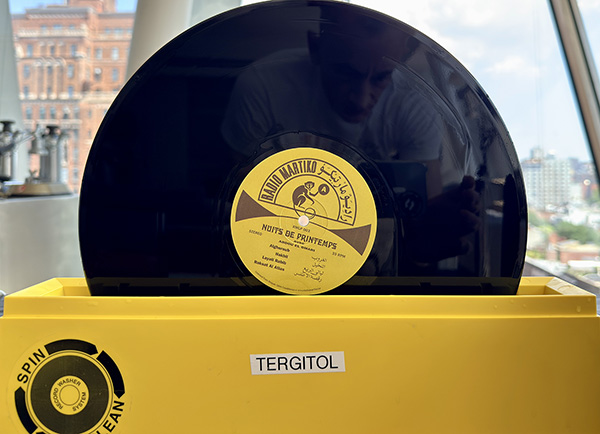
• You may want a method of preliminary cleaning—a Spin-Clean or maybe just a sink, dishwashing soap, and a "label saver"—for very filthy records.
The method: If the record is filthy, start with precleaning. Be gentle. If you haven't done this before, start with a low-value record. Water from the sink and a little bit of dish soap are fine. Whatever method you use to scrub, be careful, because as we all know, vinyl scratches easily.
Occasionally, you'll notice a little chunk of something dried on the record surface, across a few grooves. Sometimes it dissolves away easily; other times, it doesn't. If it doesn't, try mechanical agitation with a small, soft brush; you'll want to try the brush on a low-value record the first time. I've had some luck with stylus-cleaning brushes, the kind with very short bristles, intended for use with fluid. Work slowly. Let it soak in. Don't use too much force. Rinse the soap off with water from the sink.
Fill the first ultrasonic tank with a mixture of distilled water and Tergitol. How much surfactant? More than I said in June, but don't worry about it. A nice round number. This is arbitrary, but let's say 20 drops.
In the second tank, mix a 10:1 solution of distilled water and isopropyl alcohol.
Do an ultrasonic cycle in the first tank. The ultrasonic action (with surfactant assist) should solubilize the contaminants on the record surface, and the surfactant will keep those contaminants in suspension in the water.
When the wash cycle is done, skip the drying cycle if there is one. Pop the record in the second tank and press Play. The distilled water/alcohol mix will wash off any remaining surfactant. The alcohol will vaporize. Let the drying cycle do its thing. Change the water frequently. If your cleaner has parts that come in contact with the dirty record surface, clean them often. Enjoy the record.
Footnote 1: In April 2026 and June 2026. Footnote 2: Also see Miguel's review of the latest Degritter here.
Footnote 1: In April 2026 and June 2026. Footnote 2: Also see Miguel's review of the latest Degritter here.