For this issue, in addition to compiling Recommended Components, I finished my review of the CH Precision C10 D/A processor (see p.133). Yet for these last few weeks, my attention has been mainly focused on analog things.
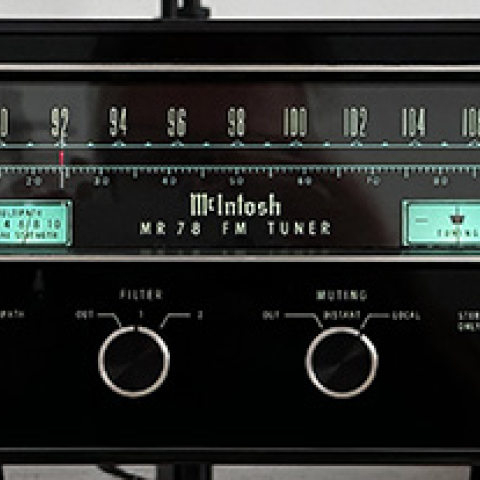
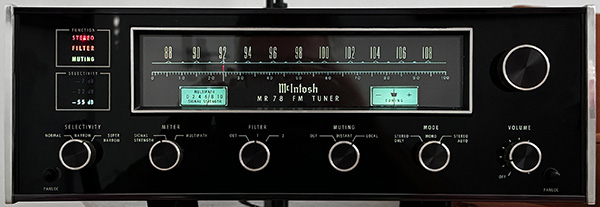
Here's the first analog thing: After owning a McIntosh MR78 tuner for many years—I bought it on eBay sometime early in this millennium; it was fully functional and in superficially excellent condition—I finally did what I'd long intended to do: I sent it in to Audio Classics for inspection, refurbishment, and the famed Modafferi mod.
At the time of its introduction, the MR78 was almost certainly the best tuner ever made. It is the only radio tuner in the IEEE Consumer Electronics Hall of Fame, alongside the original iPhone, the Fuzzbuster radar detector, the Sony Trinitron, the Technics SL-1200 turntable, the Bowmar 901B electronic calculator, the Sony Walkman, the Marantz CD-7, the Epson Stylus color printer, the Zircon StudSensor, the TI Speak & Spell, the Casio F-91W digital watch, TiVo, the Panasonic PV-1563 VHS VCR, the Boss TU-12 guitar tuner (the only other tuner on the list—heh), the Grundig Satellit shortwave radio—back in my shortwave-radio days, I so wanted one of these—the Atari 2600, the Tandy/RadioShack TRS-80, and the PhoneMate 400 (footnote 1). This last was the very first telephone answering machine, which (IEEE says) weighed 10lb and cost $300 in 1971. It stored up to 20 messages on a small reel-to-reel tape.
Anyway, the MR78 is in the Hall of Fame.
The MR78 was designed to solve a problem. In the early 1970s, the FM dial had become crowded. Weak, distant stations were often too close (in frequency) to stronger, closer stations. Excellent tuners existed—the Hall-of-Fame description lists the McIntosh MR71, the Fisher FM-1000, and the Marantz 10B (footnote 2)—but they all were sloppy in the sense that the bandwidth of their filters was much too wide, wider than the 0.2MHz that broadcasters were allotted. None of the tuners on the market had the selectivity to deal with an increasingly crowded FM dial.
The MR78 was designed by a "young engineering genius"—I'm quoting the Hall of Fame—"named Richard Modafferi." He first designed the MR77, which was received by enthusiasts with raves but which, when hauled to the home of Harold Colt in Farmington, Connecticut, and subjected to McIntosh's tuner torture test, did not do as well as Modafferi had hoped (footnote 3). On the trip home, he conceptualized the MR78—and over the course of months built a Frankenstein's monster of a tuner that combined two MR71s and an MR77 to demonstrate the ideas that would soon become the MR78. He returned to Colt's place with "the Kludge." "Picture his surprise, and mine, too, when this contraption pulled in clear signals" from all three NYC radio stations.
He then applied lessons learned to make his magnum opus, the MR78, which was introduced in 1972 (one year after the PhoneMate 400). Modafferi's breakthrough was a new filter called the Rimo (short for Richard Modafferi; footnote 4). The MR78 was perhaps the first tuner to be designed by computer: Specifically, Modafferi used "an IBM1130 high speed computer" to fine-tune the filter's response. The owner's manual says the computer "spent eighteen minutes on the mathematics for the design of the IF filter. It would have taken an engineer, working twenty-four hours a day, seven days a week, and working error-free three-hundred years to perform the same mathematical calculations." Modafferi also designed a new FM detector, to work with the new filter.
The new design greatly improved selectivity and, as a bonus, reduced intermodulation distortion—a huge, underappreciated problem—from some 15% (typical in tuners of the time) to below 1% (in the MR78). No wonder FM could sound fuzzy.
When it was introduced, the MR78 cost $1699, and I've read (but haven't verified) that McIntosh lost money on every unit sold.
To get to the point finally: The FM dial may be less crowded than it was circa 1970, but for $1200 paid to Audio Classics, Richard Modafferi—the man himself, who is now 88 years old—will personally clean, align, and modify your McIntosh tuner, employing technology beyond what was included when new. After all those years of intending to, I finally got it done.
It turned out that my MR78, which was very clean on the outside, was kind of a mess on the inside. Indeed, from the notes Modafferi made, I'm surprised it worked at all. "Very dirty!," wrote the no-longer-young "genius engineer." "One and a half days just to clean it!" This was, weirdly, a blow to my ego. Modafferi traced a short and replaced a transistor and several diodes, resistors, and capacitors. He installed a new dial-pointer insert. And then he got to the mods (footnote 5).
The result: Using an indoor Magnum Dynalab ST-2 antenna, I can receive all the stations I am interested in hearing in quality ranging from pretty good to outstanding. I am listening now to classical piano on a local public station. There's a strong stereo image with good depth and rich, creamy tone. I know people say that terrestrial radio no longer sounds good—but then I don't recall hearing FM radio sound this good. Ever.
Other analog matters have arisen in recent weeks, but now I'm out of space. They'll need to wait for a future column.
Footnote 1: I'm making this a long list because it's so much damn fun. You can find the complete list at spectrum.ieee.org/special-reports/consumer-electronics-hall-of-fame/. Footnote 2: Modafferi gives great credit to Richard Sequerra, designer of the 10B, which he (Modafferi) calls "a landmark design." Footnote 3: The man himself told this story in a letter published in Audio magazine in 1977. The test was to try to clearly receive three New York City stations from this Connecticut location, all adjacent to strong local stations.
Footnote 4: The very first tuner featuring a Rimo filter was built in 1965—by Modafferi, while he was in graduate school at the New Jersey Institute of Technology. That one used vacuum tubes.
Footnote 5: The mods are rather technical, so rather than discuss them here, I'll just include a link: audioclassics.com/mods.
Footnote 1: I'm making this a long list because it's so much damn fun. You can find the complete list at spectrum.ieee.org/special-reports/consumer-electronics-hall-of-fame/. Footnote 2: Modafferi gives great credit to Richard Sequerra, designer of the 10B, which he (Modafferi) calls "a landmark design." Footnote 3: The man himself told this story in a letter published in Audio magazine in 1977. The test was to try to clearly receive three New York City stations from this Connecticut location, all adjacent to strong local stations.