
Over the years, a few Americans have asked me what Copenhagen is like. I'm Dutch. Clearly, although Denmark and the Netherlands are 400 miles apart, the difference isn't always clear to everyone. (I blame the initial D and the sibilant endings: Dutch, Danish.) Honestly, I take no offense, and as a Stereophile writer I may even consider it a compliment: Denmark, with barely a third of the Netherlands' population, has produced so many hi-fi manufacturers, you can't throw a capacitor without hitting an audio engineer. We Dutch have some catching up to do.
Still, during two days at the annual Dutch Audio Event in Veldhoven in the southern Netherlands that was held October 10–11, I felt heartened. The scene was electric (no pun). I encountered locally made loudspeakers made from exotic nanocomposites, modular designs that can grow with their owners, and open-baffle systems that dispensed with conventional enclosures. Some of the companies behind them were on my list before I arrived; others came recommended by fellow scribes and exhibitors, or caught my ear as I walked past. In no particular order, here are the Dutch brands that made me stop and listen.
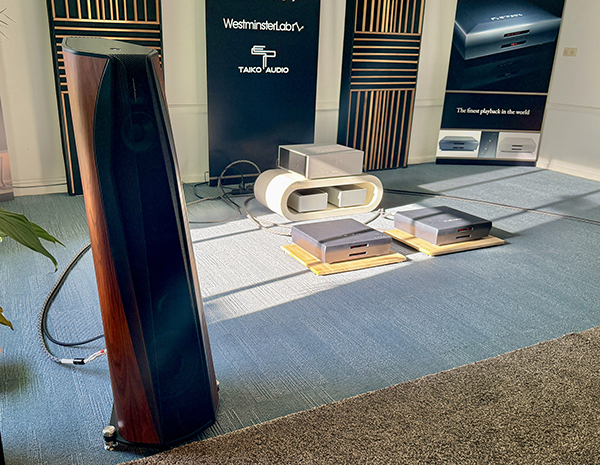
Aequo Audio’s Ensium speakers:
Eindhoven-based Aequo Audio was showing its Ensium loudspeaker ($55,000/pair), a three-way floorstander whose curved, seemingly windswept enclosure conceals some unusually ambitious materials. Each speaker weighs 284lb, yet its cabinet walls are only about ¼" thick. The secret is Diluvite, a proprietary nanocomposite material developed by Aequo cofounder and designer Ivo Sparidaens.
Most loudspeaker manufacturers strive to make their cabinets as rigid and inert as possible, using thick panels, internal bracing, damping materials, or some combination thereof. Aequo takes a different approach. Diluvite is cast into two complex, asymmetrical sections that are subsequently joined together. The company claims the material is twice as stiff as aluminum and provides 10 times the damping, converting mechanical vibrations into minute amounts of heat rather than storing and releasing that energy as audible coloration. Aequo further claims exceptionally consistent damping across a frequency range extending from 1Hz to 100kHz.
The enclosure shape serves another purpose. The drivers are staggered in depth to achieve time alignment, while the smoothly curving baffle minimizes diffraction. The Ensium uses a 10.5" woofer, a 5" midrange driver, and Aequo's proprietary SF40 tweeter, which incorporates an Enhanced Horizontal Dispersion Lens (EHDL). The claimed in-room frequency response is an impressive 16Hz–45kHz (–3dB). You won't need subwoofers with the Ensiums.
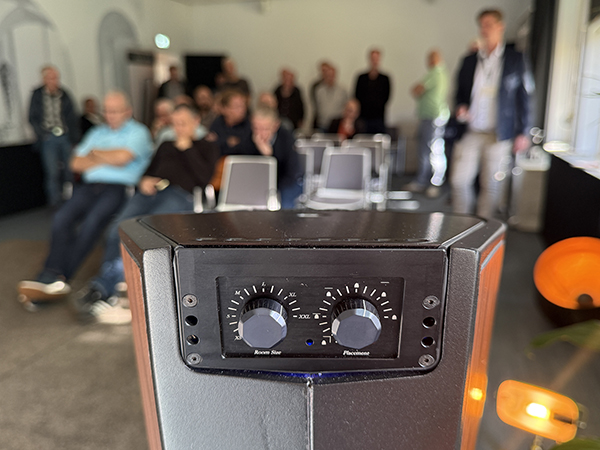
Another distinctive feature is Aequo's ARPEC system—Analog Room and Placement Extension Controller—which adjusts the bass response to accommodate room size and speaker placement. Two controls on the rear of each speaker allow the user to compensate for differences in room gain and proximity to walls. Unlike the digital room-correction systems found in many contemporary loudspeakers, ARPEC operates entirely in the analog domain.
Each Ensium incorporates a 500W Hypex Class D amplifier to drive its 10.5" woofer. This relieves the external amplifier of much of the burden of reproducing the lowest frequencies and permits the use of comparatively low-powered amplification for the midrange and treble.
Aequo's demonstration system was hardly low-powered, however. The speakers were driven by WestminsterLab Rei monoblocks ($37,900/pair) and a Quest preamplifier ($27,900). Playback Designs MPT-8 transport ($20,000) and MPD-8 DAC ($26,000) provided the digital front end, along with a Taiko Audio Extreme server (approximately $36,000).
The Ensium's combination of unconventional cabinet technology, analog bass adjustment, and ambitious driver engineering made it one of the more technically interesting loudspeakers at this year's show. I loved what I heard: for a speaker that dives well below 20Hz, the sound was exceptionally fleet of foot (as opposed to plodding), and there was plentiful soundstage depth, not just width. Coherence? Tonality? Spaciousness? I couldn’t find a single thing to kvetch about. Happily, a review pair of this remarkable product will soon be on its way to my home. More Ensium coverage to come.
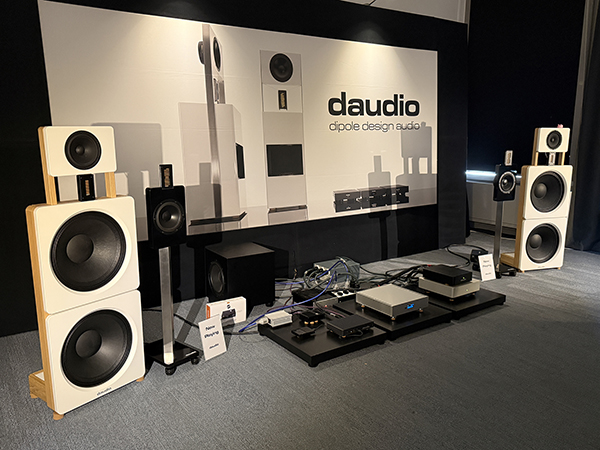
Daudio: An open-baffle Dutch delight
When several fellow audio writers and manufacturers independently recommend that you visit a particular room, you'd be foolish not to investigate. That's how, at the audio show in Veldhoven, I ended up in the room occupied by Dutch manufacturer Daudio. Principals Hans Beckeringh and Jeroen Dezaire were demonstrating two distinctly different loudspeaker systems, both open-baffle designs.
Daudio's guiding idea is that removing the conventional loudspeaker enclosure (and with it a source of unwanted resonance and coloration) brings reproduced music closer to the real thing.
The larger of the two loudspeaker systems in the room was the white MOB 2.5 (about $11,000/pair in the configuration demonstrated). MOB stands for Modular Open Baffle. Like the offerings from open-baffle pioneer PureAudioProject, Daudio's speaker designs allow buyers to choose between different drivers and crossover configurations. The show version featured Daudio's premium driver combination—an SB Acoustics Satori midrange and a Mundorf AMT tweeter—along with an upgraded crossover and the new Nero woofers, making their debut at this year's event.
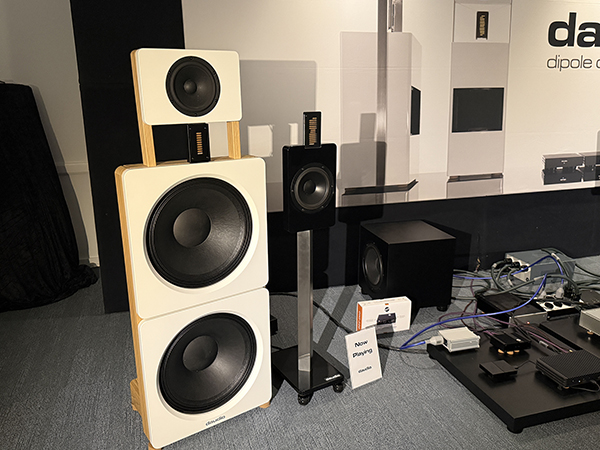
Counterintuitively, the smaller, black M1 system cost considerably more: roughly $18,000 for two open-baffle monitors, a separate subwoofer with upgraded AudioTechnology woofers, and the associated crossovers. The M1 belongs to Daudio's more ambitious High Line range, with custom AudioTechnology midrange drivers and a modified Mundorf dipole Air Motion Transformer tweeter. Both systems used the same source components and amplification.
A fanless Daudio streamer ($2300), running Roon Server or JPLAY with HQPlayer, upsampled the digital signal to DSD1024 before sending it to Daudio’s newly revised DSD DAC 1024 ($4500). The updated converter supports that unusually high DSD rate and incorporates improvements to its clock and power supply.
Amplification came from Daudio's P1000 integrated amplifier ($4200), which uses Purifi Eigentakt Class D modules rated at 450Wpc. The company supplied its AirTube Silver/Gold interconnects, USB cable, and speaker cables.
We listened to Jan Akkerman's "Mon Amour" and Arooj Aftab's "Aey Nehin" on the M1 system. The lyrical qualities of both recordings went straight from the ears to the heart, seeming completely unimpeded by the surfeit of metal and silicon the signal had to pass through.
Remarkably, Beckeringh and Dezaire have developed their own approach to an entire playback system. They build loudspeakers, electronics, and cables, offer room-acoustic advice, and provide different configurations according to customers’ circumstances and preferences.
Should they make it to, let's say, AXPONA 2027, go have a listen. I predict you’ll love what their gear is capable of (re)producing.
Lyssna: A loudspeaker that grows with you
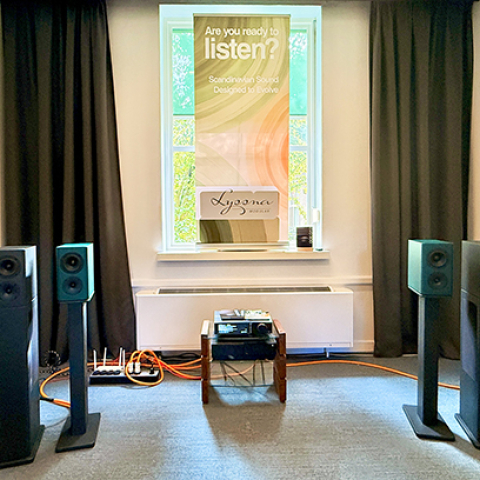
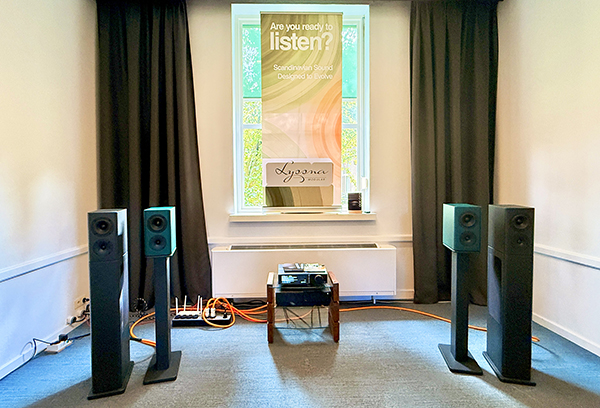
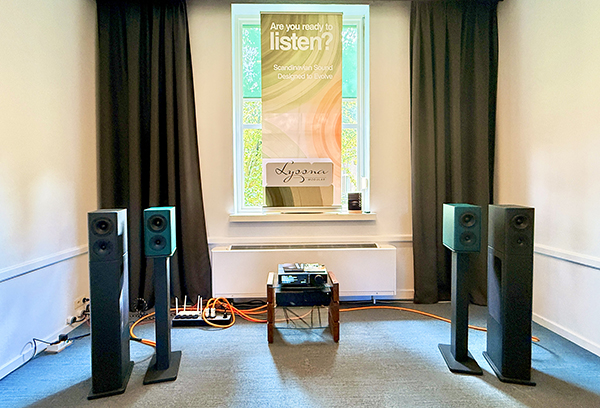
Lyssna Acoustics, a Dutch startup with a Scandinavian name (in Swedish, lyssna means listen) launched an intriguing product at the DAE. Founders Ruud Moerman and Kobus Oomen have taken their inspiration from Nordic design, emphasizing simplicity, elegance, and practicality. The Lyssna Modular, a small standmount, addresses a familiar dilemma: What happens when you love your loudspeakers but eventually want something bigger? The Dutch duo, perhaps taking a cue from Kii and its Model Three loudspeakers with optional BXT bass modules, developed a system that allows customers to upgrade from said standmount to a three-way floorstander without ditching the original speakers.
Of course, the Kiis are active, and the Lyssnas are passive; a critical distinction. The Dutch brand demonstrated the three-way configuration with Cambridge Audio's new Evo 300 streaming integrated amplifier ($3999).
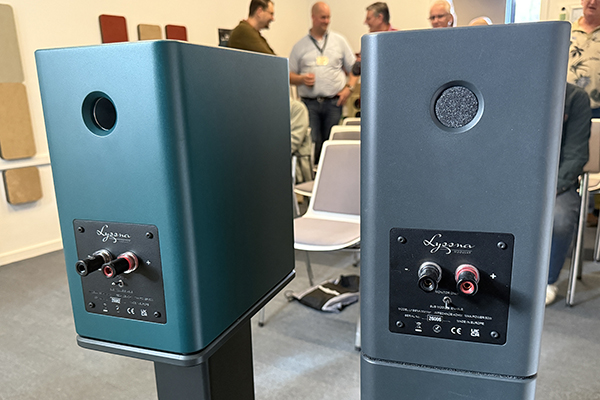
Lyssna's Monitors ($3200/pair) are two-way standmounts, only 11.4" tall. They each sport a 4.5" Wavecor bass/midrange driver and a waveguide-loaded soft-dome tweeter. The Monitors' rated frequency response is 50Hz–20kHz (–3dB). Sensitivity is given as 88dB/2.83V/m, and nominal impedance is 4 ohms. Matching stands are available.
When an owner wants more bass extension and greater output capability, the Monitors can be placed directly atop Lyssna's Bass Modules, which contain a 7.5" woofer and a matching 7.5" passive radiator. A connector on the underside of each Monitor mates with the module beneath it, eliminating the need for additional speaker cables. In that configuration, the Monitor's own crossover is bypassed, and the crossover in the Bass Module takes over, transforming the combo ($6600/pair) into a genuine three-way loudspeaker with a rated bottom extension of 32Hz.
Rather than seek investors or bank financing, Moerman and Oomen launched a 30-day Kickstarter campaign on October 10, the opening day of the show, to finance their first substantial production run. Early supporters can purchase a pair of Monitors for $2360, or the complete three-way system for $5130. Deliveries are projected for March 2027.
Crowdfunding loudspeakers carries risks, of course, particularly when the manufacturer is new and production has yet to scale up. My recent show report about Dutch turntable maker Miniot might serve as a warning of sorts. But Moerman and Oomen aren't seeking money to develop a hypothetical product. The loudspeakers already exist, and visitors to the Dutch Audio Event could hear them for themselves.
Reactions were generally positive. Personally, I admired the system even though it couldn't quite seduce me. The sound from the full setup was on the dry side with Melody Gardot's "The Rain," and bereft of bottom-end slam when I requested Control Machete's "Si Señor," a hard-hitting Mexican rap track. That's not really a knock on Lyssna or its engineering. No two ways about it: the modest cabinet volume of each speaker (even with the bass module attached) and the relatively small 7.5" woofers can’t overcome the laws of physics. Listeners who like bass-heavy music that hits the solar plexus may simply need…more speaker.
Grimm Audio brings a different kind of PA system
What do you do when the amplifiers you've auditioned aren't good enough to demonstrate your new streamer? Design your own, of course. And when you can't find a loudspeaker that does complete justice to your new amplifier? You can probably guess.
That, more or less, is how Dutch manufacturer Grimm Audio arrived at the system it demoed at the annual Dutch Audio Event.
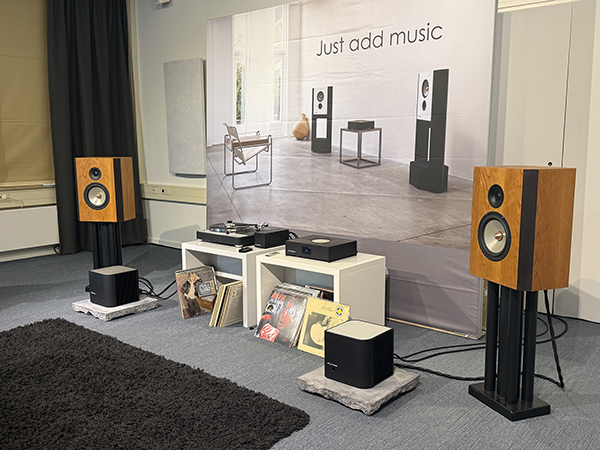
The new PA1 monoblocks ($26,500/pair) made their public debut at High End Vienna in June 2026. Their ancestry goes back further, to prototype amplifiers Grimm used while developing its MU2 streaming DAC/preamplifier. The company subsequently decided to turn those prototypes into a commercial product. A roughly 10-inch black cube, the PA1 looks almost dainty and can be confused for a small sub.
According to principals Eelco Grimm and Guido Tent, their class-AB amp was designed to combine the musical qualities of the best tube amplifiers with the power and control of solid-state designs. Getting there required addressing what Grimm calls "dynamic distortion," which varies with the music's level and frequency content, making it difficult to detect through conventional measurements that use only a single sine wave. One culprit is heat. As music plays, output transistors heat and cool rapidly, changing their electrical characteristics and potentially disturbing their carefully chosen operating point. Grimm's solution was to use 96 small, fast output transistors mounted on an aluminum circuit board that keeps them closely coupled thermally. The circuitry controlling their bias sits on the same board, allowing it to track temperature changes and maintain a stable operating point.
The designers also addressed phase modulation caused by signal-dependent changes in transistor capacitance. Grimm says the resulting amplifier achieves exceptionally low distortion without sacrificing power. Each PA1 delivers 200W into 4 ohms, draws on 90,000µF of power-supply capacitance, and employs more than 100dB of feedback throughout the audio band. Claimed distortion remains below –120dB across frequencies and output levels.
The PA1's output stage is based on a circuit originally developed in 1985 by the late Dutch engineer Henk ten Pierick. The designation PA1 ("Pierick Amp") is a nod to his memory.
The passive loudspeakers in the room were almost an accident. Grimm had auditioned several candidates for the PA1's introduction but found none entirely satisfactory. So the engineers put together a prototype of their own.
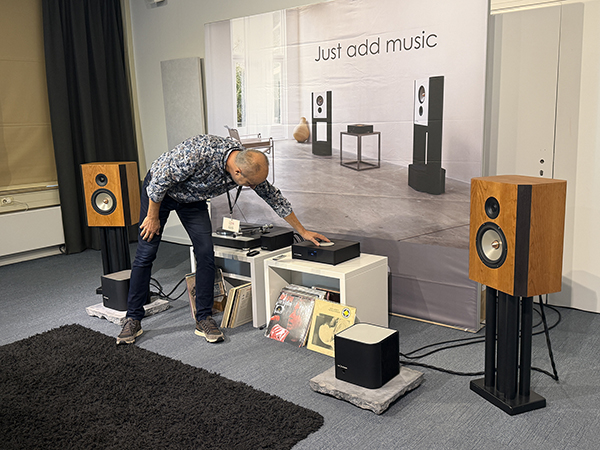
The resulting two-way standmount uses SEAS drivers, a broad baffle with rounded edges reminiscent of Grimm’s active LS1, and a passive radiator for bass extension. Achieving the desired response with a passive crossover proved challenging, Grimm acknowledged, particularly when balancing neutrality against circuit complexity. What started as an experiment is now being developed into a commercial product expected in 2027. Neither its final name nor its price has been announced. We do know that the currently somewhat basic shape of the cabinets will turn into something quite different: the enclosure designs that Eelco Grimm proudly showed me on a laptop looked luxurious and handsome.
At the Dutch Audio Event, the PA1s and prototype speakers were partnered with Grimm’s top-notch MU2 streamer/DAC/preamplifier ($20,000). Analog playback was provided by a Dr. Feickert Volare 25 turntable ($5000) with a Jico Seto Hori MC cartridge ($1000) feeding Grimm’s PW1 phono preamplifier ($5650). It all sounded arresting together, and I noted that an unknown-to-me recording of a drum solo with a live audience gave the impression of a real kit in a real space—and not just in terms of raw power. The system beautifully rendered the delicacy of each small tap on the ride cymbal, too.
Parting thought: If you get a pair of these Grimm amplifiers, you can tell your neighbors you've bought a PA system and watch their eyes widen in horror. That's almost as cool as the amps themselves.
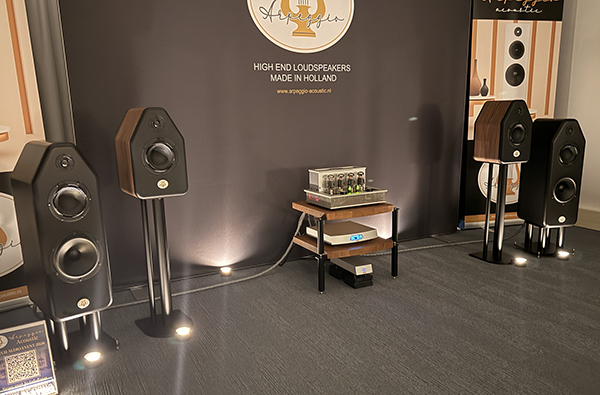
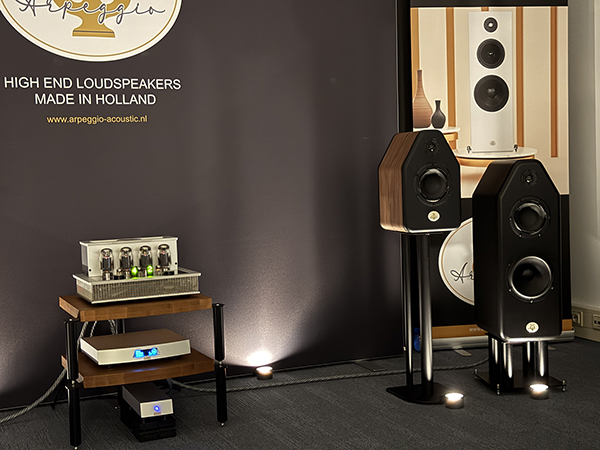
Just one more room: Arpeggio Acoustic
By late Sunday afternoon, I thought I was finished. Two days of listening, interviewing, photographing, and taking notes had produced more than enough material for my show coverage. I was ready to call it a day.
Then I heard something that changed my mind. The music was coming from the room occupied by Arpeggio Acoustic, a small Dutch loudspeaker manufacturer whose name was unfamiliar to me.
Arpeggio is the creation of Björn Jeroen Tidström, who also operates Da Capo High End Audio in Kerk-Avezaath, near Tiel. The son of professional musicians—a violinist and a pianist—Tidström has spent more than 25 years in high-end audio. He told me he began developing his own loudspeakers after observing how some expensive systems disappointed customers when installed in ordinary living rooms. But the audio bug bit when Tidström was still in britches. He traces his fascination with high-fidelity sound to a concert his father took him to when he was barely seven. "I can still vividly remember sitting spellbound, listening to Monteverdi's Vespers 1610. The passages with choir and orchestra together were especially impressive because the entire church filled with sound."
He’s been trying to recreate that experience at home ever since, readily admitting that the goal remains elusive. Still, he says, decades of experimenting with equipment, speaker placement, cables, and room acoustics have brought him progressively closer to the sound he remembers from childhood.
The speakers that had caught my ear were the Arpeggio Mezzo Opuses (Opi?), a substantial three-way design employing sealed enclosures. Tidström specifies a frequency response of 38Hz–23kHz (±3dB), a sensitivity of 91dB/1W/1m, and a nominal impedance of 8 ohms. The speakers retail for about $13,000/pair.
An Audio Research I/70 integrated tube amplifier ($9950), rated at 70Wpc and employing four 6550 output tubes, drove the Mezzo Opus speakers. The digital source was a Lumin X2 network player ($16,800).
Listening to A.R. Rahman's "Dacoit Duel," from the 2004 Sony Classical release Between Heaven and Earth, I was struck by the immediacy of the drums and the solidity of the choir. The Mezzo Opus brought drama and poetry to the track. I realize those nouns are not descriptors of sonics, but I’m using them here advisedly because, like the Daudio system, the Arpeggio gear bypassed the language center of my brain, going straight for the feels. It was a fitting finale.