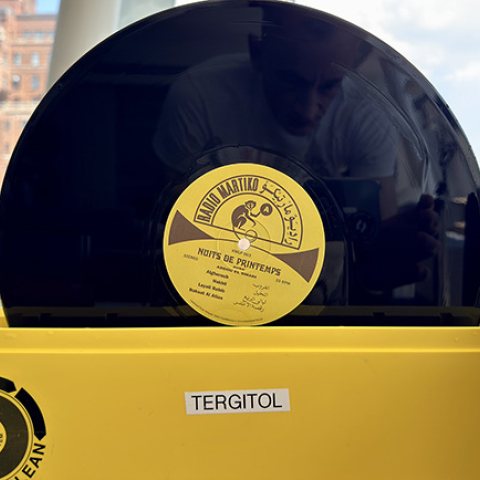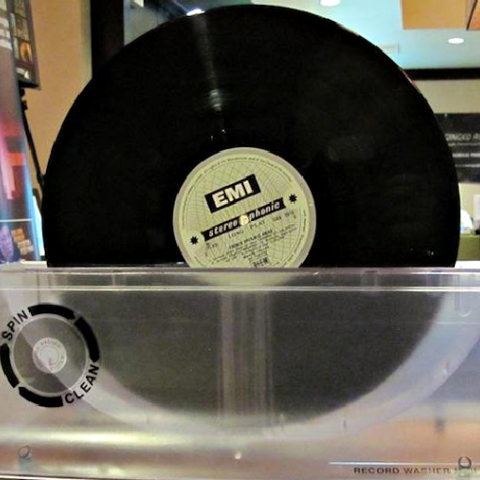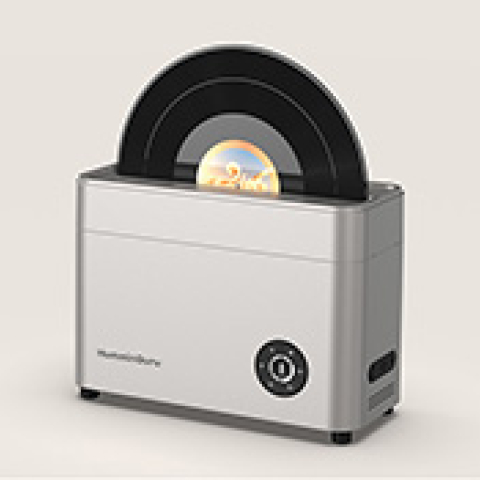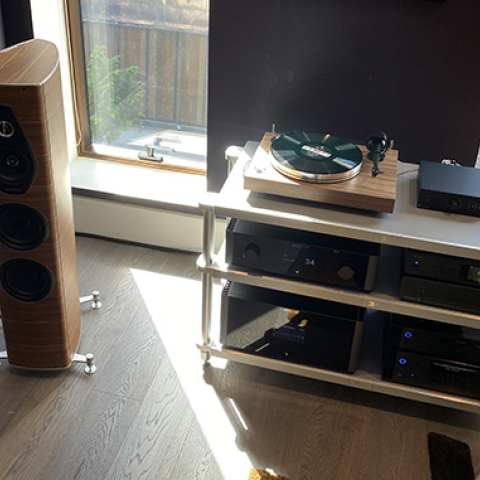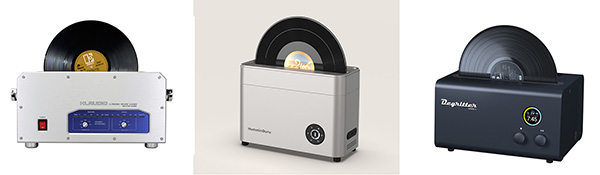
Two recent Stereophile columns have offered thoughts on record cleaning machines (RCMs). In the March Spin Doctor, Michael Trei wrote about the ultrasonic Klaudio KD-CLN-LP200T (above left), which costs north of $6000 and is great for production-scale cleaning; you can even plumb it directly into your home water supply. In this month's Gramophone Dreams, on p.21, Herb Reichert discusses his new Record Doctor VI 20th Anniversary Edition, which he received as a gift from a friend; those not as lucky as Herb will need to shell out $349 to get one. Herb notes in the column that in his life he has done quite a lot of old-fashioned, in-the-sink record cleaning. Now he's an RCM convert.
There's much to be said for cleaning records in the sink. The biggest problem is the risk of getting the labels wet. Wouldn't it be nice if there was a product that sealed the labels off so that you didn't have to worry about that?
There is such a product of course. There has been for decades. Generically, it's called a "label saver." The first serious commercial version I became aware of was the Groovmaster by Bill Grover (Bill Groover?), an early advocate of kitchen-sink record care. You can buy a Groovmaster at groovmaster.com for $50 plus $7 shipping.
Why am I mentioning label savers? Because: rinsing.
Writing about the Klaudio RCM, Trei noted that the manufacturer says to use just water. No surfactant.
The question of whether to add a surfactant in ultrasonic machines is interesting. Surfactants lower surface tension. That helps water penetrate the record grooves, which is easy to see with vacuum-style cleaners: With a surfactant, water spreads smoothly over the record surface instead of gathering in drops. If water doesn't get inside the grooves, it can't clean them.
With ultrasonic cleaners, surfactants make it easier for cavitation bubbles to form. More bubbles means a more thorough scrubbing. The bubbles are also smaller, which is good: They get deeper into the grooves. But each bubble has less energy, which could be good or bad.
The question whether to use a surfactant is bound up with another question: What kind of water should you use, tap or distilled?
Klaudio, the company, recently started up again after several years in the desert, thanks to an investment from Chad Kassem of Acoustic Sounds; Michael told that story in his column. Klaudio got started around 2010, but it still hasn't made its mind up whether to use distilled water or tap water: The website says distilled; the manual says tap.
It's an important choice. In ultrasonic cleaners, impurities in tap water act as nucleation sites for cavitation bubbles, so more bubbles form. In distilled water, fewer bubbles form: fewer but more energetic, maybe too energetic. For cavitation, tap water is usually better than distilled.
Tap water, though, has a serious problem. Even perfectly healthy drinking water contains dissolved minerals. New York City water, which is famed for its excellence, typically has some 60ppm—parts per million—of sodium, magnesium, calcium, and other stuff (footnote 1). Pull a record out of the tank, and it's left with a layer of water on the surface. Evaporate the water, and you leave behind those minerals. In my rough calculation, 60ppm is enough to form a single layer of crystal mineral across the whole surface plus a little more. That might be okay, but it's not what happens. Instead, dissolved solids concentrate into ever-smaller drops as the water evaporates. You're left with little piles—or little crystals—of mineral, much of it deep in the grooves.
Using distilled water solves this problem, but it makes cavitation less efficient. Adding a surfactant to distilled water solves the cavitation problem but creates another problem: Now the water is full of surfactant. Like those other dissolved solids in tap water, the surfactant will dry onto your record. A typical record cleaning solution will contain between 1000 and 5000ppm of surfactant. And the molecules are big.
I wrote about this briefly in footnote 3 of that Spin Doctor column. Research has determined, I wrote, that "common surfactants have a high affinity for the vinyl surface." If you don't rinse those records after removing them from the surfactant bath, "nonionic surfactants like Triton X-100 aggregate during drying." You may get rid of some clicks and pops, but the surfactant itself stays behind, causing "whooshing" or "rushing" sounds during playback.
Then I wrote that such surfactants are "easy to rinse off." Recently, I learned that Triton X-100 has a phenol ring, which causes it to stick to vinyl; it will wash off, but not as easily as some other surfactants, and only if you rinse. What's more, Triton X-100 is an Alkylphenol Ethoxylate (APE), which breaks down to octylphenol, an endocrine disruptor. That's bad for humans and other animals.
A much better choice is Tergitol 15-S-9. Tergitol 15-S-9 is a member of a family of closely related surfactants, Tergitol 15-S-X, where X is some number. The Tergitols were developed as functionally superior, nontoxic alternatives to APE surfactants. Three members of the Tergitol family are useful for cleaning records. Tergitol 15-S-9 does its job optimally and is the easiest to remove with a simple rinse. Tergitol 15-S-5 is oil-soluble, which makes it better at removing oily deposits, but it's not quite as rinsible. Tergitol 15-S-7 is a good compromise.
Rinsible surfactant is good—but it only helps if you include a rinsing step. Most tank cleaners—ultrasonics—don't include a separate rinsing step because there's no second tank. That may be why Klaudio advises not adding a surfactant, or one reason. Another might be its water filter: Surfactant molecules, which are large, may clog it up. I'm speculating.
Here's my suggestions for cleaning records in an ultrasonic record machine: Use distilled water. Add a little Tergitol 15-S-9—perhaps 0.2%—and maybe 0.1% 15-S-5 to remove oily fingerprints, unless your machine's manufacturer says not to use surfactant. Then, after a thorough ultrasonic soak, give your records a good rinse—in distilled water of course—even if you have to do it in the kitchen sink. Use a Groovmaster to save your labels.
I welcome comments from readers and members of the industry.
Footnote 1: New York City tap water is drawn from different sources, and which sources are used varies with the season. Croton Reservoir water is "harder"—more dissolved solids. Catskill water is softer. It follows that how much dissolved solids are in our drinking water varies with the season.
Footnote 1: New York City tap water is drawn from different sources, and which sources are used varies with the season. Croton Reservoir water is "harder"—more dissolved solids. Catskill water is softer. It follows that how much dissolved solids are in our drinking water varies with the season.