I remember, though not well, when I acquired my first "10-speed" bike. My parents bought it for me at Sears. It cost about $100. It had a white frame with red and blue accents. It replaced one of those super-fun high-handlebar, banana-seat bikes some folks reminisce about.
An early memory of the Sears bike is me backpedaling furiously approaching a sturdy mailbox. Ten-speed bikes don't have coaster brakes. I've still got a scar to prove it.
That would have been around 1978. Taking inflation into account, that bike would cost about $400 today. Sure, it was possible then to pay much more—Tour de France riders were not riding on bikes from Sears—but for regular folks at least, the luxury end of the road-bike market didn't really exist back then.
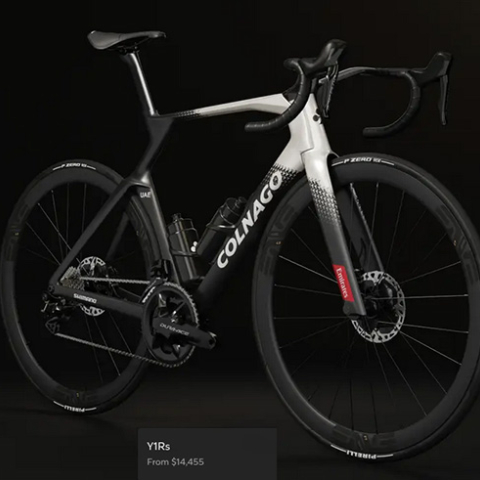
Today, a well-resourced cycling enthusiast can buy a Pinarello Dogma F for around $16,500, a bit less with discounts. The Dogma F "Edizione Speciale" can push that up to $18,500. These bikes aren't only for Tour riders; I've seen them zipping up and down Riverside Drive Sunday mornings. The next step up in price (footnote 1) would be a custom bike from a prestigious bespoke builder, maybe Passoni or Pegoretti. These bikes, I am told, can cost as much as $40,000.
Then things get silly. You can buy a bike plated in 24-karat gold, with 600 Swarovski crystals, for $100,000+; try parking that on a NYC sidewalk. The Butterfly Trek Madone, an "art bike" with real butterfly wings lacquered onto the frame, ridden by Lance Armstrong in the 2009 Tour de France, sold at a charity auction for a cool half-million.
Why talk about bicycles in a hi-fi magazine? Recently, I stumbled on a YouTube video by former UK pro cyclist Simon Richardson, for the Global Cycling Network (GCN). Richardson was excited about a new, affordable bike from Canyon, a German manufacturer that sells direct to consumer (footnote 2). Canyon bikes are popular among serious cyclists who want a fine bike, similar to what you'd get with a high-level Trek or Specialized (if perhaps not Pinarello), for significantly less cash. Canyon is a value-oriented brand, but their best bikes, and typically their best deals, are at prices few would call low.
The bike Richardson was excited about, though, was near the low end of the current market and at the very bottom of Canyon's lineup. In the US, the Endurace AllRoad costs $1500.
What I found interesting, though, was not the bike but Richardson's discussion of the road-bike market. "The price of stuff is going up and up," he said. Inflation is part of the story. Another part is what he called "premiumization.
"Didn't think that was a word?" he asked. I hadn't heard it, so I looked it up. I found essays by consultants advising businesses on how to use "premiumization" to business advantage.
"Cycling now appears to be more expensive, relative to average income, than at any time in the last 150 years," Richardson said in the video. Over an unspecified period, wages had doubled, while the price of high-end bikes quadrupled, he continued. The same phenomenon can be seen "at entry-level prices as well." A result is that for many, "cycling is just too expensive," Richardson said. For those considering entering the sport, prices are "a massive barrier."
As a lifelong cyclist who now only rides inside, on a Peloton exercise bike, I have found these prices alienating.
"I'm worried that cycling is sleepwalking into a problem," Richardson said. "Today's bikes are faster and nicer to ride than ever. But the tech you want comes at a cost. ... In this drive for ever better bikes, are we in danger of leaving people behind?"
In the drive for ever-better speakers, amplifiers, turntables, and so on, are we in danger of leaving people behind?
The similarity to the hi-fi industry is obvious, but it doesn't end there. "In cycling, ... the strongest sector of the market is the premium one, so there is much less incentive for brands to invest time and money into more affordable bikes and equipment," Richardson said. For a while now, the strongest sector of the hi-fi market, too, has been "the premium one." (footnote 3)
"What's the bike that's going to ... hook people into the sport, a bike that people can buy and ride and do everything on, and ltimately upgrade? The bike that 20-somethings can buy when they get their first job. ... [M]ore affordable bikes already exist, but they have to cut so many corners that you miss that feeling of jumping on a fast, light, responsive bike." Is this true of hi-fi as well? "That's where the addiction really starts."
What is hi-fi's gateway drug?
Later, also on YouTube, I saw a GCN talk show hosted by Richardson and another guy. Richardson again mentions the $1500 Canyon Endurace AllRoad, adding that the very week the AllRoad was introduced, US manufacturer Parlee introduced a bike called the Z-Zero with a retail price of $30,000. Richardson's opinion mirrors mine, or mine mirrors his. "I'm genuinely glad that both these bikes exist—which I know is an opinion that some people might struggle with. But I think it's perfectly possible for cycling to have super-premium and more affordable bikes. Not only that; it should have both."
But is the industry emphasizing the high end too much, at the expense of the more affordable end? "We have to give people legitimate and appealing options, to get them to bite," Richardson concluded. "Cycling should be both affordable and fun—and super-premium." Yep.
In hi-fi as in cycling, we've got the premium end covered, but what about the affordable end? I'd say there is reason for concern. The hi-fi market offers really good value, possibly more than ever before. But are those offerings exciting people? Are they drawing people in? Perhaps not. In fact, the current market makes some people angry—and that means they actually care. I know; I get letters. That's a reason to be concerned about the future.
This issue contains, on p.101, a new semiregular (that is, frequent but not every month) music column by Mike Mettler, called Sound Chaser. Mike's first column is about the great Brian Wilson, who died in June.
Footnote 1: But see below. Footnote 2: The video is from the Global Cycling Network. You can watch it at youtu.be/GefsXmg0YRI. Footnote 3: See stereophile.com/content/why-hi-fi-prices-have-risen.
This issue contains, on p.101, a new semiregular (that is, frequent but not every month) music column by Mike Mettler, called Sound Chaser. Mike's first column is about the great Brian Wilson, who died in June.
Footnote 1: But see below. Footnote 2: The video is from the Global Cycling Network. You can watch it at youtu.be/GefsXmg0YRI. Footnote 3: See stereophile.com/content/why-hi-fi-prices-have-risen.