Sometimes speakers talk to me. Usually when they do, they ask me to move them, or to move myself—the listening position—to suit them. The first time I recall experiencing this was at a Sonus faber listening event at the old McIntosh House in Manhattan—the first one, before they sold that one and got another one. That day, several speakers from a new Sonus faber line were being auditioned in various rooms throughout the mansion. As I listened to a smaller pair in a smaller room, I noticed I was leaning to the side. It was an off-center setup, with only a couple of feet between the speaker and a wall; on the other side was much more space.
I realize that this—the fact that speakers talk to me like this—doesn't make me special. I'm no "golden ears." My hearing is normal for my age, no better, no worse. Decades of careful listening over many hours, analytically and for pleasure, have turned me into a skilled listener, attuned me to stuff like this: of this I am sure. I also know that some of my Stereophile colleagues are more skilled than I am. Quite likely, a few of you, Stereophile's readers, are more skilled than I am, too. If you are, then you probably know what I mean when I write about loudspeakers talking to me. You've experienced it yourself.
Speakers don't talk in actual words of course. It works something like this: Something about a system's sound causes an internal, psychological stress that manifests as physical discomfort. The mind-body feels compelled to resolve it. When there's an obvious solution, as there is with an off-center image, the force can feel physical. That's the surprising thing: not that this happens but how visceral—how physical—it can feel. That speaker must be moved. It's a compulsion.
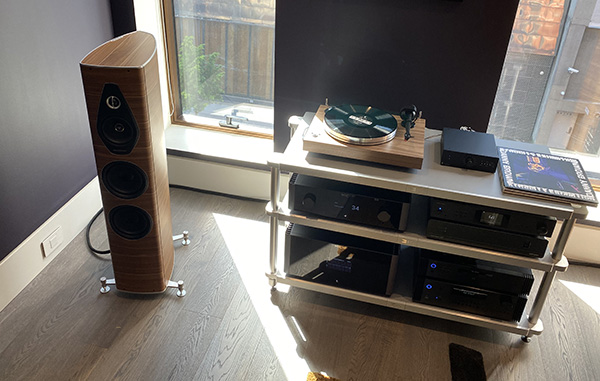
Just now, a similar thing happened at my house in Maine, where my wife, my dog, and I decamp for holidays and long weekends. This particular setup, in a finished basement, is casual, not carefully arranged. It's a two-channel system with a wall-mounted screen. The speakers are an old pair of Vienna Acoustics Beethovens inherited from my father-in-law. They're pretty good.
Those speakers said to me, "We are too close. Move us back about four inches." These speakers are pretty light, easy to move, so I did that.
Was the sound better? All I know for sure is that the speakers stopped complaining. The stress went away. Apparently, they were content, so I could be content, too.
Sometimes when hi-fi components talk to us, the message is easier to understand, if also less visceral. An example is the distortion that often results when the antiskate force is set incorrectly or not at all. I discussed the skating force in this space in the November 2025 issue of Stereophile. There, I noted that the skating force, which is rarely explained clearly, is the result of a small extra inward pull by the tonearm on the stylus, beyond what is needed to hold the stylus in place. It's a geometry thing. In that AWSI, I didn't get into the consequences much, but the result is often heard as distortion in the right channel, especially on plosives and sibilants. There I focused on the geometry and the reason the force exists. Here, I'll focus on the consequences and how to diagnose and fix the problem. Start by turning on your turntable and putting on a record. Now look at your phono cartridge straight on, with the spindle on the left, the run-in groove to the right, the platter spinning toward you. On a stereo record, you can think of the groove layout as an X, each (crossing) straight line corresponding to a channel. With this convention—looking on from the front—top-left-to-bottom-right oscillations correspond to the right channel, while top-right-to-bottom-left oscillations correspond to the left channel.
 Each oscillation—every stylus vibration—includes a dip (the low point) and a bump (the high point). Now imagine you're riding on a roller coaster: That bump is where you're grateful for the seatbelt, because the roller coaster wants to fling you off into space. On a turntable, that force is opposed—compensated—by the vertical tracking force you set. It's like your seatbelt, or the tracks on the car you're riding in: It's what keeps the stylus nicely in the groove.
At the outer groove wall, the skating force (which pulls inward) reduces the effective tracking force. At those bumps, the stylus may fly off into space and then come crashing down. Because high frequencies require very fast changes in direction—tight corners that are hard to navigate—the resulting distortion is usually in the highs, from, say, 3kHz on up. Often, the distortion is heard as sibilants—"S" sounds; instead of being smooth and soft, they are "spitty" and aggressive; they may sound too loud. It can also add an unnatural edge to cymbals and snares.
A balance control is helpful in diagnosing the problem, especially when the source of those sibilants (a vocalist, say) is centered in the soundstage. Turn the balance control all the way to the left channel, listen, and then turn it to the right. If no anti-skating force is set, and you've got a skating-force problem, you'll hear the sibilance from the right channel but not from the left. If you hear excessive sibilance in both channels, the skating force probably isn't at fault. If you hear it only in the left channel, then you've probably got your antiskate on and set too high.
Another way to deal with the skating force—with its most obvious symptom anyway—is to increase VTF. Just make sure you stay in the recommended range. But even if that works to reduce or eliminate skating-induced mistracking and sibilance distortion, there's a constant, baseline outward force on the suspension, keeping it compressed with respect to the left channel and expanded with respect to the right. That's bound to have sonic consequences.
What appeals to me most about this and similar topics is the attention to detail it suggests. Spending money is one obvious way to improve the sound of your system. Spending attention is another, cheaper way. Attention to detail—deep involvement with your system, its sound, and why it sounds like it does—pays dividends beyond the mere sonic improvement. It helps immerse you in the music. I'm not against spending money—not at all—but unless you focus attention this way, sweating small details, you're not going to get the most out of your hi-fi system, the music, or this hobby.
Each oscillation—every stylus vibration—includes a dip (the low point) and a bump (the high point). Now imagine you're riding on a roller coaster: That bump is where you're grateful for the seatbelt, because the roller coaster wants to fling you off into space. On a turntable, that force is opposed—compensated—by the vertical tracking force you set. It's like your seatbelt, or the tracks on the car you're riding in: It's what keeps the stylus nicely in the groove.
At the outer groove wall, the skating force (which pulls inward) reduces the effective tracking force. At those bumps, the stylus may fly off into space and then come crashing down. Because high frequencies require very fast changes in direction—tight corners that are hard to navigate—the resulting distortion is usually in the highs, from, say, 3kHz on up. Often, the distortion is heard as sibilants—"S" sounds; instead of being smooth and soft, they are "spitty" and aggressive; they may sound too loud. It can also add an unnatural edge to cymbals and snares.
A balance control is helpful in diagnosing the problem, especially when the source of those sibilants (a vocalist, say) is centered in the soundstage. Turn the balance control all the way to the left channel, listen, and then turn it to the right. If no anti-skating force is set, and you've got a skating-force problem, you'll hear the sibilance from the right channel but not from the left. If you hear excessive sibilance in both channels, the skating force probably isn't at fault. If you hear it only in the left channel, then you've probably got your antiskate on and set too high.
Another way to deal with the skating force—with its most obvious symptom anyway—is to increase VTF. Just make sure you stay in the recommended range. But even if that works to reduce or eliminate skating-induced mistracking and sibilance distortion, there's a constant, baseline outward force on the suspension, keeping it compressed with respect to the left channel and expanded with respect to the right. That's bound to have sonic consequences.
What appeals to me most about this and similar topics is the attention to detail it suggests. Spending money is one obvious way to improve the sound of your system. Spending attention is another, cheaper way. Attention to detail—deep involvement with your system, its sound, and why it sounds like it does—pays dividends beyond the mere sonic improvement. It helps immerse you in the music. I'm not against spending money—not at all—but unless you focus attention this way, sweating small details, you're not going to get the most out of your hi-fi system, the music, or this hobby.
Sometimes when hi-fi components talk to us, the message is easier to understand, if also less visceral. An example is the distortion that often results when the antiskate force is set incorrectly or not at all. I discussed the skating force in this space in the November 2025 issue of Stereophile. There, I noted that the skating force, which is rarely explained clearly, is the result of a small extra inward pull by the tonearm on the stylus, beyond what is needed to hold the stylus in place. It's a geometry thing. In that AWSI, I didn't get into the consequences much, but the result is often heard as distortion in the right channel, especially on plosives and sibilants. There I focused on the geometry and the reason the force exists. Here, I'll focus on the consequences and how to diagnose and fix the problem. Start by turning on your turntable and putting on a record. Now look at your phono cartridge straight on, with the spindle on the left, the run-in groove to the right, the platter spinning toward you. On a stereo record, you can think of the groove layout as an X, each (crossing) straight line corresponding to a channel. With this convention—looking on from the front—top-left-to-bottom-right oscillations correspond to the right channel,
while top-right-to-bottom-left oscillations correspond to the left channel.
Each oscillation—every stylus vibration—includes a dip (the low point) and a bump (the high point). Now imagine you're riding on a roller coaster: That bump is where you're grateful for the seatbelt, because the roller coaster wants to fling you off into space. On a turntable, that force is opposed—compensated—by the vertical tracking force you set. It's like your seatbelt, or the tracks on the car you're riding in: It's what keeps the stylus nicely in the groove.