Lately, hi-fi's technical emphasis has shifted toward time, away from its longtime main focus on the frequency domain. I'm thinking the trend, which I consider a good thing, started years ago with growing awareness it might be better to accept some aliasing in order to avoid the phase distortion resulting from a "brick-wall" reconstruction filter. More recent examples include the approach to D/A conversion taken by CH Precision (footnote 1) and—dare I mention it?—the theory behind MQA (footnote 2). I also encountered the trend once on the analog side; I'm thinking of Haniwa, which makes phono cartridges, phono preamps, and single-driver speakers that aim to preserve phase relationships (footnote 3).
I was reminded of this while preparing this month's lead review, of the Marten Mingus Septet Statement Edition loudspeaker, a time-coincident design. In most speakers, time is an afterthought—pun intended. Frequency is the headliner: How low does it go? How even is the response? How uniform is it in the vertical and horizontal planes? Such things are of course very important, but time matters too and it gets far less attention. Marten is one of the few loudspeaker manufacturers that give time top, or at least equal, billing.
Before I undertook the Marten review, I didn't know much about time-coincident loudspeakers. Writing this review improved my understanding a good bit. I decided it would be worthwhile to share what I learned.
I used to think time coincidence was all about arrival time: Do the wavefronts from the various drivers arrive at your ear at the same time? Or does the tweeter wave lead that of the midrange, which then leads the woofer's? Different arrival times for different drivers are far more common than not, because most loudspeakers use drivers with varied acoustical centers. Tweeters tend to be shallow, so their wavefronts arrive first. For most cone drivers, the larger the driver, the farther back the acoustical center. A design that aims to coordinate arrival times must compensate.
There is, however, another issue with time-domain integrity. Crossover filters shift frequencies near the crossover point relative to frequencies farther away. Higher-order filters affect a narrower frequency range than lower-order filters, but they affect it more severely, in ways that can't be repaired.
To maintain perfect time-domain integrity, you've got three options: digitize and use DSP, use a single wide-bandwidth driver, or use first-order crossovers.
These plots assume that the drivers share acoustical centers, and they ignore some other complications, like the fact that real-world bandwidth is finite. You can hear the sound of a synthesized drumstick click with the different crossover topologies in this audio file.
(Play 0526-click_demo_1500)
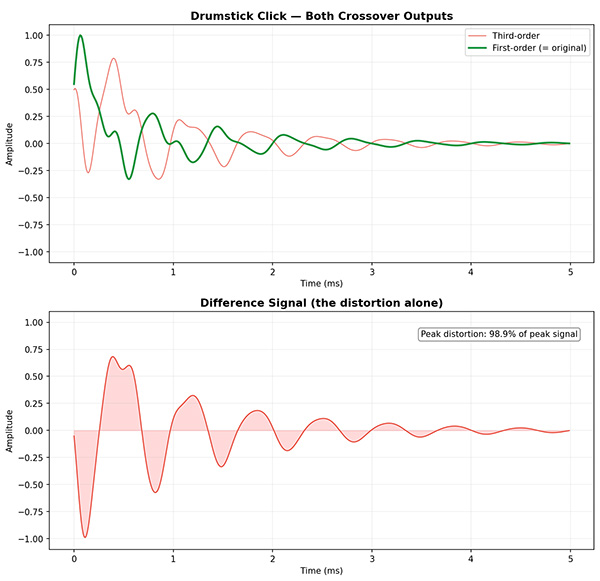
The first four clicks are the original stick-click simulation (and also the result of paired, symmetric first-order crossover filters at 1500Hz). The second four clicks reveal the impact on that original pattern of symmetric third-order Butterworth crossover filters at the same frequency. The third four clicks are are the difference file—original minus third-order—unamplified.
Does this show that all speakers with higher-order crossovers are crippled?
It does not. First, the higher the order of the crossover, the narrower the range of affected frequencies—and carefully chosen crossover points can make those regions far less impactful musically than the example shown in fig.2. Second, listening tests have consistently shown that timing integrity matters only after all the other elements of a great speaker have been addressed. As I wrote in the Marten review, it's the icing on a cake that is already delicious on its own.
Footnote 1: See my review of the C1.2 D/A processor. Footnote 2: Many choices here, but this one will do. Footnote 3: Haniwa claims that the company's "advanced digital technology ensures precise phase and frequency control, perfectly replicating the input waveform."
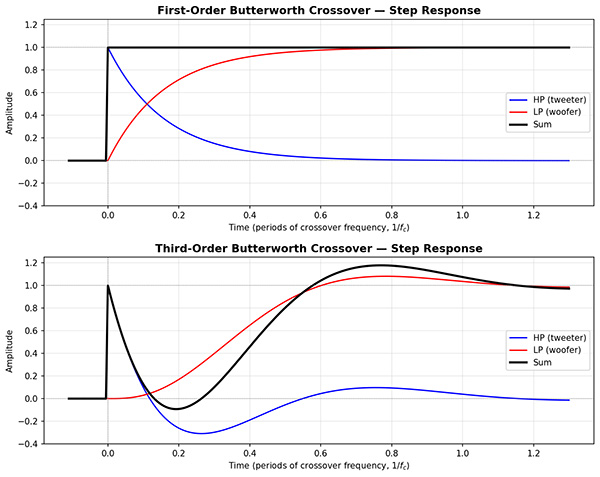
Fig.1 Idealized step function for a symmetrical first-order crossover (top panel) and a symmetrical third-order Butterworth crossover.
Fig.1 shows the idealized step response for two different crossover types on a two-way loudspeaker. In both panels, the blue trace is the tweeter, the red trace is the woofer, and the black trace is their summed output. The bottom example uses symmetrical third-order Butterworth filters for high-pass (tweeter) and low-pass (woofer). The example on top uses pure, symmetrical, first-order filters above and below the crossover frequency.
With the first-order crossover, the tweeter signal is advanced and the woofer signal is delayed, but these changes cancel each other. Consequently, the step function is perfect: The summed output of the two drivers rises immediately to full output and stays there as the tweeter output falls and the woofer output rises. Both magnitude and phase are preserved.
The crossover represented by the bottom figure uses symmetric third-order Butterworth filters. While the arrival of the wavefront is unaffected—there is no net delay—the waveform is distorted because lower-frequency sounds are delayed relative to higher-frequency sounds.
Fig.2 Waveform of a synthesized stick-click run through paired, symmetric first-order and third-order Butterworth filters at 1500Hz. The green trace shows the original signal and the output of the paired first-order filters. The pink trace shows output from the Butterworth-based crossover. The bottom panel shows the difference signal.
Fig.2 shows the waveform of a synthesized drumstick click run through the same filters, the crossover point at 1500Hz; see the figure caption for details. The difference looks dramatic, and it is easy to hear. This embedded file allow you to hear it for yourself.
Footnote 1: See my review of the C1.2 D/A processor. Footnote 2: Many choices here, but this one will do. Footnote 3: Haniwa claims that the company's "advanced digital technology ensures precise phase and frequency control, perfectly replicating the input waveform."