I wrote in the April 2026 issue of Stereophile that when you clean records in an ultrasonic bath, you need to make some decisions. The first is whether it's necessary to use distilled water or whether tap water is good enough. I learned that even very good, pure tap water has enough dissolved solids to produce major contamination once the water is evaporated from the record surface. The next decision is, should I use a surfactant? Surfactants lower water's surface tension, which allows it to penetrate deeper into grooves, but it also has implications for the ultrasonic process. Surfactant means more bubbles, but bubbles with less energy, which could be good or bad. I concluded that you should use a surfactant unless your record-cleaning machine's (RCM's) manufacturer says not to.
A surfactant, though, has a possible downside: It's more stuff in the water that will end up on your record once the water dries.
In normal use, the concentration of surfactant is much lower than the concentration of solids dissolved in tap water, so you're already well ahead of the game. Still, the best strategy is to deposit as little new stuff as possible on your just-cleaned record. For this reason—and because my calculation showed that the concentration could be significant—I advised a final step: a rinse. Surfactants, if you use the right ones, rinse off easily, but they don't fall off by themselves. If you want to be sure to get rid of them, you need to rinse them off.
After seeing that column in print, I began to worry that I'd left the wrong impression. I started off with a bit about cleaning records in the sink, which could imply that you could rinse with the water that comes out of the tap. But if you rinse with tap water, you might as well put tap water in the ultrasonic bath. To avoid those dissolved solids, you'd need to rinse with distilled water, which makes sink-rinsing more awkward and, unless you own your own water still, more expensive.
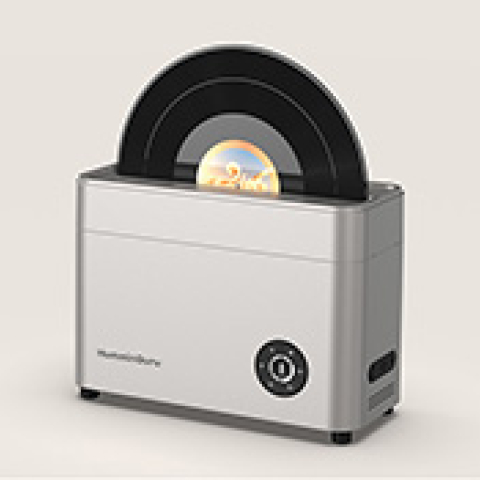
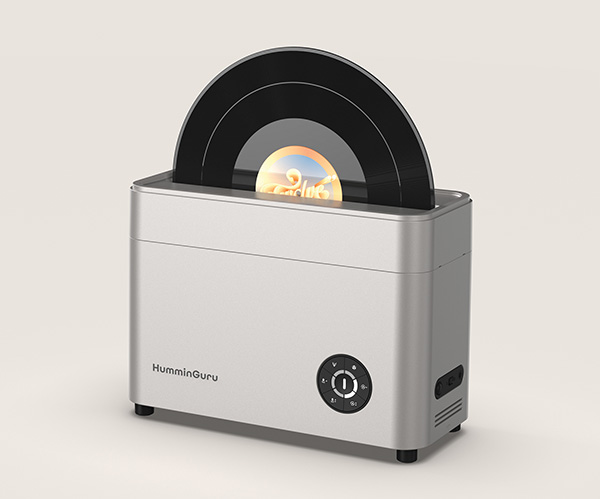
After that piece was published, I received a letter from Mark Walton of Springfield New Jersey (footnote 1). Walton is the "redditor" of the HumminGuru subreddit (reddit.com/r/humminguru), where he uses the handle @chileboy. (You can read his letter below.) Walton told me that after months of discussion, the group had concluded that the rinsing step isn't necessary.
That opinion reflects both careful thinking by thoughtful people and the experience of many records cleaned. It's worth taking seriously. So I decided to take another, more careful look. There's a scientific concept called contact angle that determines how water "sits" on any surface. It's a characteristic of the material. The static contact angle of water on PVC—vinyl—is 74°. That puts vinyl in the hydrophobic range. It's why water beads on the surface of a clean record—not as much as on a freshly waxed car, but quite a lot.
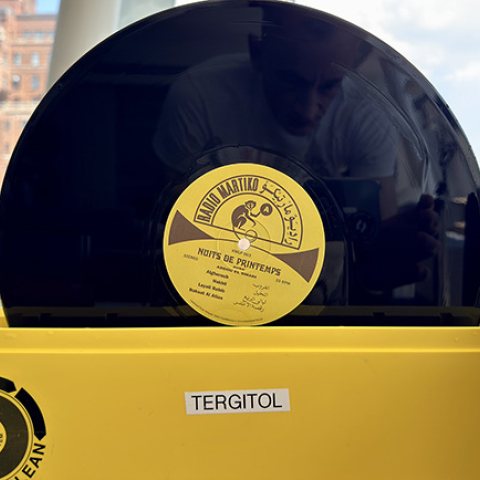
Add a little Tergitol 15-S-9—the surfactant I recommended in my April essay—and you lower the contact angle to perhaps 25°. Vinyl is not hydrophobic to this kind of water. Water covers the vinyl surface much more easily now, forming a continuous sheet. That sheet is thinner than it would be without Tergitol, but the coverage is more complete.
The concept of contact angle provides traction for more careful calculations to determine how thick the layer of water will be when you remove a record from an ultrasonic bath. That, in turn, will tell us how much surfactant will end up on the record surface once the water dries.
This more careful calculation concluded that the coating of water will be 1–10µm thick. That's a wide range, but it would be hard to do better without knowing, among other things, how fast the record is pulled out of the bath. Let us assume the thinnest layer in that range: 1µm. That will give us the lowest estimate of surfactant residue.
But first, how much Tergitol should we add? A quantity called the CMC—critical micelle concentration—tells us at what concentration the Tergitol starts to clump. When the clumping starts, you're just adding extra stuff with no further gains, so you don't want to go beyond the CMC. For Tergitol 15-S-9, the CMC is 0.0052%, so we'll aim for a Tergitol concentration of 0.005%.
"Drop" is not a very precise unit of measure, but there is a standard definition: A drop is 0.05ml. It follows that to get exactly the right concentration, we should add one drop of Tergitol per liter of water. One drop per liter, a nice, even number.
With that concentration—0.005%—a 1µm layer of water will contain about 1 × 10¹⁶ molecules: a one followed by 16 zeroes. The area of a record's playing surface is about 1000cm2, but when you take the grooves into account, the area expands by a factor of five or 10, so let's say the surface area is 5000cm2.
We're getting close to the payoff, so hang in. The area of a molecule of Tergitol 15-S-9 is 62Å2. (That's the symbol for an angstrom, which is 0.0000000001 meters.)
What can we compare that with? With an area of 5000cm2 and 1 × 10 molecules, we can figure out the percentage of surface those Tergitol molecules take up. The result is that Tergitol molecules take up about 0.6% of the surface. That's not a lot. At the high end of the range—10µm—they take up 6.4% of the record surface.
That's still not a lot. Is it enough to matter? The best gauge is what you hear after cleaning, but this new calculation convinces me that the Tergitol residue doesn't matter. I'm changing my recommendation, agreeing with the folks on the HumminGuru forum. You can skip the rinse.
What about that other recommendation? Does it need revising? Is it necessary to use distilled water?
I ran that calculation again, too, and found that with typical levels of calcium carbonate—the most common dissolved solid in tap water—there's enough to cover about 60% of the record surface. That's much less than I calculated before, but it's still quite a lot, especially considering that as the water evaporates, the calcium carbonate will concentrate in the grooves. At 200ppm, there's enough to fill the grooves 60% up the walls. That's far enough to get up into the stylus-contact area. The earlier conclusion holds.
So here's the new recommendation. Use distilled water. Add one drop of Tergitol per liter of water, unless the manufacturer says not to. And don't bother rinsing.
 Mark Walton on Record Cleaning
I read with great interest Jim Austin's As We See It "Lather. Rinse. Repeat" in the April 2026 issue. As the moderator (@chileboy) of the unofficial HumminGuru subreddit, the question of surfactants, distilled vs tap water, and rinse necessity is the subject of much and constant debate. Most users there come down on the side of "I use distilled water and surfactant, I don't bother to rinse, and my records sound great."
After I posted a link to Michael Trei's Spin Doctor column the month before, with a quote of Jim's footnote, one prolific poster noted in part (I'm paraphrasing): "The actual concentration of surfactant when using something like G-Sonic (one drop per 350ml) is vanishingly low, close to 0.0002% concentration." I didn't check the math, but I'll note they've always been firmly planted in the "no rinse" contingent.
In any event, thanks so much for the education on the science behind the finer points of cleaning our beloved vinyl. I'll be linking Jim's latest as well, just to further inflame the debate—as any good mod does! Thanks again, love the magazine!—Mark Walton, Sprintfield, New Jersey
Footnotes
1 In the print magazine, I misidentified the writer as Harry Melkonian of New South Wales, Australia. Sincere apologies to Mr. Walton and Mr. Melkonian for the error.—Jim Austin
Mark Walton on Record CleaningI read with great interest Jim Austin's As We See It "Lather. Rinse. Repeat" in the April 2026 issue. As the moderator (@chileboy) of the unofficial HumminGuru subreddit, the question of surfactants, distilled vs tap water, and rinse necessity is the subject of much and constant debate. Most users there come down on the side of "I use distilled water and surfactant, I don't bother to rinse, and my records sound great."
1 In the print magazine, I misidentified the writer as Harry Melkonian of New South Wales, Australia. Sincere apologies to Mr. Walton and Mr. Melkonian for the error.—Jim Austin