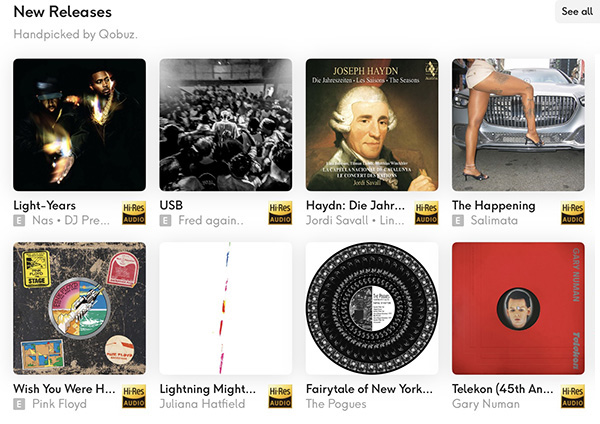
Lately in this space I've focused on all things (rather, some things) analog. This month I return to digital, specifically to streaming. I love listening to records, but I also listen to a lot of streamed music. I'm a Qobuz devotee, since Qobuz is the most approachable streaming service and the friendliest to audiophiles. When Spotify went lossless, I subscribed, because that service's popularity means that it's easy to trade music and playlists. Most playlists I've seen published online are Spotify.
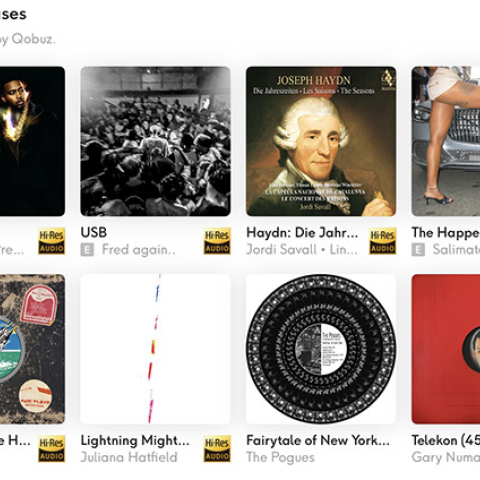
Streaming is revolutionary, but there's one aspect that bugs me. Whenever new content shows up on the services, as it does every Thursday, I look to see what's new. Each week I find ~50 new albums in the Qobuz "New Releases" section. I just counted 46 new albums that dropped on October 30, the most recent Thursday as I write. You can go a little bit deeper by filtering by genre: I found 40 new releases in Pop/Rock, 43 in classical.
In all music genres, how many new albums are added each week? I asked Dan Mackta, Qobuz's managing director. Qobuz adds some 100,000 tracks every week, he told me, on the order of 10,000 albums. So each week, we're only able to see a few percent—maybe 1%–3%—of all new music. For anything else, you must already know it exists so that you can search for it.
Streaming may still be the best music-discovery tool ever invented, but this is a serious limitation on its ability to serve that role.
This is not the fault of Qobuz or the other streaming services, where the situation is much the same. There's an innate difficulty here that's impossible to entirely overcome. What if Qobuz dumped it all on your computer screen, filling it with 10,000 new albums every week? You'd be buried in music. Browsing would be pointless. Curation is essential. Qobuz is providing that service, putting forth the albums it finds most deserving of your attention.
I asked Mackta how Qobuz curation works: Do they reflect our tastes according to some algorithm? They do not. Mackta: "The new release selections are by our editorial team, and they are not personalized."
The question called to mind bookstores (remember those?), where publishers are known to pay to have their books displayed on the shelves at the front of the store.
Do record labels pay to have their music appear at the front of the queue? Not at Qobuz they don't. Mackta again: "No. It is 100% editorial choices."
So, no payola, no AI: Real humans decide which new music you see. One wonders, though, how well Qobuz's editorial staff, which surely is modest in size, can adequately triage 10,000 new albums each week, especially for millions of individual listeners, each with individual tastes. Maybe some customized curation would be a good idea.
It's the nature of the beast. Due to sheer volume, most new music must remain hidden.
In October, Universal Music Group settled a lawsuit against music-focused generative-AI startup Udio. As a result of the settlement, the companies will collaborate to launch a new, licensed AI music creation platform. The other two majors are also suing Udio—all three major labels are also suing Suno, another generative-AI music startup—but none of those lawsuits have been settled yet.
In the most recent Billboard, I saw an article with an intriguing title: "Why Are So Many Humans Downloading AI Songs?" The article says that on Billboard's "Digital Song" chart for the week of October 18, a song called "You Got This" sat at #11, "just below Yungblud's 'Zombie' and above AC/DC's 'Thunderstruck'."
The article's description of the song sounds like every serious music lover's worst AI nightmare. Start with the title, already a bad cliché. It seems to be about kicking a drug habit. The song, the article says, "is built on a chanting 'Don't quit like this/Hold your ground' chorus and Nickelback-style vocals."
How popular is it? 294,000 streams over all the measured services, 1000 downloads. There's no artist, just a label: Unbound Music "has posted 120 tracks on TikTok over the past year with the disclaimer, 'All songs have [artificial intelligence] elements in them,'" the Billboard article says.
"Unbound Music is a boundary-pushing independent project dedicated to real, raw, and honest sound," says the label's bio on Spotify. "[E]very track is built on passion, authenticity, and the drive to inspire." Then, in the following paragraph, "all instrumentals and vocals are AI-generated, while lyrics are a mix of AI and Unbound Music. Some songs are fully AI-crafted, while others are written entirely by hand." On Spotify, Unbound Music is a "Verified Artist." Right is left; black is white.
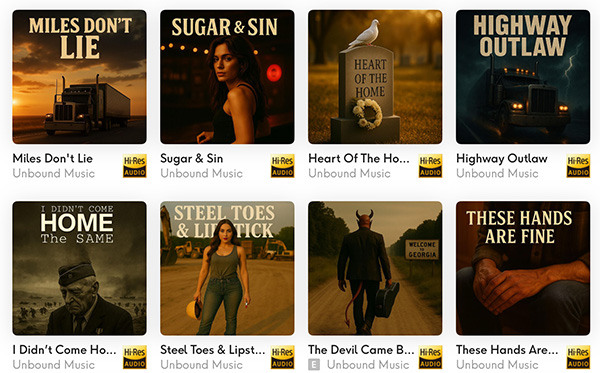 I looked up Unbound Music on Qobuz. I counted 82 of their tracks. (Spotify, too, lists Unbound Music songs, but the format makes it harder to count them.) Qobuz, oddly, has "You Got This" labeled as "Hip-Hop/Rap." It's country. Other songs by Unbound include "BAMA Blood" and "Mississippi Real." Are those titles overcompensation for not having blood, for not being real?
There surely are other labels similar to Unbound Music, but I don't know what they are, and it isn't clear how many. That Billboard article lists several other AI or AI-assisted songs that have cracked various charts. I asked Mackta in a follow-up whether Qobuz has a handle on AI music. He acknowledged that they don't—not yet—but they're working on it. He told me there's an estimate that as much as 30% of all new songs are "100% AI-gen." He said Qobuz will probably set a policy of banning AI music entirely. Enforcing it could be hard.
Here's the second interesting bit from the Billboard article: "What is surprising, and harder to understand, is why these artists are selling so many tracks online in addition to all the streaming." The implication: The kool kids don't download; downloading is so 2010. Why, then, are these songs being downloaded? The main reason: So that they can be studied by other AI music creators. Also, the downloads tend to be in genres where download rates are higher, genres of interest mainly to older, less-cool music fans; they mention country and Christian music. Classical and jazz would surely also be included—though fans of those genres are intolerant of AI in music; at least I hope we are.
AI music isn't coming—it's already here. Downloads aren't just going: They're already gone.
I looked up Unbound Music on Qobuz. I counted 82 of their tracks. (Spotify, too, lists Unbound Music songs, but the format makes it harder to count them.) Qobuz, oddly, has "You Got This" labeled as "Hip-Hop/Rap." It's country. Other songs by Unbound include "BAMA Blood" and "Mississippi Real." Are those titles overcompensation for not having blood, for not being real?
There surely are other labels similar to Unbound Music, but I don't know what they are, and it isn't clear how many. That Billboard article lists several other AI or AI-assisted songs that have cracked various charts. I asked Mackta in a follow-up whether Qobuz has a handle on AI music. He acknowledged that they don't—not yet—but they're working on it. He told me there's an estimate that as much as 30% of all new songs are "100% AI-gen." He said Qobuz will probably set a policy of banning AI music entirely. Enforcing it could be hard.
Here's the second interesting bit from the Billboard article: "What is surprising, and harder to understand, is why these artists are selling so many tracks online in addition to all the streaming." The implication: The kool kids don't download; downloading is so 2010. Why, then, are these songs being downloaded? The main reason: So that they can be studied by other AI music creators. Also, the downloads tend to be in genres where download rates are higher, genres of interest mainly to older, less-cool music fans; they mention country and Christian music. Classical and jazz would surely also be included—though fans of those genres are intolerant of AI in music; at least I hope we are.
AI music isn't coming—it's already here. Downloads aren't just going: They're already gone.
I looked up Unbound Music on Qobuz. I counted 82 of their tracks. (Spotify, too, lists Unbound Music songs, but the format makes it harder to count them.) Qobuz, oddly, has "You Got This" labeled as "Hip-Hop/Rap." It's country. Other songs by Unbound include "BAMA Blood" and "Mississippi Real." Are those titles overcompensation for not having blood, for not being real?
There surely are other labels similar to Unbound Music, but I don't know what they are, and it isn't clear how many. That Billboard article lists several other AI or AI-assisted songs that have cracked various charts. I asked Mackta in a follow-up whether Qobuz has a handle on AI music. He acknowledged that they don't—not yet—but they're working on it. He told me there's an estimate that as much as 30% of all new songs are "100% AI-gen." He said Qobuz will probably set a policy of banning AI music entirely. Enforcing it could be hard.
Here's the second interesting bit from the Billboard article: "What is surprising, and harder to understand, is why these artists are selling so many tracks online in addition to all the streaming." The implication: The kool kids don't download; downloading is so 2010. Why, then, are these songs being downloaded? The main reason: So that they can be studied by other AI music creators. Also, the downloads tend to be in genres where download rates are higher, genres of interest mainly to older, less-cool music fans; they mention country and Christian music. Classical and jazz would surely also be included—though fans of those genres are intolerant of AI in music; at least I hope we are.