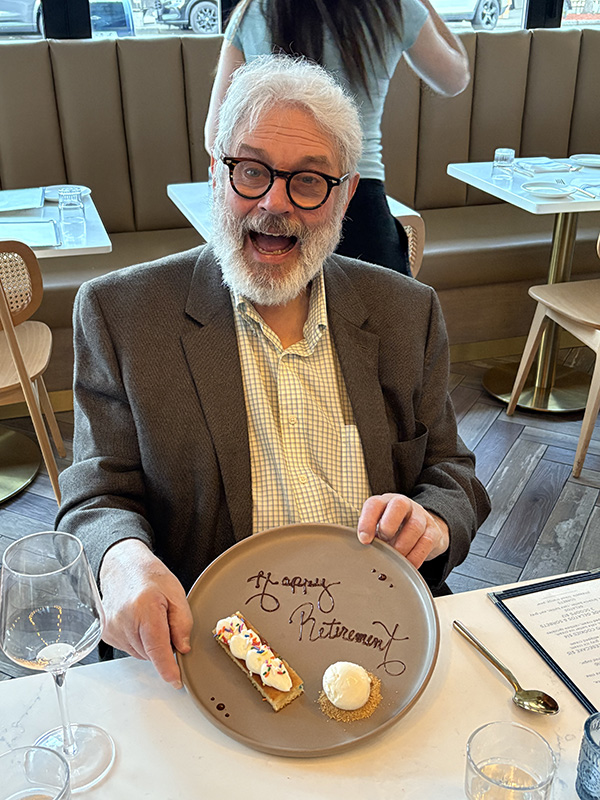
The July issue is a milestone in Stereophile's history: It's the last issue in which John Atkinson will be performing the measurements for our equipment reviews (footnotes 1 & 2). As a start toward digesting this momentous event, I asked JA1 some questions.
Jim Austin: Over your 50 years as an editor in the hi-fi industry, you've left a big mark. But let's start by recounting your history. You started at Hi-Fi News & Record Review in 1976, working under John Crabbe, then becoming editor of that magazine in 1982.
John Atkinson: I was working as a professional musician when my then-wife showed me an ad in a June 1976 issue of British newspaper The Guardian. Hi-Fi News & Record Review was looking for a news editor. "You're a hi-fi enthusiast," she said—I'd bought my first audio system in the late 1960s—"and you are better at playing than getting paid. Call the number in the ad." I got the job, and for the next six years I kept my eyes and ears open and my mouth shut, learning what makes a magazine successful.
Working for an audio magazine tied together different aspects of my education. Although my passion was for music, my bachelor's degree was in physics and chemistry, and I worked for a while in scientific research. I subsequently got a postgraduate qualification as a high school science teacher. At Hi-Fi News, I realized that, like a good teacher, a successful consumer magazine informs and educates—and must also entertain.
JA2: When you took over as Stereophile's editor, in May 1986, you turned Stereophile into a truly professional magazine. But in my opinion, your biggest impact has been in the realm of measurements—specifically, in restoring balance and working toward unifying the field's subjective and objective aspects.
JA1: When I took the job at Hi-Fi News in 1976, the magazine's editorial identity was dominated by music and recordings. The content that was most popular with readers, equipment reports, was buried in the "graveyard" at the back of the magazine. Those equipment reports were dominated by measurements and lacked any discussion of sound quality. Consequently, they were marginalized when examined in the light of readers' own experience.
It was a July 1966 Hi-Fi News review by John Crabbe, of an Ortofon moving coil cartridge, that was the prototype for what I decided I wanted to achieve with the magazine's equipment reviews. Yes, that review featured measurements, but they were not the point of the review. Instead, they reinforced and explained subjective findings. I realized that a review was, or should be, like inviting readers in for a shared listening session. So, starting with an August 1983 report on a Krell power amplifier, I illustrated the descriptive points I was making using specific musical examples. This is ubiquitous these days, but it seemed very daring back then.
This new-old approach to reviewing, tying together the subjective and objective, was the model for what I wanted to achieve at Stereophile.
JA2: Stereophile had bucked the measurements-only tide from the very beginning. It was founded in 1962 as a subjective alternative to a hi-fi press focused on measurements above all else.
JA1: Stereophile's founder, J. Gordon Holt, had pioneered the subjective approach to equipment reviews, and while he wasn't opposed to measurements, he lacked the resources to implement them. After joining Stereophile, I designed and used some of my own test gear. Things took off in 1989 when the magazine first bought an Audio Precision analyzer to measure amplifiers and digital products, then a DRA Labs MLSSA system to measure loudspeakers. Since then, I have measured more than 250 digital products, more than 400 preamplifiers and amplifiers, and more than 1000 loudspeakers. The graphs for these measurements are all presented in a consistent format on the Stereophile website, so readers can easily compare a current-day product's performance with those of similar products going back almost four decades.
JA2: What, specifically, were you hoping to achieve?
JA1: I had three goals for the magazine's measurement program. First, to pay tribute to truly talented designers (footnote 3). Second, to reveal that there wasn't a single, simple reason for a component to sound the way it does. And third, to build a database that would throw up correlations with what is heard. While meeting the first two goals was straightforward, the third was not. Yes, departures from unflat frequency response are readily audible, and an amplifier with a high level of predominantly second-harmonic distortion will sound "warm." But as the late Richard Heyser said in a 1986 presentation to the London branch of the Audio Engineering Society, traditional measurements, where one parameter is plotted against another, fail to provide a complete picture of a component's sound quality. What we hear is a multidimensional array of information in which the whole is greater than the sum of the routinely measured parts.
JA2: Speaking of Heyser: In 2011, you were invited to give the honorary Richard C. Heyser Memorial Lecture at the AES.
JA1: Of necessity, my measurements are 99.9% two-dimensional, one parameter plotted against another. In my 2011 lecture, I therefore expanded on Heyser's discussion by offering four "case studies" in which the perception doesn't turn out as expected from theory: making recordings; loudspeaker behavior; digital recording and playback; and amplifiers. I concluded the lecture by saying that I hoped it caused people to think about matters that might have been taken too much for granted.
JA2: Indeed, that may be your legacy. John, thank you for all of your contributions.
JA1: It has been a fulfilling journey this past half-century. And thank you for inviting me to share some memories.
Footnote 1: Although JA1 has already measured two components that will appear in the August and September issues.—Jim Austin
Footnote 2: It should be noted that I have also retired as a reviewer. My final two reviews were of the Dynaudio Contour 20 Black Edition loudspeaker and the NAD M10 v3 integrated amplifier. Since my first review was published in October 1977, I have written reviews of 773 products (not including measurements-based followups or measurement sidebars for reviews by other writers). An index to those reviews can be downloaded here.—John Atkinson
Footnote 3: I'd like to personally call out, for amplifiers: Wayne Colburn and Nelson Pass (Pass Labs), Florian Cossy and the late Thierry Heeb (CH Precision), John Curl (Vendetta, Parasound), Dan D'Agostino, the late Charley Hansen (Ayre), Darren Myers (PS Audio, Parasound), the late Rob Robinson (Channel D), and Nina Roscoe (Linn). For digital, Chris Hales and Andy McHarg (dCS), Eelco Grimm, Ed Meitner, Jürgen Reis (until recently of MBL), and Daniel Weiss. For loudspeakers, Paul Barton (PSB), Laurence Dickie (Vivid), the late John Dunlavy, Jörn Janczak (Tidal, Vimberg), Andrew Jones (TAD, MoFi), Martijn Mensink (Dutch & Dutch), Jack Oclee-Brown (KEF), Andy Payor (Rockport), Bruno Putzeys (Kii), Yair Tammam and Alon Wolf (Magico), and Kevin Voecks and Mark Glazer (Revel). All these engineers have designed products that combined state-of-the-art measured performance in my test lab with sound quality that was beyond reproach.—John Atkinson
Footnote 1: Although JA1 has already measured two components that will appear in the August and September issues.—Jim Austin