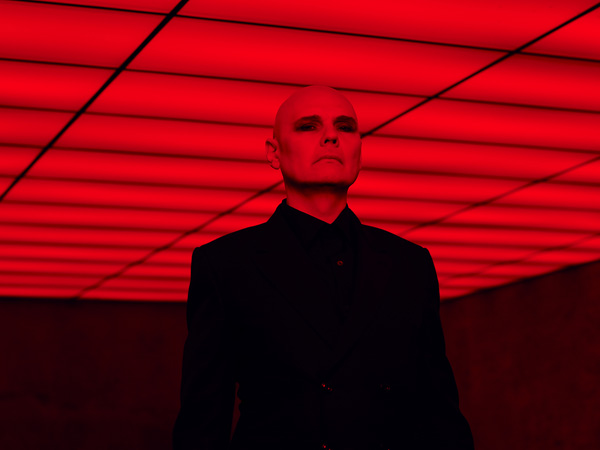
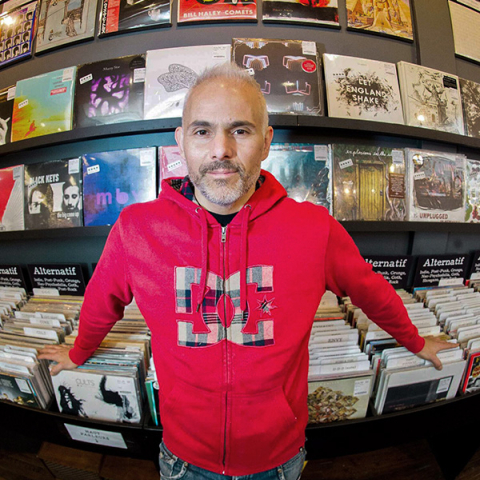
Photo by Joseph Cultice
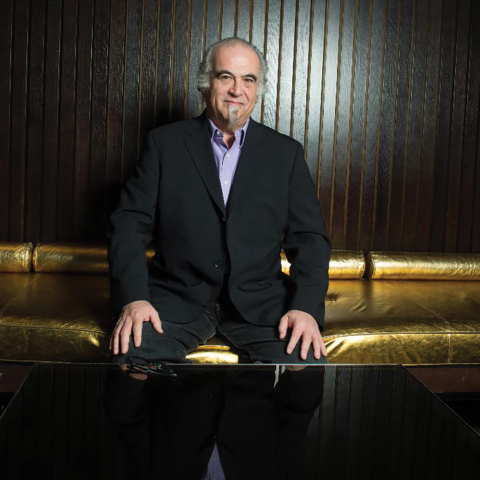
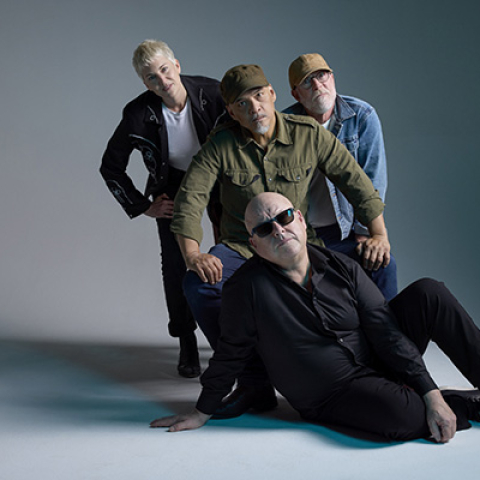
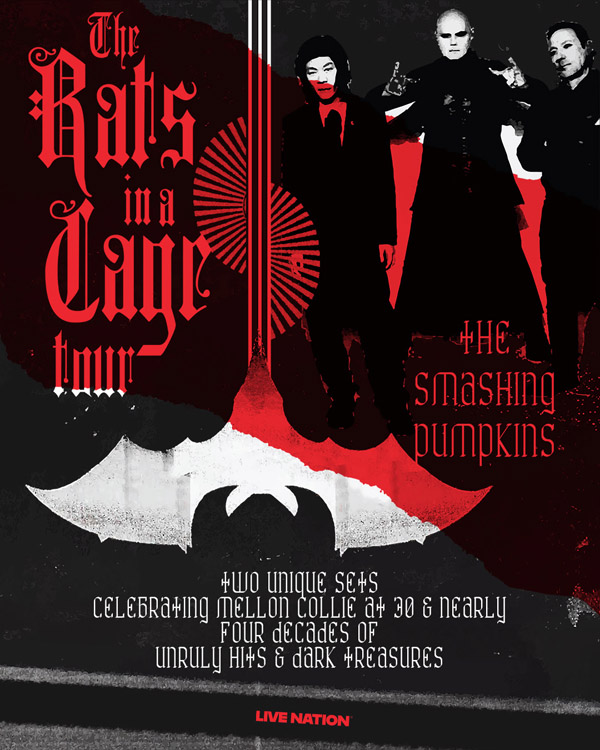
Billy Corgan is a busy man. The Smashing Pumpkins frontman has a schedule that would exhaust artists half his age. (He's 59.) Right now the guitarist/vocalist is guiding Smashing Pumpkins on "The Rats in a Cage Tour," in celebration of the 30th anniversary of the alt-rock giants' biggest release, 1995's 5× Platinum, double-album epic
Mellon Collie and the Infinite Sadness (footnote 1). He also hosts a popular podcast called
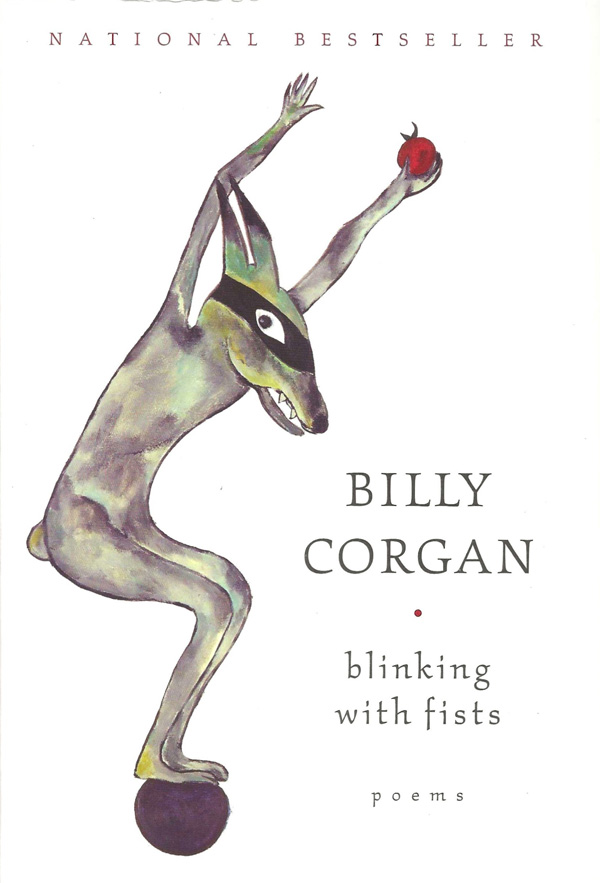
The Magnificent Others, now in its second season. He wrote a book. Plus, he cofounded Madame Zuzu's in Highland Park, Illinois, which combines a teahouse, performance space, and vinyl shop under one roof. (Zuzu's also shepherds distribution of new Pumpkins albums and exclusive, expanded, upgraded catalog reissues at a regular clip.)
Last November, Corgan partnered with Chicago's Lyric Opera to present seven orchestral performances dubbed
A Night of Mellon Collie and Infinite Sadness. Additional dates for that most operatic
MCIS reimagining have been scheduled for this fall in London, Antwerp, Paris, and Madrid. (He's also an owner and promoter of the National Wrestling Alliance, but that's a story for another magazine entirely.)
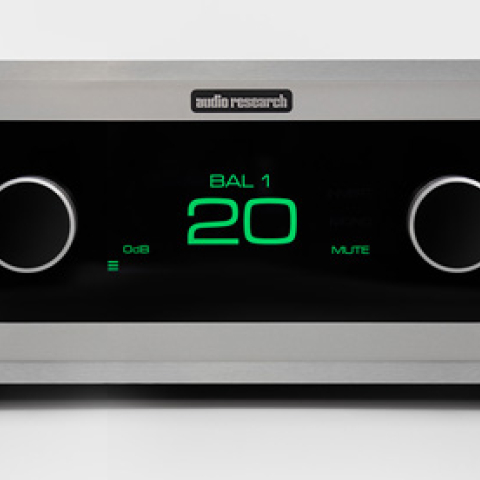
Corgan told me that the night before our Zoom interview, his wife had "gently" reminded him that after we were done talking, he still needed to approve a 16-track test pressing. To QC it, he'd use his $10,000 floating turntable, custom 1200W monoblock amplifiers, and vintage Thiel speakers. I reminded him that his current setup was a far cry from the playback session we shared one November 1991 afternoon in a Central Park West hotel room in New York, listening to selections culled from his suitcase full of Jimi Hendrix bootleg cassettes. "Yeah, that sounds like me," Corgan said with a laugh. "If you had asked me in our interview from '91 where rock'n'roll would be today, I would have thought it would be much further down the line by now."
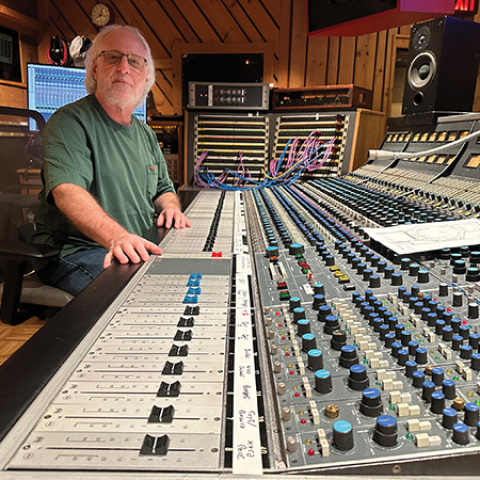
As our call came to an end, Corgan emphasized one very important point. "I want to indulge in something we oftentimes don't get to talk about—and that's how important the mixers and mastering guys are to the process," he noted. "Who have we talked about today? Bob Ludwig. Howie Weinberg. Ryan K. Smith. Roy Thomas Baker. And, of course, Butch Vig. I've been so blessed to work with
fucking geniuses in sound." Spreading sonic bullets with butterfly wings, one and all. (The following interview has been edited for clarity.)
 Mike Mettler:
 For Smashing Pumpkins reissues, do you personally relisten to things and think, "Since we're dealing with modern vinyl as opposed to how we released something 30 years ago, we have to update it"? Give me your executive producer process.
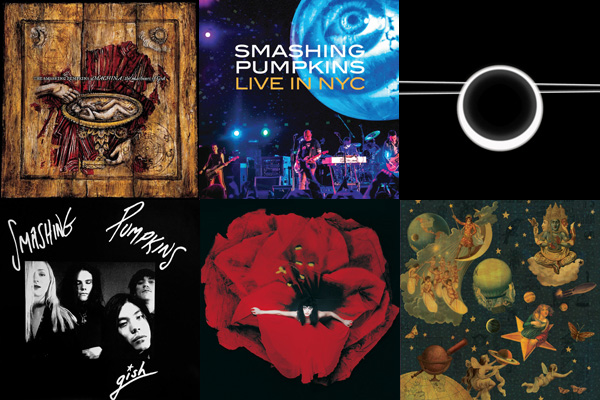
Billy Corgan: Sure. I am overseeing all the mixing and the mastering, especially for the live stuff. Every time you do a reissue, you re-examine what you have. We just did a [6LP/4CD] 30th anniversary box set for
Mellon Collie. In the case of the core
Mellon Collie album, Bob Ludwig did the mastering about 10 years ago—and it's fantastic. You're not gonna find a better person to take an album made in an analog form and convert it into the vinyl idiom. When you're sitting there and Bob Ludwig's talking about mastering
Led Zeppelin IV, I don't think there's a higher mountain to sit upon.
Mettler: No argument here. On the reissued
Mellon Collie vinyl, "1979" has a pretty wide soundfield, which is different from how a lot of your stuff was mixed back then. Do you feel "1979" unlocked the way you started mixing after that?
Corgan: Yeah, because I had the good fortune of being there when the records were mixed in the analog realm. But whenever I would finally get the CD, there'd always be this little bit of heartache that would come because it would sound 10%
worse. Some sort of compression and flattening would be going on—particularly in the highs, and with the "sparkle" of the whole thing.
We've had some correction in the modern era—but every streaming service has its limitations. Then you add the fact that most people are listening to music these days on their phones or tablets, so it's rare you get to hear the album as it was intended in a way that's both consistent with modern listening and, let's call it, the
integrity of the original process.
Your jaw drops when you listen to how Gus Dudgeon produced
Elton John (footnote 2), and you realize the absolute
supremacy of the recording, the mixing, and the whole thing. It still holds up when you put on the vinyl, because you're just like, "Wow, this is such a beautiful, beautiful experience."
Mettler: Since you continue including string elements in your newer songs, I want you to put your producer hat back on and go right to "Tonight, Tonight" on
Mellon Collie. I consider that song to be the touchstone for how to incorporate orchestral sounds in a super-grand alt-rock song. Was that one of the first times you felt like you could expand your reach as a producer?
Corgan: Well, I'm pretty much a form-follows-function guy. I'd done some string stuff on [1993's]
Siamese Dream with "Disarm," but it was more like trying to produce a certain song in a certain way. I wrote "Disarm" on the fly that day, with no string arrangement. I literally was humming stuff into a microphone.
"Tonight, Tonight" was the first time where I thought, "Okay, the doors are open to do this. We can afford these types of things." I think the idea with "Tonight" was, "Now we can take this step into the wider world of access, opportunity, and collaboration." I wasn't necessarily out to make that kind of statement; it just kind of turned into one. If you listen to the [2013]
Aeroplane Flies High box set, I put a version of "Tonight" on there without the string orchestration on it, and you can hear the song is basically like a bastardized version of The Who. I just kept saying during the recording, "It's like The Who, but with an orchestra."
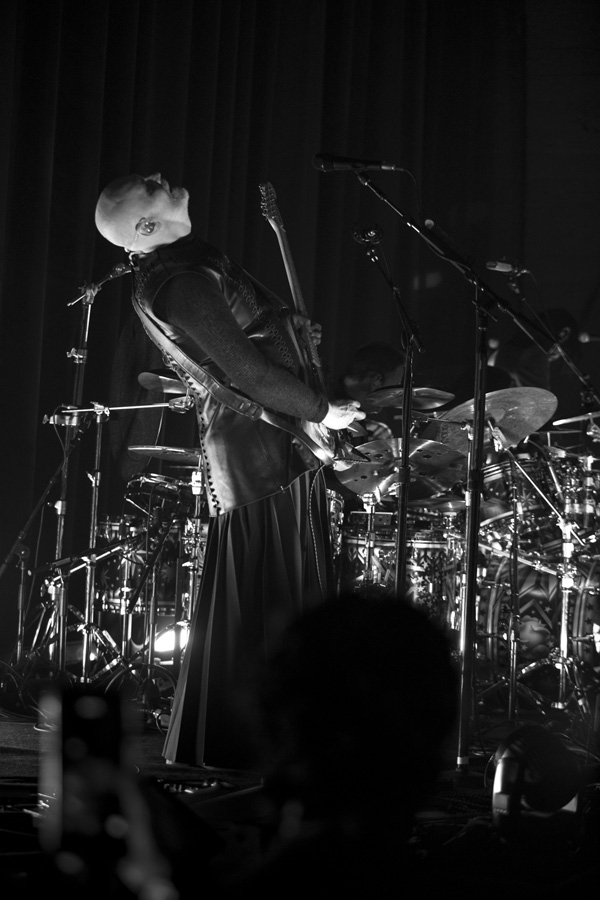
Billy Corgan leans back. Smashing Pumpkins live in LA, May 2026. (Photo by Tyler Curtis @Tyliner)
Mettler: It's not quite
Quadrophenia, although I would like to hear you do
Atmosphenia. [
Corgan laughs.] Actually, I'd love to hear you do an Atmos mix of any Pumpkins material. Is that something you've thought about at all?
Corgan: Well, that's where it gets complicated. We've all lived through Beta vs VHS, and Atmos is just the latest, greatest thing the record companies are keen to push because they wanna figure out how to reinvigorate aging catalogs—and that's totally fine. If I was in their seat, I would probably wanna do the same thing.
The problem is, they'll call you up and go, "Hey, are you willing to do an Atmos version of
Siamese Dream?" And you go, "Well, I'll think about it. I mean, Alan Moulder mixed it [in stereo], and he did an amazing job. It's one of our most important records." And they'll go, "Great. Here's 30 grand." Now, I don't mean to sound boorish, but 30 grand doesn't get you very much in terms of mixing, especially if you're dealing with the best of the best—and Alan Moulder
is the best of the best. It's like, "Here, we want you to take a classic thing from your catalog and throw it out in the market in a completely different form"—which, by the way, hasn't completely caught on with the general consumer—"but also, we don't wanna pay too much for it."
So you go, "Well, hmm, that's not gonna really work." There's no real profit model in the Atmos thing, you know what I mean? It's not like I'm looking to get more money so we can put some in our pocket—I'm looking to get enough so you can treat this music with the respect it deserves. Look, I get it. It's a business, and they throw a lot of money at the Atmos version of
The Dark Side of the Moon because that thing's gonna sell into infinity. There are other records out there I think people would be interested in hearing in that Atmos form—but they have to be done
properly, and certainly to the level that they were made.
 Mettler:
 Interesting. So, are you just a stereo guy through and through, because that's how you hear the music in your head?
Corgan: No, no. Listen, I love this question. I'm gonna explain why—and this goes back to Black Sabbath, right? Everything goes back to Sabbath. It's not so much the stereo field, it's what the stereo field
allows you—and it has limitations. It's the
impression of width, so creating literal depth and literal width are not necessarily to your advantage. Think about it this way—the human eye can see, let's say, close to 180 degrees, and your perception in life is based on what you
can't see as much as what you can see. We've all had that feeling where we can
feel somebody coming up behind us. We don't feel the wind or a noise; we just feel someone standing or looking at us. Okay, well,
that's music. Music is just as much what you feel as what you hear.
Now I'll give you an example where it works in the negative. In the last 10 to 15 years, the trend has been to have the vocals be very, very loud in the mix. I knew intuitively in the '90s that my voice worked better in a mix much like how the Stones had always traditionally mixed Mick Jagger's voice low. My voice can cut through concrete
[laughs], so it actually doesn't need to be that loud to be heard. It's a tonal thing. So, a mixer will put my voice loud, but I don't think that's always the best place for it.
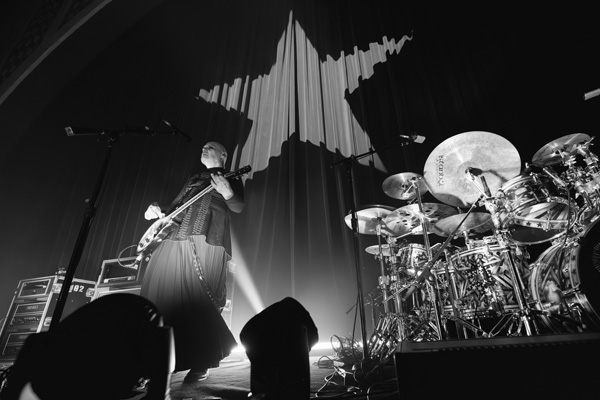
Smashing Pumpkins hold a requiem for ZERO in L.A. May 2026. (Photo by Tyler Curtis @Tyliner)
Mettler: That makes me think of [1991's]
Gish, where, in songs like "Siva" and "Rhinoceros," your voice is super quiet in spots. When I played that reissued LP earlier, I had to lean forward in my listening chair and tell myself not to reflexively turn up the volume because I knew it would soon enough be coming back at me much louder.
Corgan: Yeah, we did that shit on purpose.
[chuckles heartily.] And now have a more modern mix palette. Recently, I listened to a Morgan Wallen track where the vocals are super loud. If you listen to [2024's]
Aghori Mhori Mei, my vocals are pretty loud, but they're not
cranking loud. [Andrew] Scheps did an amazing job mixing that record, but I still think my voice is probably best being lower in the stereo field.
I'm making a long-winded Atmos point here—which is, I don't know if having my voice on its own is a good idea. Even if the record company stepped up and put up the money to properly do
Siamese or
Mellon Collie in Atmos, it would be a long, long discussion of how to properly present it, because I think voices in isolation are certainly not the experience of a singer. When I'm singing, I'm not singing in isolation. I'm not 15' from the band when I'm singing—I'm in the band, you know? My voice is in a blender. Every tone I'm choosing intuitively as I'm singing along is in relation to other instruments. I don't have a supreme vocal instrument like Pavarotti where I can just sing and you're like, "Oh my God—I don't need to hear anybody but you!"
I had to find a way to do it where it sounded good to
me—and that was an uncomfortable process because it required me to do things with my voice I didn't know if I could do, or do consistently. The singing on
Siamese Dream, for example, is a lot softer and prettier, and I couldn't sing that way live. In the studio, I was able to make the sound painting I wanted by constructing it in a particular way. But live, with 20,000 watts, it's like, "Oh my God, how am I gonna compete?"
 Mettler:
 Speaking of how you use your voice, one of my favorite things on
Mellon Collie happens in the middle of "Bullet with Butterfly Wings" when you challenge the volume dynamic in the back half where you scream the word "got" at the end of the phrase, "Well, what have you got?" How many times did you have to sing that line to get the growl/scream like that?
Corgan: The one story I can share is, we had recorded the vocals in Chicago, and when we put up the track later in Los Angeles at The Village to do the mixing, I just thought, "This vocal isn't good enough." But [coproducer] Flood said, "Well, we're mixing the song now. You better figure it out." In his estimation, the vocals
were good enough, but I said, "Let me figure out a way."
They had a little production room upstairs at The Village, and I went up there by myself. At that point, we weren't using headphones. I used a [Shure] SM58 microphone, cranked up. I literally stuck my head between the speakers and just sang the song. I did the whole vocal in about 45 minutes—which was very fast for me. Because of the pressure of the moment, that's what you hear. I just went for as live and raw a feeling as I could get because something about it was
urgent, and the vocal I originally had just didn't convey that. I was trying to find this tonal push that was more of a live thing.
Mettler: Why does Smashing Pumpkins music endure?
Corgan: I'm pretty convinced that our dynamic range emotionally is just too wide, and it's useful in a way I think will sustain us. That's the bet I've made. And if I'm wrong, well, I've spent a lot of time in studios going the wrong way
[laughs]. I stood in the shadows of absolute giants, and I was very conscious that having big record sales, being on MTV, and being in magazines would help. But at the end of the day, it's gonna be somebody in a room putting a record on and deciding that your music is part of their life. If people keep doing that, then we've got a pretty good shot at hanging around.
Footnote 1: In June 2025, Corgan test-drove the anniversary concept with his 16-date "A Return to Zero" tour that featured a four-piece band named Billy Corgan and the Machines of God.
Footnote 2: Elton John's self-titled second studio LP, which was released on Uni in April 1970.