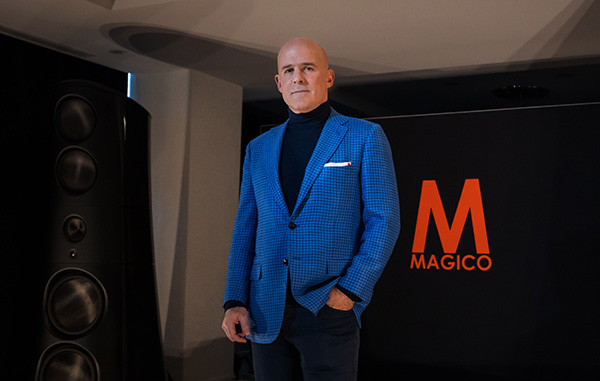
A conversation with Magico founder Alon Wolf can feel like stepping onto a moving walkway; it's best to find your balance early. Over the course of a spirited five-hour conversation at the company's impressive production facility in Hayward, California (footnote 1), Wolf questioned my choice of gear. Twice. "You should pick what you like of course," he said of a pair of speakers I'd been using as references. "But why?" I laughed, entertained by his cheek.
Hours later, as he piloted his Porsche across the San Mateo Bridge toward a sushi restaurant in downtown San Francisco, I mentioned a five-figure power amplifier I'd bought recently. "There are better options for you," he said. This time, we both laughed. But he wasn't kidding, exactly. Wolf just likes what he likes, and he likes it intensely.
Most of us are trained to leave a little air in the room, to acknowledge that other people arrive at pleasure by different routes. Not Wolf. He listens to opposing views the way an engineer listens to noise: attentively and with no intention of letting it persist. It's not arrogance, I think, but a kind of guileless audacity.
"I told you I'm crazy," he said agreeably.
"I wouldn't say crazy," I offered, "but you're no diplomat."
"Life's too short," he said. "I push, you know? It's not necessarily about making something perfect—I know that perfection is always a few steps away. But it's become a very common thing for people to say, 'Okay, just do the best you can.' Well, 'the best you can' doesn't count. We should be striving towards the best there is."
"The worst thing I've ever heard"
Many years ago, Wolf told me, he traveled to the home of a stereo writer to install a pair of Magico speakers the man was going to review. The scribe's reference speakers were from a competing brand—one Wolf doesn't care for (footnote 2). "So I'm sitting in the guy's room thinking to myself, 'Oh god, this is just the worst thing I've ever heard'," Wolf said about the speakers, which at the time were in Class A of Stereophile's Recommended Components.
"And you shared that with your host," I ventured.
"No," Wolf said proudly. Instead, he told the reviewer they were the best speakers he'd ever heard from that manufacturer.
"I don't pooh-pooh anyone's system," he told me, "because I'm aware of the fact that this is their pride and joy. So most of the time I bite my tongue when I hear a bad system that somebody actually invested in." He allows himself more freedom to criticize the choices of audio writers, because it's not unusual for them to have products on medium-term loan, with less or no financial investment.
I reminded him that many reviewers don't use Magico loudspeakers as their reference. Are they all wrong? "I don't know," Wolf said, seeming to leave that possibility on the table. "You'd have to ask your colleagues."
Abort the port
Wolf remained impervious to the conciliatory idioms I tried on him a few times: No arguing about taste. To each their own. More than one way to skin a cat. "Not if it's the same cat," he argued. "I mean, if you're building a line source, then yes, that's a different cat than a point source. But I just don't think anyone has found a better way to skin my cat." His cat, I noted, was very much alive, and very much his. Central to Magico's approach is a deep commitment to acoustic suspension—to sealed-box speakers. Wolf hates ports the way a minimalist hates throw pillows. The last speaker he bought, he told me, was a European standmount from the early '90s. "It was actually built to quite a high standard, but it had a lot of issues. It had a passive radiator—that's a port. A damped port, a controlled port, but still a port. I tinkered with that speaker, rebuilt it, and the more I damped it, the better it sounded. Eventually I took [the passive radiator] out completely and blocked it, and voilà, suddenly you're hearing resolution, you're hearing linearity. You did lose some of the "bwuf bwuf"—he makes sounds like those he thinks ports make—"but who needs that? ... That bass hump could be good on rock'n'roll I guess. It's probably not great if you're listening to a soprano."
Besides, ports create group delay, Wolf explained. "The notes don't leave the speaker at the exact same moment, so that smears out the sound. A ported speaker will never be as crisp and as clear as a sealed design.
I know you give up efficiency on the lower end, but efficiency can be brought in with bigger amplification," he said. "As my physics professor used to say, [if] there's a hole in the bucket, it doesn't matter how much water you're pouring into it; it's always going to leak."
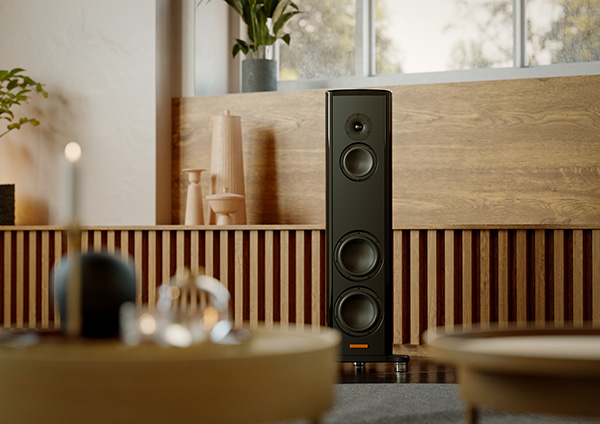 Wolf has long been familiar with listeners' reservations about sealed designs. "When people heard our products, they often asked, 'Where's the bass?' Because it doesn't have that extra bloated energy in the bottom. With sealed enclosures, the rolloff in the bass is 12dB per octave—as opposed to ported, which is 24dB per octave. So, all things being equal, at 20Hz, a sealed design will have 12dB more output than a ported one. Objectively, there is in fact more bass [with a sealed speaker], and because the bass is linear, you can very easily follow the melody and hear the decay of the lower notes."
Most Disappointing Fiber?
Wolf has long been familiar with listeners' reservations about sealed designs. "When people heard our products, they often asked, 'Where's the bass?' Because it doesn't have that extra bloated energy in the bottom. With sealed enclosures, the rolloff in the bass is 12dB per octave—as opposed to ported, which is 24dB per octave. So, all things being equal, at 20Hz, a sealed design will have 12dB more output than a ported one. Objectively, there is in fact more bass [with a sealed speaker], and because the bass is linear, you can very easily follow the melody and hear the decay of the lower notes."
Most Disappointing Fiber?
Another key principle in Magico's engineering approach is a commitment to aluminum. Wooden cabinets, Wolf says, are a hopeless compromise. "There's no reason to build a speaker cabinet from wood except cost," he told me. "It's cheap to make an MDF enclosure. You can saw stuff in your garage, glue it together—boom, you're done. But MDF is probably the worst material you can use for a loudspeaker cabinet. First of all, it's not especially stiff, so it soaks up some of the energy that should be expelled into the room. Also, part of the problem with MDF-type enclosures"—he names a specific speaker brand—"is that you can only put so much torque on the screws. You can apply maybe two, three pounds of torque before you strip the insert, and when that happens, you don't have good coupling. It's very important that a driver is completely coupled to the enclosure. The enclosure needs to be part of the frame of the drivers." Drivers need periodic retightening, Wolf said, because vibrations and environmental changes cause them to loosen. He recommends tightening Magicos three or four times a year. "Don't crank it too much, because you can break it," he cautioned. "Just make sure it's hand tight. Magicos can take 20, 30 pounds of torque." He left the room and returned with two midrange drivers, one a respectable, off-the-shelf driver from a major manufacturer, the other a bespoke Magico creation. It's a source of pride for Wolf that Magico has designed and built more than 100 production drivers since 2004. He handed me the Magico driver with a warning: "You're going to need two hands to pick this up." He was right. The off-the-shelf driver is much lighter. It has a $20 ferrite magnet; the Magico driver uses an $800 neodymium magnet, Wolf said. "See the voice coil here? Titanium." He was referring to the voice coil former. "See the voice coil on that one? Plastic. Theirs have aluminum wires. Ours is six-nines copper."
Wolf is bothered by what he sees as a lack of rigor in the high-end loudspeaker industry.
"There's a whiff of charlatanism to it all," he posited. "A lot of these products, if they were cars, you'd get behind the wheel, and as soon as you hit 35 miles per hour, they'd fall apart and explode—and the company would be gone, out of business. At least when you build electronics, you need to know a little bit, because you can kill yourself with high voltage. But with speakers, people can build anything they want and sell it, no matter if it's a good idea from a physics or engineering point of view. And those companies stay in business despite putting out one product after another with serious problems."
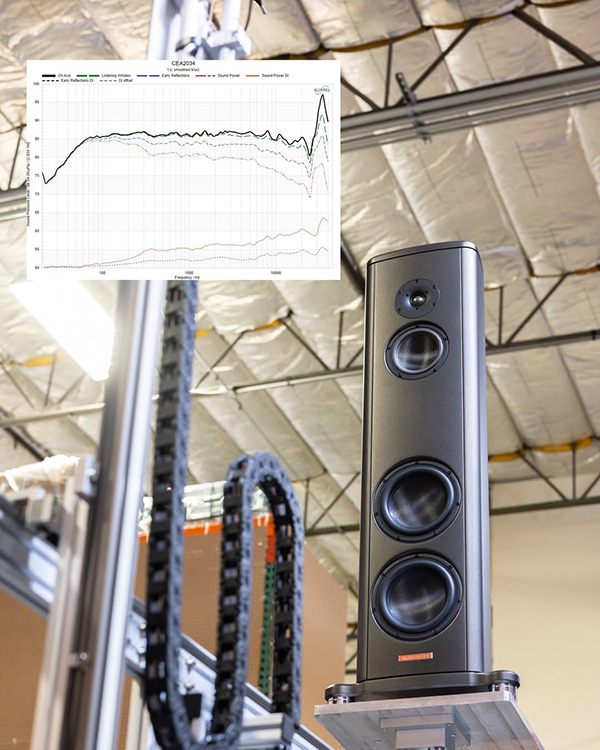
Over the past five years, Magico has invested heavily in measurement technology, including a Klippel nearfield scanner, which automates an exhaustive set of frequency-response measurements, and a Polytec laser vibrometer, used to measure vibrations in all three spatial directions. Wolf estimates that between the two measuring devices and a new state-of-the-art listening room, Magico has spent about $2 million on testing capability.
The technology is now so good, he said, that building speakers has become less an act of voicing than one of verification. "It's like push, play, done. It's beautiful on the one hand, and on the other hand, it's a bit boring. But I can live with that. I should not be part of the equation."
That's a remarkable statement. Wolf took up the violin at age 6 and later studied classical guitar at the conservatory level. He could be forgiven for letting his ears decide how his speakers should sound. But he's reached a point where what his ears say and what his measurements say no longer represent the usual Venn diagram: The circles overlap 99%. It irks him that the rest of the industry is largely "stuck in the past."
"I know speaker designers who are in their living room with the speaker there, and the crossover is open, and they're changing parts, and this is how they're voicing the speaker," he said. "It's a crime." The biggest problem, Wolf believes, is that these designer-engineers are hearing room interactions as well as the speaker. "I used to do the same thing," he allowed, "because we didn't have a custom-built listening room with virtually no modes like we do now. We'd tweak the crossover and everything else, and then we'd take it to somebody else's room, and it would sound completely different. It could be a two-month process. It was a nightmare. Luckily, with the tools we have now, that doesn't happen anymore."
Now, his feeling is, "Who the hell am I to voice a speaker?"
"Before the Klippel, you were working blind below about 800Hz," Wolf recalled. "You didn't really know what the hell was going on because you were measuring the room as well. It was very frustrating." There's now no reason for a great-sounding loudspeaker not to have near-perfect measurements, he believes. "If someone happens to like a speaker that also measures well, they can feel that their subjective assessment of reality has objective value."
He is unapologetically attached to numbers and graphs, so I had to ask: Isn't Magico a peculiar name for such a company?
"Ask any magician about the extensive preparation required to perform a successful magic trick," Wolf parried. "The more convincing the magic a loudspeaker can create, the greater the technical expertise and engineering work involved."
In fairness, Wolf named the company after the 1979 ECM album Mágico, by Egberto Gismonti, Jan Garbarek, and Charlie Haden. He was interested to learn later, he told me, that in Portuguese, mágico is a slang term for "drug dealer," the man who brings the magic (footnote 3). "I suppose I bring people the drug," Wolf half-joked. Recently he's been getting plenty of audiophiles hooked: 2024 and 2025 were the most successful years in Magico's 22-year history, he told me.
Wolf watched me fumbling with my phone. I apologized for seeming distracted: "I'm just making sure it's still recording," I said. He turned deadpan. "I hope not. I said a lot of things I probably shouldn't have."
I glanced up. He looked less like a man worried about what he'd said and more like someone who was pleased to have said it plainly (footnote 4).
Footnote 1: There, the company makes everything from the $10,800/pair A1 standmount to the beastly, carbon-fiber–clad M9 ($750,000/pair). With 30 employees working across 30,000 square feet, the place is too big to call a workshop and too tidy to call a plant, though it processes more than 300 tons of steel, aluminum, and copper annually. Watch the video at rb.gy/9anaom. Footnote 2: During the course of the conversation, Wolf panned several brands by name. We're not going to include names because then we'd need to give those companies an opportunity to respond, which doesn't work for a straight interview.—Jim Austin Footnote 3: couldn't verify this, though I was able to determine that in Brazil, "pó mágico" (magic powder) is sometimes used as a euphemism for cocaine.
Footnote 4: For more on Alon Wolf's philosophy see Jason Victor Serinus's interview in June 2008.—John Atkinson
Many years ago, Wolf told me, he traveled to the home of a stereo writer to install a pair of Magico speakers the man was going to review. The scribe's reference speakers were from a competing brand—one Wolf doesn't care for (footnote 2). "So I'm sitting in the guy's room thinking to myself, 'Oh god, this is just the worst thing I've ever heard'," Wolf said about the speakers, which at the time were in Class A of Stereophile's Recommended Components.
Wolf remained impervious to the conciliatory idioms I tried on him a few times: No arguing about taste. To each their own. More than one way to skin a cat. "Not if it's the same cat," he argued. "I mean, if you're building a line source, then yes, that's a different cat than a point source. But I just don't think anyone has found a better way to skin my cat." His cat, I noted, was very much alive, and very much his. Central to Magico's approach is a deep commitment to acoustic suspension—to sealed-box speakers. Wolf hates ports the way a minimalist hates throw pillows. The last speaker he bought, he told me, was a European standmount from the early '90s. "It was actually built to quite a high standard, but it had a lot of issues. It had a passive radiator—that's a port. A damped port, a controlled port, but still a port. I tinkered with that speaker, rebuilt it, and the more I damped it, the better it sounded. Eventually I took [the passive radiator] out completely and blocked it, and voilà, suddenly you're hearing resolution, you're hearing linearity. You did lose some of the "bwuf bwuf"—he makes sounds like those he thinks ports make—"but who needs that? ... That bass hump could be good on rock'n'roll I guess. It's probably not great if you're listening to a soprano."
Wolf has long been familiar with listeners' reservations about sealed designs. "When people heard our products, they often asked, 'Where's the bass?' Because it doesn't have that extra bloated energy in the bottom. With sealed enclosures, the rolloff in the bass is 12dB per octave—as opposed to ported, which is 24dB per octave. So, all things being equal, at 20Hz, a sealed design will have 12dB more output than a ported one. Objectively, there is in fact more bass [with a sealed speaker], and because the bass is linear, you can very easily follow the melody and hear the decay of the lower notes."
Another key principle in Magico's engineering approach is a commitment to aluminum. Wooden cabinets, Wolf says, are a hopeless compromise. "There's no reason to build a speaker cabinet from wood except cost," he told me. "It's cheap to make an MDF enclosure. You can saw stuff in your garage, glue it together—boom, you're done. But MDF is probably the worst material you can use for a loudspeaker cabinet. First of all, it's not especially stiff, so it soaks up some of the energy that should be expelled into the room. Also, part of the problem with MDF-type enclosures"—he names a specific speaker brand—"is that you can only put so much torque on the screws. You can apply maybe two, three pounds of torque before you strip the insert, and when that happens, you don't have good coupling. It's very important that a driver is completely coupled to the enclosure. The enclosure needs to be part of the frame of the drivers." Drivers need periodic retightening, Wolf said, because vibrations and environmental changes cause them to loosen. He recommends tightening Magicos three or four times a year. "Don't crank it too much, because you can break it," he cautioned. "Just make sure it's hand tight. Magicos can take 20, 30 pounds of torque." He left the room and returned with two midrange drivers, one a respectable, off-the-shelf driver from a major manufacturer, the other a bespoke Magico creation. It's a source of pride for Wolf that Magico has designed and built more than 100 production drivers since 2004. He handed me the Magico driver with a warning: "You're going to need two hands to pick this up." He was right. The off-the-shelf driver is much lighter. It has a $20 ferrite magnet; the Magico driver uses an $800 neodymium magnet, Wolf said. "See the voice coil here? Titanium." He was referring to the voice coil former. "See the voice coil on that one? Plastic. Theirs have aluminum wires. Ours is six-nines copper."
Magico uses a Klippel Nearfield Scanner to measure and optimize the design of its loudspeakers. Pictured is the S2, reviewed in this issue by Rogier van Bakel. (Photo: Magico.)
So good it's almost boringOver the past five years, Magico has invested heavily in measurement technology, including a Klippel nearfield scanner, which automates an exhaustive set of frequency-response measurements, and a Polytec laser vibrometer, used to measure vibrations in all three spatial directions. Wolf estimates that between the two measuring devices and a new state-of-the-art listening room, Magico has spent about $2 million on testing capability.
Footnote 1: There, the company makes everything from the $10,800/pair A1 standmount to the beastly, carbon-fiber–clad M9 ($750,000/pair). With 30 employees working across 30,000 square feet, the place is too big to call a workshop and too tidy to call a plant, though it processes more than 300 tons of steel, aluminum, and copper annually. Watch the video at rb.gy/9anaom. Footnote 2: During the course of the conversation, Wolf panned several brands by name. We're not going to include names because then we'd need to give those companies an opportunity to respond, which doesn't work for a straight interview.—Jim Austin Footnote 3: couldn't verify this, though I was able to determine that in Brazil, "pó mágico" (magic powder) is sometimes used as a euphemism for cocaine.