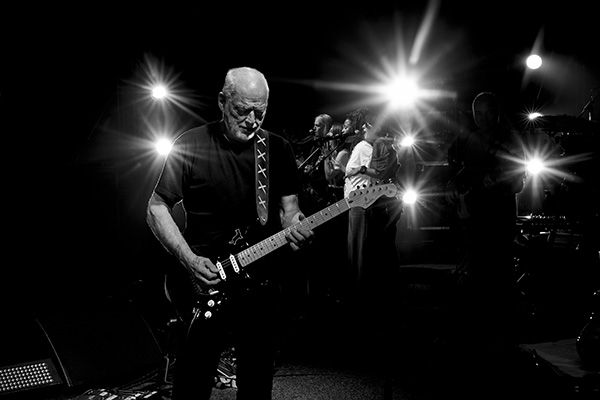
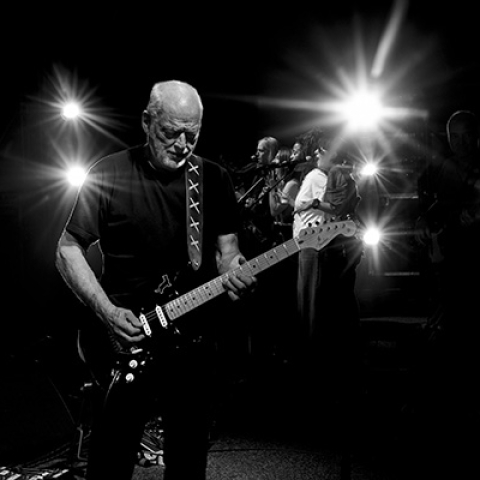
Photo by Polly Samson.
"Thank you very much indeed." That's David Gilmour offering his recurrent humble rejoinder to the fever-pitched audience response throughout the 2.5-hour performance that makes up the bulk of his latest solo release,
Live at the Circus Maximus (Sony Music), which was recorded in Rome over the course of three shows held at the storied Italian venue October 1–3, 2024.
As is his wont, Gilmour tends to speak in the traditional, understated English way—and, mind you, he's very much
not speaking with a tone of "quiet desperation," as an infamous lyric he sings toward the end of the ageless Pink Floyd track "Time" puts it (footnote 1). Whether he's acknowledging the audience's fervor, introducing the next song, or identifying his bandmates, Gilmour comes across as a seasoned country gent, albeit one adorned in his long-standardized low-key stage outfit—short-sleeved black shirt and black trousers. Still agile at age 80, Gilmour is a respected elder statesman who shepherded the rock idiom as it expanded internationally during the '60s and '70s, and he continues to perform at a level of quality few match, before some of the largest audiences of any entertainer, all over the world.
Gilmour joined Pink Floyd in 1968, replacing his good friend Syd Barrett—the "crazy diamond" of Pink Floyd lore. Gilmour took over lead guitar and vocals for the balance of the band's second LP,
A Saucerful of Secrets. From that point, his soothing yet forceful voice—on vocals and guitar—was an unmistakable part of the Pink Floyd sound. Whether evidenced by his razor-sharp guitar sequences on the 23-minute epic "Echoes," delicate scat vocals and pedal-steel work on "
Wish You Were Here," or soaring, elegiac soloing on "Comfortably Numb," Gilmour has been making adventurous yet accessible music for going on six decades.
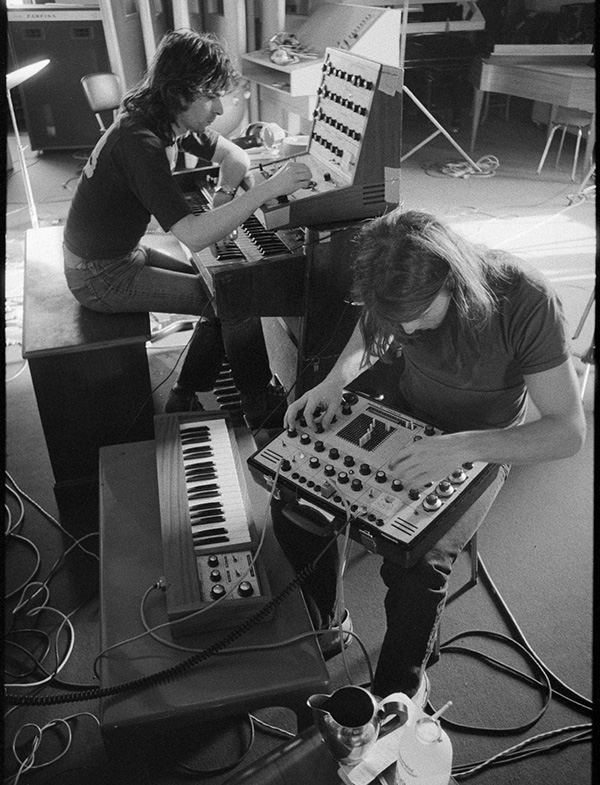
Gilmour with Richard Wright in the studio circa 1975. Photo By JD Mahn—Courtesy Sony Music Entertainment.
Pink Floyd called it quits after a world tour supporting 1994's
The Division Bell, though there have been reunions here and there and numerous archival releases. Gilmour had already released two solo studio albums,
David Gilmour from 1978 and
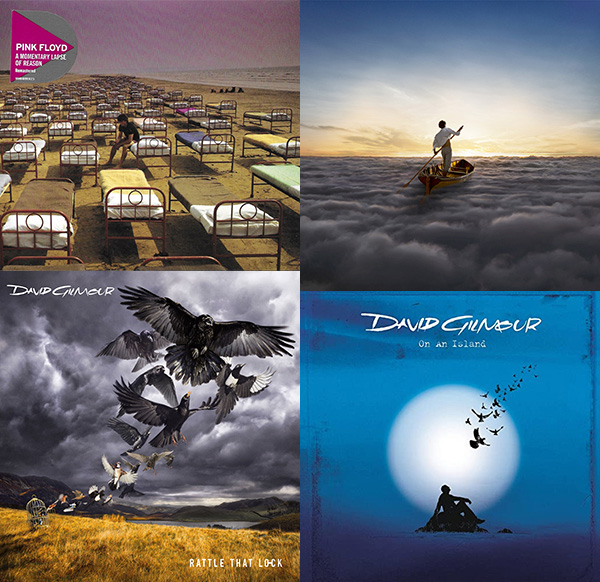
About Face from 1984. It took him 22 years—12 years after
The Division Bell—to release another, 2006's
On an Island. From that point on, Gilmour has issued an album every nine years like clockwork—2015's
Rattle That Lock and 2024's
Luck and Strange, each one followed by short, calculated bursts of international touring.
Gilmour insists that all his tours be carefully chronicled in several A/V formats. "I want the artifacts to be out there for people, you know?" he told me during an exclusive Zoom interview for this
Stereophile feature. "I want the tour films to be out there on Blu-ray and the albums to be out there on vinyl, CD, or whatever other formats people use these days."
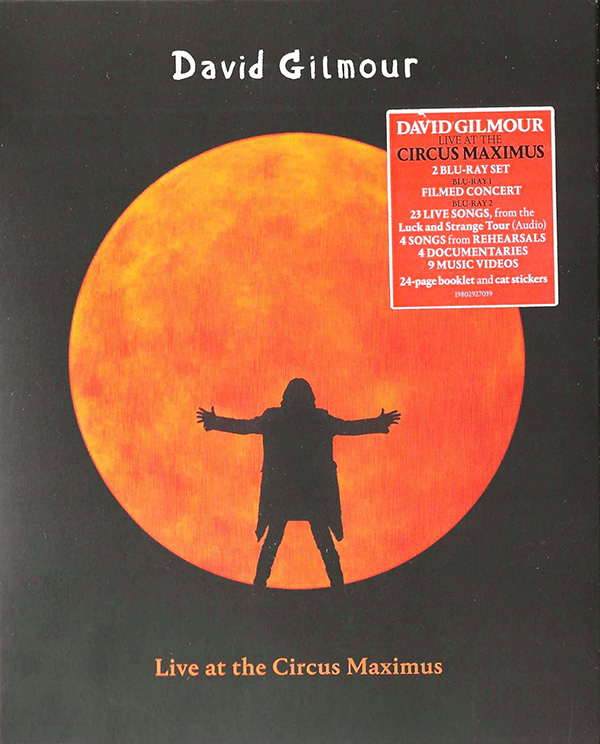
The main feature of
Live at the Circus Maximus is a 142-minute concert film (released to theaters in IMAX last October) made during the Italian portion of the 23-date tour Gilmour undertook to fete and promote his 2024 release,
Luck and Strange. In the Blu-ray version, the first of two discs serves up the 22-track film in Dolby Atmos, DTS-HD Master Audio 5.1, and 24/96 PCM stereo. The second disc, subtitled
The Luck and Strange Concerts, presents 23 live tracks curated from locales in North America, the UK, and Europe, including one track—"A Single Spark"—that isn't in the concert film. The second disc also includes extras: four songs from tour rehearsals, four documentaries, and nine music videos. A three-DVD release includes the concert film plus a disc of extras. Or you can buy four-LP or two-CD sets with all the music listed above—none of the video, obviously—but no concert film. Finally, there's the mondo, redundant "Super Deluxe"
Maximus box set, which includes literally all of the above.
Gilmour is adept, in live performance, at balancing newer material—the delicate duet with his daughter, vocalist/harpist Romany Gilmour, on "Between Two Points," and the muscular funk jam of "Dark and Velvet Nights"—with updated Floyd-era classics like the three-part harmonizing on "The Great Gig in the Sky" (from 1973's
The Dark Side of the Moon) and the still-foreboding back-to-back combo of "High Hopes" (from 1994's
The Division Bell) and "Sorrow" (from 1987's
A Momentary Lapse of Reason). Gilmour told me in the interview that his intent was to begin his live set on an "up note" followed by a more serious middle section and to end with an uplifting, comforting message before taking his final bows. "That's absolutely my intent," Gilmour said. "That feeling is what you want to get to."
To borrow Gilmour's words as my own response: Thank you very much indeed. This interview has been edited for clarity.
 Mike Mettler:
 When we first spoke in February 2006 about your
On an Island solo album, you told me "the best songs choose themselves." Was that still the case as you were figuring out what to play on the
Luck and Strange tour we're now seeing and hearing on
Live at the Circus Maximus?
David Gilmour: Ahh, let me see. Have I changed my view on that? Well, my view is that my
desire is mostly to be playing new music—and I guess I had fewer albums to pick from in that moment in 2006! [
chuckles.] This time, my selfish desire was to do new music as much as possible—but obviously realizing, understanding, and sympathizing with the public's view that they want to hear some of the older material as well. Basically, we tried to see if we could fit everything from that new album. In fact, Polly, my lovely wife, did most of the setlist herself (footnote 2).
Mettler: A hallmark of your recording career has been that you've been able to achieve great sound, in the studio and onstage. That was evident even in 1968 when you joined the group. Initially, you were working with seasoned Abbey Road engineers including
Norman Smith. Did you already have an understanding as an artist that "We need to sound, I need to sound, a certain way. I need to hear my music at a certain quality level"
Gilmour: I don't know how much I understood about that at the beginning. I was just brand-new in a professional band, and I was brand-new to the proper recording process that was going on. It was very tricky.
Norman, lovely Norman, had engineered with The Beatles, but he had been promoted to producer with us, and we also had a number of very good Abbey Road engineers like Peter Bown (footnote 3). I think my desire at the beginning was to learn how to use the studio—how to learn to use what the desk could do, what the tape machines could do—and learn about all the trickery that was possible.
The studio manager of Abbey Road at the time, Ken Townsend, had invented what we call ADT, a technical way for double-tracking yourself automatically. Automatic Double Tracking is what ADT stood for. So, yeah, I spent a lot of my time trying to see how it all worked—what all those faders meant, and what using all the sends and returns meant.
Mettler: Was there one early Pink Floyd track where you were like, "Okay, this is what I want. This is what I heard in my head, and this is what we got on tape"
Gilmour: Umm, gosh! I can't say I have an answer to that, but I can remember all sorts of disasters and things, like the recording of the orchestra in "Atom Heart Mother," and things like that (footnote 4). In the earlier days, you could chop and change engineers. The idea of a fixed engineer for a whole project took some time to bed in with the people at Abbey Road, so we would have one engineer one day and maybe a different one another day. The gradual process of turning it into that type of team where one person is in charge of the whole thing took some time to take hold.
Alan Parsons was the first guy we had that we could trust (footnote 5). Alan was someone we really got on with, and he was on the same page as us.
Dark Side was the first album where we really thought we had tied all those things together and got all those things in place. The sound was great, and the mixing was great. And the cross-phase—the cross from one track into another—was a whole technical thing that took a
long time to do in those days, but which you can now do in 10 seconds on Pro Tools. Back then, you had to really work on those things.
These days, I want to do it the easiest way. I want few things to stand in the way of what I'm trying to create musically, and Pro Tools is my method for getting things down in the studio, and all the things you can use with it. That's where I go.

David supports his vocalist daughter Romany. Photo by Polly Samson.
Mettler: The Atmos mix of the new song you and your offspring Romany did together, "Between Two Points," is a great example of how to use 360 degrees to evoke feeling and emotion.
Gilmour: Yes—and I have to give enormous credit to Charlie Andrew, my coproducer, and Matt Glasbey, my engineer, who's just genius. Brilliant, brilliant person. They work and work until there's not another detail you think you want to improve.
Mettler: You guys were already doing live quad in the 1960s, so you've always been involved in surround sound. When you were performing at the Circus Maximus, did you also have a sense of all the sound that's going on around you?
Gilmour: Well, I've got the whole stage of instruments coming at me from all sides, but they're all turned down a little bit from what I used to have going. I've got some monitor speakers down on the floor in front of me, and I asked my monitor engineer [
Dee Miller] to make me feel that I'm in the
atmosphere of the whole thing that's going on.
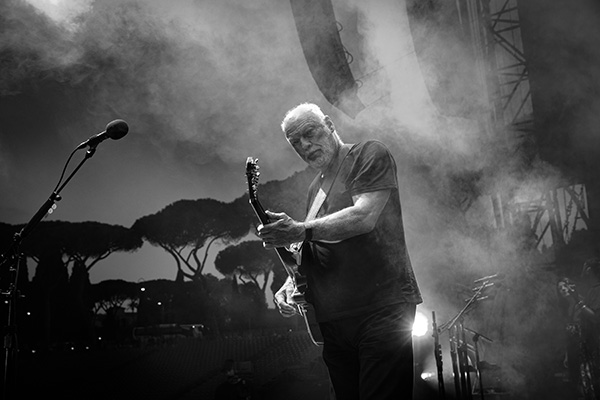
Photo by Jill Furmanovsky.
Mettler: Here's something I noticed after rewatching the recent Blu-ray of
Pink Floyd at Pompeii (footnote 6). Back in 1971, you were singing straight on into that vintage Sennheiser microphone. But as we see in
Circus Maximus, you now lean your neck upwards toward your microphone whenever you sing. Is that a performance thing you figured out over the years—that you could sing better by doing it at a different angle?
Gilmour: Well spotted! I do think opening the throat a little bit upwards makes it a more natural passage of air. If you are down here like this [
Gilmour tilts his head down into his neck and speaks in a lower, more guttural tone], it is obviously different. The other thing is, if you are sitting down, you are compressing your stomach and your lungs a little bit more than standing up. I don't feel comfortable singing when I'm sitting down.
Mettler: When you're soloing on guitar, you're looking downward. Is that a conscious thing, or is it just the way you've always played?
Gilmour: What's the truth, and the way to describe playing like that? I think I like the safety factor of being able to glance at the fretboard sometimes myself. I'm not quite as confident as some of the guys I've seen who are up there, never looking! [
laughs.]
Mettler: Is the bell sound on "Fat Old Sun," from
Atom Heart Mother, the same bell sound you used on "High Hopes," from
The Division Bell, almost 25 years later?
Gilmour: At Abbey Road, there was a room behind Studio Three, which is on the ground level floor. There was a room out the back of Studio Three that had a window
into Studio Three, and you could sneak in and watch people recording in there if you wanted to—but it also had a big cupboard full of tapes of sound effects. The sound effects for "Fat Old Sun" came out of the tape effects cupboard. They'd be labeled up, and you could get the sound of bees and wasps, a church bell, or whatever you'd like so you could create a little sound picture of what you wanted it to sound like (footnote 7).
With "High Hopes," the bell was originally just a C note on a piano. [
Gilmour sings the note sequence: "dong-dang dang-dang."] Later on, I thought, "That could be a bell—and that would add a whole thing to it." We had a bell made for it—but I don't think it was made in time for the record, so we used that bell sound, and we got it tuned as close to C as possible. Live, on
Circus Maximus, that's a bell we had made by the Whitechapel Bell Foundry in London. They've been making bells for centuries.
Mettler: That's an amazing sound—especially how it rings and resonates all around you in Atmos. Going back to "Fat Old Sun," how does a song that's 55-ish years old still connect with you as the artist? Why does that song still resonate with you?
Gilmour: It's one of the first songs I ever wrote. It's about a teenage moment in a meadow, by a river. What can you say? It captures a moment—a snapshot of a moment—but I hope it captures it well. And I still love playing it. This time, we changed the arrangement a bit. On the record, the drums don't come until the chorusy bit—but this time, playing it live, we brought them in for the second verse and just picked the whole thing up a little bit.
Mettler: It's nice to have the contrast, because you switch from acoustic to electric during that song. Acoustically, you're playing above the sound hole to get a different tone, and then you switch over to the electric seamlessly, right in the middle of it. You have to literally change your mindset in the middle of the song to get across both sides of it.
Gilmour: Well, you
do have to change mindset, but we have deliberately exaggerated the change. If you listen to the record, it sort of goes in like a murmur to the guitar change to the pedal steel—and you also have it with my rotten drum-playing on the original (footnote 8).
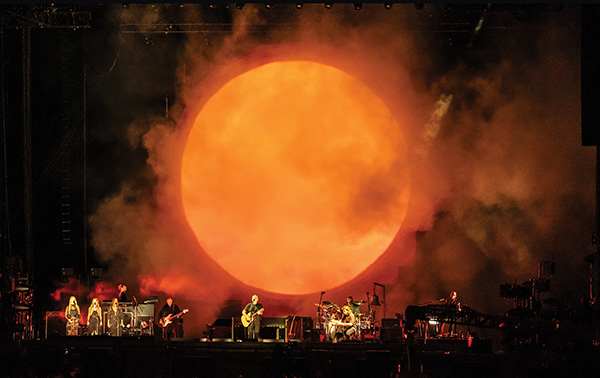
Photo by Anna Wloch.
Mettler: Well, at least we have the original on hand for posterity to compare with the newer versions. [
more laughter.] I'm also glad you continue to embrace surround sound and Atmos, which lend themselves well to both your solo releases and Pink Floyd material. Back in August 2014, I flew across the Pond to attend a playback event held on the Astoria, your houseboat recording studio on the Thames outside London. I sat in the control room with [
engineer] Andy Jackson to listen to the 5.1 mix you guys had done for
The Endless River (footnote 9). That was an amazing experience. You still use the Astoria for recording, don't you?
Gilmour: We did all the mixing and all the Atmos there in Astoria, but we set up in what we used to use as a little recording room down at the end. In fact, we made most of
A Momentary Lapse of Reason and most of
The Division Bell in this quite
tiny room—you wouldn't believe it!
Mettler: I do believe it, having stood in that room myself!
There is not a lot of room for all of you to set up gear and play! Did you listen to the Atmos playback in Astoria, or did you go somewhere else to QC it?
Gilmour: We had that little room set up with a small Atmos system—but then we took it off to Abbey Road to a big room to try to perfect some of the details, which we did a lot of for the filmed version.
Mettler: Well, it all looks great, and sounds great too. Before we go, can I put in a request? As long as you have the rights to them, can we get 1984's
About Face and 2006's
On an Island done in Atmos one of these days? I'd love to hear "All Lovers Are Deranged," from
About Face, unfold all around me. If you don't mind.
Gilmour: [
laughs.] They're all on the list somewhere. You know, when I started out in Pink Floyd in 1968, the chances of getting anything right—well, like poor old George Orwell with
1984, there was an awful lot of stuff that eventually overtook him. The progress in all the sound and playback things that have happened in my working lifetime is beyond what I could have ever imagined.
Footnote 1: "Time," the next-to-last track on side 1 of
The Dark Side of the Moon, also appears on the new album, during the first quarter of Gilmour's
Circus Maximus show.
Footnote 2: Polly Samson is also an accomplished novelist and photographer. Her visual chronicle of the recording, rehearsals, and live performances for the
Luck and Strange album project—
David Gilmour: Luck and Strange Studio/Live—was published by Thames & Hudson in January 2026.
Footnote 3: Prior to their work on
Saucerful, Norman Smith produced and Peter Bown engineered Pink Floyd's 1967 debut LP,
The Piper at the Gates of Dawn, which was done with Syd Barrett at the helm as lead guitarist/vocalist before Gilmour joined the band an album later.
Footnote 4: "Atom Heart Mother" is the challenging, 24-minute track that takes up all of side 1 on the 1970 LP of that name.
Footnote 5: When Parsons engineered 1973's
The Dark Side of the Moon, he had worked with Pink Floyd once before, as a tape operator on
Atom Heart Mother.
(In 1972 I played bass guitar on an album recorded in Abbey Road's Studio 3. The tape op was a youthful Alan Parsons, who, when the producer and engineer were at lunch, sat at the console and did a superb mix of one of our songs. Scroll down the page
here for a photo of Parsons that I took at one of the sessions.—
John Atkinson)
Footnote 6:
Pink Floyd at Pompeii MCMLXXII is the 2025 remastered update of the 1972 release of the band's October 4–7, 1971, performances in the Roman Amphitheatre in Pompeii, Italy, and it now includes a new Atmos mix by the ubiquitous Steven Wilson.
Footnote 7: Apparently, these same bell sound effects were also used on the Kinks' "Big Black Smoke," the B-side to their November 1966 single "Dead End Street" that ultimately landed on March 1972's compilation
The Kink Kronikles. It is also a bonus track on CD reissues from 1998 onwards for the Kinks' October 1966
Face to Face album.
Footnote 8: Gilmour and keyboardist Richard Wright are the only two Pink Floyd band members who play all the instruments on "Fat Old Sun."
Footnote 9:
The Endless River, touted as the "final" Pink Floyd album, was released in November 2014.