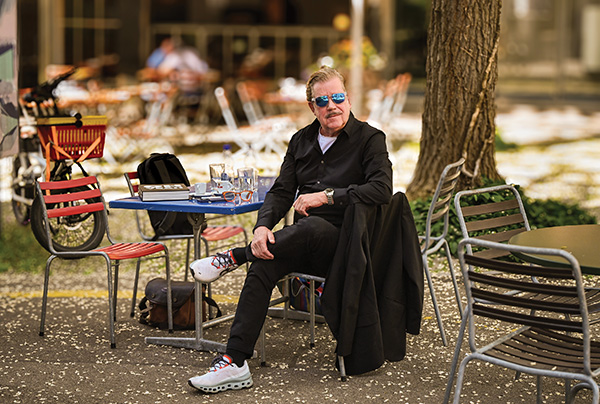
Yello's Boris Blank poses at an outdoor cafe in old town Zurich. (Photo by Rogier van Bakel.)
Boris Blank has a cold, and three days after meeting him in his hometown of Zurich, I do too. This seems apt. Metaphorically, he's been infecting me for decades.
For almost 45 years, Yello, the pioneering Swiss band that Blank formed with singer Dieter Meier, has created witty electropop that provokes joy and awe in attentive listeners. You can dance to most of this music, of course—it's often hard not to—but its allure, its spell, goes deeper. For one thing, Yello's music is delightfully visual. Cinema for the ears.
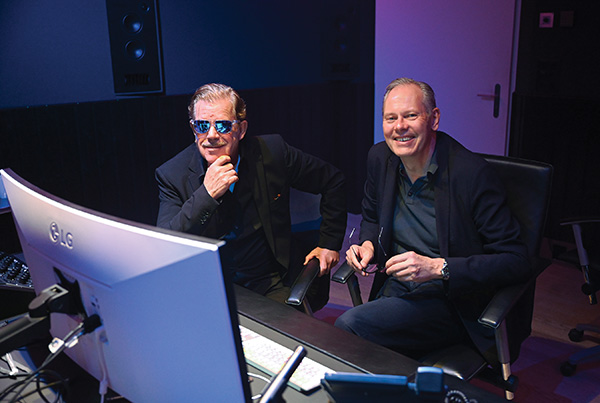
Boris Blank with Leo Gerteis of NJP Studios, during an Atmos mixing session of Yello's back catalog. (Photo by Rogier van Bakel.)
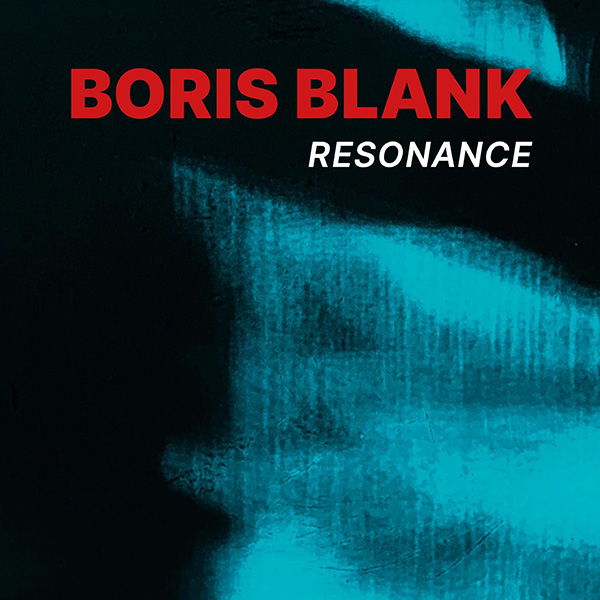
Of spas and outer spaceI congratulate him on Switzerland's win at the 2024 Eurovision Song Contest, just a few days earlier. Nemo, a flamboyant up-and-comer, took the trophy by singing "The Code," a florid, almost operatic song about being nonbinary. Blank is happy to see Nemo join the pantheon of Swiss pop music overnight, calling the young artist "someone with power and authenticity, and with a voice that is very artistic, very special." Most Swiss pop and rock acts, he says, lack originality. He makes an exception for the Young Gods, an internationally renowned industrial rock band that, like Yello, uses lots of sampling and sound effects. "I like bands that don't look to the right or to the left, wondering 'what should we do,' waiting for a train to jump on. The Young Gods have their own ideas, their own DNA. I think that's why they're successful. Other Swiss bands imitate what they see and hear from abroad, mostly from England and America. That's never going to be well received across our borders." The conversation turns to Blank's new solo album, Resonance. With the exception of the propulsive opening track, it's an introspective, downtempo set, much gentler than Yello's often kinetic fare. Resonance is an hour's worth of meditative music, all shimmering synth pads and ambient textures. There's next to no beat—or at least, no percussion. The soundscapes are as expansive and lovely as ever, but the music seems to drift a bit aimlessly, without apotheosis or even much structure. This makes sense. Blank explains that the owners of a fancy thermal spa in Baden, designed by the internationally renowned Swiss architect Mario Botta, commissioned him to do the sound design for its "audiovisual experience area." The spa focuses on mental repose, with deep space as inspiration and as an avenue for mind expansion. This music, remixed, became Resonance. (It bears some kinship to Brian Eno's 1983 album Apollo: Atmospheres and Soundtracks.) At first, Blank hadn't intended to release the recordings to an outside audience, but demand rose thanks to spa visitors' word of mouth. "So I thought, why not?" he says, ever the amiable gentleman.
 Whether he works solo or with Meier, the process is the same. Drawing from more than half a million recorded sounds and samples, most of which he recorded himself, he toys around with a few until they fit together in a pleasing way. "I pull out a sound, a fragment, a pattern, whatever, and treat it as color on a canvas. One color is interesting; adding a second one is more interesting because now they interact. After a while, I begin to see a contour, a direction. If all goes well, then in the end I've accidentally surprised myself with the result."
He considers himself "a mood maker rather than a musician." Meier is too, he says. "We don't even know musical notation. We're both naifs, dilettantes." Not coincidentally, Blank loves Florence Foster Jenkins, Stephen Frears's biopic about the earnest but bungling amateur soprano. For years, he suffered from imposter syndrome, demurring when people called him a composer. To Blank, composers are people who write elaborate scores for symphony orchestras. But he's finally allowed himself to lean into the term. "I didn't believe them at first, but over the years, so many musicians came to me, including people from the classical music world, and paid me real compliments and treated me as their equal. So it's fine. Now I just go with it."
Whether he works solo or with Meier, the process is the same. Drawing from more than half a million recorded sounds and samples, most of which he recorded himself, he toys around with a few until they fit together in a pleasing way. "I pull out a sound, a fragment, a pattern, whatever, and treat it as color on a canvas. One color is interesting; adding a second one is more interesting because now they interact. After a while, I begin to see a contour, a direction. If all goes well, then in the end I've accidentally surprised myself with the result."
He considers himself "a mood maker rather than a musician." Meier is too, he says. "We don't even know musical notation. We're both naifs, dilettantes." Not coincidentally, Blank loves Florence Foster Jenkins, Stephen Frears's biopic about the earnest but bungling amateur soprano. For years, he suffered from imposter syndrome, demurring when people called him a composer. To Blank, composers are people who write elaborate scores for symphony orchestras. But he's finally allowed himself to lean into the term. "I didn't believe them at first, but over the years, so many musicians came to me, including people from the classical music world, and paid me real compliments and treated me as their equal. So it's fine. Now I just go with it."
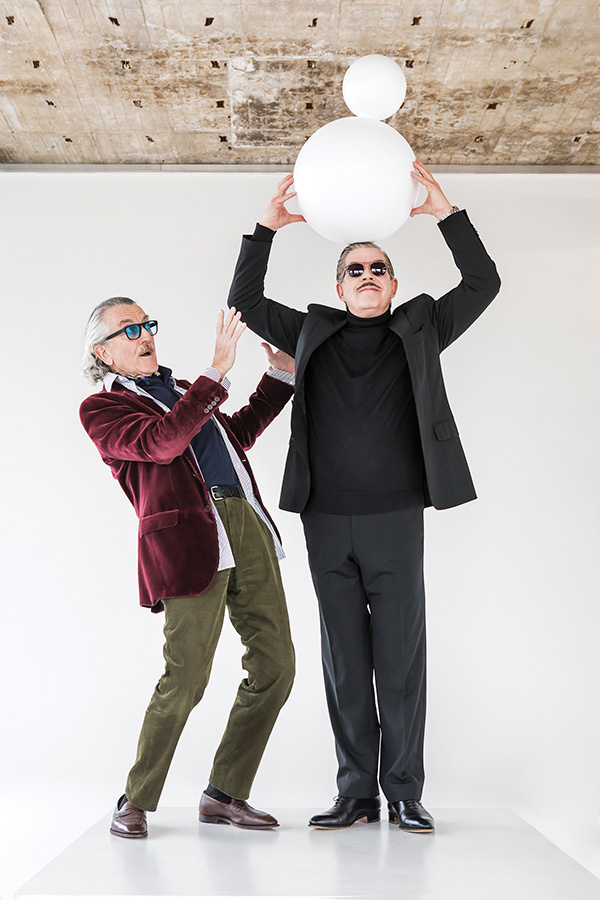
Blank and longtime Yello partner Dieter Meier, embracing absurdity. (Photo by Helen Sobiralski.)
Of democracy and double agentsBlank speaks highly of his collaborators, such as the vocalists Malia, Billy Mackenzie, and Shirley Bassey, and the jazz trumpeter Till Brönner. But he considers only Dieter Meier his musical partner (at least since keyboardist and founding member Carlos Perón departed Yello in 1983). Meier, with his slicked-back hair and sharp suits, is as much an actor as a singer. In fact, the extent of his vocal talents is hard to assess because he rarely ventures outside a single-octave range. Most of his lyrics are spoken, often with a winking undertone—one part sleazeball, one part upper-crust cad. Meier deftly channels the playboy, the trust-fund hedonist, the worldly adventurer, the debonair double agent, the love-'em-and-leave-'em lothario, the va banque player, the shady fixer, the boulevardier, the stylehound. Regrettably, he sometimes phones in the lyrics that he croons and purrs in German-accented English. ("You let your body talk, I wanna share the way you walk," he sort-of-sings on "Out of Sight," off Yello's latest studio album, 2020's Point.) Then again, creating literature was surely never in Meier's job description, and his pithy parlandos often do hit the spot. Consider the infectious, lustful "Oh yeah"s on Yello's biggest hit, and his wicked, supercilious "I know" in response to a woman who just told him "I love you," in the song of the same name.
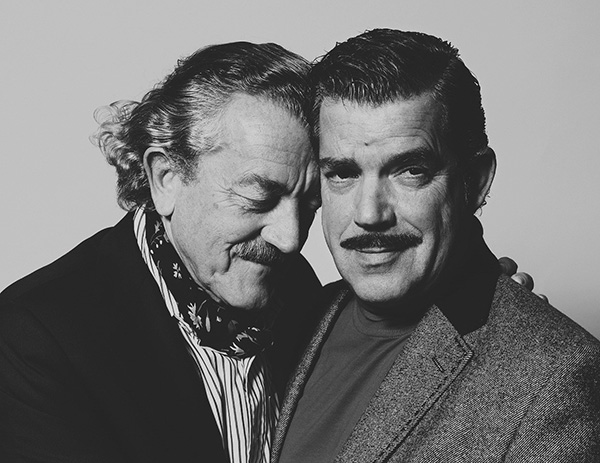
Blank & Meier. (Photo, Bänziger Fotografie, Used with permission.)
Of mustaches and robotsWhen it comes to electronica and synthesizer-driven pop, it's hard to say who the more influential pioneers are (footnote 1), Yello or Kraftwerk. My own appreciation for the latter, though sincere, is mostly academic; the heart doesn't really enter into it. I've always thought that the vital difference between Kraftwerk and Yello comes down to Blank and Meier's soigné mustaches. I'm serious. Kraftwerk has made a career out of literally pretending to be robots. Have you ever seen a robot with a mustache? That's my point. Meier and Blank, 'stache-wearers both, employ essentially the same music-making machines that Kraftwerk does, yet produce something that goes the opposite way. Yello's music exudes life, sweat, soul, dance, adventure, playfulness, willful absurdity, and self-deprecation—not things that automatons can easily fake.
Footnote 1: Perhaps the word is grandfathers; Blank is 72, Meier 79. The founding members of Kraftwerk are also in their 70s.