Photo by Vermeer Photography
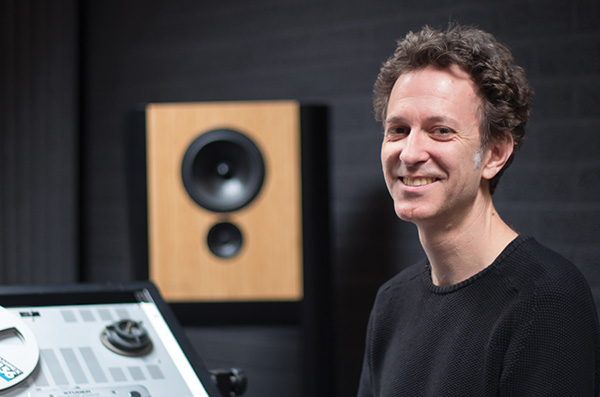
Most audio engineers split hairs. Eelco Grimm splits microseconds. His expertise in high-precision audio laid the groundwork for Grimm Audio, the Dutch venture he cofounded in 2004 with fellow electrical engineer Guido Tent. The company's master clocks and DACs, developed for both the pro audio and home hi-fi markets, combat tiny timing errors and jitter that can blight digital audio.
But Grimm Audio's engineering acumen also extends to the analog domain, as evidenced by the LS1c active speaker system that made the cover of
Stereophile's April 2025 issue. In John Atkinson's measurements section accompanying
my admiring review, JA wrote that over his 40-odd years of bench-testing audio equipment, the LS1c is "the best-measuring loudspeaker I have encountered."
Considering that accolade plus glowing
Stereophile reviews of the Grimm Audio MU1 music streamer (
JA, March 2021) and MU2 streamer-preamplifier (
KR, August 2024), and an extended conversation with Eelco Grimm seems like a splendid idea. How did he and his team pull off this succession of standout products?
It doesn't hurt that the 58-year-old entrepreneur combines formal training in electrical engineering with practical experience as a studio owner and recording engineer. He's also the former editor-in-chief of
Pro Audio magazine, and he teaches at the university-level HKU School of Music and Technology in Utrecht. He has given keynote addresses at gatherings of the international Audio Engineering Society.
In spring 2024, after I had tasked myself with learning more about the LS1 system, I spent a day with Eelco at the High End Munich audio show. Over the next 12 months, we had a half-dozen phone and Facetime calls and exchanged countless emails.
This is what I discovered: Like the equipment he designs, Eelco (pronounced ale-co) is polished, but there's no PR gloss or braggadocio. One example: He told me in Munich that Grimm Audio was replacing the beryllium tweeters in the LS1. Ecological concerns and supply-line issues had forced the use of new composite-carbon tweeters. The carbon version, Eelco told me, was "roughly as good. Very close to the beryllium tweeters." I stifled a smile. Other manufacturers would've sung the new driver's praises, insisting that it improved the sound. Eelco was content to suggest that the carbon tweeter was a lateral move.

Eelco Grimm, left, and co-founder Guido Tent (Photo by Heleen Wiering)
The interview below is compiled from our emails and other discussions.
Rogier van Bakel: It's rare for a pro audio brand to successfully cross over into consumer territory. How did you manage that?
Eelco Grimm: The LS1 is an active loudspeaker with built-in DACs. That's an obstacle to some. I mean, in pro audio, it's a widely accepted design choice, but in hi-fi, not really. Although we developed the LS1 as a studio monitor, it turned out to fit well into people's living rooms. And luckily, we've seen things change in the last few years: There are more and more active high-end loudspeakers on the market now, and their sonic virtues speak for themselves.
van Bakel: What's been your greatest stumbling block in selling Grimm Audio products to consumers?
Grimm: We weren't good at getting exposure. We're a bunch of engineers who are focused on achieving the ultimate sound quality, so whenever a nice sum of money came in, we spent it on new engineers to develop more and better products. But of course, customers will only buy those high-quality products if they know about our existence in the first place. We learned the hard way that investing in a sales network and proper marketing isn't optional!?
van Bakel: Between pro audio and home hi-fi, which is currently Grimm's bigger market?
Grimm: From about 2012 until now, without a doubt it's the hi-fi segment. That's in part because pro audio sales went down worldwide when the revenue from streaming didn't yet compensate for the drop of CD sales and paid downloads. We're happy with our success in the hi-fi world and will keep expanding our product line for that market, but we've also kept our heart for professional audio. We're investing in marketing and sales for the pro audio market, and we have a series of professional multichannel converter products under development.
van Bakel: Convince me: Why is an active speaker system better than a passive one?
Grimm: With an active speaker, the designer has a lot of freedom that can be used to sonic advantage. For instance, every loudspeaker driver is directly connected to an amplifier, creating a signal path without capacitors or coils, which reduce control and add distortion. Also, high-order active crossovers can be used, and they have less impact on sound quality than high-order passive crossovers do. One advantage of a high-order crossover is that a lower crossover frequency can be chosen for the same tweeter-woofer combo and still protect the tweeter from distorting. That brings further improvement in vertical dispersion. It also lowers breakup distortion of the woofer.
Next, in an active design, designers aren't limited to the standard voltage-style drive. The current drive of a loudspeaker can lower some forms of distortion, and when you combine that with our subs' motional feedback, distortion is dramatically reduced.
With the LS1, we take the active-speaker concept a step further by making it a digital active system with DACs—one DAC per driver. Now all filters are made in the digital domain. That provides better ways to correct the frequency response of drivers and gives us unique possibilities, like taking the acoustic driver response into account when calculating the crossover filters. The crossover becomes
acoustically correct, not just electrically correct. Oh, and we can also add digital phase correction to the crossover so that the speaker becomes completely phase linear. That's impossible by definition with higher-order filters in a passive system.
 van Bakel:
 The Dutch seem to have an aptitude for audio design. Off the top of my head, there's Grimm, Mola Mola, Hypex/NCore, Dutch & Dutch, Crystal, Kharma, Kii (footnote 1), PrimaLuna, and of course the various audio advances pioneered by Philips (footnote 2), including the CD. What is it about the Netherlands that makes it fertile soil for the development of high-end audio? Is there something about the Eindhoven region in particular—where PrimaLuna and Grimm Audio are located and where Philips grew into a multinational—that works to your advantage?
Grimm: It's not just audio-equipment manufacturing. There's also a rich history of record labels and internationally renowned orchestras and musicians here. It must be related to the fact that the Netherlands is a relatively wealthy and densely populated country, so people live close to clubs and concert halls and have the money to go there.
Philips was a global market leader in radios and televisions—
any electric product really—in the '50s and '60s and remained influential in the '70s and '80s. That inspired many people and turned the Eindhoven region into a high-tech area that still flourishes.
Of the brands you mentioned, Grimm Audio, Mola Mola, Hypex, and Kii are all connected through Bruno Putzeys, who invented UcD (footnote 3) amplification when he was a Philips employee. Guido Tent and our employees Gertjan Groot Hulze, Pieter Meijer, and Marco Schmidt also worked at Philips. So the impact of Philips on Grimm Audio has been very substantial.
van Bakel: What was Bruno Putzeys's role in the development of the LS1 speakers? How about Guido's—what kind of division of labor is there between the two of you?
Grimm: I developed the concept of the LS1. Guido supervised the oscillator and power supply design. Bruno did the electronics and the software design. He left Grimm Audio in 2014 to head for new adventures at Kii and Purifi. The 2016 LS1be beryllium version with the motional feedback sub was developed by our team without Bruno. And in the 2024 LS1c, every element has been replaced except for the cabinet and the [magnesium-cone] SEAS woofer. Our current team has 10 developers including Guido and me, and almost everybody contributed to the LS1c.
van Bakel: With streamer-preamplifiers as sophisticated as Grimm's
MU1 and
MU2, and speakers that are as "shaped" by DSP as the LS1s are, I wonder why there are no room-correction features on board. Will you add those in the future?
Grimm: It's complicated. Room EQ always compensates both the room and the loudspeaker in one go. Sure, if the loudspeaker doesn't have a flat frequency response or a linear phase response, the room EQ may be able to improve it a bit at the listening position. But if a speaker is linear by design, touching its response almost always degrades the sound. We invest a lot of knowledge, time, and effort in the individual calibration of every LS1 speaker that leaves our factory. So by just placing a microphone in a living room, running some piece of room EQ software, and adding its complex filtering to the audio path, users aren't likely to achieve optimal quality.
We think that the best solution for room mode problems is acoustic treatment of the room. The second-best treatment is minimizing the amount of energy that is put into the modes—lowering the resonance of the speakers and cutting down on distortion. So in our experience, room modes rarely pose a serious problem with our SB1 motional feedback subwoofers.
van Bakel: That was my experience. With the dual Grimm subs engaged, a room mode I have around 35–38Hz was just about gone. Normally that requires room correction.
Grimm: Yes, and that's an important point. The extended low-frequency response that manufacturers of passive loudspeakers aim for means that they're often designed with less-than-optimal damping. As a consequence, the time response around the resonance frequency is extended—smeared, really. Especially bass-reflex speakers can suffer from this because their perceived strong bass response is based on the resonance of the air in the bass-reflex pipe. If you damp this resonance too much, the intended effect will vanish. Unfortunately, the resonance frequency of all but the largest loudspeakers often occurs in the same audible frequency range where the lowest room modes reside: 20 to 60Hz. The room resonance that corresponds to these modes needs time to collect energy. Our theory is that because of the lack of control and the time-domain smear of especially bass-reflex systems, room modes receive more energy and become more audible. The resonance frequency of our SB1 motional feedback sub is around 15Hz, below the lowest frequency that humans can hear, and it's optimally damped. That means that all audio frequencies are reproduced without energy smear, and room modes don't receive more energy than what's in the original audio signal.
At the resonance frequency, the efficiency of a loudspeaker is higher than above or below it. So more amplifier energy is turned into sound. You do not necessarily see this in the frequency response, but you can always see it in the time domain response, like in waterfall graphs: It takes time before the energy at the resonance decays. This means that there is effectively more energy played into the room at the resonance frequency than at other frequencies. So room modes around that frequency receive more energy and become more audible.
van Bakel: Motional feedback (footnote 4) was developed by Philips in the 1970s and slowly slid into oblivion. If it's such a great technology, why hasn't it been used much by other manufacturers of high-end audio?
Grimm: I guess the main reason is that motional feedback, by definition, only works in an active speaker, and the market has been dominated by passive solutions. But yes, we've wondered why so few companies are incorporating the technology. My cousin Rob Munnig Schmidt, a mechanical and electrical engineer who worked for Philips and ASML, helped us develop the SB1. He explains how to design a motional feedback woofer in a series of white papers that we put on the Grimm Audio website (footnote 5). I hope the idea will finally get the following it deserves.
Footnote 1: Kii started in the Netherlands but relocated to Hamminkeln, Germany, a few years ago. Hamminkeln is just a stone's throw from the German-Dutch border.
Footnote 2: See philips.com/a-w/about/our-history.html.
Footnote 3: Universal Class D is a type of class-D amplifier topology. It's known for its self-oscillating design, high efficiency, and exceptional linearity.
Footnote 4: See mfbfreaks.com/motional-feedback/geschiedenis.
Footnote 5: See for example grimmaudio.com/publications/speakers-white-paper.