Sidebar 3: Measurements
I measured one of the Marten Mingus Septet Statement Edition loudspeakers, serial number 25080551A, in Jim Austin's listening room, with the speaker driven by the Gryphon Antileon Revelation amplifier he had in-house for review. I used DRA Labs' MLSSA system and calibrated DPA 4006 and Earthworks QTC-40 microphones with an Earthworks microphone preamplifier to measure the Mingus Septet's farfield frequency behavior. I used the Earthworks QTC-40 mike, which has a small, ¼"-diameter capsule, for the nearfield responses.
I listened to the enclosure's panels with a stethoscope while playing the half-step tonebursts on Stereophile's Editor's Choice CD (footnote 2), which range from 32Hz to 4kHz. The only resonant modes I heard lay between 256Hz and 400Hz on the sidewalls. These were low in level and unlikely to have audible consequences.
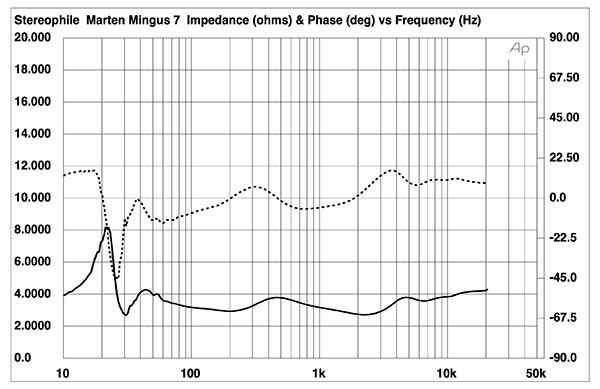
The saddle centered on 30Hz in the impedance magnitude trace in fig.2 suggests that this is the reflex tuning frequency of the two passive radiators on the speaker's rear panel, the frequency at which the back pressure from these radiators holds the woofer cones stationary. The red trace in fig.3 shows the summed nearfield responses of the passive radiators, which behaved identically. It peaks at the tuning frequency with then a fast upper-frequency rolloff interrupted by a couple of low-level peaks between 100Hz and 150Hz.
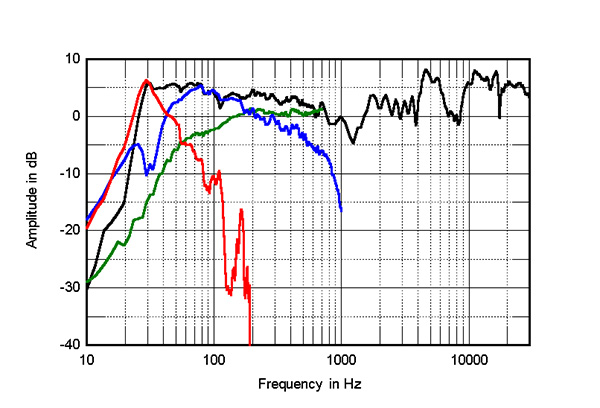
The black trace below 700Hz in fig.3 shows the complex sum of the nearfield responses of the passive radiators, woofers, and lower-midrange unit. The elevated level in the bass is due to the nearfield measurement technique, which assumes that the drive units are mounted in a true infinite baffle (footnote 3). The low frequencies roll off below 30Hz with the expected fourth-order slope, reaching –12dB at 22Hz compared with the 200Hz level.
The farfield responses taken at the 50" microphone distance (not shown) appeared to be compromised by destructive interference between the lower-frequency drive units. The black trace above 700Hz in fig.3 therefore shows the Mingus Septet's quasi-anechoic farfield response taken at 2.5m on the 38"-high optimal axis. Despite the greater microphone distance, the treble still averages around 5dB too high in level compared with that of the midrange. There is also a small suckout between 1kHz and 1.5kHz, which might have been due to the need to aggressively window the captured impulse response at this microphone distance to eliminate very early reflections.
The Mingus Septet's horizontal dispersion (not shown) is even and generally well-controlled, with the radiation pattern narrowing above 10kHz. In the vertical plane (also not shown), the boost in the treble increases above the optimal axis, as shown by the red trace in fig.1.
The Marten Mingus Septet's measured performance is dominated by its use of first-order crossover filters, which meant that I had to examine the quasi-anechoic farfield behavior at a greater distance than optimal. This was exacerbated by the fact that it wasn't possible to raise the speaker off the floor for the tests. But the spatially averaged response centered on the positions of Jim Austin's ears is respectably even.—John Atkinson
Footnote 1: EPDR is the resistive load that gives rise to the same peak dissipation in an amplifier's output devices as the loudspeaker. See "Audio Power Amplifiers for Loudspeaker Loads," JAES, Vol.42 No.9, September 1994, and stereophile.com/reference/707heavy/index.html. Footnote 2: This CD is out of print but the test-tone files can be downloaded free of charge from tinyurl.com/yfkvayat.
Footnote 3: This means that the loudspeaker is firing into hemispherical space rather than a full sphere. A speaker that has a truly flat response in the usual "4pi" space will therefore appear to have a boosted upper-bass output with a nearfield measurement, the center frequency of that boost depending on the physical dimensions of the speaker and the woofer alignment. See this explanation or aes2.org/publications/elibrary-page/?id=7171.
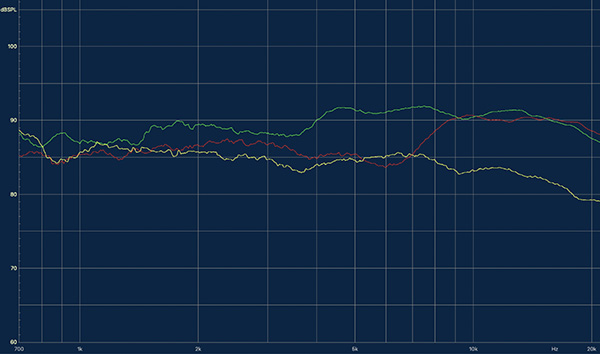
Fig.1 Marten Mingus Septet, response at 1m on the tweeter axis (red trace), at 1m on the optimal, 38"-high axis (green trace), and at 2.5m on the optimal axis (yellow trace). (Measurements supplied by Marten's Leif Olofssohn.)
It wasn't possible to raise the 211lb loudspeaker off the floor. Marten's Leif Olofsson wrote in an email that the optimal axis on which to perform the measurements was 38" from the floor, with the speaker supported on its feet, rather than on the tweeter axis, which is 44" high. Olofsson was also concerned that because the Mingus Septet uses first-order crossover filters, which means that the individual drive unit outputs don't integrate correctly at close distances, the farfield measurements should be taken with the microphone 2.5m away or greater. He sent a graph (fig.1) that shows the farfield responses taken 1m away on the tweeter axis (red trace), 1m away on the optimal, 38"-high axis (green trace), and 2.5m away on the optimal axis (yellow trace), which were made in the middle of what was described as a large, acoustically well-treated listening room. I took a full set of farfield measurements with the microphone at my usual 50" distance then performed a second set of measurements with the microphone 2.5m away.
Fig.2 Marten Mingus Septet, electrical impedance (solid) and phase (dashed) (2 ohms/vertical div.).
Marten specifies the Mingus Septet's sensitivity as 88dB/2.83V/1m. My B-weighted estimate was slightly lower, at 86dB(B)/2.83V/1m. (As always, I first measured the SPL of my reference Rogers LS3/5A, then did the same for the Mingus Septet with the same amplifier output voltage.) The impedance is specified as 4 ohms, with a minimum value of 2.7 ohms. The solid trace in fig.2 plots the impedance magnitude measured with Dayton Audio's DATS V2 system and with the woofer level control set to the minimum; the impedance lies between 2.9 ohms and 3.8 ohms over much of the audioband, with a minimum value of 2.71 ohms at 2.23kHz. The electrical phase angle (dashed trace) is sometimes high; as a result, the effective resistance, or EPDR (footnote 1), drops below 3 ohms between 45Hz and 383Hz and between 591Hz and 18.3kHz. It drops below 2 ohms between 2.5kHz and 3.9kHz. The minimum EPDR values are 2.2 ohms at 85Hz and 1.83 ohms at 3.2kHz. The Mingus Septet demands a lot of current from the partnering amplifier.
Fig.3 Marten Mingus Septet, anechoic response on optimal axis at 2.5m, averaged across a 30° horizontal window and corrected for microphone response, with the nearfield responses of the lower-midrange unit (green), woofers (blue), and passive radiators (red), and the complex sum of the nearfield responses respectively plotted below 700Hz, 1kHz, 195Hz, and 700Hz.
The two woofers behaved identically, and their summed nearfield output (fig.3, blue trace), taken with the bass level control set to the minimum, has the expected notch at the tuning frequency of the passive radiators. The control's three steps each increased the level of the woofers and radiators by 0.6dB. The woofers cross over to the lower-midrange unit (green trace) close to the specified 200Hz. As the low-pass and high-pass crossover slopes are the slow 6dB/octave typical of first-order filters, there is considerable overlap between the outputs.
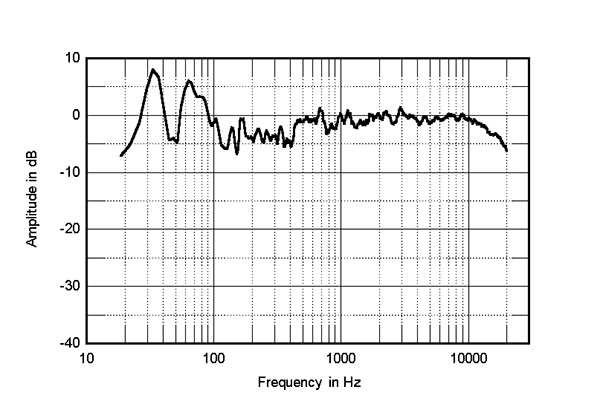
Fig.4 Marten Mingus Septet, spatially averaged, 1/10 octave-smoothed response in JCA's listening room.
With a multiway loudspeaker that uses first-order crossover filters, the sound power response at the listening position will probably best correlate with the perceived balance. The Marten Mingus Septet's manual recommends that the listening position be at least 3m from the speakers. Jim Austin's chair was 3.4m from the Mingus Septets, though his ears were higher than the optimal axis, at 43" from the floor. Using MLSSA, I averaged 20 1/10-octave–smoothed sound power spectra, individually taken for the left and right speakers, in a rectangular grid 36" wide × 18" high and centered on the positions of Jim's ears. Fig.4 shows the Marten's spatially averaged response in his room. (The responses of the two speakers at the listening position matched relatively closely over most of the audioband.) Although the spatial averaging tends to minimize the effect of room modes on the measured response, there are two peaks in the bass. The lower midrange is slightly suppressed, but the upper midrange and treble are smooth and even. The rolloff above 10kHz will be due both to the tweeter's narrowing dispersion and to the increased absorption in top octaves in this region. (A speaker that has a flat measured top-octave output in an in-room measurement will sound as if the highs are tilted up.)
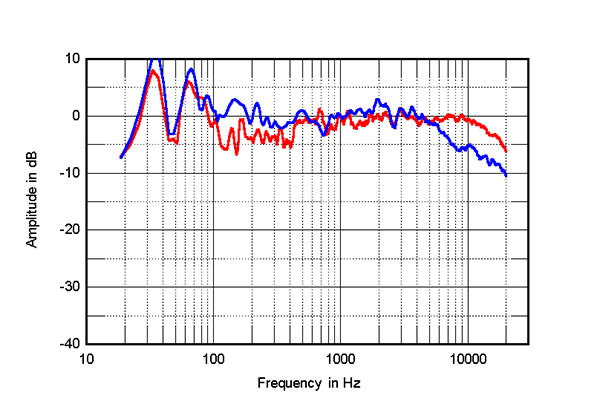
Fig.5 Marten Mingus Septet, spatially averaged, 1/10 octave-smoothed response (red) and that of the Wilson Alexx V (blue) in JCA's listening room.
The red trace in fig.5 repeats the Mingus Septet's spatially averaged response, while the blue trace shows that of JCA's long-term reference loudspeaker, the Wilson Alexx V. (Jim was using a lower chair when he auditioned the Alexx V for his review in December 20214; his ears were 34" from the floor.) The Wilsons excite the low-frequency room modes to a slightly greater degree than the Martens but have more lower-midrange energy. The Mingus Septet's treble is more smoothly balanced than the Alexx V's, though there is about 5dB greater energy in the top octave.
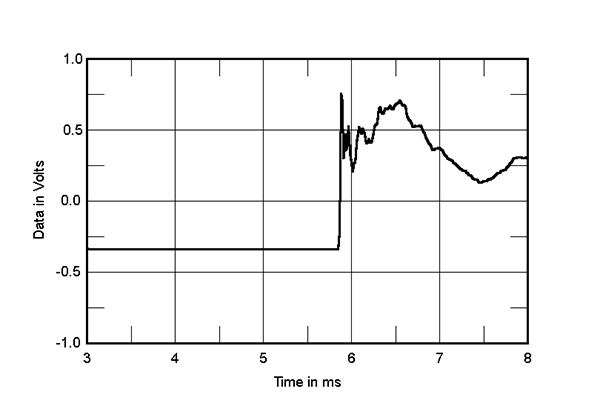
Fig.6 Marten Mingus Septet, step response on optimal axis at 2.5m (5ms time window, 30kHz bandwidth).
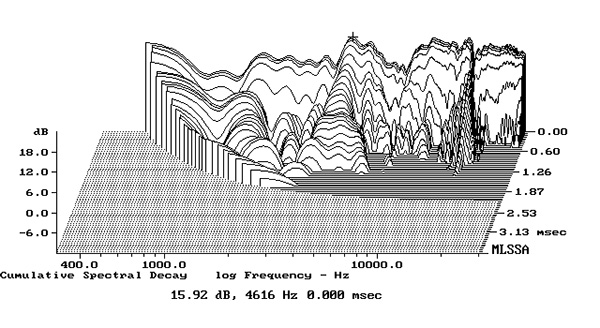
Fig.7 Marten Mingus Septet, cumulative spectral-decay plot on optimal axis at 2.5m (0.15ms risetime).
In the time domain, all four drive units are connected in positive acoustic polarity, which is optimal for a design that uses first-order crossover filters, and the distances from the farfield listening position of all the drive units' acoustic centers are similar. The Mingus Septet's step response, taken at the 2.5m microphone distance (fig.6), is close to a time-coincident right-triangle shape, though this is disturbed by an early reflection arriving 1.5ms after that of the drive units. The step response at JCA's listening position was even closer to true time coincidence but was contaminated by stronger early reflections. The Mingus Septet's cumulative spectral-decay, or waterfall, plot (fig.7) was taken at the 2.5m microphone distance, and I had to aggressively window the captured impulse response. The initial decay in the midrange and mid-treble region is clean, but there is a strong ridge of delayed energy at 4.6kHz.
Footnote 1: EPDR is the resistive load that gives rise to the same peak dissipation in an amplifier's output devices as the loudspeaker. See "Audio Power Amplifiers for Loudspeaker Loads," JAES, Vol.42 No.9, September 1994, and stereophile.com/reference/707heavy/index.html. Footnote 2: This CD is out of print but the test-tone files can be downloaded free of charge from tinyurl.com/yfkvayat.