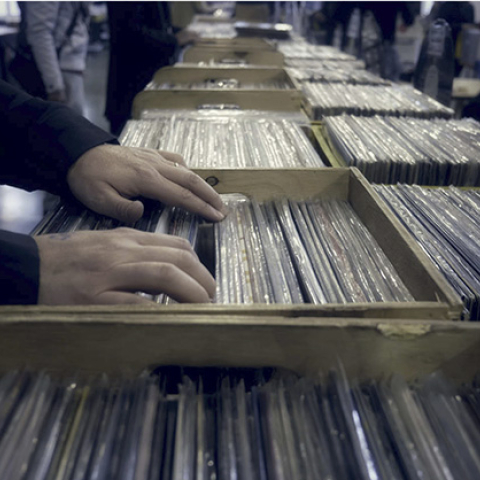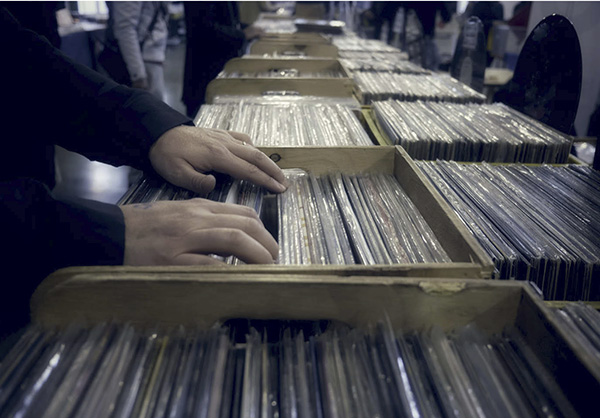
I own a lot of records. Way too many if we're being honest. It's hard for me to come up with an accurate count, and I'm not even remotely organized enough to have a formal inventory, but if I had to make a guesstimate based on linear feet I figure I must have around 10,000. About 10 years ago, I started to recognize that I owned far more records than I could ever hope to listen to, even once, in my remaining time on the planet, and since that realization my record purchasing rate has slowed to a trickle.
These days, my worst weakness kicks in when I'm visiting my friend of over 45 years, Alan B out in L.A. Our idea of great social interaction is to head out and visit some of the record stores near his home in Pasadena, such as Amoeba and Freakbeat Records. Ten years ago on these trips, I would pick up enough records over a weekend to fill three big boxes that I would then ship back home to New York, using the US Postal Service's bargain Media Mail service. Times have changed, and on my most recent visit I came home with just a dozen or so new acquisitions, few enough to easily slip into my suitcase.
Instead of coveting and seeking out the rarest and most valuable records, my tendency has always been to scour the bargain bins and understock in record stores, getting my hands dirty while seeking out diamonds in the rough that with a little TLC can turn into records anyone would be proud to own. About three-quarters of my records were bought secondhand, many of them in less-than-optimal condition, so I have become pretty good at differentiating a record that has permanent damage from one that just needs some judicious cleaning.
Forty-five years ago, when I arrived at college and finally had a turntable of my own, I owned about 20 records, most of them from the punk and post-punk bands I was listening to at the time. As my interest in records grew, my taste in music also expanded in many new directions including classical, jazz, and blues, and I began to fill the gaps in my collection. These days I sort my records into three broad categories, classical, jazz, and everything else, those first two sections each representing about a quarter of the overall total. Unlike some serious collectors I know who like to group everything by record label and catalog number, I try to take a more pragmatic approach. For the classical records, I try to put things in the same order as they would appear in the legendary Penguin Record Guide, which arranged the listings first by composer, then work, then conductor or performer.
The nonclassical sections are sorted by artist first, then chronologically, while trying to avoid the kind of pedantic obsessiveness that some geeks discuss endlessly in online record collecting forums. Questions like whether Alice Cooper records should be filed in the A's or the C's. The real answer of course is, it depends. The early Alice Cooper records up to 1973 were credited to Alice Cooper the band, and as such should be filed under A for Alice. The band broke up in 1975, and the singer legally changed his name to Alice Cooper, so his solo records should be filed under C for Cooper. In my collection, I made the executive decision to file them all in the A section. Yes folks, these are choices that can keep people up at night.
If there ever was a dark age for music on vinyl, it was the years from about 1988 to 2007, when CDs and cassettes had mostly taken over new music sales, followed by digital downloads and eventually streaming services. As a vinyl devotee, I kept buying my music on vinyl whenever it was an option, and I remember watching in despair as Tower Records slowly replaced row after row of LP bins with rows of shiny new CDs.
By the early '90s, I was mostly doing system installations for Sound by Singer, and many of the customers were ditching their records to embrace those newfangled CD things and would ask me to haul away their record collections as a simpler alternative to taking them down to the street with the trash. As a fair-minded person, I would always offer to pay a realistic price, but many refused, giving me the records in lieu of a tip. I also continued to buy new music on vinyl right through the 1990s, sometimes killing time after working at Singer with my friend Steve Guttenberg (The Audiophiliac) by taking a quick sojourn to Tower. Those were slow times for vinyl sales, and some of the records that were being pressed at that time now sell for a hefty premium because of the very limited vinyl runs. My original vinyl copies of otherwise common albums like Nirvana's Nevermind, Springsteen's The Ghost of Tom Joad, and Neil Young's Harvest Moon, all purchased new by me at Tower, are now sought-after collectibles.
Back in Spin Doctor #23, I wrote about how even at age 9 I was actively seeking out the best ways to take care of my records, starting with a very alcoholic-smelling blue fluid with a velvet brush whose brand I have no recollection of. Over a half-century, I have tried all kinds of things starting with brushes, cloths, and Dust Bugs before finally convincing Alan that I needed to "borrow" his Keith Monks record-cleaning machine for a few years. Eventually, in about 1990, I bought a machine of my own, a new VPI HW-17, which served me well and cleaned many hundreds of records for about 25 years. By that time, a new type of cleaner using ultrasound was making waves (no pun intended), and I was able to check out the German Audio Desk Systeme ultrasonic cleaner by running a few records through one at Andy Singer's home.
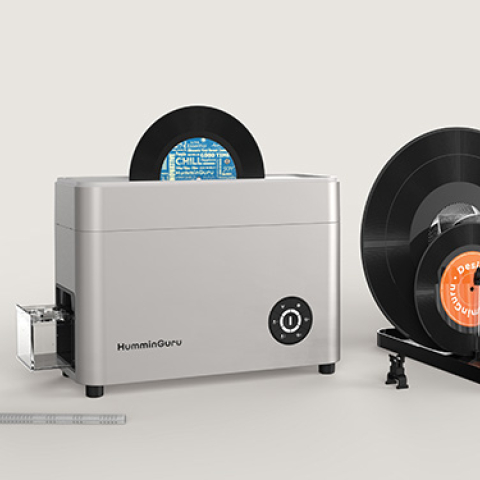
Suitably impressed by the results, I procured one for myself and cleaned a lot more records until it simply stopped turning the record. I figured it would be an easy fix but discovered that the Audio Desk is about as easy to get into as Fort Knox. It's a sealed box with no obvious point of entry, so repair typically involves an expensive trip to its maker in Germany. Alternatively, a discount on a new one is offered by the importer. Taking pity on me after I told them my tale of woe, a customer offered me a good deal for his older Audio Desk but it too failed shortly after arriving; this time it was the water pump. Around this time, I was seeing a Kickstarter campaign for a very affordable Chinese-made ultrasonic machine, which eventually developed into the HumminGuru Nova, which I reviewed in Spin Doctor #22.
The Klaudio machine I'm checking out this month is similar to the HumminGuru Nova the same way a Toyota Corolla is very similar to a Mercedes-Maybach S 680. Both get the basic job done, but one does it much better.
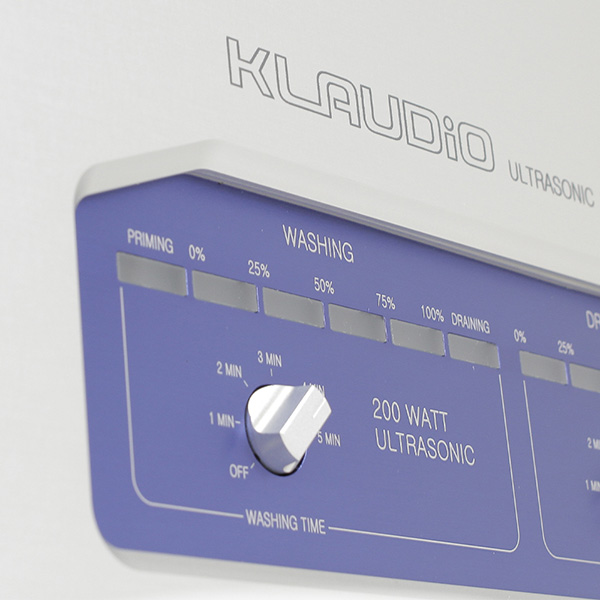
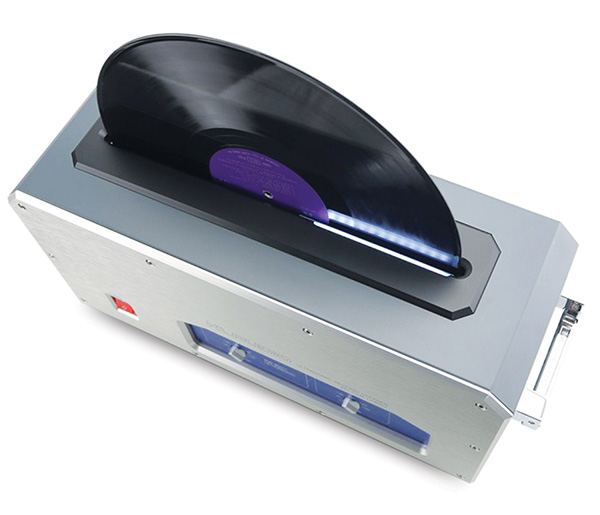
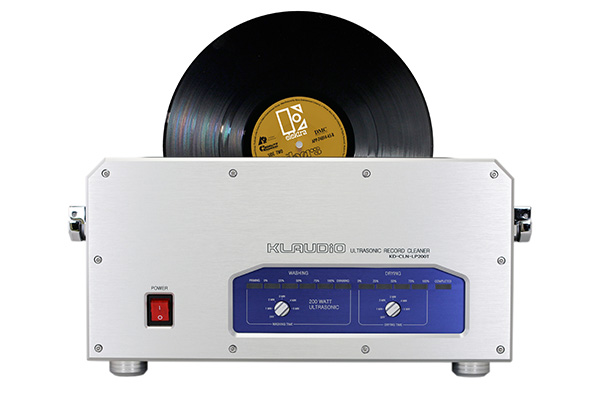 The Klaudio KD-CLN-LP200T ultrasonic record-cleaning machine
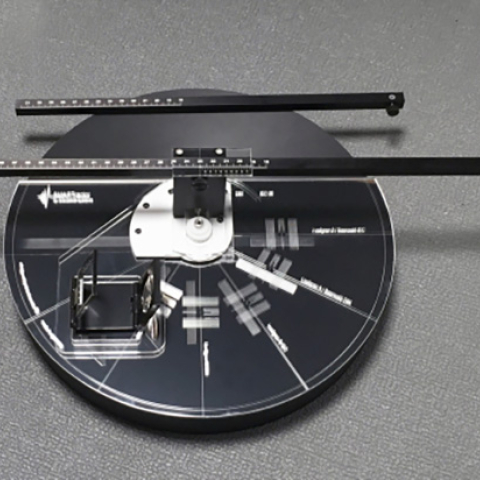
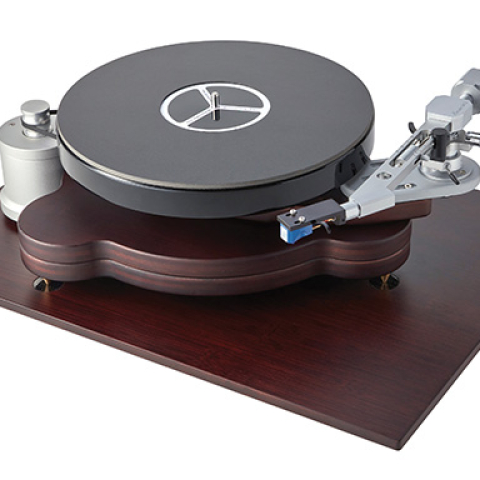
Klaudio (footnote 1)—which is pronounced as a single word, and not kay el Audio as I had initially thought—was founded in 2013 by Peter Cheon as a subsidiary of his main business, Koolance Inc., a leading manufacturer of high-tech water cooling and handling equipment for the computer, video projection, and medical industries. Mr. Cheon's operation is based near Seattle, Washington, with a manufacturing arm back in his native South Korea. As a lifelong audiophile, Cheon wanted to leverage his company's manufacturing capabilities, and his own knowledge of water handling, to create the finest ultrasonic record-cleaning machine possible. The original version of the KD-CLN-LP200 was launched later that year, followed a couple of years later by a clever pivoting tangential tonearm and more recently the amazing Magnezar turntable, which includes some eye-opening features. But after a few years building a loyal base of devoted customers for his record-cleaning machines, Cheon realized that he was losing money on every one he built. Klaudio was an indulgence feeding his personal interests, but it was draining funds from his core business. He suddenly stopped production. Cheon admits he knows little about marketing audio components, and he was hesitant to increase the price or lower his quality standards, so he pulled back on Klaudio to refocus on his core Koolance business.
With the supply of Klaudio record-cleaning machines drying up, some loyal power users like Mike Esposito from The 'In' Groove record store in Phoenix, Arizona, and Chad Kassem from Acoustic Sounds in Kansas started to panic. They had grown to rely on the robust Klaudio machines to clean the large quantities of used records that rotated through their businesses, and the machine's durability and optional five-record automatic loader were helping make their own operations run more efficiently. Eventually, Kassem managed to cut a deal where Klaudio would resume production of an improved version of the cleaner, in exchange for a guaranteed minimum order, all paid for up front.
There have now been three versions of the Klaudio ultrasonic record cleaner, all of which have names that I challenge you to say three times quickly. The original machine was the $4000 KD-CLN-LP200, a self-contained, all-in-one unit with a built-in water reservoir. Then Cheon created the KD-CLN-LP200S, which connects to an off-board water tank, pump, and filter, allowing the main machine to be a bit squatter and lighter. Finally, for his new distribution arrangement with Acoustic Sounds, he developed the KD-CLN-LP200T, which is very similar to the S version but replaces some internal belt-driven components with direct-drive motors for improved reliability. At $6500 it's undeniably expensive, but its ruggedness and repairability promise a long service life.
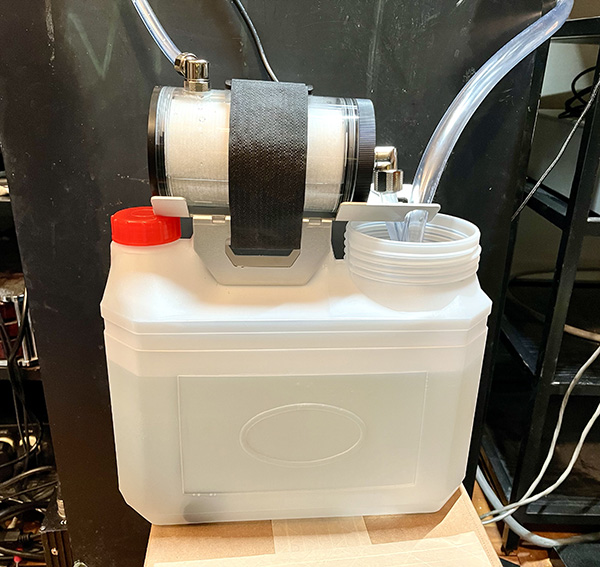
 Moving the water reservoir out of the machine let Klaudio employ a much larger volume of water and a massive particulate filter housed in a cylinder larger than the oil filters on some cars I have owned. The water tank can hold about 2½ gallons, and the manual suggests filling it to around 80%, about 2 gallons. There's also a kit available that allows you to bypass the tank completely, connecting the machine directly to your home plumbing. This results in a constant supply of fresh tap water but introduces another point of discussion. In the manual, Klaudio says to use either tap or bottled drinking water and recommends against using distilled water, which is what every other ultrasonic machine maker wants you to use. A Klaudio representative told me that there have been situations where distilled water lacked the conductivity needed to trigger the water-level sensor that starts the cleaning process. Peter Cheon himself has sent out somewhat contradictory messages on this topic but now seems to favor using distilled water. At first I went by the book and used New York City's finest—frequently cited as some of the best tap water in the country—but later I refilled the tank with distilled water and didn't encounter any problems.
Another potentially contentious issue is whether you should use a surfactant to help break up surface tension. Klaudio's position is clearer here: They do not recommend a surfactant. They say plain water is ideal (footnote 2).
One surprise and disappointment is that while the Klaudio machine itself is beautifully designed, thoughtfully laid out, and built like industrial-grade equipment, the external tank setup feels almost like an afterthought. The tank itself looks like an off-the-shelf plastic jerry can, with a small cap and a large cap on top. A metal bracket supports the big filter, attaching it to the top of the jerry can by wrapping it all together with the bracket using a wide Velcro strap that passes through the handle. The electric water pump connects to a power outlet on the back of the machine; then you simply drop it into the water through the big opening in the tank. A short piece of plastic tubing connects the pump to one end of the filter, while a second, longer piece connects the output of the filter to the machine.
To evacuate water from the machine, a third, thicker tube goes back to the tank, held in position over the big opening by a notch on the filter bracket. Because the return line operates using gravity, the tank needs to sit lower than the machine. In my setup, I had to raise the tank off the floor using a box to get it to the required height.
Moving the water reservoir out of the machine let Klaudio employ a much larger volume of water and a massive particulate filter housed in a cylinder larger than the oil filters on some cars I have owned. The water tank can hold about 2½ gallons, and the manual suggests filling it to around 80%, about 2 gallons. There's also a kit available that allows you to bypass the tank completely, connecting the machine directly to your home plumbing. This results in a constant supply of fresh tap water but introduces another point of discussion. In the manual, Klaudio says to use either tap or bottled drinking water and recommends against using distilled water, which is what every other ultrasonic machine maker wants you to use. A Klaudio representative told me that there have been situations where distilled water lacked the conductivity needed to trigger the water-level sensor that starts the cleaning process. Peter Cheon himself has sent out somewhat contradictory messages on this topic but now seems to favor using distilled water. At first I went by the book and used New York City's finest—frequently cited as some of the best tap water in the country—but later I refilled the tank with distilled water and didn't encounter any problems.
Another potentially contentious issue is whether you should use a surfactant to help break up surface tension. Klaudio's position is clearer here: They do not recommend a surfactant. They say plain water is ideal (footnote 2).
One surprise and disappointment is that while the Klaudio machine itself is beautifully designed, thoughtfully laid out, and built like industrial-grade equipment, the external tank setup feels almost like an afterthought. The tank itself looks like an off-the-shelf plastic jerry can, with a small cap and a large cap on top. A metal bracket supports the big filter, attaching it to the top of the jerry can by wrapping it all together with the bracket using a wide Velcro strap that passes through the handle. The electric water pump connects to a power outlet on the back of the machine; then you simply drop it into the water through the big opening in the tank. A short piece of plastic tubing connects the pump to one end of the filter, while a second, longer piece connects the output of the filter to the machine.
To evacuate water from the machine, a third, thicker tube goes back to the tank, held in position over the big opening by a notch on the filter bracket. Because the return line operates using gravity, the tank needs to sit lower than the machine. In my setup, I had to raise the tank off the floor using a box to get it to the required height.
 With everything hooked up, it looks a bit like a patient in an ICU hospital bed, with tubes and wires running up and down. The big opening remains uncapped and open to the elements, so you need to take care not to tip over the tank assembly. It all feels a bit like a cobbled-together prototype, but instead of refining those parts through additional rounds of development, they stuck with the prototype setup.
Does it really matter? It does if you keep your record-cleaning system stored away and pull it out occasionally to clean a few records, because setting up this Klaudio system takes a good bit of time and space.
Once you have it all assembled and arranged, operating the Klaudio couldn't possibly be any easier. Just lower the record into the slot on the top of the machine and walk away for however many minutes you have set for the combined washing and drying cycles. You don't even have to hit a start button; the machine knows to start as soon as it senses a disc in the slot.
Continuing the simplicity theme: Instead of having a bunch of cleaning programs for various levels of record contamination, there are two rotary switches, one for the washing time, one for the drying time. Each switch offers five settings, from one to five minutes, plus an off position should you want to use the Klaudio for washing without drying or vice versa.
Setting drying time is easy: Two minutes got most records dry, but I normally set it to three to catch any stray leftover droplets.
As for cleaning time, for dirty records I usually went with the maximum five-minute wash cycle, but I cut that back to two or even one minute for brand-new records or records that had already been cleaned and just needed a touch-up.
As I've found with other ultrasound-based machines, the Klaudio excels at deep cleaning the groove but doesn't do as well with obvious fingerprints and grimy surface deposits. To deal with such surface contamination, a prewash using something like a Spin Clean is recommended, allowing the Klaudio to focus on the deep groove cleaning. It's a bit like picking up around the house, before the housekeeper arrives.
In my review of the HumminGuru Nova, one concern I mentioned was how during the cleaning cycle all the debris removed from the record would then be suspended in the water, and how after the water was drained, you were still left with a record wet with the dirty water. This was then evaporated back onto the record surface during the drying cycle. To avoid this problem, the Klaudio continues to cycle the water throughout the cleaning cycle, passing it back into the tank and through the big filter so that by the end of the cycle, there should only be clean, uncontaminated water left on the record before drying. One manufacturer of another machine has said that cavitation cleaning—that's the cleaning mechanism in ultrasound machines—won't happen if the water is moving, but in their machine, the record itself is spinning, which causes the water close to the record to move. It's still not a static situation.
With everything hooked up, it looks a bit like a patient in an ICU hospital bed, with tubes and wires running up and down. The big opening remains uncapped and open to the elements, so you need to take care not to tip over the tank assembly. It all feels a bit like a cobbled-together prototype, but instead of refining those parts through additional rounds of development, they stuck with the prototype setup.
Does it really matter? It does if you keep your record-cleaning system stored away and pull it out occasionally to clean a few records, because setting up this Klaudio system takes a good bit of time and space.
Once you have it all assembled and arranged, operating the Klaudio couldn't possibly be any easier. Just lower the record into the slot on the top of the machine and walk away for however many minutes you have set for the combined washing and drying cycles. You don't even have to hit a start button; the machine knows to start as soon as it senses a disc in the slot.
Continuing the simplicity theme: Instead of having a bunch of cleaning programs for various levels of record contamination, there are two rotary switches, one for the washing time, one for the drying time. Each switch offers five settings, from one to five minutes, plus an off position should you want to use the Klaudio for washing without drying or vice versa.
Setting drying time is easy: Two minutes got most records dry, but I normally set it to three to catch any stray leftover droplets.
As for cleaning time, for dirty records I usually went with the maximum five-minute wash cycle, but I cut that back to two or even one minute for brand-new records or records that had already been cleaned and just needed a touch-up.
As I've found with other ultrasound-based machines, the Klaudio excels at deep cleaning the groove but doesn't do as well with obvious fingerprints and grimy surface deposits. To deal with such surface contamination, a prewash using something like a Spin Clean is recommended, allowing the Klaudio to focus on the deep groove cleaning. It's a bit like picking up around the house, before the housekeeper arrives.
In my review of the HumminGuru Nova, one concern I mentioned was how during the cleaning cycle all the debris removed from the record would then be suspended in the water, and how after the water was drained, you were still left with a record wet with the dirty water. This was then evaporated back onto the record surface during the drying cycle. To avoid this problem, the Klaudio continues to cycle the water throughout the cleaning cycle, passing it back into the tank and through the big filter so that by the end of the cycle, there should only be clean, uncontaminated water left on the record before drying. One manufacturer of another machine has said that cavitation cleaning—that's the cleaning mechanism in ultrasound machines—won't happen if the water is moving, but in their machine, the record itself is spinning, which causes the water close to the record to move. It's still not a static situation.
 Several accessories are available for the KD-CLN-LP200T. The five-record automatic disc loader allows you to set the machine to wash and dry five records in sequence, so you can walk away for 45 minutes while it works. At $3850 this is clearly aimed at businesses that have a lot of records to clean. There's an $800 water-cooling kit, which only seems to be needed if you are running the machine constantly. For me, the water never became more than just slightly warm. While the Klaudio is designed for cleaning 12" records, adapter rings are available for cleaning the 7" and 10" varieties.
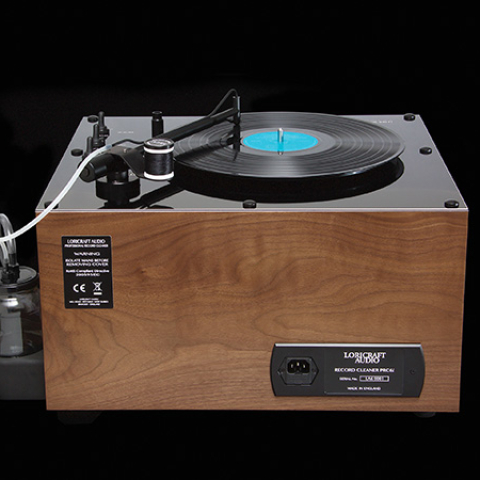
Finally, there's a noise-reduction accessory. Most ultrasonic machines are quieter than the typical slot vacuum machine, but with the Klaudio I measured 86dB (A-weighted) from 3' away during the drying cycle. That's much noisier than the genteel Loricraft PRC6i. Klaudio offers a Silencer Box for $2365. It's essentially a large sarcophagus that envelops the machine, cutting back substantially on the noise level.
The most important question is, how well does it work? The Klaudio delivered the best results I have heard from any record cleaner. True cavitation machines are able to scrub the inner surfaces of the grooves clean, allowing the stylus to trace the subtlest deflections without being blocked by a layer of unwanted material.
Since I got the Klaudio to test, I have been cleaning records like mad, trying to give as many favorites as I can the Klaudio effect before Acoustic Sounds asks me to send it back. A thorough groove-deep cleaning doesn't just make records quieter—it makes them sound significantly better, and that's the type of upgrade people will open their wallets for.
Several accessories are available for the KD-CLN-LP200T. The five-record automatic disc loader allows you to set the machine to wash and dry five records in sequence, so you can walk away for 45 minutes while it works. At $3850 this is clearly aimed at businesses that have a lot of records to clean. There's an $800 water-cooling kit, which only seems to be needed if you are running the machine constantly. For me, the water never became more than just slightly warm. While the Klaudio is designed for cleaning 12" records, adapter rings are available for cleaning the 7" and 10" varieties.
Finally, there's a noise-reduction accessory. Most ultrasonic machines are quieter than the typical slot vacuum machine, but with the Klaudio I measured 86dB (A-weighted) from 3' away during the drying cycle. That's much noisier than the genteel Loricraft PRC6i. Klaudio offers a Silencer Box for $2365. It's essentially a large sarcophagus that envelops the machine, cutting back substantially on the noise level.
The most important question is, how well does it work? The Klaudio delivered the best results I have heard from any record cleaner. True cavitation machines are able to scrub the inner surfaces of the grooves clean, allowing the stylus to trace the subtlest deflections without being blocked by a layer of unwanted material.
Since I got the Klaudio to test, I have been cleaning records like mad, trying to give as many favorites as I can the Klaudio effect before Acoustic Sounds asks me to send it back. A thorough groove-deep cleaning doesn't just make records quieter—it makes them sound significantly better, and that's the type of upgrade people will open their wallets for.
Footnote 1: Klaudio, 2840 W. Valley Hwy. N, Ste. 101, Auburn, WA 98001. Tel: (253) 249-7813. Web: klaudio.com. US distributor: Acoustic Sounds, P.O. Box 1905, Salina, KS 67402-1905. Tel: (888) 926-2564. International Tel: (785) 825-8609. Web: acousticsounds.com Footnote 2: This is a fascinating topic that deserves more space than we have here, but in a nutshell: Surfactants lower the surface tension of water, making it easier for water to form cavitation bubbles and to penetrate deep into the record grooves. But there are downsides: Common surfactants have a high affinity for the vinyl surface, so if you don't rinse them off, they contaminate the records themselves. Research by the Library of Congress and the Canadian Conservation Institute found that if not thoroughly rinsed off, nonionic surfactants like Triton X-100 aggregate during drying, causing a "whooshing" or "rushing" sound. (The fact that it is nonionic doesn't mean that it won't aggregate, but it does mean it's easy to rinse off.) Making it easier to form cavitation bubbles sounds like an advantage, but it means there's less energy when the bubbles collapse, which may reduce cleaning action. One last point: Higher-frequency cavitation results in smaller bubbles, which are more likely to get deep inside the grooves even without a surfactant. The 40kHz cavitation frequency of the Klaudio cleaner is on the low side, which makes it safer for records but also means its bubbles will be larger. This may be an unfortunate metaphor for those seeking pristine record surfaces, but here it goes: "The proof is in the pudding."—Jim Austin
The Klaudio KD-CLN-LP200T ultrasonic record-cleaning machineKlaudio (footnote 1)—which is pronounced as a single word, and not kay el Audio as I had initially thought—was founded in 2013 by Peter Cheon as a subsidiary of his main business, Koolance Inc., a leading manufacturer of high-tech water cooling and handling equipment for the computer, video projection, and medical industries. Mr. Cheon's operation is based near Seattle, Washington, with a manufacturing arm back in his native South Korea. As a lifelong audiophile, Cheon wanted to leverage his company's manufacturing capabilities, and his own knowledge of water handling, to create the finest ultrasonic record-cleaning machine possible. The original version of the KD-CLN-LP200 was launched later that year, followed a couple of years later by a clever pivoting tangential tonearm and more recently the amazing Magnezar turntable, which includes some eye-opening features. But after a few years building a loyal base of devoted customers for his record-cleaning machines, Cheon realized that he was losing money on every one he built. Klaudio was an indulgence feeding his personal interests, but it was draining funds from his core business. He suddenly stopped production. Cheon admits he knows little about marketing audio components, and he was hesitant to increase the price or lower his quality standards, so he pulled back on Klaudio to refocus on his core Koolance business.
Moving the water reservoir out of the machine let Klaudio employ a much larger volume of water and a massive particulate filter housed in a cylinder larger than the oil filters on some cars I have owned. The water tank can hold about 2½ gallons, and the manual suggests filling it to around 80%, about 2 gallons. There's also a kit available that allows you to bypass the tank completely, connecting the machine directly to your home plumbing. This results in a constant supply of fresh tap water but introduces another point of discussion. In the manual, Klaudio says to use either tap or bottled drinking water and recommends against using distilled water, which is what every other ultrasonic machine maker wants you to use. A Klaudio representative told me that there have been situations where distilled water lacked the conductivity needed to trigger the water-level sensor that starts the cleaning process. Peter Cheon himself has sent out somewhat contradictory messages on this topic but now seems to favor using distilled water. At first I went by the book and used New York City's finest—frequently cited as some of the best tap water in the country—but later I refilled the tank with distilled water and didn't encounter any problems.
With everything hooked up, it looks a bit like a patient in an ICU hospital bed, with tubes and wires running up and down. The big opening remains uncapped and open to the elements, so you need to take care not to tip over the tank assembly. It all feels a bit like a cobbled-together prototype, but instead of refining those parts through additional rounds of development, they stuck with the prototype setup.
Does it really matter? It does if you keep your record-cleaning system stored away and pull it out occasionally to clean a few records, because setting up this Klaudio system takes a good bit of time and space.
Once you have it all assembled and arranged, operating the Klaudio couldn't possibly be any easier. Just lower the record into the slot on the top of the machine and walk away for however many minutes you have set for the combined washing and drying cycles. You don't even have to hit a start button; the machine knows to start as soon as it senses a disc in the slot.
Several accessories are available for the KD-CLN-LP200T. The five-record automatic disc loader allows you to set the machine to wash and dry five records in sequence, so you can walk away for 45 minutes while it works. At $3850 this is clearly aimed at businesses that have a lot of records to clean. There's an $800 water-cooling kit, which only seems to be needed if you are running the machine constantly. For me, the water never became more than just slightly warm. While the Klaudio is designed for cleaning 12" records, adapter rings are available for cleaning the 7" and 10" varieties.
Footnote 1: Klaudio, 2840 W. Valley Hwy. N, Ste. 101, Auburn, WA 98001. Tel: (253) 249-7813. Web: klaudio.com. US distributor: Acoustic Sounds, P.O. Box 1905, Salina, KS 67402-1905. Tel: (888) 926-2564. International Tel: (785) 825-8609. Web: acousticsounds.com Footnote 2: This is a fascinating topic that deserves more space than we have here, but in a nutshell: Surfactants lower the surface tension of water, making it easier for water to form cavitation bubbles and to penetrate deep into the record grooves. But there are downsides: Common surfactants have a high affinity for the vinyl surface, so if you don't rinse them off, they contaminate the records themselves. Research by the Library of Congress and the Canadian Conservation Institute found that if not thoroughly rinsed off, nonionic surfactants like Triton X-100 aggregate during drying, causing a "whooshing" or "rushing" sound. (The fact that it is nonionic doesn't mean that it won't aggregate, but it does mean it's easy to rinse off.) Making it easier to form cavitation bubbles sounds like an advantage, but it means there's less energy when the bubbles collapse, which may reduce cleaning action. One last point: Higher-frequency cavitation results in smaller bubbles, which are more likely to get deep inside the grooves even without a surfactant. The 40kHz cavitation frequency of the Klaudio cleaner is on the low side, which makes it safer for records but also means its bubbles will be larger. This may be an unfortunate metaphor for those seeking pristine record surfaces, but here it goes: "The proof is in the pudding."—Jim Austin