Sidebar 3: Measurements
I performed a full set of measurements on the First Watt J2, using my Audio Precision SYS2722 system (see the January 2008 "As We See It"). Before doing any testing, I preconditioned the J2 by running it at one-third power into 8 ohms for an hour. (With a an amplifier having a class-B or -AB output stage, this power level results in the highest thermal stress on the output devices.) At the end of the hour, the heatsinks were hot, at 125.6°F (52°C), though the top panel was a little cooler, at 113.3°F (45.2°C).
The First Watt's voltage gain into 8 ohms measured a lower-than-average 19.5dB from both its balanced and unbalanced inputs, and both inputs preserved absolute polarity (ie, were non-inverting). The unbalanced input impedance measured the specified 100k ohms at low and middle frequencies, dropping to a still high 65k ohms at 20kHz. The balanced input impedance was a consistent 208k ohms across the audioband.
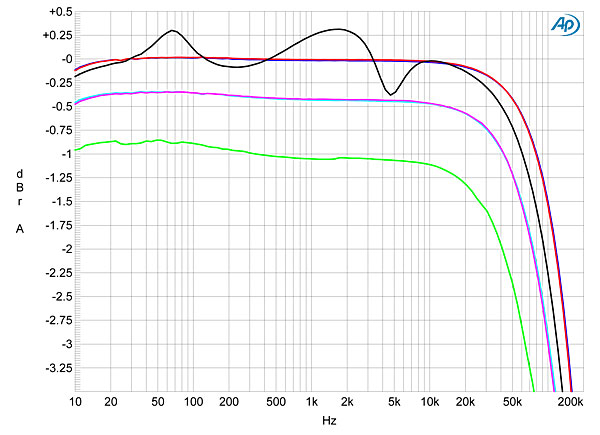
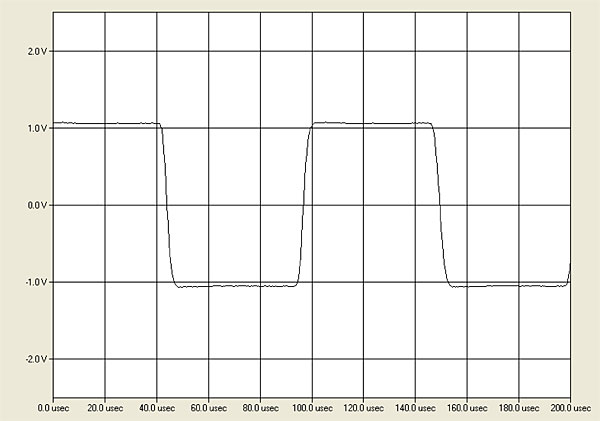
The output impedance was relatively high for a solid-state design, at 0.5 ohm from 20Hz to 20kHz. As a result, the response with our standard simulated loudspeaker varied by ±0.35dB (fig.1, gray trace). This graph, taken with a balanced input (the unbalanced behavior was identical), shows that the audioband response is flat into 8 ohms (blue and red traces), with the ultrasonic rolloff reaching –1.5dB at 100kHz. The response rolled off a little earlier with lower impedances, but even into 2 ohms, the response was down by just 0.25dB at 20kHz (green trace). The J2 reproduced a 10kHz squarewave with short risetimes, and no overshoot or ringing (fig.2).
 With "clipping" defined as when the THD+noise reaches 1%, fig.4 reveals that the J2 clipped at 25Wpc into 8 ohms (14.0dBW), with a gentle rise in THD+N below that power. Unusually, but as specified, the J2 delivers less power into 4 ohms (fig.5), clipping at 12.5Wpc (8dBW). In general, while the First Watt offers low levels of distortion into 8 ohms, it is less comfortable into lower impedance. This is shown graphically in fig.6, which plots the percentage of THD+N into 8 ohms (blue and red traces), 4 ohms (cyan, magenta), and 2 ohms (gray).
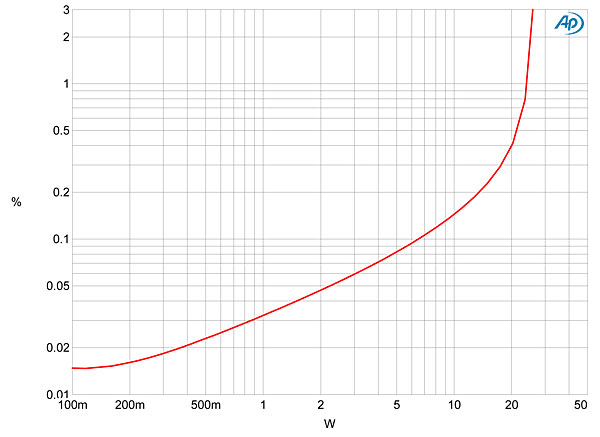
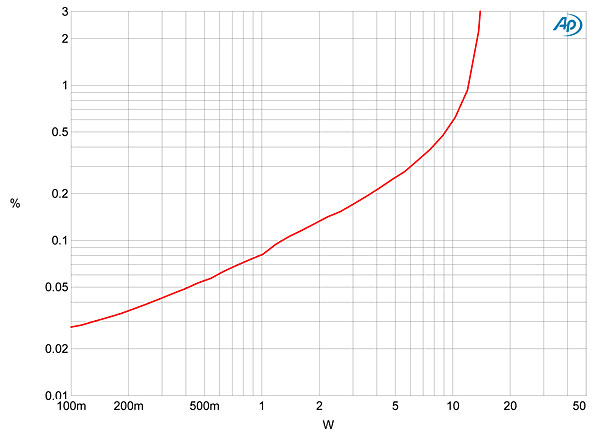
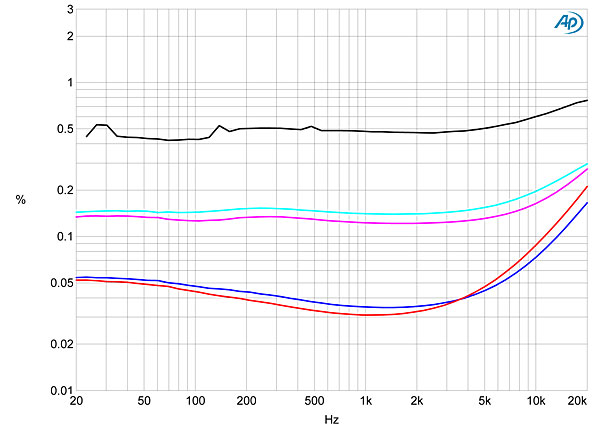
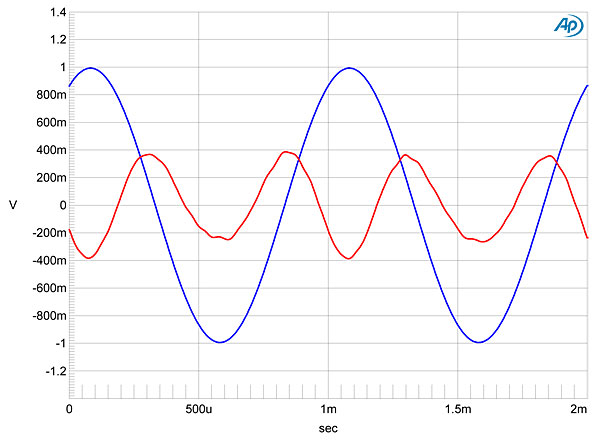
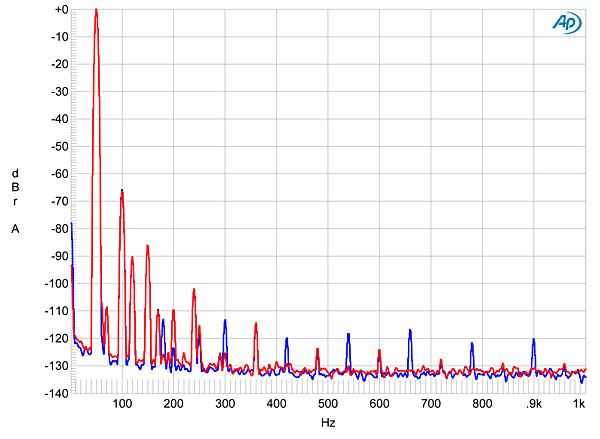
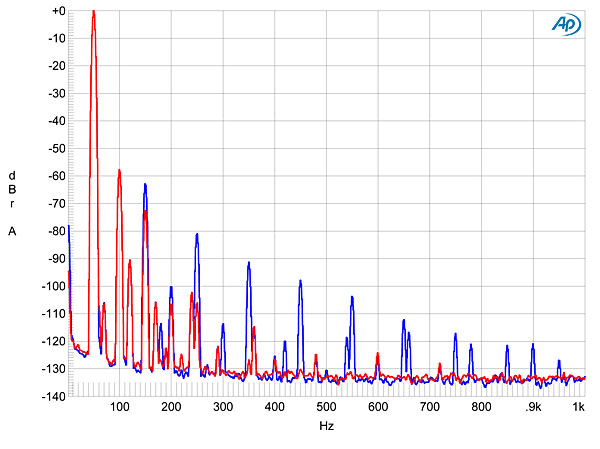
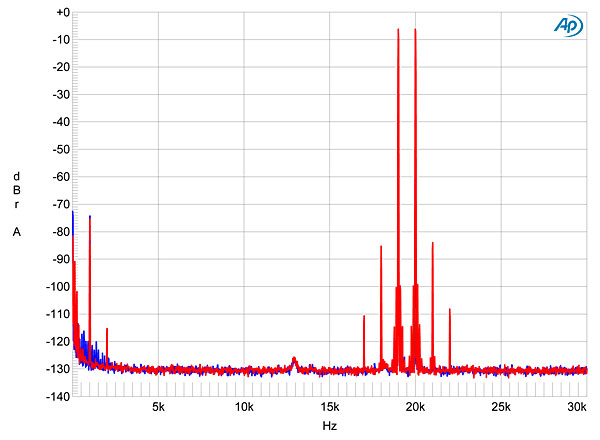
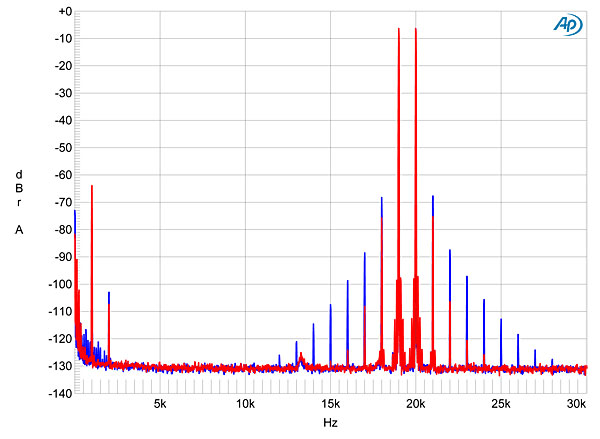
Fig.1 First Watt J2, balanced frequency response at 2.83V into: simulated loudspeaker load (gray), 8 ohms (left channel blue, right red), 4 ohms (left cyan, right magenta), 2 ohms (red) (0.5dB/vertical div.).
Fig.2 First Watt J2, small-signal, 10kHz squarewave into 8 ohms.
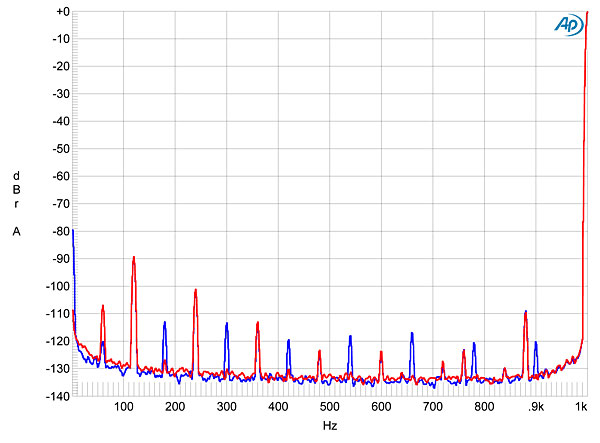
Channel separation was excellent, at >100dB in both directions below 3kHz, and still 80dB at 20kHz. The wideband, unweighted signal/noise ratio, ref. 2.83V and measured with the input shorted to ground, was a respectable 84.1dB (average of both channels), which improved to 88.3dB when the measurement bandwidth was restricted to the audioband, and to 99.75dB when A-weighted. Spectral analysis of the J2's noise floor (fig.3) revealed spuriae at 120Hz and its harmonics, which will be due to a non-zero impedance to ground; and at 60Hz and its odd-order harmonics, which will be due to magnetic interference from the AC power transformer. All of these spuriae are very low in level, however, and will not be audible.
Fig.3 First Watt J2, spectrum of 1kHz sinewave, DC–1kHz, at 1W into 8 ohms (linear frequency scale).
Fig.4 First Watt J2, both channels driven, distortion (%) vs 1kHz continuous output power into 8 ohms.
Fig.5 First Watt J2, both channels driven, distortion (%) vs 1kHz continuous output power into 4 ohms.
Fig.6 First Watt J2, THD+N (%) vs frequency at 2.83V into: 8 ohms (left channel blue, right red), 4 ohms (left cyan, right magenta), 2 ohms (left gray).
Fortunately, and as specified by the J2's designer, Nelson Pass, its distortion into higher impedances is primarily the sonically benign second harmonic (figs.7 and 8), though the third harmonic becomes stronger into 4 ohms, and is accompanied in the left channel by some higher odd-order harmonics (fig.9). Intermodulation distortion into higher impedances was also low (fig.10), with the second-order difference component at 1kHz lying at –74dB (0.02%). Into 4 ohms, this component rose by 10dB to 0.06% (fig.11)—but again, the left channel (blue trace) appears less linear than the right (red) into this lower impedance, with higher levels of higher-order intermodulation products.
Fig.7 First Watt J2, 1kHz waveform at 1W into 8 ohms, 0.035% THD+N (blue); distortion and noise waveform with fundamental notched out (red, not to scale).
Fig.8 First Watt J2, spectrum of 50Hz sinewave, DC–1kHz, at 1W into 8 ohms (linear frequency scale).
Fig.9 First Watt J2, spectrum of 50Hz sinewave, DC–1kHz, at 2W into 4 ohms (linear frequency scale).
Fig.10 First Watt J2, HF intermodulation spectrum, DC–24kHz, 19+20kHz at 1W peak into 8 ohms (linear frequency scale).
Fig.11 First Watt J2, HF intermodulation spectrum, DC–24kHz, 19+20kHz at 2W peak into 4 ohms (linear frequency scale).
Other than the slightly worse linearity of the left channel into lower impedances, the First Watt J2 measured well. But its measured performance does suggest that owners not use it with speakers that drop below 4 ohms. But as HR found, with higher-impedance speakers, the J2 will sing!—John Atkinson