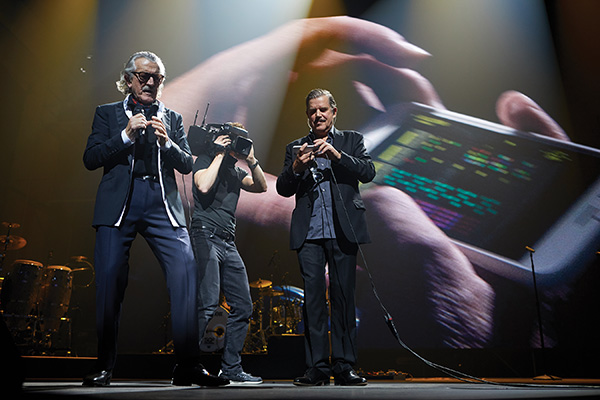
Yello live at Kraftwerk Berlin, 2016. (Photo: Michael Wilfiling.)
Of Atmos and forensicsWe finish our cappuccinos and climb into Blank's electric Volkswagen e-Up. About 10 years ago, he received it in lieu of cash for VW using his song "Electrified" in a commercial. We're headed for the town of Küsnacht, 15 minutes away. (It was once home to psychiatrist Carl Jung and soul belter Tina Turner, who died there about a year before I visited.) In a state-of-the-art sound studio next to Lake Zurich, Blank and studio owner Leo Gerteis are working on Dolby Atmos mixes of some older Yello recordings. The digitized original multitrack tapes have already been loaded onto a workstation. Blank and Gerteis demo the mixing process for me, using computers and a mixing console to carefully position real and virtual instruments in the three-dimensional space conjured by the 14-channel PMC Atmos system. Yello in stereo is often fantastic; in Dolby Atmos, it's magnificent and mesmerizing.
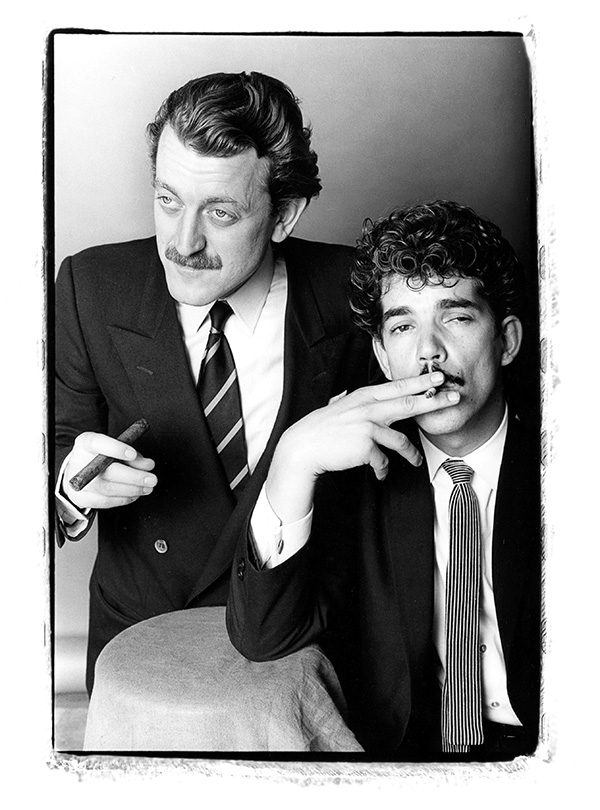
Yello. (Photo: Koni Nordmann.)
After an hour spent at the mixing desk, Blank and I retreat to the studio's sunny garden, where we discuss the Atmos work. Too bad the iPhone on which I record our conversation overheats and shuts down. Blank notices and picks up the hot device. "You can iron your trousers with it," he marvels. With threats and sweet nothings, he tries to lure the phone back to life. No dice. Luckily, I brought a little Zoom recorder as a backup, and we resume.
"I'm always open to new music technology," Blank says. "The immersiveness you can achieve with Dolby Atmos is fantastic. It's like having 360-degree access to the entire soundfield. That's an immense advantage for me." But a lot depends on the type of music. "A while back, a team from Berlin came to Zurich to demonstrate the possibilities of Dolby Atmos, in a local cinema with dozens of loudspeakers. They played some Elton John, some Norah Jones, and the Berlin Symphony Orchestra directed by von Karajan. And it sounded ... okay. You could sense a bit of the acoustics of the venue where the recording was made. That was nice, but there's only so much that this technology can do. Obviously, with the symphony orchestra, the Atmos people can't move the violin section to the back and place the timpani 5' high to your right, and it would be ridiculous if they did. Even with a regular pop mix, you're more or less stuck with the original soundstage."
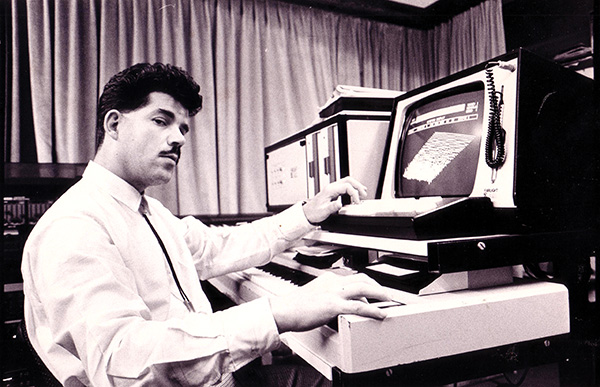
Boris working on a Fairlight computer at Rote Fabrik, 1983. (Photo by Laura Levine Laura@Lauralevine.com.)
Of mountains and hair dryersBlank came of age along with the modern synthesizer. He was 16 when Wendy (then Walter) Carlos's seminal synth record Switched-On Bach came out. I ask what would've become of him if he'd been born 10, 20 years earlier, in the pre-synthesizer era. "I would've played rooms, spaces, random objects," he says. "I did play those things. As a little kid, when I was in the mountains, I was completely fascinated by the sounds I made that echoed all around me. Later I found that this was almost like electronic music, where you can record a sound and you have a delay on the machine. Reverb. Echo. I always thought it was beautiful." In his mid-teens, long before he owned his first keyboard, Blank would create sound collages. "I recorded a hair dryer, and air being blown through a straw into a glass of milk, and the spring of a garage door when you pluck it with your finger or hit it with a hammer. I recorded it all on quarter inch and cut the tape into little pieces and moved them around and spliced them back together, and then found various ways of running the tape over the head—at different speeds." Of course he also recorded sounds he made with his mouth. "The human voice is maybe the greatest synthesizer we have, " he says (footnote 2). He hasn't stopped adding to his sound collection and has gotten used to people looking at him funny when he's on the hunt. "I get in an elevator, I always drum on the walls and listen to the acoustics. Then I store it away in my head. I may or may not record it, but I'll know how to recreate that sound if I ever need it."
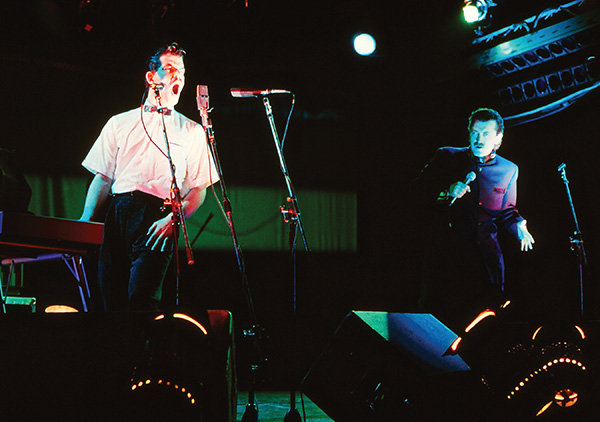
Yello Live at the Roxy, New York, 1983. (Photo by Bruno Bänziger.)
Of church bells and CalvinistsHe tells me about the house that he and his wife bought in Tuscany, in a rural area with cypress trees. "It's so quiet and beautiful there," he says dreamily. "We have breakfast and listen to the birdsong as it mixes with Chopin on the speakers." He also loves Shostakovich, Boulez, Ligeti, Tchaikovsky. Every kind of music has its time and place, he feels. "Believe it or not, when I wake up in Tuscany, my first thought isn't 'I'd really like to hear some electronic dance music right now.'" But why Tuscany, I ask. Isn't it beautiful and quiet here on the edge of Zurich, too? "Yeah, but not at my place downtown," he says. "It's getting more and more noisy in Zurich. There are helicopters overhead and"—he ably imitates a siren—"I get a little impatient with that."
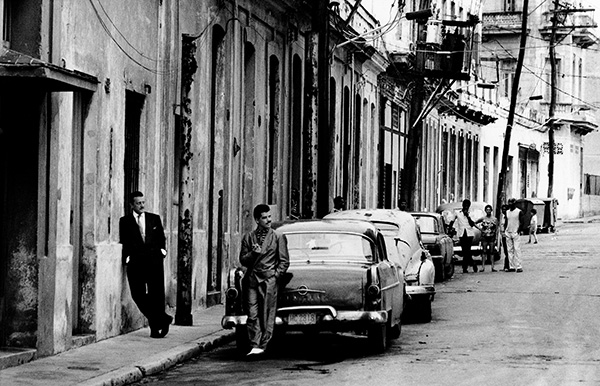
Yello in Havana, 1985. (Photo, Anton Corbijn.)
Of hi-fi and germsAs enamored as Blank is of sound in all its forms, he doesn't consider himself an audiophile. In his own studio, he listens to big JBLs—he doesn't know what model—alongside a pair of PSI Audio A23-M studio monitors he describes as "very linear, very one-on-one." One-on-one means that "what you give in, comes out," he explains. The speakers are driven by Electrocompaniet amplifiers. He has less lofty standards at home, where he listens to a Sonos setup. He's never pined for a high-end system. The ones he's heard are "too much hi-fi," he says. "I hear it as—I don't know ... exaggerated."
Footnote 2: Case in point: Blank's Yellofier smartphone app, a voice-driven pocket sequencer that he demonstrates at tinyurl.com/27dxp9up.