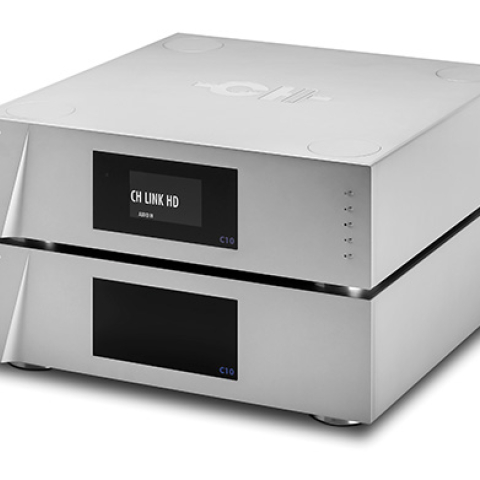
At CH Precision, the model-number increment indicates upgradeability. Physically, the C1.2 is very similar to the C1. The ".2" designation indicates that if you own a C1, you can upgrade it to .2 status—for $4000. The D1.5, though, is so different from its predecessor, the D1, that it's not physically possible to upgrade the older to the newer: The D1.5 uses a different transport, with a different door height. Not to worry though: CH Precision offers a guaranteed buy-back in cases like that.
One very visible change in the C1.2 is the introduction of MQA support, which was not present in the C1. The C1.2 supports full decoding—unfolding and rendering—to frequencies up to 768kHz, including data from MQA-CDs played back on the D1.5 transport over the proprietary CH interface as well as MQA data streamed from Tidal.
I asked the two engineers how MQA is handled in the C1.2—with an off-the-shelf chip, perhaps? Not hardly. The C1.2 detects whether a datastream is MQA or not then sends it in one of two directions, toward the MQA algorithm (MQA data) or toward the PEtER upsampling algorithm (everything else). MQA data is interpreted in silico using a software library provided by MQA.
Maybe the biggest news with the C1.2 is a new MEMS (micro-electromechanical systems)–based clock, which is shunt-regulated (roughly, designed so that noise is shunted to ground) and temperature-compensated for improved accuracy.
Processing power has increased by a factor of four. The most obvious impact of this change is on the expanded range of input formats supported; the C1.2 now supports all of them, from a file or silver disc. The more significant impact of this increased computational power is more precise upsampling calculations. That's possible in part because the computational space has been expanded to 32 bits fixed-point (not floating).
It has become clear over time that one key to achieving the best possible digital sound is to keep the signal path free of noise. So—this is new also—the C1.2 turns off all processing channels that aren't currently in use, in order to lower system noise.
What else has changed? That hybrid analog/digital volume control has changed—but I'm not clear on whether it's completely new or just tweaked. Also, the display screen is better, although you won't notice it at first. It's capable of higher resolution than what you see most of the time. It's still not a thing you'd watch a movie on, but it looks pretty spiffy when you put the C1.2 in preamp mode and change the volume.
The C1.2 is modular, and when you consider all the options, remarkably flexible. It can utilize any common digital input, including Ethernet, plus CH Precision's proprietary data link, which resembles I2S and supports data-transmission rates up to the highest rates you'll commonly see. With the analog input card, you get two sets of analog inputs. Since it has a very good volume control, you could make it the central component of your audio system.
Listening
What do we look for—rather, listen for—in a digital music source? Or, for that matter, any audio source, or any audio system? "Tastes vary" may be the most important answer to that question, but I hope there are values we can all agree on: rich timbres and textures, vivid colors, images that seem solid and real, commanding bass, airy highs. Some will insist more than others that the sounds our systems produce be true to the source, although that can be hard to determine. (Loudspeaker designers, a suggestion: Don't release a high-end speaker that can't accurately reproduce common piano, like the sound of a Steinway Model D in a good hall. I hear a few loudspeakers that can't do that at every audio show I attend.)
Recently, over lunch with a small group of Stereophile writers, I shared my belief that one crucial thing in experiencing reproduced audio is a constant sense of surprise. Heads nodded. When a hi-fi system does harm to the music, it often takes the form of homogenization, making sounds seem more similar to each other, hence more ignorable and less surprising. Dynamic compression, for example, reduces contrast between loud and soft sounds, which tends to make music less surprising (especially with so-called microdynamics) and so, less real (footnote 10). Homogenization of every kind makes music less interesting and puts us to sleep. In contrast, a constant stream of pleasant surprises, which come through when the uniqueness of every sound is preserved, makes us look up and smile with delight at the music even when we're not paying close attention. That's a big part of what keeps me coming back.
There's another thing, though, that tends to come up in conversations about digital sources: a sense of relaxation in the music, whether the music encourages or at least allows relaxation in the listener—or whether, conversely, it is itself a source of stress. Digitally reproduced music can be stress-inducing. (So, in a different way, can scratchy old LPs.)
It's a peculiar idea: that something so important in hi-fi, some of the most important stuff, is something we experience in some unknown way but don't directly, or consciously, hear. How else to explain bass that (as I wrote in my review of the CH Precision D1.5 transport/player) sounds "fundamental" (in the sense of the root word "fundament") and "seismic," when we all know the LF frequency response will measure the same? So it's not the intensity or depth of the bass response I'm hearing per se; rather, it's how I experience it—and something in the music causes that.
When Heeb, Cossy, and the C1.2 documentation talk about the importance of precision in upsampling calculations or of reducing timing errors, they're not saying that if we don't do those things we'll end up with awful jitter, gross errors that affect measured frequency response, or that transients will be dulled or artificially sharpened (although our perceptions of all those things may be altered). In executing their design brief, they are indeed producing a more accurate signal, but the most important subjective consequences are—let's say, indirect. The specific mechanism is unknown, at least to me, but when you get it right, you hear it. They're gaining something, but they're also getting rid of something that, when it's present, stands in the way of our ability to perceive music simply and directly, with low stress and nothing interfering. (Then again, I think much that we call distortion, measurable or not, is like that.)
 Remember Grosvenor's B-minor sonata, which I started listening to earlier? After it ended, Roon Radio started up Khatia Buniatishvili's 2011 recording of the Mephisto Waltz No.1, also by Liszt. The sound got better—it's a much livelier recording. I'm listening to just two speakers, sitting 11' in front of me, but the sound is enveloping me in a way that the Grosvenor recording didn't, especially in the louder passages. That sense of piano-case overload I mentioned is absent from this recording. The perspective here is more distant than on the Grosvenor recording, yet I can clearly hear a difference in soundstage depth between the piano's high notes and low notes, sounds emerging where the hammer hits the strings—rather, where those sounds reflect off the piano's open lid. I'd say I'm sitting in row 20 or so—that's the aural perspective—so the piano is pretty far away, but the effect is very clear. And even the loudest sounds seem relaxed, stress-free.
 Speaking of Buniatishvili: Not only does she make wonderful recordings of great music beautifully played; she also chooses superbly interesting repertoire. The next-to-last track on her album Labyrinth, from 2020 (24/96 FLAC, Sony Classical/Qobuz), is John Cage's 4'33". I won't say it's her best performance, but it's certainly her most perfect, the one with the fewest mistakes.
Over the last few months, I've listened to a lot of classical music, naturalistically recorded in a real space. (Is that choice of music affected by my current DAC? I wonder.) With such recordings, what I hear with the C1.2 is what acoustical instruments sound like, precisely rendered in space. The sense of that space, and of the sounds flowing through it, is expansive and relaxed; that expansiveness and sense of relaxation are somehow connected. Except when the pressures of getting the magazine out the door interfere with my state of mind, I am relaxed while listening.
Speaking of Buniatishvili: Not only does she make wonderful recordings of great music beautifully played; she also chooses superbly interesting repertoire. The next-to-last track on her album Labyrinth, from 2020 (24/96 FLAC, Sony Classical/Qobuz), is John Cage's 4'33". I won't say it's her best performance, but it's certainly her most perfect, the one with the fewest mistakes.
Over the last few months, I've listened to a lot of classical music, naturalistically recorded in a real space. (Is that choice of music affected by my current DAC? I wonder.) With such recordings, what I hear with the C1.2 is what acoustical instruments sound like, precisely rendered in space. The sense of that space, and of the sounds flowing through it, is expansive and relaxed; that expansiveness and sense of relaxation are somehow connected. Except when the pressures of getting the magazine out the door interfere with my state of mind, I am relaxed while listening.
 In this issue, Jason Victor Serinus reviews Caroline Shaw's recording The Wheel (24/192 wave download, Alpha), with the French collective I Giardini; it's Stereophile's Recording of the Month. It's my Recording of the Month, too.
One track Jason didn't mention in his review is the second, "Gustav Le Gray," which, for its first half or so, is identical to—indeed, is—Chopin's Mazurka Op.17 No.4. After the halfway point, the mazurka comes unglued. "Gustave Le Gray," Shaw writes in the liner notes, "is a multi-layered portrait of Op.17 #4 using some of Chopin's ingredients overlaid and hinged together with my own." Fascinating stuff. Through the C1.2 DAC, it—especially the piano, which is what I focused on the most—simply sounded right.
Just now, I needed a break from writing, and my six-month-old puppy Ella (who is responsible for this lightly chewed listening chair I'm sitting in) needed a break from not peeing, so we headed outside then south on Riverside Drive. At last night's dinner, a guest had mentioned Duke Ellington Blvd., also known as W. 106th St. My wife's grandparents lived there for a long time, on the northwest corner with Riverside Drive. Their apartment building was across from a beaux-arts mansion, which some—including one of my dinner guests—have said Duke Ellington lived in for a while. He didn't (footnote 11); he lived around the corner at a more modest address (331 Riverside, it is said). But when we both needed a break, I put Ella, the new puppy, on a leash, and we headed toward 106th Street.
In this issue, Jason Victor Serinus reviews Caroline Shaw's recording The Wheel (24/192 wave download, Alpha), with the French collective I Giardini; it's Stereophile's Recording of the Month. It's my Recording of the Month, too.
One track Jason didn't mention in his review is the second, "Gustav Le Gray," which, for its first half or so, is identical to—indeed, is—Chopin's Mazurka Op.17 No.4. After the halfway point, the mazurka comes unglued. "Gustave Le Gray," Shaw writes in the liner notes, "is a multi-layered portrait of Op.17 #4 using some of Chopin's ingredients overlaid and hinged together with my own." Fascinating stuff. Through the C1.2 DAC, it—especially the piano, which is what I focused on the most—simply sounded right.
Just now, I needed a break from writing, and my six-month-old puppy Ella (who is responsible for this lightly chewed listening chair I'm sitting in) needed a break from not peeing, so we headed outside then south on Riverside Drive. At last night's dinner, a guest had mentioned Duke Ellington Blvd., also known as W. 106th St. My wife's grandparents lived there for a long time, on the northwest corner with Riverside Drive. Their apartment building was across from a beaux-arts mansion, which some—including one of my dinner guests—have said Duke Ellington lived in for a while. He didn't (footnote 11); he lived around the corner at a more modest address (331 Riverside, it is said). But when we both needed a break, I put Ella, the new puppy, on a leash, and we headed toward 106th Street.
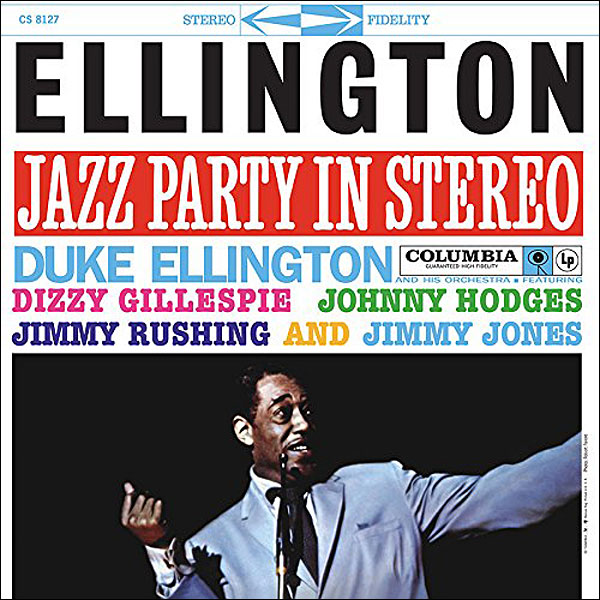 All this put me in mind of the Duke, so when we got back, I put on one of my favorite albums—an unusual one for Duke—Jazz Party in Stereo (footnote 12). I usually listen to this record—this album—on vinyl. How would Jazz Party in Stereo, which is such a natural on vinyl, with its spacious soundstage, full of all sorts of percussive sounds, from timpani (aka kettledrum) to triangle, sound through fancy digital gear?
This is a ping-pong-y album. All those percussive sounds distributed across the soundstage, left to right and front to back, make a spectacular impression. Immediately, though, I noticed a lighter, smoother character to this highly percussive album, not in a good way. Is digital really this much worse than analog, even through a $43,000 DAC? And then I realized I was listening to a DSD file I bought some years ago (DSD64, Columbia). I know some people love it, but I have often found DSD to sound unnaturally smooth—it's one of those homogenizing influences I mentioned earlier.
I switched to the MQA version, streaming (16/44.1 MQA/Tidal). The C1.2's front panel display turned green, indicating MQA Studio. This version was louder than the DSD version, so I turned it down a bit, matching levels by ear but only roughly. Restarting the track, I immediately noticed more grunt and heft in the drums, more sharpness—even harshness—in the high percussion (xylophone, vibraphones, glockenspiel, tambourine, triangle). At first, Jimmy Woode's bass sounded like it could be a kettledrum or some other percussion instrument, but over time its "pluck" emerged. Britt Woodman's trombone had real, blatty flesh. Duke's piano sound was very natural—one of the better-recorded jazz pianos I can remember from this era.
This is what this album sounds like. It's what the record—the LP—sounds like. I'd probably still put the vinyl on on a celebratory Friday night, but this sounds just as good, or—it pains me to say it—perhaps better. I'm listening at 10am on a Sunday morning, feeling exhilarated, nothing between me and the music (footnote 13). Time to whip up a cocktail? It's 5 o'clock somewhere.
All this put me in mind of the Duke, so when we got back, I put on one of my favorite albums—an unusual one for Duke—Jazz Party in Stereo (footnote 12). I usually listen to this record—this album—on vinyl. How would Jazz Party in Stereo, which is such a natural on vinyl, with its spacious soundstage, full of all sorts of percussive sounds, from timpani (aka kettledrum) to triangle, sound through fancy digital gear?
This is a ping-pong-y album. All those percussive sounds distributed across the soundstage, left to right and front to back, make a spectacular impression. Immediately, though, I noticed a lighter, smoother character to this highly percussive album, not in a good way. Is digital really this much worse than analog, even through a $43,000 DAC? And then I realized I was listening to a DSD file I bought some years ago (DSD64, Columbia). I know some people love it, but I have often found DSD to sound unnaturally smooth—it's one of those homogenizing influences I mentioned earlier.
I switched to the MQA version, streaming (16/44.1 MQA/Tidal). The C1.2's front panel display turned green, indicating MQA Studio. This version was louder than the DSD version, so I turned it down a bit, matching levels by ear but only roughly. Restarting the track, I immediately noticed more grunt and heft in the drums, more sharpness—even harshness—in the high percussion (xylophone, vibraphones, glockenspiel, tambourine, triangle). At first, Jimmy Woode's bass sounded like it could be a kettledrum or some other percussion instrument, but over time its "pluck" emerged. Britt Woodman's trombone had real, blatty flesh. Duke's piano sound was very natural—one of the better-recorded jazz pianos I can remember from this era.
This is what this album sounds like. It's what the record—the LP—sounds like. I'd probably still put the vinyl on on a celebratory Friday night, but this sounds just as good, or—it pains me to say it—perhaps better. I'm listening at 10am on a Sunday morning, feeling exhilarated, nothing between me and the music (footnote 13). Time to whip up a cocktail? It's 5 o'clock somewhere.
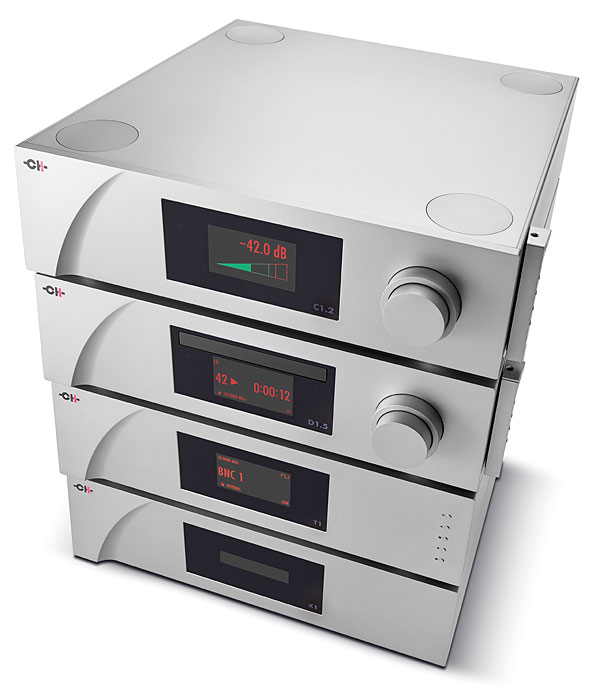 The CH Precision digital stack
This is a review of the C1.2 DAC, but I was privileged to hear that instrument in the context of the full CH Precision digital front-end, with the D1.5 transport, X1 power supply, and T1 clock. How much difference did all the fixins make?
Some difference, for sure, but I didn't find them necessary. As editor of Stereophile, I suppose I should be an absolute perfectionist, but the fact is, I have limits. Not infrequently, I hear sound that's totally satisfying, that I could happily, joyously, live with forever. I'm getting that with just the one box, the C1.2.
Sure, if money (and, importantly, space) were no object, I'd buy them all. I say "pretty sure" because money and space are indeed objects, so I can't really put myself in that position; I can only pretend.
In my review of the D1.5, using it as a player, digital conversions carried out by its dual-mono DAC boards, I found—this surprised me—the external clock made a big, meaningful difference. I did not find that to be the case this time, with the C1.2. I heard differences, subtle and difficult to describe, but none that substantially increased or decreased my pleasure in listening. The X1 power supply made a bit more difference, adding, I thought, a touch more flesh, more tangibility, to acoustic objects, but I could live without that, too. Call me easy to please, but I'm willing to settle for just the $38,500 version (with the options I'd need installed)—although I'd also be tempted to include the analog input board for another $2500. I guess a $40,000 DAC—this $40,000 DAC—is good enough for me. So sue me.
If I were to buy both the D1.5 and the C1.2—and if money were no object, I would buy both, because it's nice to have the ability to play discs—I would add the T1 clock. And the power supply? Compared to the other components, it's pretty affordable. Might as well throw that in, too. If money were no object.
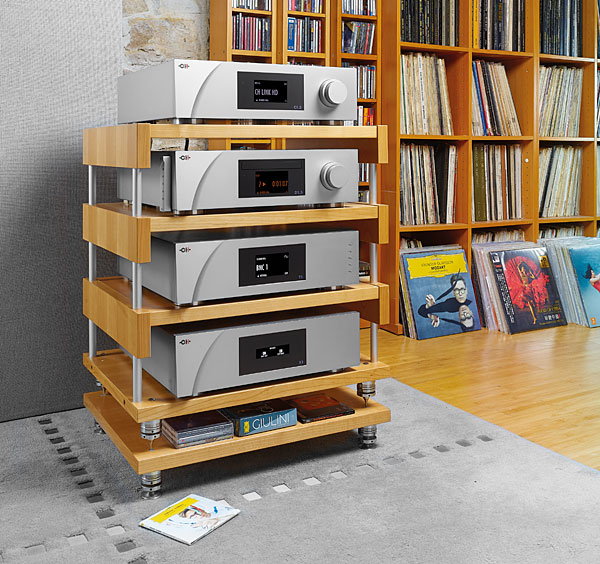 Summing up
I have little to add. There are other digital sources in this price class, from the three-letter companies, dCS and MSB. There undoubtedly are others in a similar price class—and one manufacturer at least is charging more. But I haven't heard any of those other sources in my system, so there's no way I can compare. If there's a downside, it's the price. It would be cool if it cost a tenth as much, but then it would also be cool if I could fly. As I've often said and occasionally written, value is a question of values—and also of wealth. If you're richer than me, I'm okay with that. It's a decision each of us must make on our own.
The C1.2, both with and without its external clock and power supply, produced the best sound I've heard from a digital source—far better than far cheaper chip DACs that we've put in Class A+ on our list of Recommended Components. Which is a problem for Stereophile's editor: Do we need to create a class A++? The CH Precision C1.2 gives new meaning to "turn it up to 11!"
Footnote 10: Although even a hall acoustic—I'm tempted to say especially a hall acoustic—can homogenize sound. Also: Used tastefully, dynamic compression is an essential tool for audio engineers. Footnote 11: The mansion does have a musical history though, sort of. Back in the 1980s and '90s, when my wife and I were visiting her grandparents in the apartment across the street, it was known as the Seagram building because Seagram heir Edgar Bronfman Jr. lived there. Bronfman would soon become Seagram's CEO and sell off valuable assets to make big bets in the music industry just as illegal file sharing was starting to shred it. He would go on to be CEO and chairman of the Warner Music Group and do a skillful job keeping the company afloat during some of its worst years.
Footnote 12: There's a mono version, which is called just Jazz Party. Straight from the liner notes: "As the crowd gathered, Duke was on the phone calling his group of nine percussionists, and the studio lobby was filling up with kettle drums and xylophones. Chairs were set up for our unexpected audience, and Duke, with the innocent expression of a small boy who has just dropped a match into a gas tank, said, "Let's see what happens."
Footnote 13: No, I'm not listening naked. That's not what I meant.
What do we look for—rather, listen for—in a digital music source? Or, for that matter, any audio source, or any audio system? "Tastes vary" may be the most important answer to that question, but I hope there are values we can all agree on: rich timbres and textures, vivid colors, images that seem solid and real, commanding bass, airy highs. Some will insist more than others that the sounds our systems produce be true to the source, although that can be hard to determine. (Loudspeaker designers, a suggestion: Don't release a high-end speaker that can't accurately reproduce common piano, like the sound of a Steinway Model D in a good hall. I hear a few loudspeakers that can't do that at every audio show I attend.)
Remember Grosvenor's B-minor sonata, which I started listening to earlier? After it ended, Roon Radio started up Khatia Buniatishvili's 2011 recording of the Mephisto Waltz No.1, also by Liszt. The sound got better—it's a much livelier recording. I'm listening to just two speakers, sitting 11' in front of me, but the sound is enveloping me in a way that the Grosvenor recording didn't, especially in the louder passages. That sense of piano-case overload I mentioned is absent from this recording. The perspective here is more distant than on the Grosvenor recording, yet I can clearly hear a difference in soundstage depth between the piano's high notes and low notes, sounds emerging where the hammer hits the strings—rather, where those sounds reflect off the piano's open lid. I'd say I'm sitting in row 20 or so—that's the aural perspective—so the piano is pretty far away, but the effect is very clear. And even the loudest sounds seem relaxed, stress-free.
Speaking of Buniatishvili: Not only does she make wonderful recordings of great music beautifully played; she also chooses superbly interesting repertoire. The next-to-last track on her album Labyrinth, from 2020 (24/96 FLAC, Sony Classical/Qobuz), is John Cage's 4'33". I won't say it's her best performance, but it's certainly her most perfect, the one with the fewest mistakes.
In this issue, Jason Victor Serinus reviews Caroline Shaw's recording The Wheel (24/192 wave download, Alpha), with the French collective I Giardini; it's Stereophile's Recording of the Month. It's my Recording of the Month, too.
One track Jason didn't mention in his review is the second, "Gustav Le Gray," which, for its first half or so, is identical to—indeed, is—Chopin's Mazurka Op.17 No.4. After the halfway point, the mazurka comes unglued. "Gustave Le Gray," Shaw writes in the liner notes, "is a multi-layered portrait of Op.17 #4 using some of Chopin's ingredients overlaid and hinged together with my own." Fascinating stuff. Through the C1.2 DAC, it—especially the piano, which is what I focused on the most—simply sounded right.
All this put me in mind of the Duke, so when we got back, I put on one of my favorite albums—an unusual one for Duke—Jazz Party in Stereo (footnote 12). I usually listen to this record—this album—on vinyl. How would Jazz Party in Stereo, which is such a natural on vinyl, with its spacious soundstage, full of all sorts of percussive sounds, from timpani (aka kettledrum) to triangle, sound through fancy digital gear?
This is a ping-pong-y album. All those percussive sounds distributed across the soundstage, left to right and front to back, make a spectacular impression. Immediately, though, I noticed a lighter, smoother character to this highly percussive album, not in a good way. Is digital really this much worse than analog, even through a $43,000 DAC? And then I realized I was listening to a DSD file I bought some years ago (DSD64, Columbia). I know some people love it, but I have often found DSD to sound unnaturally smooth—it's one of those homogenizing influences I mentioned earlier.
The CH Precision digital stackThis is a review of the C1.2 DAC, but I was privileged to hear that instrument in the context of the full CH Precision digital front-end, with the D1.5 transport, X1 power supply, and T1 clock. How much difference did all the fixins make?
Summing upI have little to add. There are other digital sources in this price class, from the three-letter companies, dCS and MSB. There undoubtedly are others in a similar price class—and one manufacturer at least is charging more. But I haven't heard any of those other sources in my system, so there's no way I can compare. If there's a downside, it's the price. It would be cool if it cost a tenth as much, but then it would also be cool if I could fly. As I've often said and occasionally written, value is a question of values—and also of wealth. If you're richer than me, I'm okay with that. It's a decision each of us must make on our own.
Footnote 10: Although even a hall acoustic—I'm tempted to say especially a hall acoustic—can homogenize sound. Also: Used tastefully, dynamic compression is an essential tool for audio engineers. Footnote 11: The mansion does have a musical history though, sort of. Back in the 1980s and '90s, when my wife and I were visiting her grandparents in the apartment across the street, it was known as the Seagram building because Seagram heir Edgar Bronfman Jr. lived there. Bronfman would soon become Seagram's CEO and sell off valuable assets to make big bets in the music industry just as illegal file sharing was starting to shred it. He would go on to be CEO and chairman of the Warner Music Group and do a skillful job keeping the company afloat during some of its worst years.