If you had to describe the kind of audio system that you would like to have, with only one word, what word would you choose? Some would choose the word "quality." In a book titled Zen and the Art of Motorcycle Maintenance: An Inquiry into Values, from 1974, Robert Pirsig considers the word and concept as a worldview, as a fundamental way of thinking about things that encompasses both reason and feelings, in the pursuit of value, excellence, truth, nobility, perfection, goodness, and beauty. He capitalizes the word throughout the book. I'll do the same here.
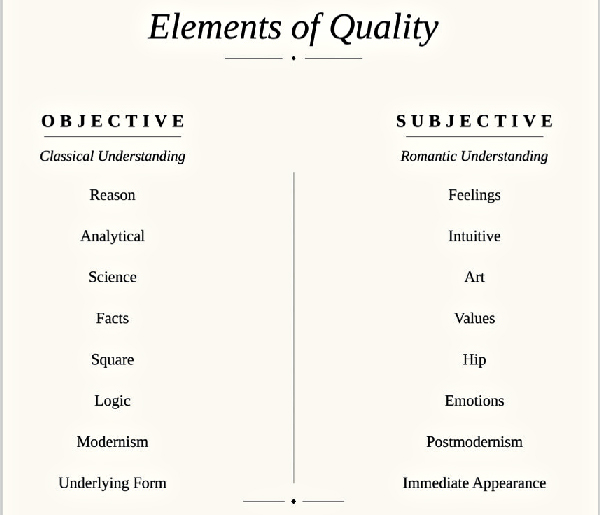
Somewhere in the work of the Greek philosophers, the thinking goes, a mistake was made that sent Western civilization down the wrong path by taking the Quality worldview and splitting it in half, into a dichotomy of objective and subjective thought. Pirsig blames Aristotle. The chart above shows various ways we experience these two modes of thinking.
There is a long-running debate in audio about whether the best approach to evaluating quality—Quality—is subjective, emphasizing listening, or objective, emphasizing measurements. But what if that is the wrong question?
The main point of Pirsig's book is that this dichotomy is not real. Quality cannot be split into a fact part and a value part. For thousands of years, people didn't suffer from this misunderstanding. Then Western civilization, influenced by Greek philosophy, began to believe that it is.
From the late 1800s to around 1980, Modernism was the dominant way of looking at the world, at least among influential folks. Reason and science were emphasized over all else. Then in the 1950s, with the Beat Generation and later with the hippies, people began to question whether science and technology could answer all of life's important questions. This led to a new attitude that rejected rationalism and placed the dominant emphasis on feelings and emotions. Pirsig proposed that neither of these modes represents the whole of reality. Quality incorporates both objective and subjective thought, inseparably in balance.
Consider jazz. People think of it—correctly—as creative, improvised, intuitive: subjective. Yet playing jazz requires an extensive knowledge of theory and mastery of technique: a classical concept. People think of science as logical, analytical, and therefore objective—yet Albert Einstein once said about physics, "There is no logical path to these laws; only intuition, resting on sympathetic understanding of experience, can reach them." Physicist Max Born said, "Science is not formal logic; it needs the free play of the mind in as great a degree as any other creative art." Science may be logical, but you can't arrive at it through logic.
 What about the idea, "Beauty is in the eye of the beholder"? That may be one version of a subjectivist view. Yet T.S. Eliot spoke of developing a "disciplined taste" that recognizes depth and objective value and gets beyond subjective preference, surface stylishness, and cultural and marketing trends. The goal of art is a fusion of nature and the human spirit to create transcendent Quality. At its best, when technique is combined with a message that possesses spiritual gravity, it can communicate universal truths.
The goal in audio, in both product design and reviewing, should always be Quality Audio, which cannot be achieved through an approach that's predominantly objective or subjective. Quality Audio can become a place where classical and romantic understanding come together to make art.
The pursuit begins with each of us. Subjectivists can learn more about electronics and acoustics—about underlying form. That lets us ask better questions of manufacturers and helps to defend against product claims and reviews that lack credibility. It places their pursuit of beauty and meaning on a more solid foundation. Objectivists can learn more about ... music! Most audiophiles have preferentially explored the first half of the history of recorded jazz (to about 1975), yet there is an abundance of great music from the last 50 years—the post-Pirsig generation—including right now.
The right perspective can transform a hobby of assembling expensive components into the idea that the system you are really working on is yourself.
In some ways, our industry leans too much toward the "classical" side. Consider a musician's perspective. A musician sees a presentation at an audio show as too square, as exhibitors play demo tracks like "Bubbles," cut songs off in the middle, play bad songs over and over, and talk loudly while music is playing. In other ways, it leans too "romantic": The same musician sees a $48,000 power cord in an audio magazine, realizes he could buy a Yamaha grand piano for that price, throws the magazine in the trash, and writes off the whole industry.
The great jazz saxophonist Dave Liebman once said, "When you know what excellence is, it transfers to all fields." Quality in audio can be a way to learn about, and to teach others about, Quality in all aspects of life. Ultimately, this field is about music. Music is amazing, inspiring, profound, even sacred. There is both an opportunity and a responsibility that goes with that. With a focus on Quality Audio, our industry can thrive, and we can share both this sacred music and the wisdom of a Quality approach to life with those around us.
What about the idea, "Beauty is in the eye of the beholder"? That may be one version of a subjectivist view. Yet T.S. Eliot spoke of developing a "disciplined taste" that recognizes depth and objective value and gets beyond subjective preference, surface stylishness, and cultural and marketing trends. The goal of art is a fusion of nature and the human spirit to create transcendent Quality. At its best, when technique is combined with a message that possesses spiritual gravity, it can communicate universal truths.
The goal in audio, in both product design and reviewing, should always be Quality Audio, which cannot be achieved through an approach that's predominantly objective or subjective. Quality Audio can become a place where classical and romantic understanding come together to make art.
The pursuit begins with each of us. Subjectivists can learn more about electronics and acoustics—about underlying form. That lets us ask better questions of manufacturers and helps to defend against product claims and reviews that lack credibility. It places their pursuit of beauty and meaning on a more solid foundation. Objectivists can learn more about ... music! Most audiophiles have preferentially explored the first half of the history of recorded jazz (to about 1975), yet there is an abundance of great music from the last 50 years—the post-Pirsig generation—including right now.
The right perspective can transform a hobby of assembling expensive components into the idea that the system you are really working on is yourself.
In some ways, our industry leans too much toward the "classical" side. Consider a musician's perspective. A musician sees a presentation at an audio show as too square, as exhibitors play demo tracks like "Bubbles," cut songs off in the middle, play bad songs over and over, and talk loudly while music is playing. In other ways, it leans too "romantic": The same musician sees a $48,000 power cord in an audio magazine, realizes he could buy a Yamaha grand piano for that price, throws the magazine in the trash, and writes off the whole industry.
The great jazz saxophonist Dave Liebman once said, "When you know what excellence is, it transfers to all fields." Quality in audio can be a way to learn about, and to teach others about, Quality in all aspects of life. Ultimately, this field is about music. Music is amazing, inspiring, profound, even sacred. There is both an opportunity and a responsibility that goes with that. With a focus on Quality Audio, our industry can thrive, and we can share both this sacred music and the wisdom of a Quality approach to life with those around us.
What about the idea, "Beauty is in the eye of the beholder"? That may be one version of a subjectivist view. Yet T.S. Eliot spoke of developing a "disciplined taste" that recognizes depth and objective value and gets beyond subjective preference, surface stylishness, and cultural and marketing trends. The goal of art is a fusion of nature and the human spirit to create transcendent Quality. At its best, when technique is combined with a message that possesses spiritual gravity, it can communicate universal truths.
The goal in audio, in both product design and reviewing, should always be Quality Audio, which cannot be achieved through an approach that's predominantly objective or subjective. Quality Audio can become a place where classical and romantic understanding come together to make art.
The pursuit begins with each of us. Subjectivists can learn more about electronics and acoustics—about underlying form. That lets us ask better questions of manufacturers and helps to defend against product claims and reviews that lack credibility. It places their pursuit of beauty and meaning on a more solid foundation. Objectivists can learn more about ... music! Most audiophiles have preferentially explored the first half of the history of recorded jazz (to about 1975), yet there is an abundance of great music from the last 50 years—the post-Pirsig generation—including right now.