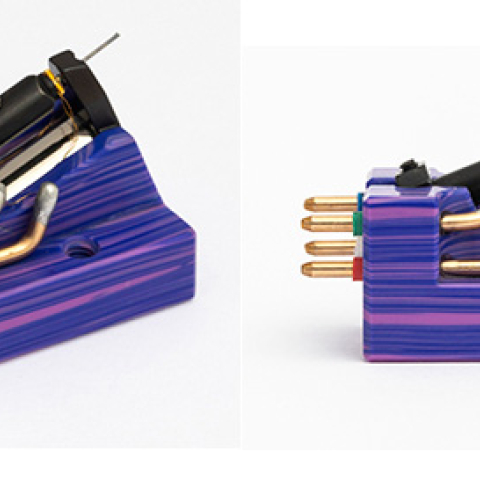
It's been years since I lived with the purple Murasakino, but my quibble with this otherwise stellar SUT was its merely decent portrayal of tone colors. Happily, the Monster Can elicited richer, more saturated colors from my records. A good color test is the title track from Gabor Szabo's
Spellbinder (Impulse! AS-9123), an improvisation with the slightly crazed, careening feel of surf rock. The Hungarian guitarist's second release from 1966, recorded at Rudy Van Gelder's Englewood Cliffs studio, highlights the distinctive and very full sound Szabo created with his amplified Gibson guitar, captured with eerie vividness on my orange-label first US stereo pressing. The Monster Can's presentation reveled in the instrument's molasses-hued glory, imbuing it with the air-pressurizing tonal density that magnetics excel at bringing into a room.
One reason people like SUTs is that they—all of them—sound unfailingly pleasant. Where some tend to falter is in the portrayal of detail, particularly when it comes to reverberation and texture. Some tend to generalize this information. The Monster Can generalizes less than any SUT I've heard, retrieving scads of information that it presents, unlike certain digital components, in a natural and unfatiguing way, never truncating the notes' decay.
On
Djam Leelii (Mango MLPS 9840), a classic recording that Senegalese superstar Baaba Maal made with blind guitarist Mansour Seck in 1984, the songs seem to exist out of time, melding centuries-old West African musical traditions with elements of American blues and Afropop. The Monster Can made the halos of reverberation around Maal's shiver-inducing tenor and background instrumental touches eerily apparent, an effect that heightened the record's sonic realism and emotional heft.
Listening with the Consolidated Audio SUT was proving to be more fun than racing a go kart through a yoga retreat. To help me calibrate my ears and make more sense of what I was hearing, I invited my friend
Jerome Sabbagh over for a listen. A terrific musician, Sabbagh also makes some of the best-sounding records I know of; his two most recent releases were this magazine's Recordings of the Month for
February 2024 and
October 2024.
To make things more interesting, Sabbagh brought over a handful of SUTs, including well-loved vintage models from Langevin and Altec Lansing. Having gotten into a bottle of good Beaujolais, we spent an evening listening to LPs through nearly a dozen transformers. All sounded some variety of nice, but in the end it wasn't much of a contest. Though none cost as much as the Monster Can, the German SUT outclassed all of them, handily, in all the usual sonic parameters. With the Monster Can, we were also struck by the remarkable solidity of what we were hearing, in terms of the spatial specificity and stability of a recording's various elements as well as their sheer presence. "It sounds like tape," Sabbagh remarked at one point. He regularly spends hours listening to tape at 30ips on a highly modified Ampex 351 recorder, so I took the comment to be more than audiophile hyperbole.
After spending nearly two months listening to the Monster Can, I could find nothing to criticize about its sonic or musical performance—until another small but heavy box arrived from Berlin. This was the second SUT I mentioned earlier, identical to the first except for its mu-metal core, which the Consolidated Audio website refers to as "Hi-Nickel." The first SUT's nanocrystalline core is an iron-based alloy with additions of silicon, boron, niobium, and copper; the second's more conventional mu-metal core is 80% nickel, with additions of iron and other materials.
It sounds more conventional, too. The Hi-Nickel Monster Can lacks the nanocrystalline-core unit's beguiling liquidity and its intricately illuminated textures. It places slightly less emphasis on the high frequencies. And though the differences I'm describing are minor, it's not
quite as spacious or resolving. But something about it kept me listening and engrossed, until eventually I found myself reaching for it more often than its more sonically accomplished sister.
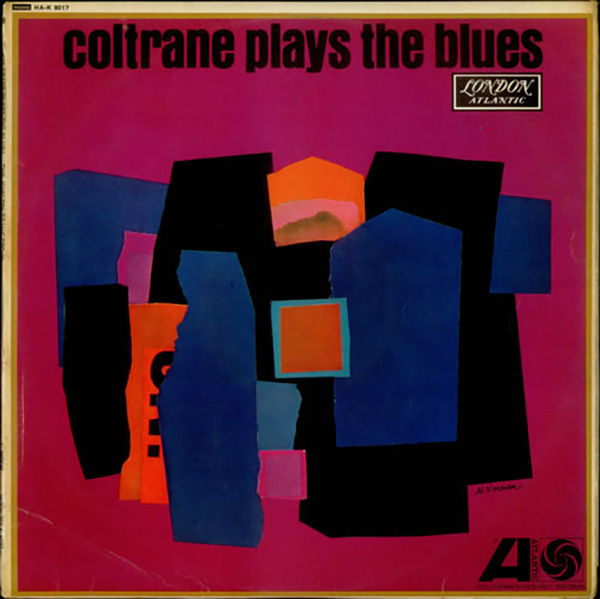
Wanting to get to the bottom of this, I compared familiar recordings played back through both units. The differences were most apparent, and most meaningful, on "Mr. Day," from the first UK stereo pressing of
Coltrane Plays the Blues (London SH-K 8017). As I've gotten older, I've grown to enjoy Coltrane's Atlantic releases—in particular
Giant Steps and
My Favorite Things—more than the classic Impulse! sides I preferred as a younger listener. Some critics continue to characterize the Atlantic material as "transitional," so I was delighted when I recently read that
My Favorite Things was Coltrane's favorite of his records. Weirdly, British pressings of early Atlantic LPs sound far better to me than their US counterparts. I'm not sure why this might be the case.
Listening to the Coltrane track through the nanocrystalline-core Monster Can, my attention was drawn to the sonic details of this imperfect but dazzling record: the way the mix presents the tenor sax as ever so slightly hot, the startling force of McCoy Tyner's left-hand chording, the woody wallop of Steve Davis's bass. The SUT didn't leave anything out or soften the edges.
Switching to the Hi-Nickel unit, the instruments came across as less vivid and separate, but they were portrayed in a more physically believable way and sounded slightly more relaxed and natural. Interestingly, this SUT moved my attention from the individual sounds and toward the musicians' interplay: I noticed that Tyner, with his heavy left hand, functions almost like a Cuban conga player, using the piano as a roiling percussive engine for Coltrane's horn, while Elvin Jones's shimmering drum kit mostly contributes texture.
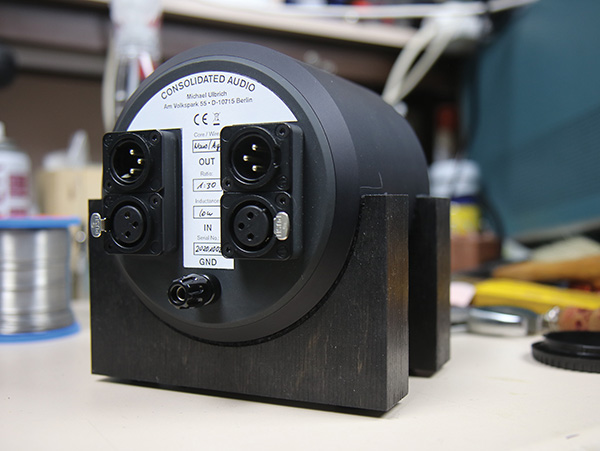
During a subsequent Zoom conversation, Ulbrich likened the differences between the two core materials to those between silver and copper wire: While some listeners prefer silver's more emphatic detail retrieval and explicit sound, which tends to shed light on the engineer's choices, others prefer copper's less impressive but more holistic presentation, which tends to shed light on the musicians. He also mentioned that the nanocrystalline-core units make up more than 90% of his orders.
While I haven't heard the most ambitious SUTs from the likes of Audio Note and Ypsilon, I can report that the Monster Cans are the finest ones I've lived with, and not by a small margin. Besides their significant size and price, they offer nothing to criticize, and their build quality suggests that they will outlive all of us. I should add that their sonic and musical performance remained stunning regardless of which of the three cartridges I used.
Ulbrich told me that he builds these things in the apartment he shares with his family and that, despite the high demand, he isn't inclined to build substantially more than the 50 units he produced last year. "Ramping up production would take away from the joy I take in making them," he told me. This is also why he rules out hiring employees. If you want to order a Monster Can, expect a wait of three months. I hope to place an order in the coming year.
 Fairchild 235 Step-Up Transformer
In case this column hasn't yet exhausted your interest in step-up transformers, here's more. In the months since I began listening to the Fairchild 225-A mono cartridge I wrote about in a
previous column, my one quibble with its paradigm-shifting, mind-scrambling sound has been a tendency toward brightness. This high-output moving coil cartridge from the early 1950s sings with a steely edge that, depending on the recording, can grate on the ears.
Because of this, when using it, I've set the
Manley Steelhead's cartridge loading to 1000 ohms, a compromise that ameliorates the brightness but also dampens a little of the Fairchild's explosive dynamics and brilliant reproduction of ambient space. I resigned myself to this situation until a friend lent me his ancient Fairchild 235 mono step-up transformer, designed to be paired with the 225 series of cartridges.
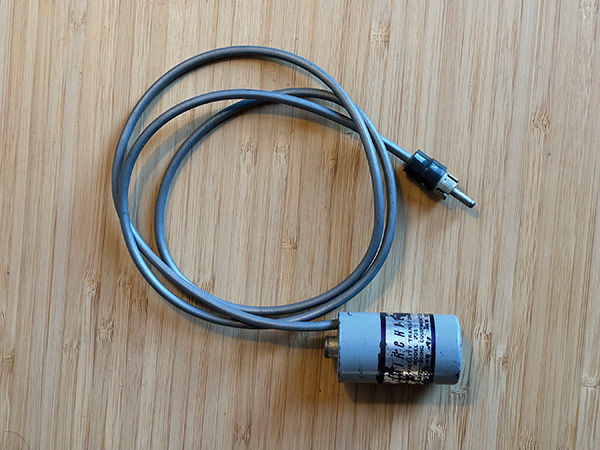
According to a Fairchild data sheet from 1955, this handy little widget has a 1:5 winding ratio, which represents a voltage gain of 14dB. Unlike the bricklike Monster Can, the Fairchild SUT is about the size of a D battery and weighs 4oz—including the captive 30" cable and RCA plug. According to the handy calculator on the Consolidated Audio website, a transformer with a 1:5 winding ratio connected to a phono stage with the standard resistance of 47k ohms presents a cartridge with a load of 1880 ohms. Given the tonal balance of the Fairchild 225-A, that seemed pretty ideal.
The proof lay in the listening. Playing records with the Fairchild cartridge and SUT combo turned out to be pretty wonderful. The transformer does away with the brightness and even adds a touch of richness while preserving the 225-A's cheetah-like speed, world-beating dynamics, spooky presence, and utterly natural sound.
Listening to "I've Got You Under My Skin" from a rather beat first pressing of Dinah Washington's
Dinah Jams (Emarcy MG 36000), the applause at the beginning and the trumpets of Clark Terry, Clifford Brown, and especially Maynard Ferguson no longer felt like having my ear canals cleaned out with a wire brush. The Fairchild combo managed to tame this live recording, one of the most offensively bright I've heard, while preserving the excitement of the wonderful performances.
In 1955, the Fairchild 235 transformer cost $10.75; you can be sure it sells for a
lot more today. But if you have your heart set on a Fairchild 225-A, the king and queen of mono cartridges, sooner or later you'll want one.