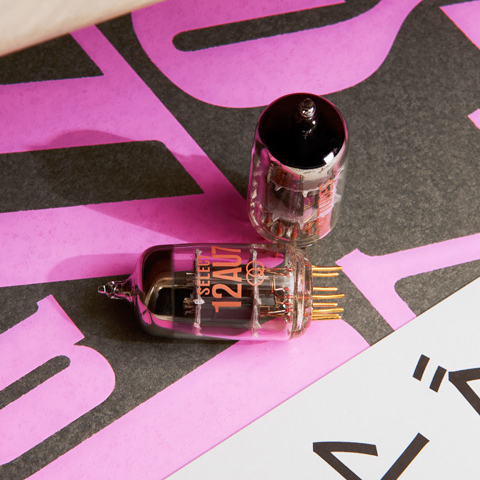
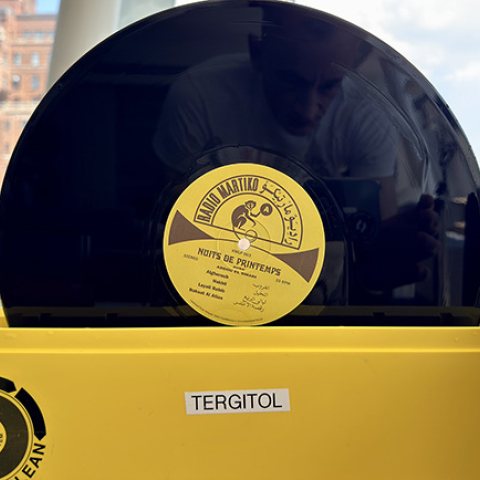
One of the privileges of being a reviewer is being able to live with a wide variety of components. For the past year and a half, I've been listening to LPs using solid state, high-gain phono preamplifiers like the Parasound Halo JC 3+, the Sutherland Little Loco, and the Lejonklou Entity, which I've come to admire for their coherence and resolution. While I was reviewing the Entity, Ken Micallef brought over his Tavish Adagio, a tubed phono preamp with a great-sounding moving magnet section that we paired with my Auditorium 23 SPU step-up transformer. The combination didn't always sound as refined and clean as the solid state alternatives, but it had oodles of punch and drive and produced more saturated tone colors. It also managed to transmit something I hadn't heard in a while that took me back to Pasha's apartment in Moscow: the sensation of music physically pressurizing the air, a subtle layer of realism I realized I had been missing. Another way to describe it is as a physically palpable sense of presence. Why did this information elude the otherwise highly resolving solid state preamps? Are passive devices better at creating a physical facsimile of a recording than active ones?
 To investigate what I heard, I borrowed a handful of step-up transformers at various price points, as well as an Adagio from Scott Reynolds at Tavish Design. (The tubed phono section of my Shindo Aurieges preamp sounds a bit more nuanced and textured than the Adagio, but it lacks that unit's muscular drive, transparency, and lower noisefloor.) Because I was using the Ortofon MC Cadenza Bronze and the Dynavector Te Kaitora Rua—low-output moving coil cartridges with internal impedances of 5 and 6 ohms respectively—I borrowed SUTs designed to work with low-output and low-impedance cartridges. All but one of the transformers had a winding ratio of 1:20, ensuring a useful amount of gain. The cartridges were installed in the Schick 12" tonearm on my Garrard 301 turntable, and the Adagio was routed into the line-level inputs of my Shindo Aurieges preamp or the Ayre AX-5 Twenty integrated amplifier.
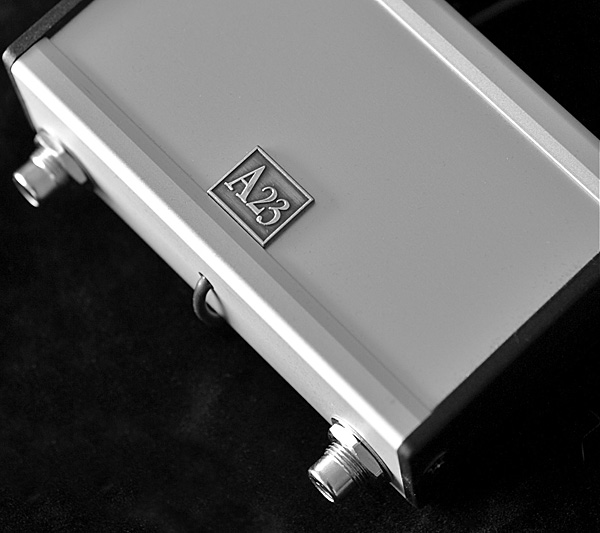
To establish a baseline, I spent several weeks listening to my Auditorium 23 step-up (footnote 3), which is designed for the Ortofon SPU cartridge (a different version is designed for the Denon DL-103) and retails for $1495. It's about the size of a pack of cigarettes, surprisingly heavy, and probably an intensely satisfying thing to chuck through a plate glass window.
To investigate what I heard, I borrowed a handful of step-up transformers at various price points, as well as an Adagio from Scott Reynolds at Tavish Design. (The tubed phono section of my Shindo Aurieges preamp sounds a bit more nuanced and textured than the Adagio, but it lacks that unit's muscular drive, transparency, and lower noisefloor.) Because I was using the Ortofon MC Cadenza Bronze and the Dynavector Te Kaitora Rua—low-output moving coil cartridges with internal impedances of 5 and 6 ohms respectively—I borrowed SUTs designed to work with low-output and low-impedance cartridges. All but one of the transformers had a winding ratio of 1:20, ensuring a useful amount of gain. The cartridges were installed in the Schick 12" tonearm on my Garrard 301 turntable, and the Adagio was routed into the line-level inputs of my Shindo Aurieges preamp or the Ayre AX-5 Twenty integrated amplifier.
To establish a baseline, I spent several weeks listening to my Auditorium 23 step-up (footnote 3), which is designed for the Ortofon SPU cartridge (a different version is designed for the Denon DL-103) and retails for $1495. It's about the size of a pack of cigarettes, surprisingly heavy, and probably an intensely satisfying thing to chuck through a plate glass window.
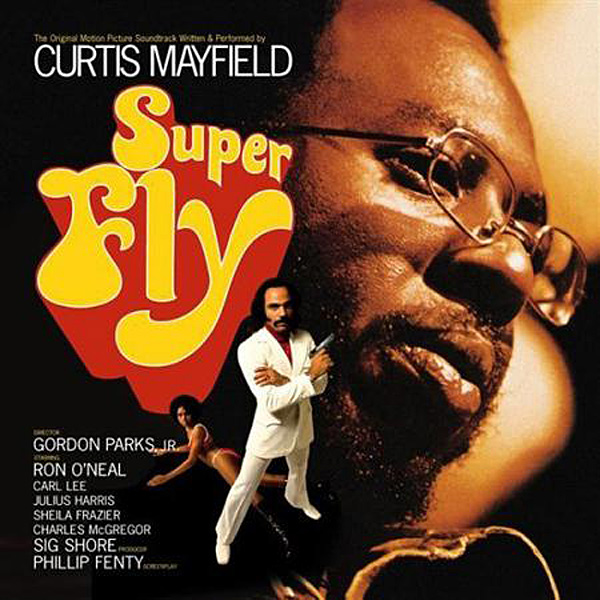 To my delight, it sounded as tactile and vivid as I'd remembered. It made recordings tuneful and colorful, if a little warmer than real, and did the usual hi-fi things with aplomb. The little German brick was particularly adept at rock, pop, and soul: On "Pusherman" from the Super Fly soundtrack, it depicted the hard-panned percussion, devastating baseline, drum kit, and stiletto electric guitar flashes surrounding Curtis Mayfield's voice with the Cinemascope saturation, free-flowing dynamics, and the impeccable rhythmic thrust the track deserves. And it proved to be the most consistently colorful SUT I auditioned. In sonic terms, though, the Auditorium 23 generalized a bit, leaving out some low-level detail and spatial information I could hear through the Little Loco and some of the other transformers. But in musical terms it left little to criticize, offering a tremendously fun interface through which to experience your LPs.
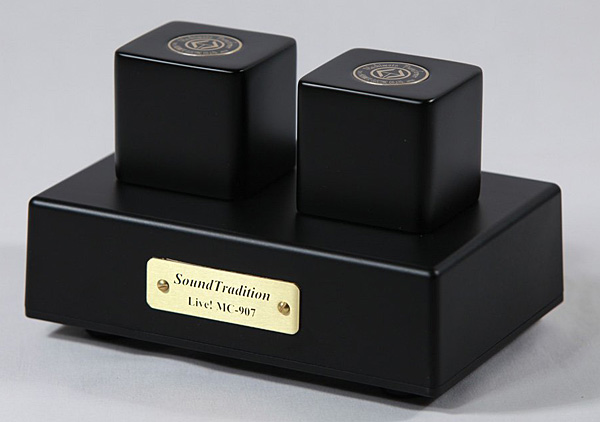 Some of the Auditorium 23's sonic omissions were revealed by a device named the SoundTradition Live! MC-907 (footnote 4). It uses a pair of Hashimoto HM-7s, the top-of-the-line step-up transformers from the venerable Japanese firm, retails for $1895, and is cased in a reassuringly black metal chassis of the usual sort. Among the units I auditioned, it was the only SUT offering two usable taps—providing 1:15 and 1:30 winding ratios and respective gain of 23dB and 29dB—selected via top-mounted switches. As SoundTradition's Isao Asakura suggested I would, I preferred the sound of the higher-gain setting with both cartridges, which lent them more giddy-up and more satisfying bass.
 The MC-907 posed a cerebral alternative to the Auditorium 23's celebratory personality, resolving slightly more detail and casting a wider and taller soundstage. It also revealed marginally more spatial cues, which made it a fortuitous pairing with classical (and Indian classical) recordings. Listening to "Misra Mand" from Ali Akbar Khan's Morning and Evening Ragas, the MC-907 allowed me to discern clearly the force with which Khan played every note as well as their reverberation and decay, but it was considerably less successful at depicting the sweetness and woodiness of his sarod, a fretless instrument with a bell-like resonator on the neck and 25 strings, 10 of which are plucked with a piece of coconut shell while the others resonate sympathetically.
For all its sonic talents, the wound-in-Japan, assembled-in-Michigan SUT produced muted tonal colors. Compared to the others, it lent music a slightly grayish cast, a quality I found difficult to enjoy or overlook. According to Asakura, the unit is currently being redesigned. Look for the forthcoming MC-907 Supreme, which, according to its designer, should be quieter, with less electromagnetic interference, due to a heavier-duty chassis; the transformers themselves, and the wiring, will be the same.
The MC-907 posed a cerebral alternative to the Auditorium 23's celebratory personality, resolving slightly more detail and casting a wider and taller soundstage. It also revealed marginally more spatial cues, which made it a fortuitous pairing with classical (and Indian classical) recordings. Listening to "Misra Mand" from Ali Akbar Khan's Morning and Evening Ragas, the MC-907 allowed me to discern clearly the force with which Khan played every note as well as their reverberation and decay, but it was considerably less successful at depicting the sweetness and woodiness of his sarod, a fretless instrument with a bell-like resonator on the neck and 25 strings, 10 of which are plucked with a piece of coconut shell while the others resonate sympathetically.
For all its sonic talents, the wound-in-Japan, assembled-in-Michigan SUT produced muted tonal colors. Compared to the others, it lent music a slightly grayish cast, a quality I found difficult to enjoy or overlook. According to Asakura, the unit is currently being redesigned. Look for the forthcoming MC-907 Supreme, which, according to its designer, should be quieter, with less electromagnetic interference, due to a heavier-duty chassis; the transformers themselves, and the wiring, will be the same.
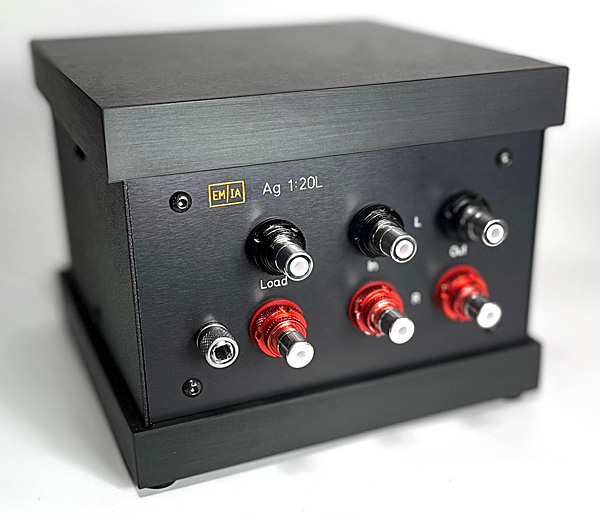 If I had expected these seemingly straightforward, passive devices to sound similar to each other, listening to them proved me wrong. I discovered just how wrong while listening to the EMIA MC step-up transformer (footnote 5). This fairly large, industrial-looking device uses silver wire wound around permalloy cores. It can be customized to a particular cartridge and retails for $6000. (A copper-wire version costs $3375, footnote 6.) In addition to the usual input and output jacks, the EMIA MC provides a pair of inputs for resistors, which EMIA's Dave Slagle believes can make certain systems sound more natural. Trying the 37 ohm resistors with RCA plugs he sent me made the high-end response a little smoother and better behaved, so I left them in for most of our time together.
I have to admit I wasn't looking forward to hearing the EMIA. My earliest experiences with silver wire were starkly negative: Seemingly every silver interconnect or speaker cable left me gritting my teeth at their brightness and a fluorescent-white coloration that made the music played through them sound bleached. I've avoided silver until recently, when a few weeks with AudioQuest's crazy good FireBird interconnect persuaded me that not all of it sounds alike. Slagle suggests that this coloration may be a result of impurities like cadmium, which is added to silver to make it more malleable for jewelry making; the wire he uses is 0.9999% pure. A self-proclaimed silverhead, he said that the metal oxidizes in a more benign fashion than copper, making for a more conductive and resolving medium (footnote 7).
The EMIA sounded nothing like the silver wire I remembered, providing an addictively smooth, highly resolving facsimile of my music. While it wasn't quite as punchy as the Auditorium 23, it produced a little more detail and a lot more space as well as deeper, more precise bass. It sounded colorful but painted its images with a cooler palette than the copper transformers. Most remarkably, music played through the EMIA took on a glow, as though the sonic images around my speakers were suddenly filled with moonlight. With certain music—like Johnny Gandelsman's impossibly weightless versions of Bach's Cello Suites performed on the violin, or Radiohead's In Rainbows—the EMIA made me feel like the angel band from the famous Stanley Brothers song had winged its way into my Brooklyn loft and was performing in front of me. The experience left me wishing that adjectives like "haunting" and "ravishing" weren't clichés. The EMIA loves reverberant spaces and decay, but on music with other priorities—like, say, ZZ Top's Tres Hombres—I found myself longing for the earthier pleasures and more palpable drive of the Auditorium 23.
Like most components, the silver EMIA may not be the device for every record or system, but at its best it reduced me to silence.
Violet isn't a color one sees a lot of in hi-fi design. With its violet anodized-aluminum shell and golden pedestal, the Nobala, a SUT manufactured by Murasakino Ltd. of Kyoto, Japan (footnote 8), looks like a metallic beetle or possibly a mysterious prop from a David Cronenberg film. As it turns out, the color scheme matches the other two products manufactured by Murasakino, namely the mono and stereo versions of the Sumile moving coil cartridge. I've not heard either Sumile, but the manufacturer specifies that the Nobala, which costs an eye-watering $7495, should play well with cartridges with impedances of 5 ohms or lower. I can attest here that it does.
If I had expected these seemingly straightforward, passive devices to sound similar to each other, listening to them proved me wrong. I discovered just how wrong while listening to the EMIA MC step-up transformer (footnote 5). This fairly large, industrial-looking device uses silver wire wound around permalloy cores. It can be customized to a particular cartridge and retails for $6000. (A copper-wire version costs $3375, footnote 6.) In addition to the usual input and output jacks, the EMIA MC provides a pair of inputs for resistors, which EMIA's Dave Slagle believes can make certain systems sound more natural. Trying the 37 ohm resistors with RCA plugs he sent me made the high-end response a little smoother and better behaved, so I left them in for most of our time together.
I have to admit I wasn't looking forward to hearing the EMIA. My earliest experiences with silver wire were starkly negative: Seemingly every silver interconnect or speaker cable left me gritting my teeth at their brightness and a fluorescent-white coloration that made the music played through them sound bleached. I've avoided silver until recently, when a few weeks with AudioQuest's crazy good FireBird interconnect persuaded me that not all of it sounds alike. Slagle suggests that this coloration may be a result of impurities like cadmium, which is added to silver to make it more malleable for jewelry making; the wire he uses is 0.9999% pure. A self-proclaimed silverhead, he said that the metal oxidizes in a more benign fashion than copper, making for a more conductive and resolving medium (footnote 7).
The EMIA sounded nothing like the silver wire I remembered, providing an addictively smooth, highly resolving facsimile of my music. While it wasn't quite as punchy as the Auditorium 23, it produced a little more detail and a lot more space as well as deeper, more precise bass. It sounded colorful but painted its images with a cooler palette than the copper transformers. Most remarkably, music played through the EMIA took on a glow, as though the sonic images around my speakers were suddenly filled with moonlight. With certain music—like Johnny Gandelsman's impossibly weightless versions of Bach's Cello Suites performed on the violin, or Radiohead's In Rainbows—the EMIA made me feel like the angel band from the famous Stanley Brothers song had winged its way into my Brooklyn loft and was performing in front of me. The experience left me wishing that adjectives like "haunting" and "ravishing" weren't clichés. The EMIA loves reverberant spaces and decay, but on music with other priorities—like, say, ZZ Top's Tres Hombres—I found myself longing for the earthier pleasures and more palpable drive of the Auditorium 23.
Like most components, the silver EMIA may not be the device for every record or system, but at its best it reduced me to silence.
Violet isn't a color one sees a lot of in hi-fi design. With its violet anodized-aluminum shell and golden pedestal, the Nobala, a SUT manufactured by Murasakino Ltd. of Kyoto, Japan (footnote 8), looks like a metallic beetle or possibly a mysterious prop from a David Cronenberg film. As it turns out, the color scheme matches the other two products manufactured by Murasakino, namely the mono and stereo versions of the Sumile moving coil cartridge. I've not heard either Sumile, but the manufacturer specifies that the Nobala, which costs an eye-watering $7495, should play well with cartridges with impedances of 5 ohms or lower. I can attest here that it does.
 To ruin the surprise, the Nobala reproduced more of my music than any other SUT, and possibly any phono device, I'd heard at home. If listening to most transformers feels like sipping water through a straw, listening to the Nobala was like suddenly sipping through a garden hose. It simply let through more of everything: detail, texture, dynamics, even groove noise. To figure out how well a component excavates low-level information, I like to pay attention to the background singers on "Famous Blue Raincoat" from Leonard Cohen's Songs of Love and Hate. With some components, Carolynn Hanney and Susan Mussmano's voices sound like breathy, intermittent humming in the right and left channels. While the Nobala didn't turn Hanney and Mussmano into the Pointer Sisters, it made every moment of their singing distinct, musically significant, and placed precisely in space. This preternatural clarity made me reach for records I hadn't heard in years just so I could hear them through the Nobala.
Despite its nearly world-beating performance, the violet transformer from Japan wasn't above criticism. It didn't sound quite as colorful as the Auditorium 23 or the EMIA. It sounded like neither typical silver nor typical copper, and I suspect it's constructed with an exotic amorphous or nanocrystalline core. Finally, the floodlight it shines on recordings requires careful system matching: When I tried the Nobala with the ultra-resolving Pass Labs INT-60, the combination proved to be too much of a good thing, bordering on fatiguing.
Just as each of us has unique preferences in music, we thrill at different things in our hi-fis. I believe that to be a very good thing. These days, I find myself most dependably transfixed and moved by sonic density—the illusion that life-sized, weighty, embodied humans are making music in front of me, enhanced by sensations of texture, touch, pressure, color, and realistic scale (footnote 9). Spending much of the spring and summer listening to step-up transformers reminded me that they may be the most dependable method of extracting those rich umami flavors from vinyl records. While high-gain phono preamps offer more left-brain pleasures—the highest highs, the lowest lows, ultimate resolution, and refinement—SUTs remain irresistible to those of us whose tastes run to a sound that Dave Slagle described to me as "juicy."
Life is too short to settle for other people's pleasures, so if you recognize your bliss in that description, give one of these handmade devices a try.
To ruin the surprise, the Nobala reproduced more of my music than any other SUT, and possibly any phono device, I'd heard at home. If listening to most transformers feels like sipping water through a straw, listening to the Nobala was like suddenly sipping through a garden hose. It simply let through more of everything: detail, texture, dynamics, even groove noise. To figure out how well a component excavates low-level information, I like to pay attention to the background singers on "Famous Blue Raincoat" from Leonard Cohen's Songs of Love and Hate. With some components, Carolynn Hanney and Susan Mussmano's voices sound like breathy, intermittent humming in the right and left channels. While the Nobala didn't turn Hanney and Mussmano into the Pointer Sisters, it made every moment of their singing distinct, musically significant, and placed precisely in space. This preternatural clarity made me reach for records I hadn't heard in years just so I could hear them through the Nobala.
Despite its nearly world-beating performance, the violet transformer from Japan wasn't above criticism. It didn't sound quite as colorful as the Auditorium 23 or the EMIA. It sounded like neither typical silver nor typical copper, and I suspect it's constructed with an exotic amorphous or nanocrystalline core. Finally, the floodlight it shines on recordings requires careful system matching: When I tried the Nobala with the ultra-resolving Pass Labs INT-60, the combination proved to be too much of a good thing, bordering on fatiguing.
Just as each of us has unique preferences in music, we thrill at different things in our hi-fis. I believe that to be a very good thing. These days, I find myself most dependably transfixed and moved by sonic density—the illusion that life-sized, weighty, embodied humans are making music in front of me, enhanced by sensations of texture, touch, pressure, color, and realistic scale (footnote 9). Spending much of the spring and summer listening to step-up transformers reminded me that they may be the most dependable method of extracting those rich umami flavors from vinyl records. While high-gain phono preamps offer more left-brain pleasures—the highest highs, the lowest lows, ultimate resolution, and refinement—SUTs remain irresistible to those of us whose tastes run to a sound that Dave Slagle described to me as "juicy."
Life is too short to settle for other people's pleasures, so if you recognize your bliss in that description, give one of these handmade devices a try.
Footnote 3: Auditorium 23, Gabelsbergerstrass 23, D-60389 Frankfurt, Germany. Tel: (49) (0)69-4652202. Web: auditorium23.de. US distributor: Tone Imports LLC. Tel: (646) 425-7800. Web: toneimports.com. Footnote 4: Sound Tradition Live! OBS, Inc., PO Box 616, Lawton, MI 49065. Tel: (866) 702-6973. Email: support@obsinc.us. Web: https://tube-amps.net/MC_Step_Ups.htm, also see acoustic-dimension.com/hashimoto/hashimoto-mc-stepup-transformers.htm.
Footnote 5: EMIA. E-mail: Dslagle@earthlink.net, Experiencemusic@hotmail.com. Web: myemia.com.
Footnote 6: Art Dudley listened to a silver version of the EMIA SUT in August 2017. Herb Reichert auditioned the copper version in Gramophone Dreams #54.
Footnote 7: While editing Alex's column, I reached out to Dave Slagle for clarification. "The general concept ... presented to me by Dick Sequerra is that both silver and copper react and form semiconductors when exposed to oxygen. ... While both are semiconductors, the silver oxide is a much better conductor than its copper counterpart, and when considered at the grain-boundary level, the silver boundaries are less damaging (easier to navigate) than the copper ones, with the net result being better sound. ... Dick even went as far as to equate the 'reaction' that forms at grain boundaries to 'tiny diodes' that the signal must pass through, and that silver degrades into much better-sounding ones than copper [does]. ... Can I prove any of the above? No, but it sure seems a lot more plausible than 'all wire sounds the same.'"—Jim Austin
Footnote 8: Web: murasakino.audio/en/products/nobala.html. USA distributor: Tone Imports. Tel: (646) 425-7800. Web: toneimports.com.
Footnote 9: In his Listening column in the August 2010 Stereophile, Art Dudley referred to the kind of sound Alex is referring to as "bloody." He used the word again, the same way, in a 2013 review of the AVM Evolution CD Receiver. In the 2010 piece, Art credited former columnist/Deputy Editor Stephen Mejias with first use, which was in a 2009 blog.—Jim Austin
To investigate what I heard, I borrowed a handful of step-up transformers at various price points, as well as an Adagio from Scott Reynolds at Tavish Design. (The tubed phono section of my Shindo Aurieges preamp sounds a bit more nuanced and textured than the Adagio, but it lacks that unit's muscular drive, transparency, and lower noisefloor.) Because I was using the Ortofon MC Cadenza Bronze and the Dynavector Te Kaitora Rua—low-output moving coil cartridges with internal impedances of 5 and 6 ohms respectively—I borrowed SUTs designed to work with low-output and low-impedance cartridges. All but one of the transformers had a winding ratio of 1:20, ensuring a useful amount of gain. The cartridges were installed in the Schick 12" tonearm on my Garrard 301 turntable, and the Adagio was routed into the line-level inputs of my Shindo Aurieges preamp or the Ayre AX-5 Twenty integrated amplifier.
To establish a baseline, I spent several weeks listening to my Auditorium 23 step-up (footnote 3), which is designed for the Ortofon SPU cartridge (a different version is designed for the Denon DL-103) and retails for $1495. It's about the size of a pack of cigarettes, surprisingly heavy, and probably an intensely satisfying thing to chuck through a plate glass window.
To my delight, it sounded as tactile and vivid as I'd remembered. It made recordings tuneful and colorful, if a little warmer than real, and did the usual hi-fi things with aplomb. The little German brick was particularly adept at rock, pop, and soul: On "Pusherman" from the Super Fly soundtrack, it depicted the hard-panned percussion, devastating baseline, drum kit, and stiletto electric guitar flashes surrounding Curtis Mayfield's voice with the Cinemascope saturation, free-flowing dynamics, and the impeccable rhythmic thrust the track deserves. And it proved to be the most consistently colorful SUT I auditioned. In sonic terms, though, the Auditorium 23 generalized a bit, leaving out some low-level detail and spatial information I could hear through the Little Loco and some of the other transformers. But in musical terms it left little to criticize, offering a tremendously fun interface through which to experience your LPs.
Some of the Auditorium 23's sonic omissions were revealed by a device named the SoundTradition Live! MC-907 (footnote 4). It uses a pair of Hashimoto HM-7s, the top-of-the-line step-up transformers from the venerable Japanese firm, retails for $1895, and is cased in a reassuringly black metal chassis of the usual sort. Among the units I auditioned, it was the only SUT offering two usable taps—providing 1:15 and 1:30 winding ratios and respective gain of 23dB and 29dB—selected via top-mounted switches. As SoundTradition's Isao Asakura suggested I would, I preferred the sound of the higher-gain setting with both cartridges, which lent them more giddy-up and more satisfying bass.
The MC-907 posed a cerebral alternative to the Auditorium 23's celebratory personality, resolving slightly more detail and casting a wider and taller soundstage. It also revealed marginally more spatial cues, which made it a fortuitous pairing with classical (and Indian classical) recordings. Listening to "Misra Mand" from Ali Akbar Khan's Morning and Evening Ragas, the MC-907 allowed me to discern clearly the force with which Khan played every note as well as their reverberation and decay, but it was considerably less successful at depicting the sweetness and woodiness of his sarod, a fretless instrument with a bell-like resonator on the neck and 25 strings, 10 of which are plucked with a piece of coconut shell while the others resonate sympathetically.
If I had expected these seemingly straightforward, passive devices to sound similar to each other, listening to them proved me wrong. I discovered just how wrong while listening to the EMIA MC step-up transformer (footnote 5). This fairly large, industrial-looking device uses silver wire wound around permalloy cores. It can be customized to a particular cartridge and retails for $6000. (A copper-wire version costs $3375, footnote 6.) In addition to the usual input and output jacks, the EMIA MC provides a pair of inputs for resistors, which EMIA's Dave Slagle believes can make certain systems sound more natural. Trying the 37 ohm resistors with RCA plugs he sent me made the high-end response a little smoother and better behaved, so I left them in for most of our time together.
I have to admit I wasn't looking forward to hearing the EMIA. My earliest experiences with silver wire were starkly negative: Seemingly every silver interconnect or speaker cable left me gritting my teeth at their brightness and a fluorescent-white coloration that made the music played through them sound bleached. I've avoided silver until recently, when a few weeks with AudioQuest's crazy good FireBird interconnect persuaded me that not all of it sounds alike. Slagle suggests that this coloration may be a result of impurities like cadmium, which is added to silver to make it more malleable for jewelry making; the wire he uses is 0.9999% pure. A self-proclaimed silverhead, he said that the metal oxidizes in a more benign fashion than copper, making for a more conductive and resolving medium (footnote 7).
To ruin the surprise, the Nobala reproduced more of my music than any other SUT, and possibly any phono device, I'd heard at home. If listening to most transformers feels like sipping water through a straw, listening to the Nobala was like suddenly sipping through a garden hose. It simply let through more of everything: detail, texture, dynamics, even groove noise. To figure out how well a component excavates low-level information, I like to pay attention to the background singers on "Famous Blue Raincoat" from Leonard Cohen's Songs of Love and Hate. With some components, Carolynn Hanney and Susan Mussmano's voices sound like breathy, intermittent humming in the right and left channels. While the Nobala didn't turn Hanney and Mussmano into the Pointer Sisters, it made every moment of their singing distinct, musically significant, and placed precisely in space. This preternatural clarity made me reach for records I hadn't heard in years just so I could hear them through the Nobala.
Despite its nearly world-beating performance, the violet transformer from Japan wasn't above criticism. It didn't sound quite as colorful as the Auditorium 23 or the EMIA. It sounded like neither typical silver nor typical copper, and I suspect it's constructed with an exotic amorphous or nanocrystalline core. Finally, the floodlight it shines on recordings requires careful system matching: When I tried the Nobala with the ultra-resolving Pass Labs INT-60, the combination proved to be too much of a good thing, bordering on fatiguing.
Just as each of us has unique preferences in music, we thrill at different things in our hi-fis. I believe that to be a very good thing. These days, I find myself most dependably transfixed and moved by sonic density—the illusion that life-sized, weighty, embodied humans are making music in front of me, enhanced by sensations of texture, touch, pressure, color, and realistic scale (footnote 9). Spending much of the spring and summer listening to step-up transformers reminded me that they may be the most dependable method of extracting those rich umami flavors from vinyl records. While high-gain phono preamps offer more left-brain pleasures—the highest highs, the lowest lows, ultimate resolution, and refinement—SUTs remain irresistible to those of us whose tastes run to a sound that Dave Slagle described to me as "juicy."
Footnote 3: Auditorium 23, Gabelsbergerstrass 23, D-60389 Frankfurt, Germany. Tel: (49) (0)69-4652202. Web: auditorium23.de. US distributor: Tone Imports LLC. Tel: (646) 425-7800. Web: toneimports.com. Footnote 4: Sound Tradition Live! OBS, Inc., PO Box 616, Lawton, MI 49065. Tel: (866) 702-6973. Email: support@obsinc.us. Web: https://tube-amps.net/MC_Step_Ups.htm, also see acoustic-dimension.com/hashimoto/hashimoto-mc-stepup-transformers.htm.