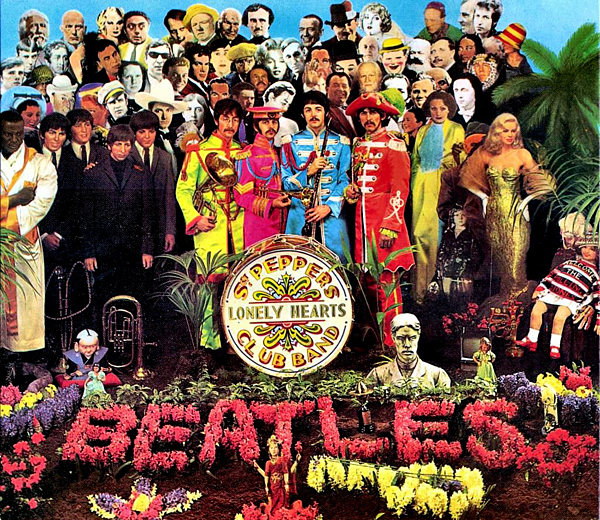
The Beatles: Sgt. Pepper's Lonely Hearts Club Band: Anniversary Edition
Parlophone/EMI PCS 7027 0602557455328 (4 CDs, 1 BD, 1 DVD). 1967/1987/2009/2017. Giles Martin, prod.; Sam Okell, mix; Jeff Jones, exec. prod.; Jonathan Clyde, Guy Hayden, project prods.; Matt Mysko, Greg McAllister, mix assts.; Miles Showell, Sean Magee, mastering; Matthew Cocker, transfer eng.; James Clarke, audio restoration. ADD? TT: 3:23:11 (CDs only)
Performance *****
Sonics ***** Even VIP visitors to Abbey Road studios are allowed to only peer down a dimly lit hallway to the vault where the Beatles tapes, arguably the UK's most valuable crown jewels, are meticulously stored. Given the value of the band's recorded legacy, it was only a matter of time before even Macca, who over the years has made cryptic and patently false statements about scraping the bottom of the barrel, would get behind new stereo mixes and the long-awaited official release of alternates and outtakes. While the three double-CD volumes of Anthology contained some of this material—and bootlegs had the rest—the release of Sgt. Pepper's Lonely Hearts Club Band: Anniversary Edition is a welcome and wonderful conglomeration of music and information, old and new, about this landmark recording. In describing the Beatles' music, magic is never too hyperbolic a word. And despite troubled and troubling lyrics in spots, perhaps the most magical Beatles record of all will always be Sgt. Pepper's Lonely Hearts Club Band. Released in 1967, the band's eighth album and the first produced by the group after their retirement from live performances, unleashed the band's creative impulses because it's assumed, somewhere, subconsciously at least, the band knew they would never have to play any of it live. Along with a certain background tension that can be felt in lines like "Getting better all time the time / It can't get no worse," the group's penchant for experimentalism ran wild, creating in its wake an eternally fresh-sounding masterpiece of poppy, psychedelic art-rock music that owed much to the English dance-hall and vaudeville traditions. Although Ringo Starr has said that everyone called it a "concept album" only because it had the same song at the beginning and at the end, Sgt. Pepper's is an embryonic example of an album whose songs do seem deliberately sequenced to tell a story.
As for these much-ballyhooed Anniversary Editions, it's important to keep in mind that this is a remix, not a remastering. The remastering phenomenon, which crested in 2009 with the much-praised remastering of the Beatles' entire catalog, has grown predictable. Remasterings of so-called heritage rock, never released at bargain prices, have sound that is inevitably described as being a bit brighter and slightly more three-dimensional than the originals. But no one had the guts or the permission to tamper too much with the success of a record like Sgt. Pepper's. The remastering mission was just to smarten it up a bit. These remixes are very different indeed and may represent a new frontier in reissues. Given the success of the waves of remastered reissues of heritage rock—once a fresh angle on how record labels can once again exploit their rich catalogs—remixing rather than remastering may now be a trend that is only just getting started.
This new stereo mix of Sgt. Pepper's, though guided entirely by the mono mix that all of the Beatles worked on with producer George Martin, is a very obvious improvement over the original stereo mix. Paul McCartney was recently quoted in Mojo as agreeing that the sound of the new stereo mix is much more "3D mono." Taken from the four-track session masters, the new mix is easily differentiated from the original stereo mix by a louder, more present and full-blooded overall sound in which Ringo's drums are centered in the mix. McCartney's bass has never sounded better. And the sound of the voices is expansive, ringing with fresh energy. There are also smaller tweaks worth noting, such as a faster, higher-pitched version of "She's Leaving Home" that matches what was present on the original mono mix. The simple answer to the looming question is: Yes, there is a large audible difference between the original and new stereo mixes that makes any of these new Anniversary Editions well worth the money.
Anthology 1–3, released in 1995–96, included some of the extra material included here, but much of it appeared in the form of new "composite mixes" that, as stated in the liner note for "A Day in the Life" on Anthology 2, were "Assembled expressly for the Anthology." In the Anniversary Edition, the extra takes are thankfully presented whole, unmixed with other takes. It's terrific to listen to the Beatles as they listen to the playback of "Penny Lane," adding overdubs and claps, and chatting about what else could be done. At last, we hear the genius as it unfolds. For being "inside" an album, this is fantastic stuff. Hilarious experiments in humming the last chord of "A Day in the Life" are followed by a number of takes of Mal Evans hitting the chord on piano, most with McCartney giving instructions. The two-and-a-half discs of extra material and all the studio patter are what Beatles collectors, or anyone who's heard the original album innumerable times, will find most essential in this set. It's unfailingly fascinating. In Mojo, even McCartney admitted that this mass of outtakes "humanizes" the album.
As is common with Apple productions, which are unfailingly classy and well done, several different versions of the Anniversary Edition are available: a single CD containing only the new stereo mix ($13.99); Deluxe two-CD and two-LP sets ($37.04), both of which contain the new stereo mix and the same roster of outtakes, as well as takes of "Penny Lane" and "Strawberry Fields Forever." The Super Deluxe edition of four CDs, one BD, and one DVD, includes a 5.1-channel surround mix (I didn't listen to it), and 24/96 high-resolution versions of the new stereo mix (both sonically impressive), as well as posters and reproductions of period adverts—but no vinyl ($149.98). The Super Deluxe also includes the original mono mix (CD 3), and a gorgeous, 180-page book of never-before-seen images and immensely detailed recording information for each of the original album's 13 tracks. The BD and DVD have the same program of the new stereo mix, the "Penny Lane"/"Strawberry Fields Forever" single, three 1967 promotional films (for "A Day in the Life," "Strawberry Fields," and "Penny Lane"), and a documentary, The Making of Sgt. Pepper, broadcast in 1992 but unavailable since then. The Super Deluxe is packaged in a facsimile of a 2" tape box with a lenticular panel pasted on its sleeve, which is ironic, given that the Rolling Stones used such a panel on the first pressings of Their Satanic Majesties Request, their less-than-compelling response to Sgt. Pepper's. MP3 downloads are available, but hi-rez downloads of any of this are still TBA.
All of which leads to the central questions: Why a new mix, and why now? While this new mix makes it clear that the old stereo mix was not fully realized and dynamically limited, the original stereo mix was not a complete disaster. But because the master and session tapes were all in pristine condition, it was always a given that EMI (now Universal Music) and the Beatles or their stakeholders would finally begin to play their ace cards. The possibility of new stereo mixes of Revolver, Rubber Soul, The Beatles, and Abbey Road, not to mention gobs of extra material, is a very tantalizing prospect.—Robert Baird
Parlophone/EMI PCS 7027 0602557455328 (4 CDs, 1 BD, 1 DVD). 1967/1987/2009/2017. Giles Martin, prod.; Sam Okell, mix; Jeff Jones, exec. prod.; Jonathan Clyde, Guy Hayden, project prods.; Matt Mysko, Greg McAllister, mix assts.; Miles Showell, Sean Magee, mastering; Matthew Cocker, transfer eng.; James Clarke, audio restoration. ADD? TT: 3:23:11 (CDs only)
Performance *****
Sonics ***** Even VIP visitors to Abbey Road studios are allowed to only peer down a dimly lit hallway to the vault where the Beatles tapes, arguably the UK's most valuable crown jewels, are meticulously stored. Given the value of the band's recorded legacy, it was only a matter of time before even Macca, who over the years has made cryptic and patently false statements about scraping the bottom of the barrel, would get behind new stereo mixes and the long-awaited official release of alternates and outtakes. While the three double-CD volumes of Anthology contained some of this material—and bootlegs had the rest—the release of Sgt. Pepper's Lonely Hearts Club Band: Anniversary Edition is a welcome and wonderful conglomeration of music and information, old and new, about this landmark recording. In describing the Beatles' music, magic is never too hyperbolic a word. And despite troubled and troubling lyrics in spots, perhaps the most magical Beatles record of all will always be Sgt. Pepper's Lonely Hearts Club Band. Released in 1967, the band's eighth album and the first produced by the group after their retirement from live performances, unleashed the band's creative impulses because it's assumed, somewhere, subconsciously at least, the band knew they would never have to play any of it live. Along with a certain background tension that can be felt in lines like "Getting better all time the time / It can't get no worse," the group's penchant for experimentalism ran wild, creating in its wake an eternally fresh-sounding masterpiece of poppy, psychedelic art-rock music that owed much to the English dance-hall and vaudeville traditions. Although Ringo Starr has said that everyone called it a "concept album" only because it had the same song at the beginning and at the end, Sgt. Pepper's is an embryonic example of an album whose songs do seem deliberately sequenced to tell a story.