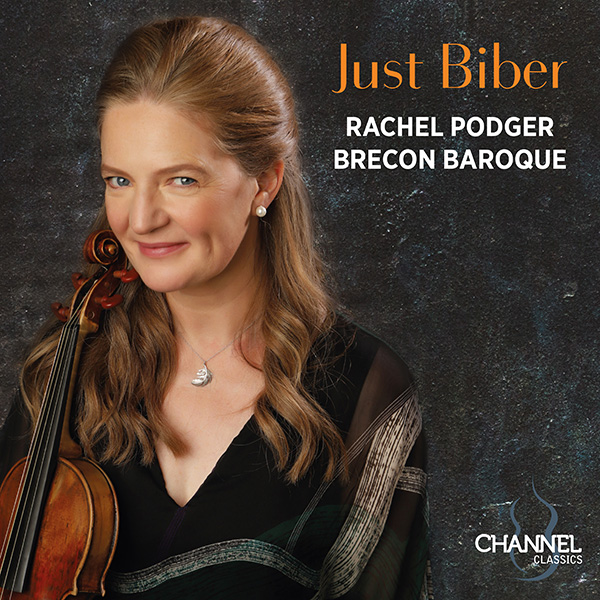
Just Biber
Rachel Podger, baroque violin; Brecon Baroque
Channel Classics CCS48525 (Reviewed in DSD128 and 24/96 PCM). 2025. Jonathan Freeman-Attwood, Prod.; Jared Sacks, Eng./Edit/Master
Performance *****
Sonics ***** Each time I approach a new recording, the music always comes first. In that spirit, with thoughts of savoring the abundant beauties in six of the eight Sonatas for Violin Solo that Heinrich Ignaz Franz von Biber dedicated to Maximilian Gandolf Graf von Kuenburg, the Archbishop of Salzburg, in 1681, I cued up Channel Classics' latest offering, Just Biber. But once I heard the first 10 seconds of the 70-minute recording, the union of its extraordinarily silent background with its abundance of color and clarity, captured to perfection by engineer Jared Sacks, left me in awe. Given that Sacks records in DSD256 with excellent equipment—he uses a Merging Technologies Horus A/D converter, Brüel & Kjaer 4006 and Schoeps microphones, a Pyramix workstation (also from Merging Technologies), van den Hul 3T Carbon cabling, custom Rens Heijnis microphone preamplifiers, and Grimm LS1 mastering speakers—I expected top-notch sound. But none of that could account for the venue's pristine silence.
I asked Sacks himself to account for the uncanny sonics. As if reflecting my own values, he began with musical commentary. "What is special about this recording is the use of two gambas," he wrote. "The sounds from these beautifully played instruments added extra character to the music."
Then he addressed the venue. "I recorded Rachel Podger and her ensemble, Brecon Baroque, during a very cold December in an English church in a little village near Oxford. Maybe 20 houses at the most. No traffic or airplanes to disrupt us—just the extreme cold! We only had infrared heaters churning out a bit of warmth. I sat in a back room open to the church with its own heater. But maybe that is what makes it sound more silent."
Sacks's challenge was to create a soundstage that would sound natural, yet very intimate to the listener. He turned to his usual setup: B&K4006 and an MS (mono/stereo microphone) between the gambas, with Podger under the main pair and a couple of Rens Heijnis MPM-91s supporting her. All microphones were modified to 4-pin XLR.
"The microphone setup is similar to the Decca tree with a stereo pair, except I always put a mono/stereo microphone in the middle—sometimes in front of the tree, sometimes in back. I add this signal to the stereo pair to adjust the stereo imagery and depth. It adds exceptional depth and clarity to the overall sound."
Sacks also gave credit to Heijnis's battery-powered unit, which supplies power to the microphones and their preamplifiers. "When working in difficult situations (like churches in England) where the current is not always stable, this power unit is fantastic for keeping recording quality at its highest level," he wrote.
The pristine silence and superb engineering enable us to fully savor the unique timbres of Podger's gut-stringed Pesarinius violin from 1739, Walter Chinaglia's authentic wood organ, and modern copies of Italian theorbo, Venetian baroque guitar, archlute, and viola da gamba.
Podger's technique is faultless. As virtuosic as the music may be—the rapid passagework is made even more riveting by a dedication that consistently values musicality over showmanship for showmanship's sake—nothing Podger plays is improvised: Biber knew what he wanted from his soloist and wrote out every note the violin plays. Not so the continuo (aka accompaniment), which in true baroque fashion consisted of a single bass line. Here, Brecon Baroque performs wonders. Wait until you hear the organ sounding for all the world like a drone as its timbres and textures contrast beautifully with violin.
Parts of these sonatas overflow with pastoral grace, other parts with joy, yet others with sobriety. I love how easily Biber can shift from bold and vigorous passages to stately courtly dances (including gavotte and allemande). Shifts are frequent and often unexpected. Savor, for example, the contrast between the First Sonata's Adagio and its Variations. The First's finale is so transcendent that you may bliss out while listening.
For all his presumed holiness, Archbishop Gandolf clearly had a sense of humor. The nine-movement Sonata Violino Solo Representativa in A Major, C.146, which may have been copied from Schmelzer, includes imitations of nightingale, cuckoo, hen, frog, and cat. The violin's clucking is delectable.
By email, Podger shared a few thoughts on Biber's music. "Biber's Mystery Sonatas are mind-blowingly beautiful pieces," she wrote. "Since they follow the Biblical stories of Christ and Mary, they have strong spiritual meaning.
"In contrast, the sonatas of 1681 have a more secular feel. Although there are lots of devout moments, of repose and contemplation, such moments are brief. The flamboyance of the written-out improvisations and flights of fancy is on a different level. There's so much jubilance in the virtuosity in these pieces—not just in the rapid scale figurations but also in the many rhythmically dotted chordal sections. And then there are the gorgeous 'Arias' with those stunning, written-out improvisations—so touching and inventive."
I hope you can find the time to savor these sonatas and Podger's accomplishments, not just as background music but fully immersed in the glories of this music as recorded and presented in high-resolution two-channel or surround.
Masterfully captured in a special venue, these sonatas are truly a treat.—Jason Victor Serinus
Rachel Podger, baroque violin; Brecon Baroque
Channel Classics CCS48525 (Reviewed in DSD128 and 24/96 PCM). 2025. Jonathan Freeman-Attwood, Prod.; Jared Sacks, Eng./Edit/Master
Performance *****
Sonics ***** Each time I approach a new recording, the music always comes first. In that spirit, with thoughts of savoring the abundant beauties in six of the eight Sonatas for Violin Solo that Heinrich Ignaz Franz von Biber dedicated to Maximilian Gandolf Graf von Kuenburg, the Archbishop of Salzburg, in 1681, I cued up Channel Classics' latest offering, Just Biber. But once I heard the first 10 seconds of the 70-minute recording, the union of its extraordinarily silent background with its abundance of color and clarity, captured to perfection by engineer Jared Sacks, left me in awe. Given that Sacks records in DSD256 with excellent equipment—he uses a Merging Technologies Horus A/D converter, Brüel & Kjaer 4006 and Schoeps microphones, a Pyramix workstation (also from Merging Technologies), van den Hul 3T Carbon cabling, custom Rens Heijnis microphone preamplifiers, and Grimm LS1 mastering speakers—I expected top-notch sound. But none of that could account for the venue's pristine silence.