Of the hundreds of product reviews I have written over the years, it is perhaps those of power amplifiers that present the hardest task in defining their worth. This is not because power amps are unimportant. As I wrote in my review of the MBL Corona C15 monoblock, in June 2014, "it is the power amplifier that is responsible for determining the character of the system's sound, because it is the amplifier that must directly interface with the loudspeakers. The relationship between amplifier and loudspeaker is complex, and the nature of that relationship literally sets the tone of the sound quality." But because the amplifier's role is so fundamental, it can at first be difficult to determine a given amp's balance of virtues and failings. A paradox.
As well as that MBL, in recent years I have reviewed the Pass Labs XA60.5, in January 2014; the Lamm M1.2 Reference, in April 2012; and the Classé CT-M600, in March 2011. All four amplifiers are relatively expensive monoblocks, though the Pass ($11,000/pair) and the Classé ($13,000/pair) cost much less than the MBL ($25,000/pair) and the Lamm ($27,190/pair). (All prices current as of February 2015.) But one monoblock I wish I had reviewed was the Ayre Acoustics MX-R, which, at the time of Wes Phillips's review, in April 2007, cost $16,500/pair. Wes had described the MX-R as being "in many ways—size, energy efficiency, stability—one of the most remarkable performers at any price."
In the brief time I had the MX-Rs in my system, to perform the measurements that accompanied Wes's report, the amplifiers hinted at brilliance. But as they had to be returned almost immediately, I never got their full measure. Then, at the October 2014 Rocky Mountain Audio Fest, Ayre Acoustics premiered an updated version of the MX-R, the MX-R Twenty, to join the KX-R Twenty preamplifier (which I reviewed in December 2014) and the AX-5 Twenty integrated amplifier (reviewed elsewhere in this issue by Art Dudley). All three models celebrate the Colorado company's 20th anniversary, and each features a reworking of the half-century-old "diamond" circuit topology. And, like the AX-5 Twenty, the new version of the MX-R is considerably more expensive than its predecessor: $29,500/pair. I had no choice—I had to ask for review samples.
The Twenty
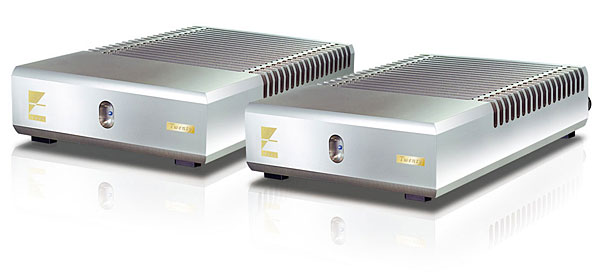
Like all Ayre amplifiers, the MX-R Twenty is an elegant-looking, zero-loop-feedback, fully balanced design using discrete devices. Its rated power output is 300W into 8 ohms or 600W into 4 ohms, and it has a single balanced input jack (XLR). Other than a discreet "Twenty" badge, the MX-R Twenty is functionally and aesthetically identical to the MX-R; for a full description, I refer you to Wes Phillips's 2007 review. Double Diamonds
The diamond buffer circuit was first described by an MIT professor, Richard Baker, in 1964. In its simplest form, two pairs of complementary bipolar transistors are arranged as emitter-followers in crosswise symmetry, which, with just four resistors, gives a reliable, wide-bandwidth circuit element with very high current gain, very low distortion, high power-supply rejection ratio, and low output impedance. The downsides are that it uses more devices than other circuits and, as the input is the paralleled bases of a pair of complementary transistors (NPN and PNP), is more difficult to drive.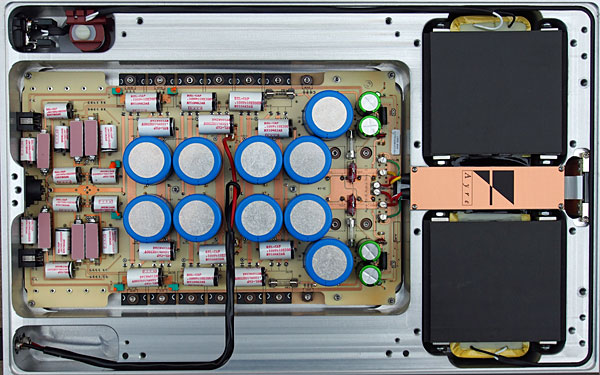 Art Dudley described this circuit in his review of the original AX-5. Ayre's Charles Hansen discussed it in a posting to the Audio Asylum Web forum in May 2013, in which he admitted that while he didn't know why the diamond circuit sounded better than conventional push-pull topologies, he conjectured that it is the only one in which the two half-signals are joined at a single point in the circuit, with no intervening circuitry. Thus, the diamond circuit creates an output that is more faithful to the shape of the input.
When used as a power amplifier's output stage, the diamond circuit runs very hot. So for the MX-R Twenty and AX-5 Twenty, Ayre designed what they call the Double Diamond output stage, to reduce the operating temperature so it could be used in the existing MX-R chassis.
Other features include Ayre's AyreLock voltage regulator in the power supply, which has a second active device that draws additional current to ground when the audio circuit draws less current. "This 'locks' the output voltage of the regulator, regardless of any fluctuations in the load," says Hansen. Like every Ayre design since the original MX-R, the Twenty also uses Ayre's EquiLock circuitry, which is intended to compensate for changes in the operating conditions of the voltage-gain transistors when the current they pass also changes. In the Twenty, however, the transistor load in the EquiLock circuit, which is a current mirror, has been further optimized.
Other improvements over the original MX-R include custom audio-grade resistors, while keeping the proprietary polystyrene capacitors and the Cardas Audio binding posts, in which both spade lugs of a speaker cable can be simultaneously tightened with a single hand.
Transformation
Art Dudley described this circuit in his review of the original AX-5. Ayre's Charles Hansen discussed it in a posting to the Audio Asylum Web forum in May 2013, in which he admitted that while he didn't know why the diamond circuit sounded better than conventional push-pull topologies, he conjectured that it is the only one in which the two half-signals are joined at a single point in the circuit, with no intervening circuitry. Thus, the diamond circuit creates an output that is more faithful to the shape of the input.
When used as a power amplifier's output stage, the diamond circuit runs very hot. So for the MX-R Twenty and AX-5 Twenty, Ayre designed what they call the Double Diamond output stage, to reduce the operating temperature so it could be used in the existing MX-R chassis.
Other features include Ayre's AyreLock voltage regulator in the power supply, which has a second active device that draws additional current to ground when the audio circuit draws less current. "This 'locks' the output voltage of the regulator, regardless of any fluctuations in the load," says Hansen. Like every Ayre design since the original MX-R, the Twenty also uses Ayre's EquiLock circuitry, which is intended to compensate for changes in the operating conditions of the voltage-gain transistors when the current they pass also changes. In the Twenty, however, the transistor load in the EquiLock circuit, which is a current mirror, has been further optimized.
Other improvements over the original MX-R include custom audio-grade resistors, while keeping the proprietary polystyrene capacitors and the Cardas Audio binding posts, in which both spade lugs of a speaker cable can be simultaneously tightened with a single hand.
Transformation
Owners of original MX-Rs can have them upgraded to Twenty status by returning them to the Ayre factory or to an authorized Ayre distributor. The chassis, transformers, and binding posts of the MX-R are kept; everything else is changed. In North America, Ayre says, MX-Rs purchased from an authorized dealer will receive a new five-year warranty on transformation to MX-R Twentys. Music
I used the MX-R Twenty with all of the speakers I have reviewed this year (see sidebar, "Associated Equipment"); my auditioning comments and my comparisons with other amplifiers are an amalgam of my experience with all of them and, in light of the thought expressed in the introduction to this review, were compiled over a period of several months. Looking at my notes, it appears that I played a lot of piano recordings in those months. Many amplifiers have problems with piano. They can correctly reproduce the weight and extension of the left-hand register while rendering the right-hand register too shrilly. Or they emphasize the middle of the keyboard, with too much clangor to the sound. The MX-R Twentys, however, offered a clean tonal window into every recording, no matter how different.
Whether it was Keith Jarrett's extraordinary new album Creation (CD, ECM 2450), which was recorded in five different halls in Paris, Rome, Tokyo, and Toronto and has an ultravivid, ultraclose piano image throughout; the concert-hall perspective of Peter McGrath's more lifelike recording of Ivan Davis performing Schumann and Liszt on our "Recording of the Month" for September 1982 (CD, Audiofon 72004); or Philip Martin's very distant, "clattery"-sounding ostinato piano in Percy Grainger's Handel in the Strand, with Kenneth Montgomery leading the Bournemouth Sinfonietta (CD, Chandos CHAN8377), the Ayre amplifiers maximized the difference of the sound of each piano from the others. They simply stepped out of the way of the music, letting it flow unimpeded. The MX-R Twenty thus proved the perfect tool for reviewing loudspeakers, each model sounding more like itself and more different from others.
Like all Ayre amplifiers, the MX-R Twenty is an elegant-looking, zero-loop-feedback, fully balanced design using discrete devices. Its rated power output is 300W into 8 ohms or 600W into 4 ohms, and it has a single balanced input jack (XLR). Other than a discreet "Twenty" badge, the MX-R Twenty is functionally and aesthetically identical to the MX-R; for a full description, I refer you to Wes Phillips's 2007 review. Double Diamonds
The diamond buffer circuit was first described by an MIT professor, Richard Baker, in 1964. In its simplest form, two pairs of complementary bipolar transistors are arranged as emitter-followers in crosswise symmetry, which, with just four resistors, gives a reliable, wide-bandwidth circuit element with very high current gain, very low distortion, high power-supply rejection ratio, and low output impedance. The downsides are that it uses more devices than other circuits and, as the input is the paralleled bases of a pair of complementary transistors (NPN and PNP), is more difficult to drive.
Art Dudley described this circuit in his review of the original AX-5. Ayre's Charles Hansen discussed it in a posting to the Audio Asylum Web forum in May 2013, in which he admitted that while he didn't know why the diamond circuit sounded better than conventional push-pull topologies, he conjectured that it is the only one in which the two half-signals are joined at a single point in the circuit, with no intervening circuitry. Thus, the diamond circuit creates an output that is more faithful to the shape of the input.
Owners of original MX-Rs can have them upgraded to Twenty status by returning them to the Ayre factory or to an authorized Ayre distributor. The chassis, transformers, and binding posts of the MX-R are kept; everything else is changed. In North America, Ayre says, MX-Rs purchased from an authorized dealer will receive a new five-year warranty on transformation to MX-R Twentys. Music
I used the MX-R Twenty with all of the speakers I have reviewed this year (see sidebar, "Associated Equipment"); my auditioning comments and my comparisons with other amplifiers are an amalgam of my experience with all of them and, in light of the thought expressed in the introduction to this review, were compiled over a period of several months. Looking at my notes, it appears that I played a lot of piano recordings in those months. Many amplifiers have problems with piano. They can correctly reproduce the weight and extension of the left-hand register while rendering the right-hand register too shrilly. Or they emphasize the middle of the keyboard, with too much clangor to the sound. The MX-R Twentys, however, offered a clean tonal window into every recording, no matter how different.