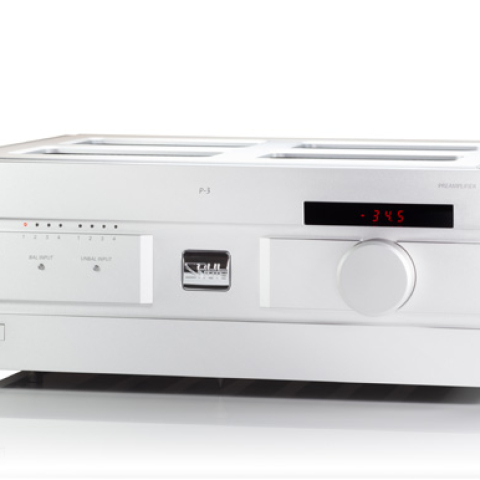
John Atkinson wrote about the Audio Research Reference 6SE in August 2021 (Vol.44 No.8):
Jason Victor Serinus's first impressions of this $17,000 tubed preamplifier (footnote 1) in Stereophile's November 2020 issue were very positive: "Am I really getting paid to do this?," he wrote, calling it "some of the most polished, transparent, and arresting sound I'd heard from my system." But as his auditioning resumed after a break of a few days, he discovered that the REF 6SE sounded very different than it had a few days earlier. "Much of the tonal beauty that had momentarily caused me to hold my breath remained," he wrote, "but the shiny polish and transparency that had knocked me over was gone."
After some investigation, JVS found that the REF 6SE was very sensitive to system tuning. "The essential building blocks—the components—remain unchanged, but the context in which they are presented brings out their magic," he wrote, adding "What was formerly 'really good hi-fi' blossoms into an audiophile bouquet." Once his system had been optimized, JVS was able to conclude that the Audio Research REF 6SE "is a bouquet with a fragrance all its own, one that you may well find irresistibly seductive. If you want to hear all it has to offer, pay particular attention to context, and give it all the attention it deserves."
Given the unevenness of Jason's reviewing experience, Editor Jim Austin felt that a second opinion was called for. Accordingly, Audio Research shipped the review sample, serial number 52307, back to Stereophile so I could take a listen.
Other than my Roon Nucleus+ server, with its HDPlex 200W linear power supply, and an AudioQuest Niagara 5000, with which I condition the AC for the power amplifiers, the system I used to audition the REF 6SE had nothing in common with Jason's. Digital bits were converted to analog with a network-connected MBL N31 processor, which was connected to the Audio Research with 2m lengths of AudioQuest Wild Blue balanced cable. The preamplifier's balanced output was connected to the two Parasound Halo JC 1+ monoblock amplifiers with 3m lengths of Wild Blue interconnect. Loudspeakers were either my long-term reference KEF LS50s or new samples of the GoldenEar BRX I reviewed in September 2020, both pairs sitting on 29" Sanus stands.
The REF 6SE's balanced output impedance was 669 ohms at 1kHz and 20kHz, rising to 1394 ohms at 20Hz. There were thus no compatibility issues with the Parasound amplifiers, which have a balanced input impedance of 92k ohms at low and middle frequencies, and 89k ohms at the top of the audioband.
Speaker cables were AudioQuest K2—while I am by no means a tweak fanatic, these cables were raised above the carpet with AudioQuest Fog Lifters, and both the MBL and the Audio Research components were supported on Ayre Myrtle Blocks. The server's power supply, the DAC, and the preamplifier were plugged into an AudioQuest Niagara 1000 conditioner. Although the preamplifier's display indicated that its tubes had been used for 372 hours, I waited for another 36 hours with the REF 6SE being powered up before starting my critical listening.
Before I installed the Audio Research preamplifier in my system, I had been using the MBL N31 to feed the Halo JC 1+ monoblocks directly, using its volume control in Roon set to a maximum of –17dB for most recordings. The MBL's volume control was set to the maximum for use with the REF 6SE. With its volume control set to the maximum, "103" on the display, the REF 6SE's voltage gain from its balanced inputs to balanced output is 12dB. The control steps are around 0.3dB, meaning that the unity-gain setting is "62." However, the system had too much gain, so I set the Parasounds to Low gain, equivalent to 23dB. I listened with the Audio Research's control mainly set to "31," ie, attenuating the MBL's analog output by close to 10dB.
The reason I have examined my system's gain architecture in detail is that the measurements that accompanied Jason's review indicated that at this volume setting, the REF 6SE offers vanishingly low levels of noise and distortion. The latter is predominantly second harmonic, which is subjectively innocuous even at a level 100× greater than that in the REF 6SE's output.
It might reasonably be expected, therefore, that the Audio Research preamplifier will be transparent to the source.
In this respect, the REF 6SE ($17,000) was no different from the last three high-performance preamplifiers that had passed through my system: the MBL N11 ($14,600), the Pass Labs XP-32 ($17,500), and the Benchmark LA4 ($2599). The measured performance of all four preamplifiers implies that audible defects are unlikely. Yet the three other preamps did sound different from one another, something that continues to disturb this measurer's sleep. The MBL N11's tonal balance was slightly warmer than that of the Pass Labs XP-32, the Benchmark LA4's presentation a little more forward. All three were champs at retrieving recorded detail, though the soundstage reproduced by the LA4 had a little less depth than with the other two. And the aspect that most puzzled me was that the MBL's presentation of acoustic objects within the soundstage was a little more palpable than that of the Pass Labs and Benchmark.
So how did the Audio Research REF 6SE sound? As Jason described in his review, its presentation of recorded detail was superb. I hadn't played Kavi Alexander's recording of Gary Woodward performing Prokofiev's Flute Sonata (16/44.1 ALAC file from Poem, Stereophile STPH001-2) for too long a time. However, triggered by writing As We See It for this, the magazine's 500th issue, I cued up this first recording on the Stereophile label in Roon. Speakers were the KEF LS50s.
Thanks to the accurate amplitude-stereo imaging captured by Alexander's Blumlein miking, I was transported back 32 years to USC's Allan Hancock Foundation Auditorium. The heroic arpeggios on the centrally placed flute in the final movement could be heard lighting up the hall's acoustic, and the realistically sized, harmonically rich New York Steinway piano, with Brooks Smith's empathetic accompaniment, was set halfway across the stage behind the flute, this clearly revealed by the Audio Research's transparency.
Turning to a classic recording, "Three to Get Ready" from Time Out (DSD64 file, Columbia/Analogue Productions), Dave Brubeck's piano is panned hard left and Joe Morello's drums hard right. But with the Audio Research preamp in the system, I could unambiguously perceive the reverb excited by both instruments and placed in the center of the soundstage. I had intended to listen to just this track from Time Out but ended up playing the album all the way through, always a sign that something good was happening.
Changing from the KEF speakers to the GoldenEars, I followed the Brubeck album with another modern jazz favorite, Charlie Haden and Jim Hall from Live from Montreal International Jazz Festival (24/48k MQA FLAC, unfolded to 24/96k Impulse/Tidal). Thelonious Monk's "Bemsha Swing" opens with Haden soloing. His double bass hung in space between the speakers, its sound superbly well-resolved, with excellent pace. (Haden always had a great sense of time.) Curious about the effect of the MQA encoding, I switched to the 16/44.1 version in my Roon library: Ah, not the same mix. The double bass was louder and richer but with less of a sense of flow. The REF 6SE was clearly stepping out of the way of the differences in recordings, and it preferred the lighter tone of the MQA file.
The MBL and Benchmark preamplifiers have long since been returned, but I still had the Pass Labs XP-32 on hand. With levels matched to within 0.1dB using the 1kHz, –20dBFS warble tone on my Editor's Choice CD (Stereophile STPH016-2), the Audio Research's presentation was more upfront than that of the Pass Labs. A favorite Bruce Hornsby live album, Noisemakers Summer 2007, was only available as a 256kbps MP3 download, but even with the lossy compression, the band rocks the music mightily, especially the medley of "Fortunate Son" and "Comfortably Numb." Even though it was actually 0.07dB louder at 1kHz, the XP-32 sounded a little quieter than the REF 6SE on this track. Repeated listening indicated that the Pass Labs preamplifier wasn't actually quieter but that everything was laid a little farther back in the soundstage. Paradoxically, the rear of that soundstage—the occasional audience noise—wasn't as distant as it had been with the REF 6SE.
The Audio Research preamplifier's presentation was more robust-sounding, especially in the midrange. With the REF 6SE, Paul Desmond's alto saxophone on "Take Five" from Time Out and Arturo Delmoni's violin on his lyrical if leisurely performance of Brahms's Violin Sonata No.1 (16/44.1 ALAC file, ripped from John Marks Records JMR2) were both pushed a little forward in the soundstage compared with the XP-32.
And while the Pass Labs' lows were better defined—the kickdrum on the Brubeck and Hornsby tracks had more attack—Charlie Haden's double bass had less body than it had with the Audio Research, this evident with both the MQA and the plain 16/44.1 playback.
Which preamplifier I preferred depended on the loudspeakers I used. The lighter-balanced treble of the Pass Labs worked well with the KEFs, which tend to be a touch mellow-sounding. By contrast, the Audio Research's somewhat softened highs—Michael Fremer had written about the original REF 6 that "shimmering cymbals sounded somewhat muted"—proved to be a better match with the GoldenEars.
So, did the Audio Research Reference 6SE's sound change during the five days I had it in my system, as it had chez Jason? No. Its presentation was consistent from the beginning of Day One to the end of Day Five. However, I believe its sonic signature will work best with systems that are a little laid-back in the upper midrange and that don't have underdamped or poorly defined low frequencies.
But, as to why the REF 6SE sounded the way it did in Jason's system, I don't have a measured clue.—John Atkinson
Footnote 1: Audio Research Corp., 6655 Wedgwood Rd. N, Suite 115, Maple Grove, MN 55311. Tel: (763) 577-9700. Web: audioresearch.com.
Footnote 1: Audio Research Corp., 6655 Wedgwood Rd. N, Suite 115, Maple Grove, MN 55311. Tel: (763) 577-9700. Web: audioresearch.com.