Way back in the age when Stereophile's print magazine was the size of a theater playbill, common wisdom declared that the tube preamp was the ideal complement to solid state amplification. That axiom was rooted in two assumptions: (1) Tube equipment produces softer, warmer, more flowing and pleasing sound than solid state, and (2) transistor-based devices need some softening because their sound is often hard, brittle, and mechanical. The trope was the high-end audio equivalent of the yin/yang stereotype that depicts women as soft, gentle, pliable, and flowing and men hard, harsh, and unyielding. Godzilla the Hun weds the Celestial Mermaid.
Over the past few decades, advances facilitated by research, computer modeling, and higher-quality parts have helped transcend the tube-vs–solid state dichotomy. Most of the solid state amps that I've reviewed in the past decade have delivered sound I consider organic and musical (footnote 1). While each had its strengths and shortcomings, the majority sang in a unique voice and achieved brute force and delicacy with equal aplomb. While my opportunities to review tube amps and preamps have been fewer, almost all the differently voiced tube components I've reviewed have also produced organic, full-range sound distinguished by dynamic attacks and delicate details.
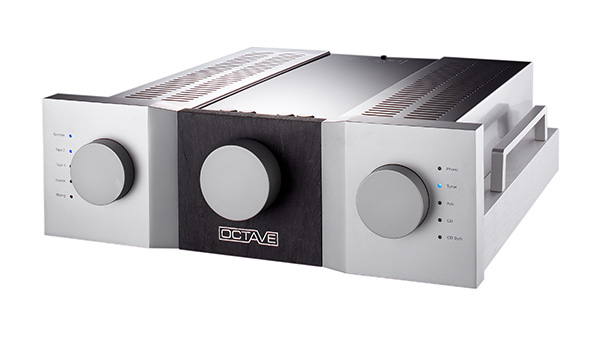
Apparently not everyone has shared my experience. Take, for example, Andreas Hofmann, the owner and chief engineer of Octave Audio of Germany. When I Zoomed with Hofmann and John Quick, VP of sales and marketing at Dynaudio USA, Octave's US distributor, to discuss the Jubilee Hybrid, Octave's flagship linestage preamplifier ($42,000; $45,500 with optional stepped attenuator), Hofmann asserted his belief that tubes deliver superior sound.
"You can design the same hybrid circuit [that's in the Jubilee preamplifier] without tubes, using only solid state transistors or even op-amps," he said. "But for me, even though I cannot say why a tube sounds better and more musical than solid state, tubes have a more human touch."
Which leaves the ball, as it were, in my court. How does music reproduced through the Jubilee preamp sound, and how does it make me feel?
 Exploring the Jubilee
The latest iteration of the Jubilee preamp, which was introduced in 1998, remains a zero-feedback, two-stage hybrid design with a tube-based "precision balancing stage" with four ECC82 tubes and a semiconductor-based, discrete output stage. The tubes, which are sourced from either JJ in the Slovak Republic or Russian companies, are carefully matched to ensure optimal sound.
Octave's website (footnote 2) and manual (footnote 3) offer a lot of insight into the technology behind the sound. The company says that the Jubilee preamp's tubed precision balancing stage generates signals that are "absolutely constant phase and amplitude symmetrical"; this ensures that "no phase or time error will occur between phase and antiphase of the balanced output signal." The preamp's feedback-free output stage employs semiconductors as the basis of a "unity gain power buffer" that's responsible for the preamp's "extremely low-impedance output" and high current delivery. This is another way of saying that the transistors in the Jubilee's output stage do the hard work, leaving its tubes free to generate the preamp's unique sonic signature.
As much as Octave believes that zero feedback delivers optimal sonic purity, its website acknowledges that successfully implementing zero feedback designs is not easy. Success requires "an almost perfect power supply with extreme stability, low noise, and low hum."
The manual elaborates on the challenges posed by zero-feedback designs. "Any amplifier that dispenses with negative feedback also dispenses with the corrective mechanism provided by negative-feedback circuitry. In the Jubilee preamplifier, we solve this problem through the extremely high specification of the output stages and power supply section, creating virtually perfect conditions for achieving perfectly accurate amplification without the need for corrective mechanisms." (footnote 4) After perfecting the Jubilee preamp's design over decades, the company claims that it will now deliver optimal sound quality "with virtually any amplifier."
Hofmann, who began designing components at age 16, discussed this further during our interview. "If you want to design a tube preamplifier with zero feedback, you have to optimize every aspect of the power supply that you need for the tubes: plate voltage, heater voltage, for everything," he said. "If you have feedback, you can use a poor power supply because the amplifier is regulating these factors. If there is zero feedback, the power supply must be better."
Quick offered additional commentary. "Feedback makes amplifiers and preamplifiers more stable, with lower distortion into a much broader range of loads. The Jubilee was the first preamp that Andreas engineered that was a combination of tubes and transistors, used zero feedback, and was bulletproof, stable, and measured well."
 The Jubilee's XLR inputs, which I used exclusively, are equipped with unity-gain isolation transformers. According to Hofmann, these "have no sonic signature of their own. They also function as a ground lift circuit and are particularly helpful for ground problems in complex multi-amp combinations," because hum can happen even in circuits with fully balanced connections.
The preamp's soft-start function, which gently increases heater and supply voltage over a period of four minutes, is a central part of a power management system that's designed to protect the unit and maintain tube life to its theoretical maximum of 10,000 hours. To quote Hofmann, "Without the regulation introduced by feedback, the amplifier takes a longer time to stabilize itself. I don't want to push high currents into the unit to make it turn on faster, because it would be bad for the parts. It makes no sense."
Octave offers a choice of attenuators: the standard one (which I used), which can be adjusted with Octave's extremely simple remote, or for $3500 more, a precision-resistor stepped attenuator with 47 steps; if this option is included, the volume must be adjusted by hand. In an email, Hofmann cited some benefits of the stepped attenuator: "Better channel matching, within 0.1dB, and more microdetails—it sounds banal, but it is true. Finally, a higher differentiation in the mids and highs—especially in depth."
The Jubilee preamp also includes a home-theater bypass and monitor/record output for use with tape recorders.
When asked to describe the sonic differences among Octave's three linestage preamplifiers, Hofmann said, "Refinement. The basic design of the Jubilee is exactly the same as it was 25 years ago, but it is yet more refined. There are internal changes—very fine details, including the quality of the parts and the layout—that you cannot see easily.
"Zero feedback is so extremely sensitive. That's why I now use special resistors and caps that were not available 25 years ago. It took a long time to find perfect resistors that have good sound, good technical specs, and guarantee long-time stability.
"The most important thing for me is that this is a hybrid preamplifier that uses four tubes. For me, it's more or less impossible to make a pure tube preamplifier that has an output stage as strong as the Jubilee's. It's impossible. This design and this sound are only possible in a hybrid design."
The Jubilee's XLR inputs, which I used exclusively, are equipped with unity-gain isolation transformers. According to Hofmann, these "have no sonic signature of their own. They also function as a ground lift circuit and are particularly helpful for ground problems in complex multi-amp combinations," because hum can happen even in circuits with fully balanced connections.
The preamp's soft-start function, which gently increases heater and supply voltage over a period of four minutes, is a central part of a power management system that's designed to protect the unit and maintain tube life to its theoretical maximum of 10,000 hours. To quote Hofmann, "Without the regulation introduced by feedback, the amplifier takes a longer time to stabilize itself. I don't want to push high currents into the unit to make it turn on faster, because it would be bad for the parts. It makes no sense."
Octave offers a choice of attenuators: the standard one (which I used), which can be adjusted with Octave's extremely simple remote, or for $3500 more, a precision-resistor stepped attenuator with 47 steps; if this option is included, the volume must be adjusted by hand. In an email, Hofmann cited some benefits of the stepped attenuator: "Better channel matching, within 0.1dB, and more microdetails—it sounds banal, but it is true. Finally, a higher differentiation in the mids and highs—especially in depth."
The Jubilee preamp also includes a home-theater bypass and monitor/record output for use with tape recorders.
When asked to describe the sonic differences among Octave's three linestage preamplifiers, Hofmann said, "Refinement. The basic design of the Jubilee is exactly the same as it was 25 years ago, but it is yet more refined. There are internal changes—very fine details, including the quality of the parts and the layout—that you cannot see easily.
"Zero feedback is so extremely sensitive. That's why I now use special resistors and caps that were not available 25 years ago. It took a long time to find perfect resistors that have good sound, good technical specs, and guarantee long-time stability.
"The most important thing for me is that this is a hybrid preamplifier that uses four tubes. For me, it's more or less impossible to make a pure tube preamplifier that has an output stage as strong as the Jubilee's. It's impossible. This design and this sound are only possible in a hybrid design."
 Chassis and functions
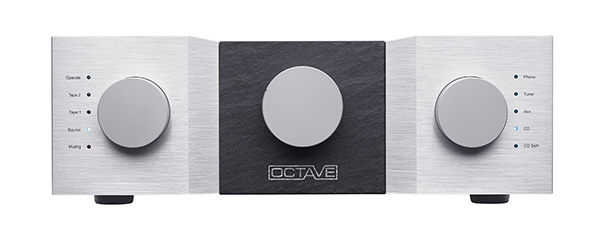
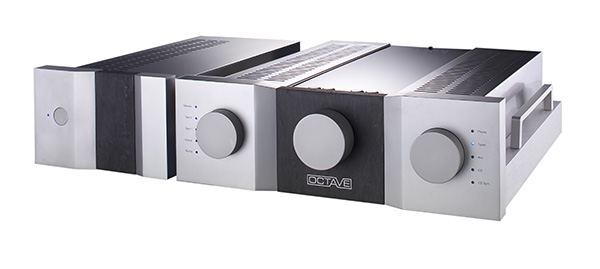
The Jubilee preamp's 38lb solid aluminum body is equipped with handles that make placement a snap. The 25lb outboard power supply has a handle, too, but it doesn't need it as much because it is smaller, lighter, and easy to position. The electronics inside the Jubilee pre have been updated, but its design and layout are decidedly old school. The preamp's front panel features three large knobs. The center knob adjusts volume. With the only volume demarcation line on the knob's side, where it cannot be seen from the listening position, and no volume readout, the only way to match levels for accurate comparisons is by attaching a voltmeter to a speaker's input and playing test tones, such as the 1kHz warble on Stereophile's Editor's Choice CD (footnote 5). (This is the most reliably accurate way to match levels in any system.) Source selection on the Jubilee is unusual. The left knob has four positions: Muting, Source, Tape 1, and Tape 2. Just above these sources is an LED and a label ("Operate") that looks like the labels on this knob but doesn't correspond to a knob setting. When you initiate the soft-start cycle by depressing the power button on the power supply, the LEDs next to Source and Muting are activated, and the sound is muted. Once the soft-start cycle is complete, the preamp automatically unmutes, the Muting LED turns off, and the Source and Operate LEDs light up: the source is selected and it's time to play music.
On this same, leftmost knob, selecting Tape 1 or Tape 2 activates those inputs. When Source is selected, whichever input is chosen on the right-hand knob becomes active. This right-hand knob selects among five inputs: Phono, Tuner, Aux, CD, and CD Sym for balanced (XLR) inputs.
At the center of the top panel of the main preamp chassis are four buttons labeled Gain, Phase, Copy, and, most cryptically, 2-1/1-2. These last two buttons allow you to copy a tape from Tape 1 to Tape 2, or vice versa. When the second-from-right button is set to "off," whichever source is selected with the Source knob is routed to both Tape outputs. Old-school.
I never used the tape functions, but I spent considerable time with Gain and Phase. High Gain, the preferred position for most power amplifiers and loudspeakers, is indicated by a green LED situated behind and to the left of the Gain button. Low Gain is recommended for use with high-sensitivity speakers or very high-gain amplifiers. When Low Gain is chosen, a green LED behind and to the right of the button lights up. I used High Gain throughout the review.
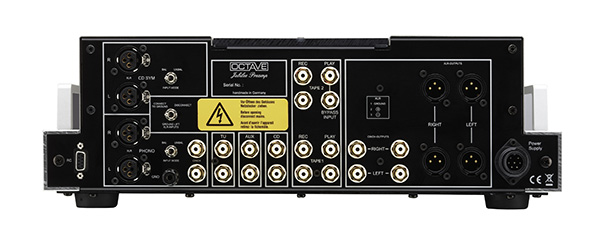
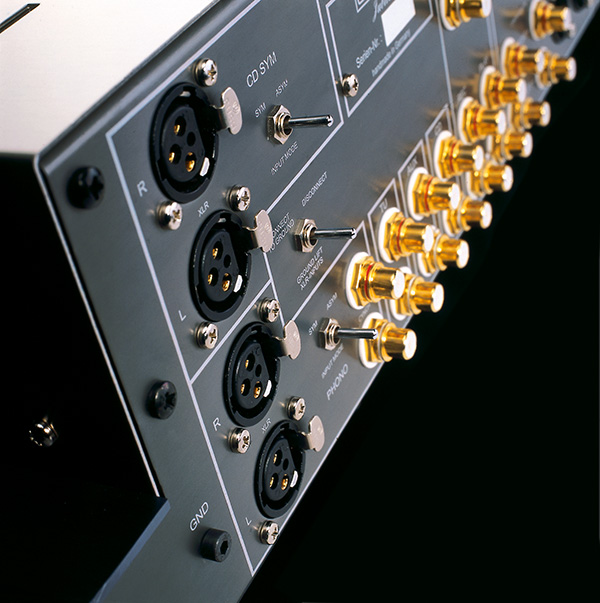
The Phase button, when activated, inverts absolute phase. According to Hofmann, "When inverting phase, there are no additional components (or op amps) at play. The tube amplifier gain stage of the Jubilee pre feeds a solid state output buffer circuit that is connected directly to the XLR output jacks. When the phase-inversion button is pressed, the circuit reverses the plus (XLR Pin 2) and minus (XLR Pin 3) of the XLR outputs." The RCA output is connected in parallel with the XLR output, so its phase is inverted as well. The rear panel's input section includes two pairs of XLR inputs—CD SYM and Phono—four pairs of RCA inputs, and three toggle switches. The first of the RCA inputs is labeled CINCH; apparently that's a European name for an RCA input. The others are labeled TU for tuner, AUX, and CD. Two of the switches enable you to select either the XLR or RCA inputs for CD and Phono inputs (the input labeled CINCH is the RCA alternative to the XLR Phono connection); the third switch controls grounding on the XLR inputs, allowing you to choose between "Connect to Ground" and "Disconnect" (eg, ground lift).
There's a small, separate section for Tape, with, for each of the two Tape circuits, inputs on the right (PLAY) and outputs on the left (REC). On request, a "home-theater" bypass can substitute for the Tape 2 input. In the separate output section are two pairs of RCA outputs and two more XLR outputs. Finally, there's a grounding terminal and an umbilical receptacle for the outboard power supply.
 Review strategy, setup, and operation
We like to think big in Serinusland. My initial plan was to evaluate the Octave Jubilee preamp on its own merits and then compare it with my two solid state reference preamps, the much more expensive, three-piece D'Agostino Relentless ($150,000) and one-piece Soulution 727 ($77,975 without phono). This plan, though, encountered an obstacle: shelf space. With assistance from friends and the husband (who can sometimes also be friendly), it wasn't too difficult to remove the Relentless from the top shelf, replace it with the Jubilee, install the Jubilee's power supply on the shelf beneath, and support everything with Wilson Audio Pedestals. I began my review with this setup.
Preamp comparisons, however, required moving several large components in and out of my nine-shelf Grand Prix Monza double rack. After lowering a shelf two notches—I couldn't have done it without you, Scott—I was able to fit either the D'Agostino or the Soulution on the top shelf and the main chassis of the Jubilee preamp on the shelf below. Alas, there was no room in (or on) the inn for the Jubilee's power supply. So I placed said power supply atop the mammoth Stromtank S-4000 MK-II XT power generator. Concerned about the possibility of electromagnetic radiation pollution from the Stromtank, I placed two heavy HRS DPX-14545 Damping Plates between it and the power supply. Pedestals provided further isolation.
Footnote 1: The only exceptions I can think of were all first-generation class-D. Footnote 2: See octave.de/en/products/jubilee-line/jubilee-preamp. Footnote 3: See octave.de/fileadmin/user_upload/manuals/ba_jubilee_preamp_en.pdf. Footnote 4: Emphasis in the original. Footnote 5: This CD is sold out but the test tone files can be downloaded free of charge from tinyurl.com/yfkvayat.—John Atkinson
Exploring the JubileeThe latest iteration of the Jubilee preamp, which was introduced in 1998, remains a zero-feedback, two-stage hybrid design with a tube-based "precision balancing stage" with four ECC82 tubes and a semiconductor-based, discrete output stage. The tubes, which are sourced from either JJ in the Slovak Republic or Russian companies, are carefully matched to ensure optimal sound.
The Jubilee's XLR inputs, which I used exclusively, are equipped with unity-gain isolation transformers. According to Hofmann, these "have no sonic signature of their own. They also function as a ground lift circuit and are particularly helpful for ground problems in complex multi-amp combinations," because hum can happen even in circuits with fully balanced connections.
Chassis and functionsThe Jubilee preamp's 38lb solid aluminum body is equipped with handles that make placement a snap. The 25lb outboard power supply has a handle, too, but it doesn't need it as much because it is smaller, lighter, and easy to position. The electronics inside the Jubilee pre have been updated, but its design and layout are decidedly old school. The preamp's front panel features three large knobs. The center knob adjusts volume. With the only volume demarcation line on the knob's side, where it cannot be seen from the listening position, and no volume readout, the only way to match levels for accurate comparisons is by attaching a voltmeter to a speaker's input and playing test tones, such as the 1kHz warble on Stereophile's Editor's Choice CD (footnote 5). (This is the most reliably accurate way to match levels in any system.) Source selection on the Jubilee is unusual. The left knob has four positions: Muting, Source, Tape 1, and Tape 2. Just above these sources is an LED and a label ("Operate") that looks like the labels on this knob but doesn't correspond to a knob setting. When you initiate the soft-start cycle by depressing the power button on the power supply, the LEDs next to Source and Muting are activated, and the sound is muted. Once the soft-start cycle is complete, the preamp automatically unmutes, the Muting LED turns off, and the Source and Operate LEDs light up: the source is selected and it's time to play music.
Review strategy, setup, and operationWe like to think big in Serinusland. My initial plan was to evaluate the Octave Jubilee preamp on its own merits and then compare it with my two solid state reference preamps, the much more expensive, three-piece D'Agostino Relentless ($150,000) and one-piece Soulution 727 ($77,975 without phono). This plan, though, encountered an obstacle: shelf space. With assistance from friends and the husband (who can sometimes also be friendly), it wasn't too difficult to remove the Relentless from the top shelf, replace it with the Jubilee, install the Jubilee's power supply on the shelf beneath, and support everything with Wilson Audio Pedestals. I began my review with this setup.
Footnote 1: The only exceptions I can think of were all first-generation class-D. Footnote 2: See octave.de/en/products/jubilee-line/jubilee-preamp. Footnote 3: See octave.de/fileadmin/user_upload/manuals/ba_jubilee_preamp_en.pdf. Footnote 4: Emphasis in the original. Footnote 5: This CD is sold out but the test tone files can be downloaded free of charge from tinyurl.com/yfkvayat.—John Atkinson