

Sidebar 3: Measurements
For logistical reasons, I measured one of the Ø Audio Verdande loudspeakers, serial number 023-22525, in Tom Fine's listening room, the speaker driven by TF's Benchmark AHB2 amplifier. I subsequently returned to TF's place in Upstate New York the following week to repeat some of the tests on the other loudspeaker, serial number 023-12525. I used DRA Labs' MLSSA system and a calibrated DPA 4006 microphone with an Earthworks microphone preamplifier to measure the Verdande's farfield frequency behavior and dispersion.
It wasn't possible to raise the 220lb loudspeaker off the floor, so I left it on its feet and took a full set of farfield measurements with the microphone 1m away from the center of the horn that loads the tweeter. I then took another set of measurements at my usual 50" distance to check that aggressively windowing the MLSSA time-domain data at the farther distance, to eliminate the floor bounce of the woofer output, wasn't reducing the measured behavior's midrange resolution. (It didn't.) I used an Earthworks QTC40 mike, which has a small, ¼"-diameter capsule, for the nearfield responses.
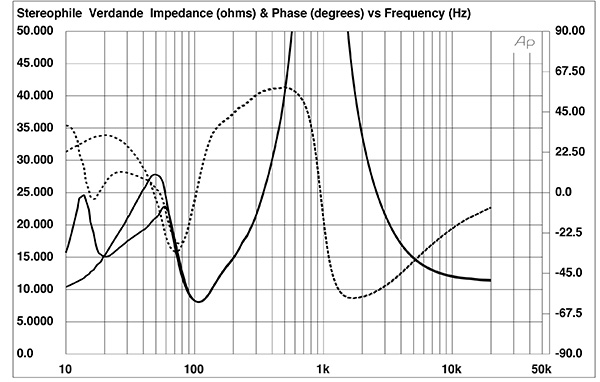
Ø Audio specifies the Verdande's sensitivity as 94dB; the specifications don't say whether that's in dB/W/1m or dB/2.83V/1m. My B-weighted estimate was 86dB(B)/2.83V/1m. As always, I first measured the SPL of my reference Rogers LS3/5A, then did the same for the Verdande with the same output voltage. While the Verdande was louder than the Rogers, it wasn't the 12dB louder the specification implies. However, as you can see from the solid trace in fig.1, which plots the impedance magnitude measured with Dayton Audio's DATS V2 system, the impedance is >20 ohms over much of the audioband. With this very high impedance, 2.83V is significantly less than 1W, meaning that the sensitivity must be at least 92dB/W/1m.
 As I listened I tried to forget the measured performance, with which I was by then overfamiliar. I found that there was insufficient low bass and too much upper bass. Organ pedal notes and orchestral bass drum didn't have sufficient weight, and cellos sounded over-ripe in their lowest register. The midrange lacked clarity, and while high frequencies seemed smooth and uncolored, the treble balance was consistently polite. Stereo imaging was precise and stable, though there was significantly less soundstage depth on the Portland choral track than I am used to.
What surprised me was that despite the lack of tonal accuracy, the Verdande's sound quality was acceptable, particularly with rock recordings. I am intrigued by how an active version, with DSP used to implement a time-coincident crossover and provide the necessary baffle-step compensation for the woofer, would sound and measure.
The Verdande is superbly amplifier-friendly, its large enclosure is well-damped, and the horn's dispersion is very well controlled. The outputs of the horn-loaded tweeter and the 15" woofer are not well-integrated at my usual measurement distances of 1m and 50". As shown in the measurement provided by Ø Audio (fig.3) and the spatially averaged response at TF's listening position (fig.6), which was 9' from the speakers, the Verdande's behavior is optimized for farther listening distances.—John Atkinson
As I listened I tried to forget the measured performance, with which I was by then overfamiliar. I found that there was insufficient low bass and too much upper bass. Organ pedal notes and orchestral bass drum didn't have sufficient weight, and cellos sounded over-ripe in their lowest register. The midrange lacked clarity, and while high frequencies seemed smooth and uncolored, the treble balance was consistently polite. Stereo imaging was precise and stable, though there was significantly less soundstage depth on the Portland choral track than I am used to.
What surprised me was that despite the lack of tonal accuracy, the Verdande's sound quality was acceptable, particularly with rock recordings. I am intrigued by how an active version, with DSP used to implement a time-coincident crossover and provide the necessary baffle-step compensation for the woofer, would sound and measure.
The Verdande is superbly amplifier-friendly, its large enclosure is well-damped, and the horn's dispersion is very well controlled. The outputs of the horn-loaded tweeter and the 15" woofer are not well-integrated at my usual measurement distances of 1m and 50". As shown in the measurement provided by Ø Audio (fig.3) and the spatially averaged response at TF's listening position (fig.6), which was 9' from the speakers, the Verdande's behavior is optimized for farther listening distances.—John Atkinson
Footnote 1: EPDR is the resistive load that gives rise to the same peak dissipation in an amplifier's output devices as the loudspeaker. See "Audio Power Amplifiers for Loudspeaker Loads," JAES, Vol.42 No.9, September 1994, and stereophile.com/reference/707heavy/index.html.
Footnote 2: This CD is out of print but the test-tone files can be downloaded free of charge from tinyurl.com/yfkvayat.
Footnote 3: This means that the loudspeaker is firing into hemispherical space rather than a full sphere. A speaker that has a truly flat response in the usual "4pi" space will therefore appear to have a boosted upper-bass output with a nearfield measurement, the center frequency of that boost depending on the physical dimensions of the speaker and the woofer alignment. See this explanation or aes2.org/publications/elibrary-page/?id=7171.
Footnote 4: See https://en.wikipedia.org/wiki/Precedence_effect.
Fig.1 Ø Audio Verdande, electrical impedance (solid) and phase (dashed) with ports blocked and with two of the five ports open (5 ohms/vertical div.).
The Ø Audio website specifies the Verdande's impedance as 8 ohms, though TF told me that he was told that the minimum impedance was 9 ohms. While the minimum impedance was 8.1 ohms at 108Hz (fig.1, solid trace), the magnitude otherwise ranged between 10 ohms and 50 ohms, with a maximum value of 143 ohms at 950Hz! The electrical phase angle (dashed trace) is occasionally high; as a result the effective resistance, or EPDR (footnote 1), drops below 5 ohms between 80Hz and 215Hz and below 6 ohms between 4.87kHz and 5.3kHz. The minimum EPDR values are 4.85 ohms at 85Hz and 4.05 ohms at 132Hz. The Verdande is an easy load for an amplifier.
The enclosure seemed inert when I rapped the surfaces with my knuckles. Unfortunately, the preamplifier I use with my plastic-tape accelerometer had failed and I didn't have time to repair it before I drove to Tom's place. I therefore listened to all the enclosure's panels with a stethoscope while playing the half-step tonebursts on Stereophile's Editor's Choice CD (footnote 2), which range from 32Hz to 4kHz. Commendably, I didn't hear any resonant modes.
The double-peaked solid trace below 100Hz in fig.1 was taken with two of the five ports on the speaker's base open, which TF told me he preferred with digital sources. The saddle centered at 20Hz in this trace suggests that this is the tuning frequency of the woofer's reflex loading, the frequency at which the back pressure from the port resonance holds the woofer cone stationary. With all five ports open, the saddle was higher in frequency, centered on 45Hz. The single peak centered on 60Hz in the solid trace below 100Hz in fig.1 was taken with all five ports blocked and suggests that this is the tuning frequency of the woofer's sealed-box alignment.
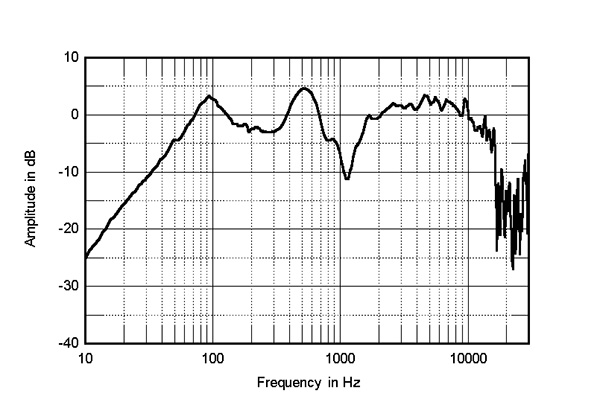
Fig.2 Ø Audio Verdande, anechoic response on tweeter axis at 1m, averaged across a 30° horizontal window and corrected for microphone response, with the nearfield responses of the woofer with the ports closed plotted below 310Hz.
The trace below 310Hz in fig.2 shows the nearfield response of the woofer with the ports blocked. The 5dB peak between 60Hz and 150Hz is due in part to the nearfield measurement technique, which assumes that the drive units are mounted in a true infinite baffle (footnote 3). The low frequencies roll off below 90Hz with the expected second-order slope, reaching –12dB at 22Hz compared with the level at 200Hz. This implies that the Verdande doesn't offer extended low frequencies with the ports blocked. The peak in the woofer's nearfield response was identical with all the ports open (not shown), but as my nearfield measurement of the port's output was corrupted by crosstalk from the woofer, I wasn't able to estimate the increased low-frequency extension with the ports open.
The black trace above 310Hz in fig.2 shows the Verdande's quasi-anechoic farfield response, averaged across a 30° horizontal window centered on an axis level with the center of the horn. The treble is generally smooth and even, but a peak in the midrange centered on 525Hz is followed by a suckout between 800Hz and 1.5kHz. (The two loudspeakers measured identically.)
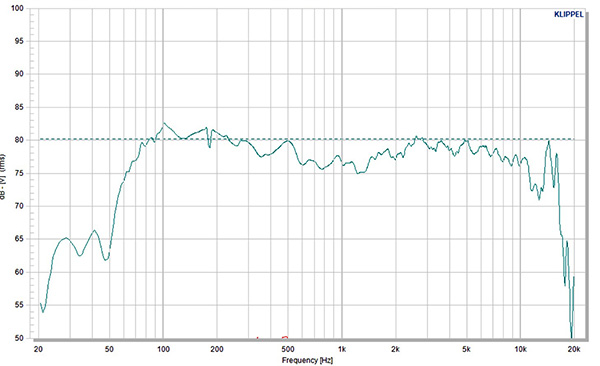
Fig.3 Ø Audio Verdande, anechoic frequency response on the tweeter axis at 3m. Measurement performed at SEAS.
Upon reviewing fig.2, Ø Audio sent along a measurement it said was made in an anechoic chamber at SEAS, the driver manufacturer, made farther from the speaker, at 3m distance and 1m height (fig.3). "I believe JA's measurement is correct for the exact position used," wrote Sveinung Mala, the Verdande's designer. "In the Verdande, the physical spacing between the horn/ compression driver and the 15" woofer makes the crossover region sensitive to measurement distance. For the Verdande, full integration is reached at around 2.7m."
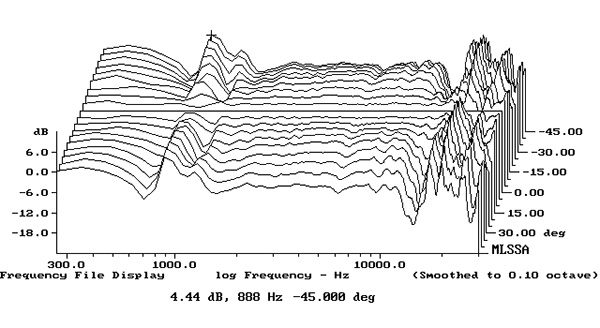
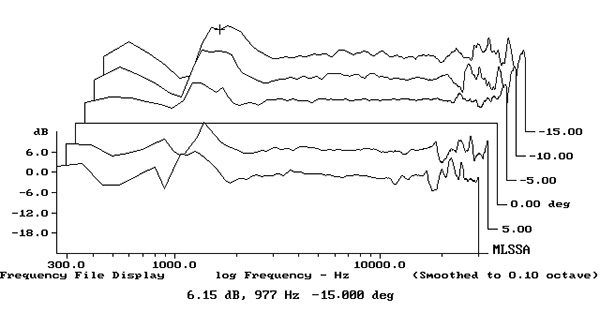
Fig.4 Ø Audio Verdande, lateral response family at 50", normalized to response on tweeter axis, from back to front: differences in response 45–5° off axis, reference response, differences in response 5–45° off axis.
Fig.4 shows the Verdande's horizontal dispersion, normalized to the response on the center on the horn axis, which thus appears as a straight line. (It wasn't possible to measure the off-axis responses more than 45° to the speaker's sides.) The dispersion in the region covered by the horn is well controlled, up to the upper cutoff frequency, which will correlate with stable stereo imaging. It also appears that both the peak in the upper midrange and the suckout in the low treble tend to even out more than 15° off axis, which suggests that the most even tonal balance will be achieved if the speakers are not toed in to the listening position.
Fig.5 Ø Audio Verdande, vertical response family at 50", normalized to response on tweeter axis, from back to front: differences in response 15–5° above axis, reference response, differences in response 5–10° below axis.
The Ø Audio speaker's radiation pattern in the vertical plane, again normalized to the response on the central horn axis, which is 38" from the floor with the speaker supported on its feet, is shown in fig.5. The low-treble suckout tends to fill in 5° above and below the tweeter axis; as Tom Fine's ears are 42" from the floor when he is sitting in his listening chair, it might be possible that this suckout will have less of an effect on the perceived balance.
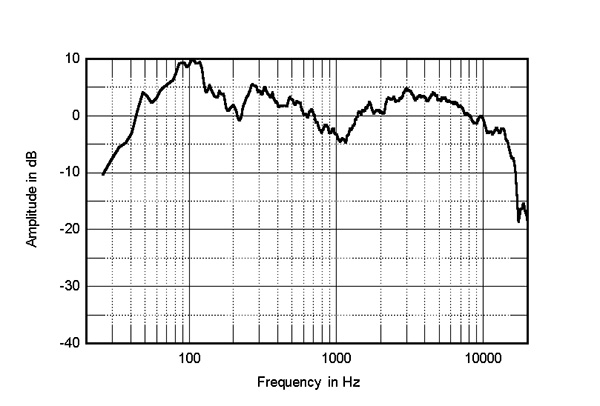
Fig.6 Ø Audio Verdande, spatially averaged, 1/10 octave-smoothed response in TF's listening room.
Fig.6 shows the Ø Audio Verdande's spatially averaged response in TF's listening room. Using MLSSA, I averaged 20 1/10-octave–smoothed spectra, individually taken for the left and right speakers, in a rectangular grid 36" wide × 18" high and centered on the positions of Tom's ears. While the responses of the two speakers at the listening position matched within ±1dB over most of the audioband and within ±0.5dB in the treble, the suckout in the low treble is still present. Although the spatial averaging tends to minimize the effect of room modes on the measured response, there is a 10dB-high peak centered on 100Hz in this graph. It is possible that this peak was due to the woofer's tuning frequency coinciding with a room resonance, but it might also be due to the speaker's placement well out in the room. (The centers of their front baffles were 49" from the wall behind them.)
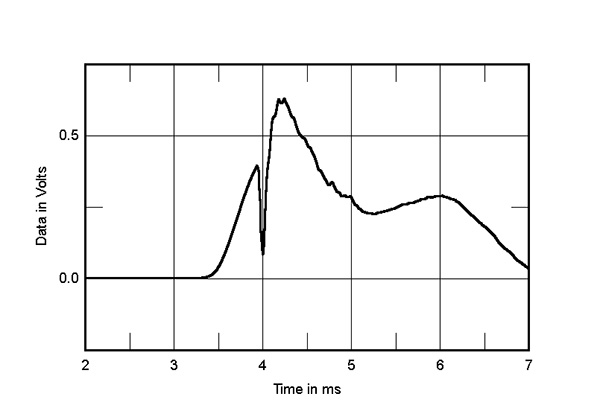
Fig.7 Ø Audio Verdande, step response on tweeter axis at 1m (5ms time window, 30kHz bandwidth).
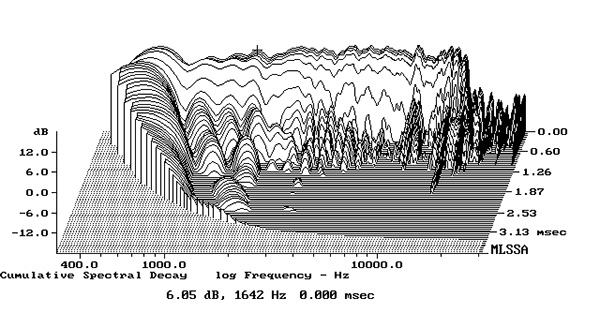
Fig.8 Ø Audio Verdande, cumulative spectral-decay plot on tweeter axis at 1m (0.15ms risetime).
In the time domain, the Ø Audio Verdande's step response (fig.7) indicates that the woofer's output arrives first at the microphone, followed 0.7ms later by that of the horn-loaded tweeter. (Both speakers behaved identically in this respect.) This difference in arrival times falls within the ear's tolerance for arrival time difference (footnote 4). More important is the fact that the woofer is connected in positive acoustic polarity, the tweeter in inverted polarity. The Verdande's crossover uses first-order low-pass and high-pass filters, and the drive units are usually connected in the same acoustic polarity with such filters. It is possible, therefore, that the lack of energy in the low treble seen in fig.2 and fig.6 is due to the outputs of the two drive units canceling in this region. The initial decay in the Verdande's cumulative spectral-decay, or waterfall, plot (fig.8) is relatively clean, though there are low-level ridges of delayed energy in the treble and higher-level ridges in the midrange.
After I finished the second round of measurements, TF asked me to take a listen to the Verdandes and report what I heard. The woofer was loaded with two of the ports open and three blocked, which was his preference for listening to digital audio. I listened to some of the recordings on Tom's Qobuz Bass Test playlist, some orchestral recordings, and finished with my recording of the Portland State University Chamber choir singing "In paradisum" from Translations (Naxos/Qobuz), which was Stereophile's Recording of the Month for June 2020.
As I listened I tried to forget the measured performance, with which I was by then overfamiliar. I found that there was insufficient low bass and too much upper bass. Organ pedal notes and orchestral bass drum didn't have sufficient weight, and cellos sounded over-ripe in their lowest register. The midrange lacked clarity, and while high frequencies seemed smooth and uncolored, the treble balance was consistently polite. Stereo imaging was precise and stable, though there was significantly less soundstage depth on the Portland choral track than I am used to.
Footnote 1: EPDR is the resistive load that gives rise to the same peak dissipation in an amplifier's output devices as the loudspeaker. See "Audio Power Amplifiers for Loudspeaker Loads," JAES, Vol.42 No.9, September 1994, and stereophile.com/reference/707heavy/index.html.















