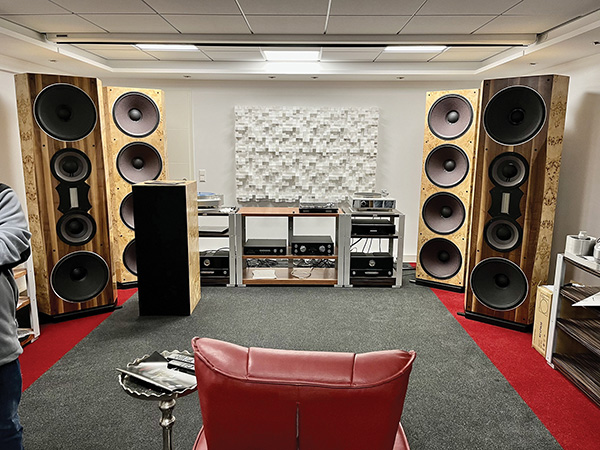
10. Acoustic Signature's listening room with its massive PBN loudspeaker system.
May has long been one of my favorite months of the year, mostly because it means it's time for the Munich show, the annual gathering of the high-end audio tribe in the Bavarian capital. High End Munich 2023 marked my return to the biggest audio show in the Western world following three years of lockdowns and travel restrictions, so I was eager to get back to the land of Wiener schnitzel and bratwurst.
This year, as an added bonus, I was invited to visit the production facilities of turntable and tonearm manufacturer Acoustic Signature, which is based about 110 miles west of Munich, near Stuttgart (footnote 1).
One day prior to High End Munich's opening, I traveled with a group of dealers, distributors, and fellow hi-fi scribblers west by motor coach from Munich. With perfect weather replacing the previous day's rain, we drove for a couple of hours past rolling hills and fields of bright yellow rapeseed flowers until we arrived in the small town of Süssen, home of Acoustic Signature turntables. Nestled in the Fils River valley about 30 miles west of Stuttgart, Süssen manages to blend light industry and housing without the type of zoning restrictions we often see in the US, which tend to sequester small factories in dingy industrial corners. Here, residential neighborhoods surround the factory; somehow it manages to work together beautifully.
Just-in-time (JIT) is an inventory management system where you keep only the amount of raw materials on hand that you need for immediate production, while relying on supply chains to deliver more goods as needed. It's a system I normally associate with much larger-scale production, but Acoustic Signature tries to keep things lean and timely. Frohnhöfer said that when the supply chains were fractured during the global pandemic, they grabbed what they could, when they could, but now that things are slowly returning to normal, they are cautiously moving back toward procuring only what's needed immediately.
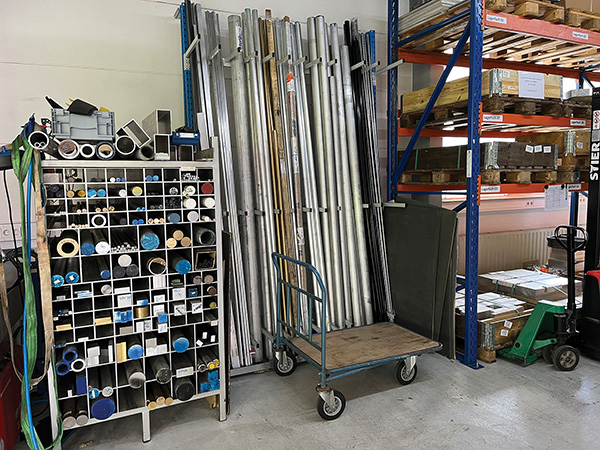
1. Round-section raw stock in various materials and dimensions at the AS factory.
Acoustic Signature turntables are known for their massive construction, usually made from heavily damped slabs of machined aluminum. The parts arrive as billets in the approximate shape needed, then each part is loaded into a series of machines that mill it to its final form. Frohnhöfer says that the company always wants to be at the cutting edge with the best machine tools available, because having the latest technology not only allows for greater precision but can also increase production speed and efficiency by allowing one machine to perform more operations, automatically.
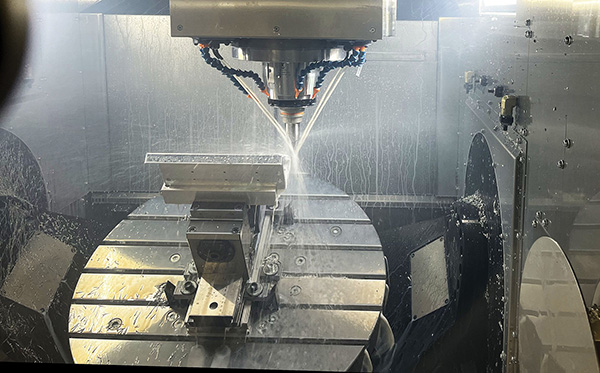
2. Acoustic Signature's new five-axis CAM milling machine in use.
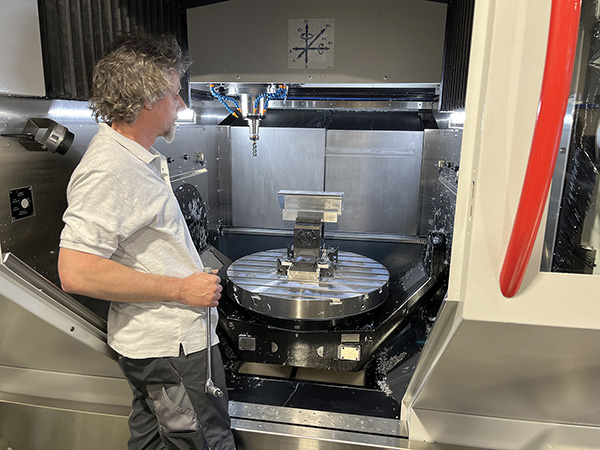
3. An operator changes the work part in the five-axis milling machine.
Over the course of the day, it became clear that Frohnhöfer is a gearhead when it comes to having the latest industrial equipment. He gets a twinkle in his eye when describing the company's latest acquisitions. He was particularly proud of the new five-axis CAM milling machine just installed, which can change tools automatically and perform a multitude of operations without requiring manual operator input. Perhaps by the next time I visit, they'll have assembly robots like the ones I saw down the road at the Mercedes-Benz factory, screwing the finished turntables together.
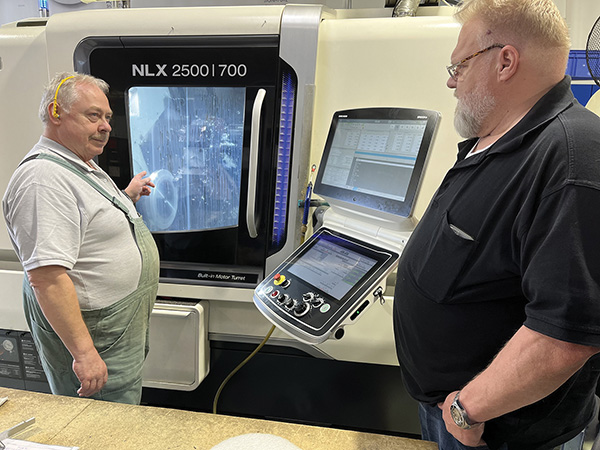
4. The lathe used to make round parts like platters and bearings.
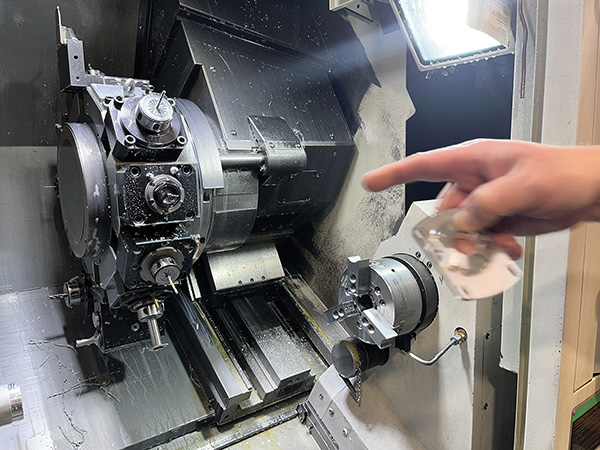
5. A rotary tool selector automatically changes tools.
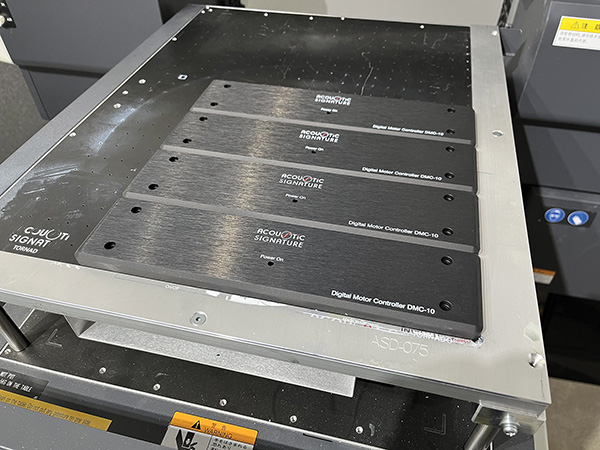
6. A silk-screen printer labels faceplates.
Acoustic Signature's dedication to keeping production in-house extends well beyond critical mechanical parts like plinths, platters, bearings, and the like. They also have laser engraving and silk-screening equipment, which they use to create badges, buttons, and identification plates for every product; they even manufacture and engrave the custom-built cartridge-alignment tools provided with each product. One thing that they do not make themselves is the wood-veneer plinths used for the Double X NEO and the new Verona NEO turntables. While they can handle any type of metal or plastic machining, Frohnhöfer said, they use a local supplier for wood-based parts.
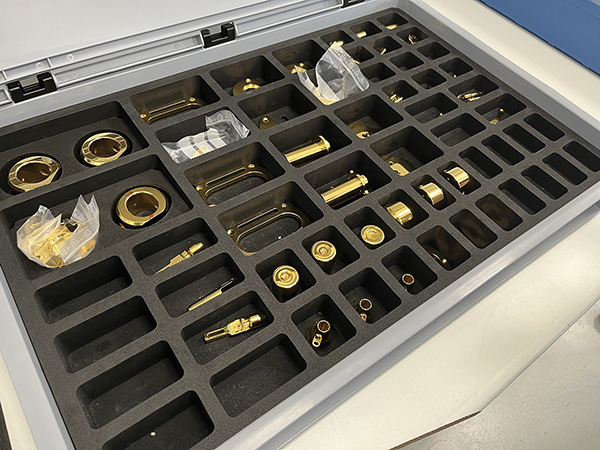
7. Gold-plated tonearm parts.
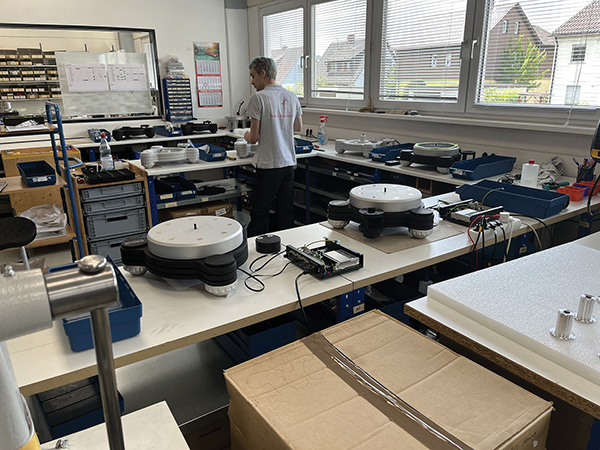
8. Turntables prepared in the assembly room.
Once all the parts have been manufactured and finished, they are brought to the assembly room, where the parts are built up into complete turntables. Tonearms are assembled and the internal wiring installed and terminated in a room next door. Women must be better than men at the precision work of tonearm assembly (smaller hands?): This is the second factory I've visited where all of the people I saw working on tonearms were women.
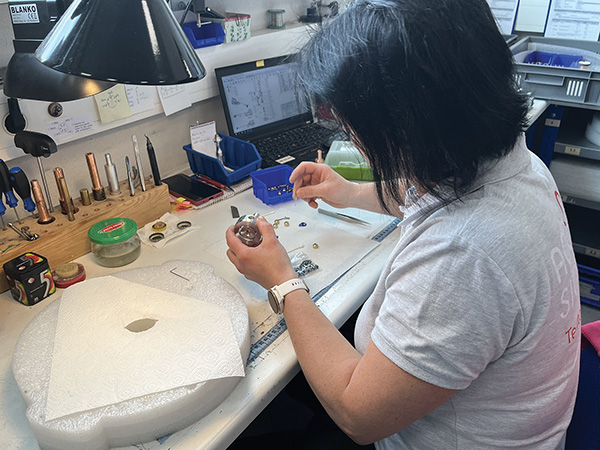
9. Assembling a TA-9000 tonearm.
After all the assembly has been completed, the turntables are allowed to run in for 24 to 48 hours. Every tonearm has a test cartridge installed and is then used to play a complete record side.
Footnote 1: Acoustic Signature, Made by AS Distribution GmbH Hillenbrandstrasse 10, D-73079 Süssen, Germany. Web: acoustic-signature.com. US distributor: Rutherford Audio, 14 Inverness Dr. East, Unit G-108, Englewood, CO 80112. Tel: (888) 279-6765. Email: info@acousticsignature.audio. Web: acousticsignature.audio.