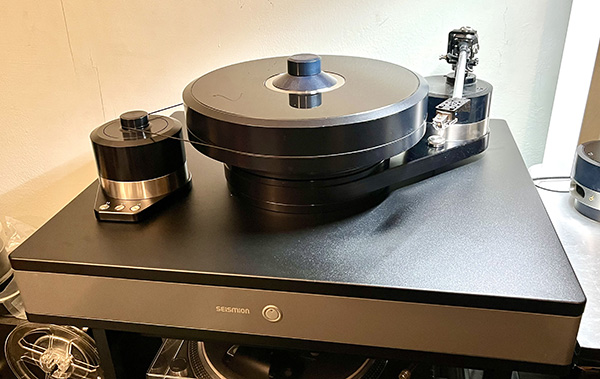
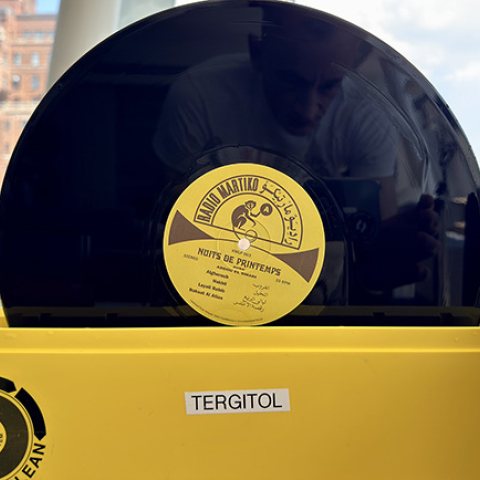
MT's Brinkmann LaGrange turntable sits on the Seismion Reactio 2 isolation platform
Renowned British turntable manufacturer
Rega once defined a turntable as a vibration-measuring machine; that definition became the title of a coffee table book tracing the company's history and design philosophy (footnote 1). To me that title perfectly captures what a turntable does: measure the microscopic undulations pressed into the record groove by using a phono cartridge to convert them into an electrical signal that feeds the rest of the system. The more accurately the turntable can measure those tiny squiggles, the better the turntable is. It's really that simple.
I always get a chuckle when someone tries to tell me that a turntable's sole requirement is to rotate at a steady 33
1/
3rpm—that assuming that's achieved, every turntable sounds the same. While rotational speed accuracy and consistency is a critical factor for reading those grooves correctly, it is just one of several factors that affect the signal that ends up traveling down the tonearm wire.
The little squiggles pressed into the groove walls of your record are a physical representation of the audio signal. They range in size from deflections you can easily see with the naked eye to the truly infinitesimal. Look carefully at a copy of Tchaikovsky's
1812 Overture on Telarc (
DG-10041)—specifically at the cannon shots near the end of the piece: You can practically measure the size of those squiggles with a ruler. Playing those cannons will tax the tracking abilities of most cartridges to the point where sometimes I fear for the safety of the stylus and cantilever.
But while the loud stuff can be fun and impressive for showing off your system, it really tells you nothing about what is happening down at the other end of the dynamic scale, which is where the differences between a good turntable and a truly great one manifest.

The V-shaped groove on a stereo LP is nominally about 56μm wide at the top, but the tiniest deflections that can be pressed into that groove are far smaller, down in the nanometer range. This size is defined not so much by the frequency of the sound—although high frequencies require less deflection even after RIAA adjustment—but by how loud or quiet that sound is relative to the rest of the signal. Those tiny deflections are what lets you hear deeper "into the mix," revealing the subtle details and shadings that are a hallmark of great vinyl playback. Obviously, if you are to hear them, they must not be drowned out by extraneous noise.
A turntable measures vibrations, but it has no real way to differentiate between the vibrations we want—those generated by the record groove—and those we don't want, which come from other sources that shake the critical junction between the stylus and the record. The biggest offender is the turntable itself, a mechanical device with lots of moving parts including motors (which vibrate) and bearings (that if inferior can cause a kind of mechanical jitter). Over the decades, a vast array of methods, informed by divergent philosophies, have been used to insulate the stylus-record interface from unwanted noise and for controlling the nature of the noise.
When stereo records were introduced toward the end of the 1950s, the problem was compounded, because to play stereo records, you need to measure both the lateral and vertical movements of the stylus. On older mono cartridges, the stylus could only move laterally—they measured only lateral squiggles—which made them less susceptible to rumble from the platter bearing and motor noise. To isolate the new stereo cartridges from motor noise, in the early '60s turntable designs moved away from idler drive (where the idler wheel formed a firm connection between the motor and the platter) toward belt-drive, which allowed the motor and the platter to be kept apart, connected only via the belt, a compliant buffer that filtered out motor vibration. One of the first belt-drive models, the legendary Acoustic Research (AR) turntable from 1961, also popularized the concept of floating the tonearm and platter on a separate subchassis, supported by a coil-spring suspension. This mechanically isolates them from motor noise and structure-borne external vibrations. This approach is still being used on turntables such as the Scottish
Linn Sondek LP12 and certain models from Germany's Thorens (footnote 2).
The second main source of unwanted vibrations at the critical record-stylus interface is airborne noise that directly vibrates the record surface. Far too often, when I go to work on someone's turntable, I see little consideration for dealing with this problem; the most basic precaution is to keep your turntable out of the speakers' direct line of fire. Dust covers can make this problem worse, with poor designs acting like an acoustic pickup, feeding airborne vibrations directly to the turntable's plinth (footnote 3).
Perhaps the most effective way to isolate your turntable from airborne vibration is to put it in a different room from the speakers. One of my regular customers, a guy called Carl, puts his Basis turntable and Pass Labs electronics in his study. He then passes the speaker cables through a small opening cut in the wall separating the two rooms and on to his Wilson Audio speakers on the other side in the living room. He has to get up and walk into the study to change records, but Carl thinks the added resolution and transparency he gets is well worth the slight inconvenience.
Once those factors have been addressed, we have to deal with structure-borne vibrations, mechanical energy that gets into the turntable through the surface it's sitting on. There is a big accessory industry built around ways to mitigate structure-borne energy, with all manner of equipment stands, platforms, footers, and pads you can place between your turntable and terra firma.
In the tradition of the original AR turntable, some modern turntables already have superb isolation built in as part of their design. Two state-of-the-art contenders, the
XD-1 from SAT and the
Döhmann Audio Helix One, both have built-in suspensions made by a California company called Minus K Technology, which floats the whole turntable on special passive springs with a very low resonant frequency. This approach should be so effective that it shouldn't matter what surface the turntable is sitting on.
On the flip side, there are turntables that offer no environmental isolation at all, not even rubber footers to block vibrations. I have a theory that that way of thinking may stem from global differences in construction techniques and the location of the companies making the turntables, a topic I explored in
Spin Doctor #14. Here in the US, most home construction uses timber framing, whereas in Europe, buildings tend to get made from bricks and concrete, resulting in a far more rigid structure, with walls and floors that move less than our springy wood-and-sheetrock homes. When turntables are developed and then installed on very rigid structures, isolation is less of an issue, so some of those turntables have no isolation at all. The Germans are the key offenders here: Most models from Acoustic Signature, Clearaudio, and Brinkmann use an entirely rigid structure—not even a sliver of rubber between the platter and the supporting shelf.
A few years back, I went to install a new Clearaudio Innovation turntable for a customer who lived in an old prewar building in Brooklyn's DUMBO neighborhood, right next to where the D subway train comes off the Manhattan Bridge. Everything was going fine—the system sounded great—until a train rolled through, rattling the apartment's windows and making the record skip.
Oh Nooo! The dealer he bought it from had not included any kind of isolation for the turntable, so I had to improvise, fast. Three thin cork drink coasters were pressed into service, one under each foot. That thin but compliant layer was enough to stop the skipping until a more permanent solution could be installed.
Usually it doesn't take much, and something as simple as an Ikea Aptitlig butcher block cutting board supported by some quarter-sized Sorbothane discs can be remarkably effective. You can upgrade performance by replacing the Sorbothane discs with some
IsoAcoustics Orea footers or A/V RoomService EVPs. From there, the sky's the limit: The Minus K platform mentioned earlier is available on its own, so you could put it under your turntable. And then there's the subject of my evaluation here, the Seismion Reactio 2 from Germany (footnote 4).
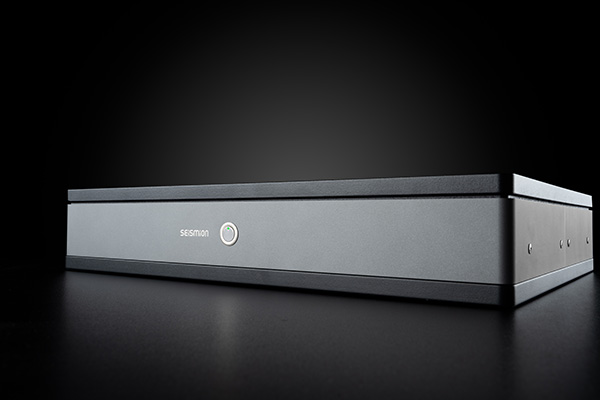 The Seismion Reactio 2 isolation platform
My Brinkmann LaGrange turntable is one of those solid-as-a-rock German designs without a sliver of isolating material between the platter and the surface it's sitting on. In fact, it has an adjustable spike designed to act as a mechanical ground, allowing energy to exit the turntable's structure into whatever is supporting it. Unfortunately, this also means that structure-borne vibration can enter just as easily.
Almost every Brinkmann turntable I have encountered in the US, including mine, ends up supported by a platform made by Harmonic Resolution Systems (HRS), which is based in upstate New York. I use their top-of-the-line HRS M3X, considered the ideal support for a Brinkmann in a wood-framed building. It uses a granite slab held in an aluminum frame supported by four compliant feet and provides more than 55lb of mass to sink the turntable's energy into; the extra mass lowers the frequency of any resonances and (most importantly) their amplitude, and the compliant feet keep structure-borne vibrations at bay. The HRS M3X does a superb job of letting the LaGrange deliver the goods, lowering the noisefloor and clearing the way for low-level detail to be heard more easily.
The Seismion Reactio 2 uses a completely different approach. It's an active device, with deflection sensors, isolators, and motors working to keep the platform level and isolated from external disturbances.
It is available in two sizes, the larger one measuring about 23.6" × 19.7", the smaller one 19.7" × 15.75". Both are just over 3.5" tall. They are spendy at $18,999 and $15,999 respectively, so I'm pretty sure nobody will be using one of these with their Rega P3. (Both sizes cost more than even the flagship
Rega Naia if you buy it without a cartridge.) I was sent the larger version, which can support a whopping 330lb; for the LaGrange, the smaller version with its 143lb capacity would have been sufficient. Even the smaller one costs four times as much as my top-of-the-line HRS M3X platform. Can it deliver the goods?
Installing the Reactio 2 is very simple. You plug the small inline power supply into the socket on the back of the Reactio then press the button on the front. You will hear the internal motors spring to life as it automatically adjusts its level and compensates for the weight sitting on it. There are three operating modes. Fully Active means what you would think: All powered isolation functions are working. Passive Isolation means the platform is powered, but there's some passive isolation that's still operating. Locked mode raises the platform against its housing, so it's effectively bypassed. This is useful if you're working on something like setting up a turntable on it and don't want it to be constantly adjusting as you change things. It's also good for making comparisons.
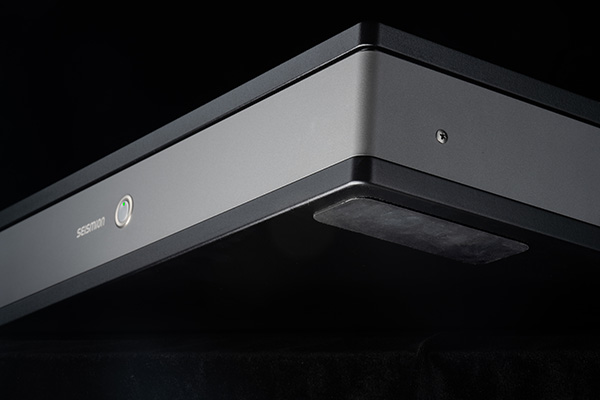
In contrast to some other isolation platforms I have encountered, the supporting surface on the Reactio never moves much. It's not floaty like the Minus K or compliant like the air-supported Vibraplane. The top surface moves the most when you switch it into locked mode; otherwise it just feels like a box with a top surface that moves a little.
To test its effectiveness, I used what I like to call the
Jurassic Park test, recreating the famous scene from the movie where Dr. Grant and the kids are hiding in the car. They first learn that the
T. rex is approaching when they notice little ripples forming on the surface of two cups of water sitting on the car's dashboard. In my less-scary version, I put a cup with water on the Reactio next to the turntable then tap the leg of the supporting stand with the handle of my screwdriver. With the Reactio in the locked position, I get ripples in the water that clearly distort the reflection of the lamp over the turntable. When I switch on Active Isolation, those ripples disappear. The Reactio isn't doing anything obvious, but it's working as advertised.
Silly little improvised tests like this are fun exercises, but the real question is, how does the Reactio influence the sound? I tried the Reactio 2 with three turntables, my Technics SL-1200MK2, the Garrard 301 Advanced I wrote about in the
December 2025 Spin Doctor, and the Brinkmann LaGrange. I didn't try it with my
SME Model 30/2, because that turntable is already equipped with a pretty elaborate isolation system.
As I expected, the biggest effect by far was with the LaGrange, which has no built-in isolation. For this test, I used it partnered with the Brinkmann 10.1 tonearm and the
Audio Technica AT-ART1000X cartridge. I have owned the Brinkmann and the HRS platform for almost a decade, and while that combination has proven itself to be a worthy reference point, the Reactio 2 advanced its performance a notch or three, allowing me to hear deeper into recordings.
Moving around a 70lb turntable and a couple of 50lb platforms to make snap comparisons isn't really my thing, so I first compared the Reactio in Active Mode and locked, then returned to play the same tracks with the HRS platform. Both platforms were supported on top of my rack by an ancient VPI platform taken from one of their isolation boxes made more than 40 years ago. That platform probably weighs a good 35lb by itself, made from what I believe is a sandwich of MDF and steel.

Digging out an old demo chestnut from the 1980s, I played "Mountains O' Things" from Tracy Chapman's self-titled debut album (Elektra 9 60774-1). The ultrafast ART1000X reveled in the subtle details of this recording. Here the drum kit is replaced by Brazilian percussionist Paulinho da Costa playing an array of percussion instruments, and with the Reactio, everything sounded a bit quieter and clearer, with a richer palette of tonal color. It sounded like the system was digging a little more information out of the groove, encouraging me to keep listening to song after song until I heard the clickety click of the runout groove.
The more dynamic a recording is, the easier it is to appreciate the lower noisefloor. Classical records were particularly well served, and I soon found myself digging into
The String Quartets, my boxed set of Shostakovich played by the Fitzwilliam String Quartet (Decca D188 D7). These definitive recordings from the late 1970s have never sounded better on my system, with the acoustics of All Saints Church in London clearly defined in the quieter passages. I'm struggling a bit to find the right words to describe the Reactio's effect. It's not really brighter, darker, or more dynamic. The words that come to mind are "quieter," "deeper," "clearer."
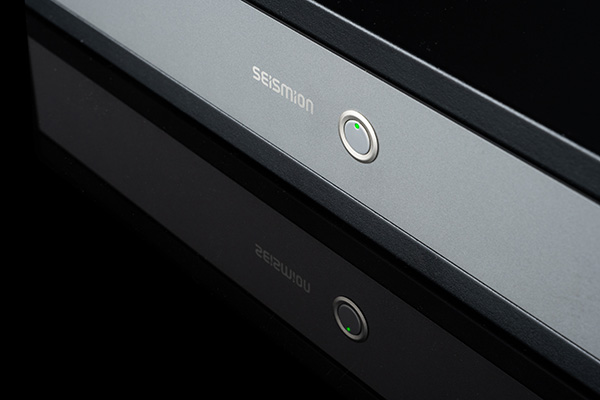
The Reactio 2 works as advertised, providing a stable, vibration-free support that will allow your turntable to perform at its very best. It's very easy to set up and will sit there unobtrusively making your sound better.
While I was focused on checking out its capabilities with turntables, importer Shane Buettner encouraged me to also try it under my electronics and even my power conditioner. I plan to try that, but in the meantime, I can report that its ability to draw the best from a turntable is nothing short of remarkable.
Footnote 1: That book was coauthored by a former
Stereophile contributing editor, the late Paul Messenger.—
Jim Austin
Footnote 2: The
Thorens TD 124 was an interesting, curious case. Introduced in 1957, it combined the two approaches, using a belt to drive an idler wheel, which pushed the platter. Eight years later, in 1965, Thorens introduced its first suspended 'table, the
TD 150.
Footnote 3: That's unfortunate, because otherwise I'm a big advocate of dust-cover use, not only to keep dust at bay but also dust-averse housekeepers who have been known to break costly cartridges. When I checked out the Kuzma Stabi M turntable in
Spin Doctor #28, I was impressed that it includes a dust cover described as being "constructed not to pick up any vibration from loud music." That's encouraging, but it isn't new. Those with long memories may recall a turntable from the early 1980s called the Audionics LK-1, which was built like a miniature bank vault, with a thick black dust cover that when closed enveloped the turntable in an isolating cocoon. Two thick windows in the top of the cover allowed you to peer at your record as it played, a bit like looking at a preemie baby in hospital incubator.
Footnote 4: Seismion GmbH, Berliner Strasse, 8 30457 Hannover, Germany. Email:
info@seismion.de. Web: seismion.com. US distributor: MIBS Distro LLC, Gig Harbor, WA. Tel: (253) 209-6792. Email:
Shane@mibsdistro.com. Web: mibsdistro.com.