Sidebar 3: Measurements
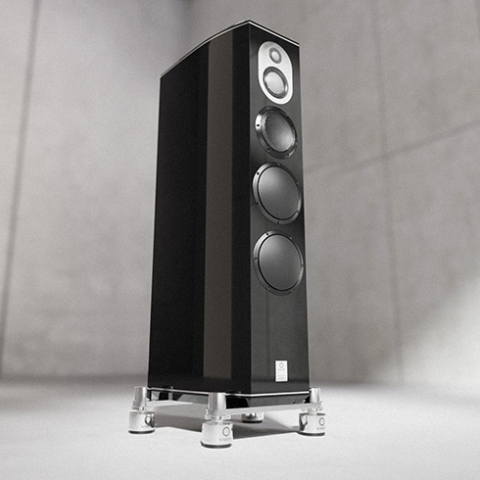
Due to the Raidho TD3.8's bulk, I wasn't able to bring it up the stairs from the driveway to our living room, where I usually measure loudspeakers. I therefore measured the speaker in the driveway, keeping its front baffle turned away from the sun so the drive units would stay cool. I used DRA Labs' MLSSA system with a calibrated DPA 4006 microphone to measure the loudspeaker's behavior in the farfield and an Earthworks QTC-40 mike for the nearfield responses. It wasn't possible to raise the 183lb TD3.8 off the ground for the measurements, so the first reflection from the ground occurs earlier than is usually the case with my measurements.
Footnote 1: EPDR is the resistive load that gives rise to the same peak dissipation in an amplifier's output devices as the loudspeaker. See "Audio Power Amplifiers for Loudspeaker Loads," JAES, Vol.42 No.9, September 1994, and stereophile.com/reference/707heavy/index.html.
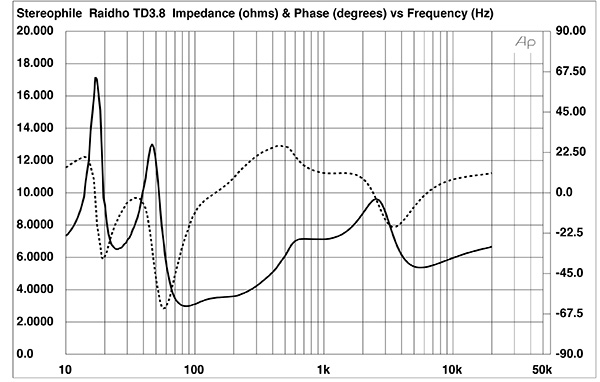
Fig.1 Raidho TD3.8, electrical impedance (solid) and phase (dashed) (2 ohms/vertical div.).
Raidho specifies the TD3.8's specified sensitivity as 89dB/2.83V/m. My B-weighted estimate was somewhat lower, at 86.5dB(B)/2.83V/m. The TD3.8's nominal impedance is specified as 6 ohms. I measured the speaker's impedance parameters with Dayton Audio's DATS V2 system. The speaker's impedance magnitude (fig.1, solid trace) drops below 6 ohms in the midrange and upper bass, with a minimum value of 2.98 ohms at 82Hz. The electrical phase angle (dotted trace) is occasionally high, especially at low frequencies. The equivalent peak dissipation resistance, or EPDR (footnote 1), lies below 3 ohms between 170Hz and 540Hz and below 2 ohms between 56Hz and 101Hz. The minimum EPDR values are 1.1 ohms at 70Hz and 2.17 ohms at 287Hz. The TD3.8 is a demanding load.
An equipment failure meant that it wasn't possible to investigate the enclosure's vibrational behavior. However, listening to the side panels with a stethoscope while the TD3.8 played the MLSSA noise signal, I could hear a couple of resonant modes in the midrange, very low in level.
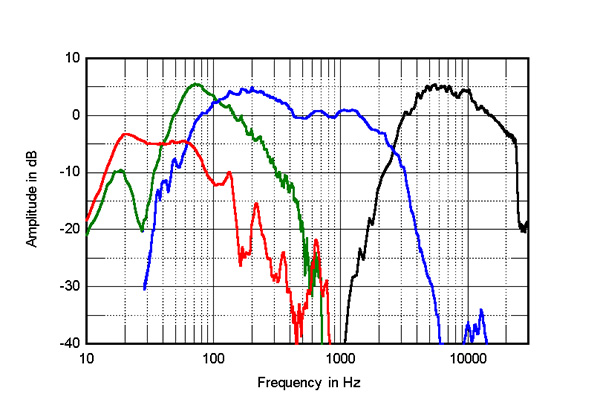
Fig.2 Raidho TD3.8, acoustic crossover on tweeter axis at 50", corrected for microphone response, with the nearfield midrange (blue), woofer (green), and port (red) responses plotted below 440Hz, 650Hz, and 300Hz.
The saddle centered on 27Hz in the TD3.8's impedance-magnitude plot suggests that this is the tuning frequency of the three ports at the top of the rear panel. The two woofers behaved identically, their summed nearfield response (fig.2, green trace) having the expected reflex notch at this frequency and rolling off sharply above 80Hz. The ports also behaved identically to one another; their summed output (fig.2, red trace) features a broad peak between 20Hz and 70Hz, implying extended low frequencies. The port's upper-frequency rolloff is disturbed by some resonant peaks. Standing behind the TD3.8, I could hear these faintly with the MLSSA signal, but as these modes have a high Q (Quality Factor) and as the ports face to the speaker's rear, their audibility will be minimal.
The blue trace in fig.2 indicates that the midrange units cross over to the woofers just above 100Hz, two octaves lower than the specified 400Hz. Even though the microphone was placed immediately in front of the midrange diaphragms for these nearfield measurements, I wondered if the response was affected by crosstalk from the woofers. However, the lower midrange driver behaved identically to the upper unit, and the latter is too far from the woofers to be affected by crosstalk. The crossover between the midrange drivers and the ribbon tweeter occurs at the specified 2.4kHz, though the tweeter appears to be balanced 5dB too high in level.
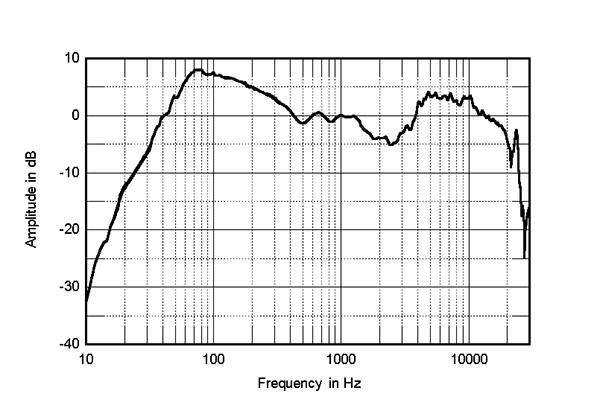
Fig.3 Raidho TD3.8, anechoic response on tweeter axis at 50", averaged across 30° horizontal window and corrected for microphone response, with the complex sum of the nearfield responses plotted below 300Hz.
This can also be seen in fig.3, which, above 300Hz, shows the Raidho's farfield output, averaged across a 30° horizontal window centered on the tweeter axis. There is also a lack of energy in the presence region, at the top of the midrange units' passband. The complex sum of the midrange, woofer, and port responses is shown as the black trace below 300Hz in fig.3. The boost in the upper bass will be due in part to the nearfield measurement technique, which assumes that the drive units are placed on a true infinite baffle, ie, one that extends to infinity in both vertical and horizontal planes. But the excess of upper-bass energy does suggest that the TD3.8's reflex alignment is underdamped, which will not be optimal for small rooms.
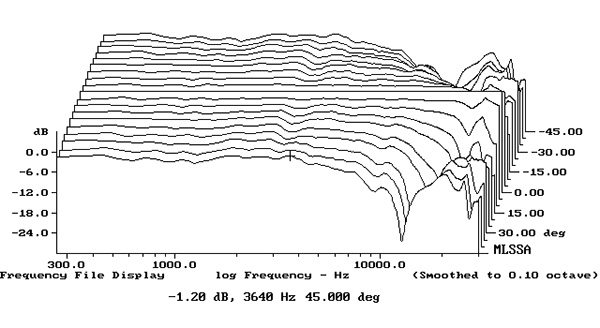
Fig.4 Raidho TD3.8, lateral response family at 50", normalized to response on tweeter axis, from back to front: differences in response 45–5° off axis, reference response, differences in response 5–45° off axis.
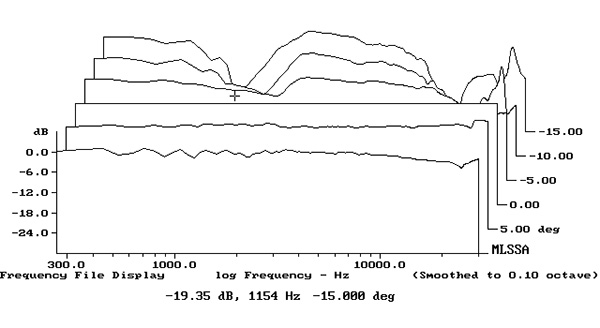
Fig.5 Raidho TD3.8, vertical response family at 50", normalized to response on tweeter axis, from back to front: differences in response 15–5° above axis, reference response, differences in response 5–10° below axis.
The TD3.8's horizontal dispersion graph (fig.4), with the off-axis outputs normalized to the tweeter-axis response, indicates that the presence-region depression doesn't fill in off-axis. (Due to the geometry of my driveway, I could measure the responses only up to 45° to each side.) However, the speaker's top-octave output falls off to the speaker's sides, which implies that the in-room high-treble balance can be adjusted by reducing the toe-in to the listening position. In the vertical plane (fig.5), the tweeter-axis balance is maintained 5°–10° below that axis, which is useful considering that the center of the tweeter is 43" from the floor. A suckout at 1.15kHz, an octave below the upper crossover frequency, appears 15° above the tweeter axis.
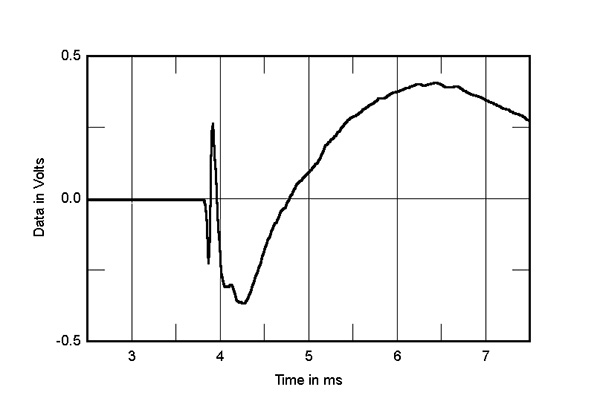
Fig.6 Raidho TD3.8, step response on tweeter axis at 50" (5ms time window, 30kHz bandwidth).
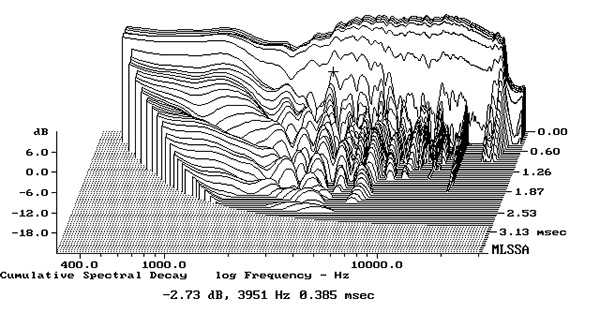
Fig.7 Raidho TD3.8, cumulative spectral-decay plot on tweeter axis at 50" (0.15ms risetime).
Turning to the time domain, fig.6 shows the TD3.8's step response on the tweeter axis. The tweeter and both midrange units are connected in negative acoustic polarity, the woofers in positive polarity. The tweeter's output arrives first at the microphone, followed by that of one of the midrange units. The small glitch at 4.1ms in the response is due to the output of the other midrange unit arriving a little later than the first. The decay of each unit's step smoothly blends with the start of that of the next lower in frequency, which implies an optimal crossover implementation. The Raidho's cumulative spectral-decay, or waterfall, plot (fig.7) was affected by the early reflection from the ground in front of the speaker, which meant I had to window the impulse response more aggressively than usual when I calculated the plot. Even so, the initial decay is impressively clean.
It is possible that in a medium-size-to-large room, the Raidho TD3.8's under-damped low frequencies will subjectively balance the excess of treble energy. But that still leaves the lack of presence-region energy, which might make the speaker sound somewhat laid-back.—John Atkinson
Footnote 1: EPDR is the resistive load that gives rise to the same peak dissipation in an amplifier's output devices as the loudspeaker. See "Audio Power Amplifiers for Loudspeaker Loads," JAES, Vol.42 No.9, September 1994, and stereophile.com/reference/707heavy/index.html.