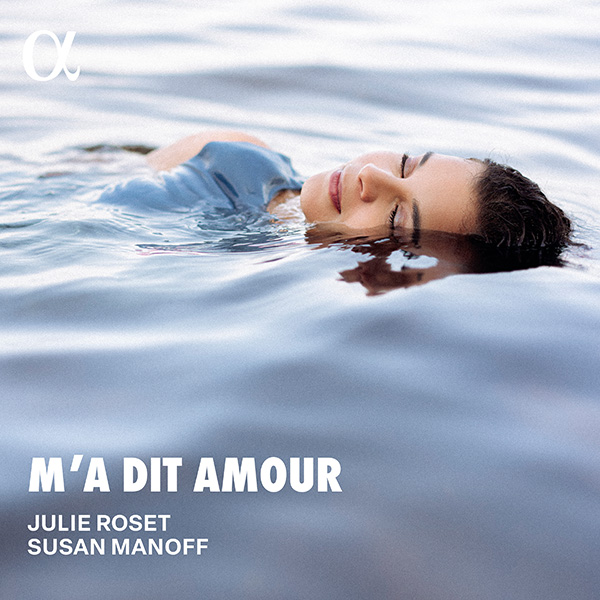
Julie Roset: M'a dit Amour
Julia Roset, soprano; Susan Manoff, piano
Alpha 1189 (24/96 WAV download). 2025. Martin Sauer, prod.; Jupp Wegner, eng.
Performance *****
Sonics ****½ For vocal lovers, regardless of the specific genre they favor, few thrills are as great as encountering a young artist whose fresh voice radiates health, confidence, and optimism. To hear such a voice intelligently deployed in a wide-ranging recital of extremely beautiful, rarely programmed French songs—each a gem in its own right—compounds the sense of discovery andjoy. With thanks to Paula Mlyn of Naxos, whose praise for this album compelled me to listen, meet Julie Roset, one of the finest lyric/coloratura sopranos I've heard in many a year. Born in France on February 21, 1997, Roset recorded M'a dit Amour when she was still 27. After discovering some of the songs while studying at Juilliard, she decided to construct her debut recital around Debussy's "La fille aux cheveux de lin" and "La romance d'Ariel" and Louis Beydts's four-song cycle Chansons pour les oiseaux.
Roset and pianist (and Beydts lover) Susan Manoff worked for almost a year to construct this program of 20 French songs punctuated by two short piano solos by Debussy. Only Lili Boulanger's "Elle était descendue au bas de la prairie," from her cycle, Clairières dans le Ciel, and perhaps Reynaldo Hahn's disarmingly beautiful and charming "Naïs" have often made their way onto recordings. I've heard the Boulanger numerous times, but it was only when I heard it sung by a voice in first bloom, with its references to a meadow all abloom and a girl with the gaze of lavender blossoms, that I understood its miniature perfection.
"Perfection" applies equally to the recital's engineering and to repertoire choices that match Roset's voice and temperament and Manoff 's strengths. Priceless gifts from Koechlin, Rosenthal, Aboulker, Enesco, Poulenc, Bonis, Debussy, Beydts, Roset, and Manoff await you.—Jason Victor Serinus
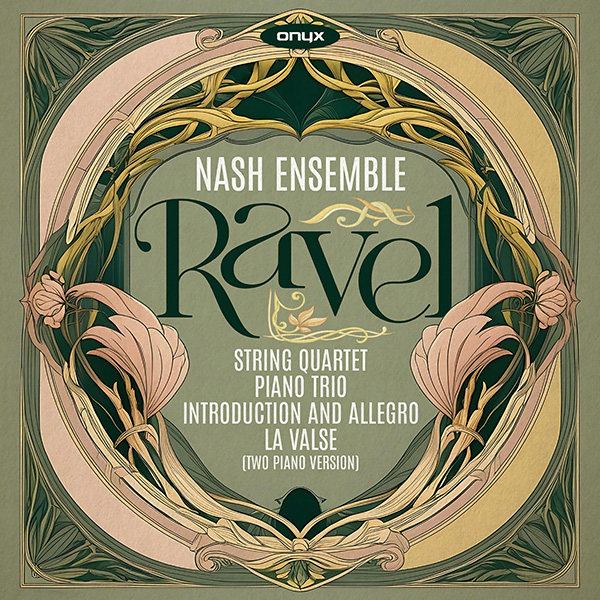 Ravel: Chamber Music
Nash Ensemble
ONYX 4270 (CD). 2025. Andrew Keener, prod.; Oscar Torres, eng.
Performance ****
Sonics ****½ The Nash Ensemble, a fluidly shifting aggregation, gained international attention with their CRD recordings in the 1970s; it's good to see them still chugging along.
The Introduction and Allegro works well with full orchestral strings—see the marvelous Martinon/Chicago (RCA)—but Ravel's original one-to-a-part concept allows subtler, more precise effects. Here, the gently placed string notes at the start are answered by a well-matched flute and clarinet; the slower passage further on is mysterious and mournful. Pentatonic touches lend an exotic overlay.
Many listeners know La valse in its whirling orchestral version, full of fin-de-siècle foreboding. In contrast, the two-piano original frequently comes off as almost pointillistic, with a few Romantic moments. Here we get some lovely, delicate pianissimi about halfway through.
The quartet performance is flowing above all. In the purposeful first movement, graceful ritards and lifts mark off the phrases, and the violin/viola octaves are haunting. The development's peak sounds a bit cluttered, but the return brings a nice hush. The scherzo's pizzicatos are buoyant and emphatic; the sustained note heralding the Trio has the force of a trumpet blast. The très lent is characterful, though it's two-thirds over before it reaches a real tune. The finale's incisive tremolos and punctuations wrap things up.
For me, alas, the Piano Trio is a sticking point. The Nash players do well by its shifting moods: the antique opening that grows more modern; the overbusy climax of Pantoum; the Passacaglia's solemn, ambiguous chorales; the scurrying Finale. But it's unsatisfying to hear the two strings attempt to match the piano's more angular "touch." It's pianist Simon Crawford-Phillips, in fact, whose translucent chording and grand sweeps leave the most Ravelian impression.—Stephen Francis Vasta
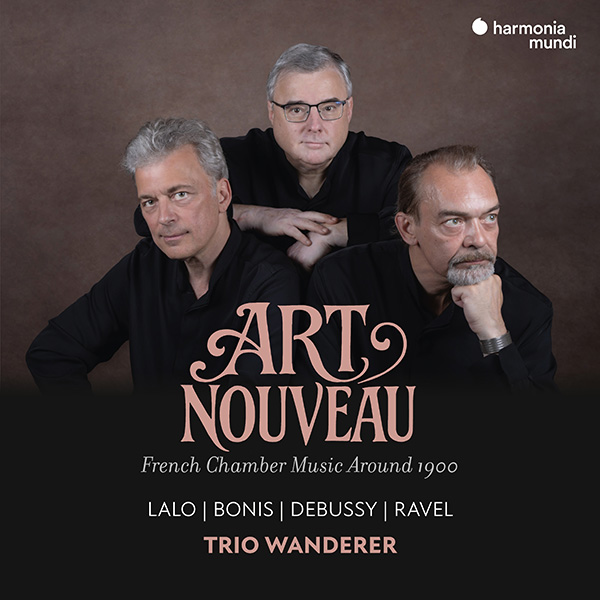 Lalo | Bonis | Debussy | Ravel: Art Nouveau: French Chamber Music Around 1900
Trio Wanderer
Harmonia Mundi HMM 902394.95 (24/192 WAV download). 2026. Hugues Deschaux, prod., eng.
Performance ****½
Sonics ****½ For lovers of turn-of-the-20th-century French music—the period when Debussy and Ravel were refining their craft—this album arrives as an early valentine, complete with unexpected treats.
When was the last time you heard the breathlessly impassioned Trio No.3 in A minor for piano, violin, and cello, Op.26, by Édouard Lalo? How about the lovely Soir et Matin for piano, violin, and cello, Op.76, and more by Mel Bonis, a gifted composer whose works should be far more widely known.
The earliest work on this album, Lalo's piano trio, dates from 1879. After hearing almost 29 minutes of music that harks back to the Romantic era, the refinement of Debussy's early Trio in G Major for piano, violin, and cello L.5, which was composed just one year later, proclaims the start of a new era. This trio was rediscovered only in the 1980s, but the enchanting melody that introduces its lovely second movement quickly became a favorite of classical FM radio hosts and remains so.
If we don't know Bonis's music, it's because she abandoned studies at the Paris Conservatoire due to family pressure and stopped composing in 1895, 15 years after she married. What a shame. The 11 minutes of her music on this recording give a taste of what was lost.
The rest of the recording includes two of Debussy's three final sonatas followed by Ravel's similarly mature Trio in A minor, which was provoked by the outbreak of WWI, and his later Sonata for Violin and Cello in A minor, composed as a memorial tribute to Debussy.
These are great works, frequently recorded on a variety of modern and period-authentic instruments. Trio Wanderer's performances of them are splendid.—Jason Victor Serinus
Julia Roset, soprano; Susan Manoff, piano
Alpha 1189 (24/96 WAV download). 2025. Martin Sauer, prod.; Jupp Wegner, eng.
Performance *****
Sonics ****½ For vocal lovers, regardless of the specific genre they favor, few thrills are as great as encountering a young artist whose fresh voice radiates health, confidence, and optimism. To hear such a voice intelligently deployed in a wide-ranging recital of extremely beautiful, rarely programmed French songs—each a gem in its own right—compounds the sense of discovery andjoy. With thanks to Paula Mlyn of Naxos, whose praise for this album compelled me to listen, meet Julie Roset, one of the finest lyric/coloratura sopranos I've heard in many a year. Born in France on February 21, 1997, Roset recorded M'a dit Amour when she was still 27. After discovering some of the songs while studying at Juilliard, she decided to construct her debut recital around Debussy's "La fille aux cheveux de lin" and "La romance d'Ariel" and Louis Beydts's four-song cycle Chansons pour les oiseaux.
Ravel: Chamber MusicNash Ensemble
ONYX 4270 (CD). 2025. Andrew Keener, prod.; Oscar Torres, eng.
Performance ****
Sonics ****½ The Nash Ensemble, a fluidly shifting aggregation, gained international attention with their CRD recordings in the 1970s; it's good to see them still chugging along.
Lalo | Bonis | Debussy | Ravel: Art Nouveau: French Chamber Music Around 1900Trio Wanderer
Harmonia Mundi HMM 902394.95 (24/192 WAV download). 2026. Hugues Deschaux, prod., eng.
Performance ****½
Sonics ****½ For lovers of turn-of-the-20th-century French music—the period when Debussy and Ravel were refining their craft—this album arrives as an early valentine, complete with unexpected treats.