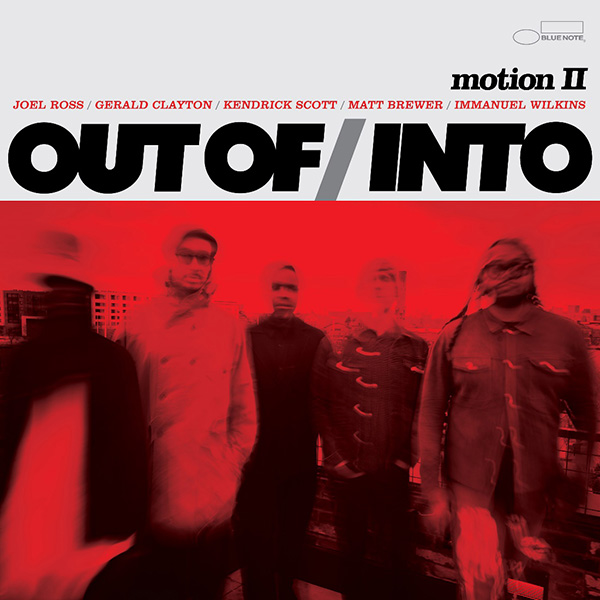
Out Of/Into: Motion II
Immanuel Wilkins, alto saxophone; Joel Ross, vibraphone, marimba; Gerald Clayton, piano; Matt Brewer, bass; Kendrick Scott, drums
Blue Note 00602478346217 (CD; available as LP). 2025. Out Of/Into, prods.; Qmillion, eng.
Performance ****
Sonics **** In jazz, all-star bands have a complicated history. Almost by definition, they offer serious solo firepower. But they may lack a unifying ensemble identity. All-star groups are often assembled for marketing reasons. Motion II is the second album by an all-star collective that contains major 21st century talent (see above). Out Of/Into was created to promote the Blue Note label's 85th anniversary. Their subsequent experience has been unusual. They went on a 40-stop tour in 2024. One of the stops was Los Angeles, where both Motion I and Motion II were recorded. All that time together was a plus. No one would say this quintet is not tight. The first impression of Motion II is that a hot band has chosen to pull in its horns a little. The six originals (contributed by everyone but Ross) are sophisticated, intricate structures. The group proves it can execute challenging material with flawless ensemble integration. Yet there is an unexpected risk-averse left-brain feel to this music. Clayton's three tunes are clever but not memorable as compositions. And in this band of world-class soloists, solos tend to be concise.
Still, the musicianship is unimpeachable. Clayton's piano solo on Scott's "The Catalyst" is hypnotic. Ross shows why he is now widely regarded as The Man on vibes. He has many fine moments, threading glittering lines all around and through the vivid voices of others.
It is not that this album lacks quality. It is that if, for example, you want to hear why Wilkins is the biggest thing on alto saxophone to happen in years, you don't start here, with a Wilkins who sounds measured. You start with his album The 7th Hand and a tune called "Lift" which, for the 26 minutes it lasts, changes your view of the world.—Thomas Conrad
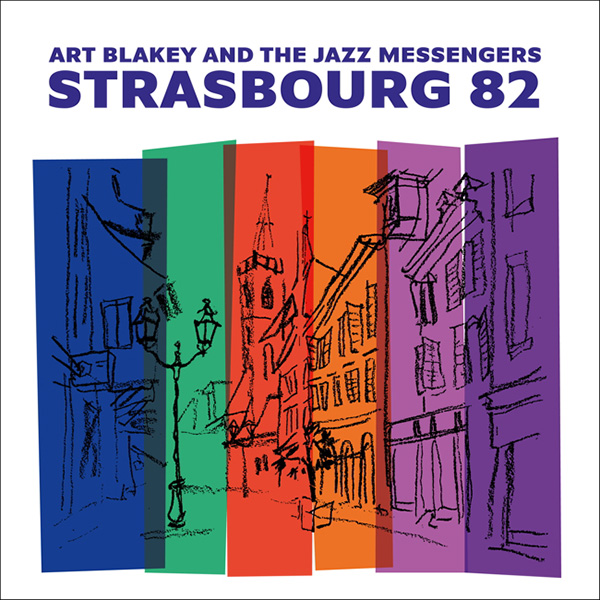 Art Blakey & The Jazz Messengers: Strasbourg 82
Blakey, drums; Terence Blanchard, trumpet; Billy Pierce, tenor saxophone; Donald Harrison, alto saxophone; Johnny O'Neal, piano; Charles Fambrough, double bass
Gearbox GB4009CD (CD; available as LP). 1982/2025. Prod., eng. unidentified
Performance ***½
Sonics ***
Art Blakey's Jazz Messengers were one of the most voluminously chronicled bands in jazz history. Between 1954 and 1990, they released around 70 recordings. Strasbourg 82 contains a previously unissued concert in France on April 1, 1982. Unhelpful liner notes claim that this album "fills a key gap in the documented history of the band." Well, maybe. The personnel of the Messengers changed constantly. The edition in Strasbourg was brand new. Wynton and Branford Marsalis had just departed. They were replaced by 20-year-old Terence Blanchard and 21-year-old Donald Harrison. Johnny O'Neal was also new. Only one other album by this short-lived configuration has ever appeared: Oh-By the Way, a studio session recorded seven weeks after Strasbourg 82. This group was not entirely tight. In 1982, Harrison (who would go on to become an important alto saxophonist) often sounded frantic and strident.
Still, there are many reasons to be grateful this tape has come to light. Any band with Blakey on drums swung maniacally. If this group lacked refinement, it made up for it with furious youthful enthusiasm. Blanchard was already a special trumpet player, as his daring solo on Ron Carter's "Eighty-One" reveals. O'Neal, still active today and still not famous, is a surprise. His solo on "Old Folks" (mistitled in the liner notes) is lavish and gorgeous. And who wouldn't want to hear any Messengers band play "Moanin'" again?
The Gearbox label, based in London, is known for finding valuable stuff in European archives and for audiophile vinyl. Strasbourg 82, here auditioned on CD, is too off-balance and sometimes too off-mike to be audiophile. But its raw, in-your-face belligerence is fun.—Thomas Conrad
 Bijan Taghavi: Cactus Sessions
Taghavi, piano
Self-released (CD). 2026. Taghavi, prod.; Dan Delaney, eng.
Performance ****
Sonics ***** Let's say that jazz fans can be divided into categories and that one is "audiophile piano junkies who believe jazz musicians should play more standards." Let's say your present correspondent belongs to this category. Since all the above is more or less true, it's no wonder your correspondent is having a very good morning. Cactus Sessions checks every box. Bijan Taghavi was a child prodigy whose early training and performance was in classical music. He converted to jazz in high school. From the opening track, Jobim's "Wave," you hear an enlightened formalism and a level of technique often associated with jazz pianists who started on the classical side: precision of fingering; extreme independence of hands; advanced harmonic vocabulary; huge dynamic swings; a disciplined regard for overall structure. But Taghavi now thinks like a jazz guy. He boldly decorates "Wave" in his own spontaneous content. Cactus Sessions, Taghavi's debut recording, emanates joy. He revels in his dominion over his instrument and in the vast world of ringing sonorities only a piano can create. Here he plays a special Yamaha C3 in a recording studio in Arizona where engineer Dan Delaney puts us in the living presence of this rich, resounding instrument. All in first takes, Taghavi plays classics like "I Should Care" and "I'll Remember April" and treats them as thematic centers to which he adds an extravagance of preambles, digressions, addenda, and epilogues. "Ask Me Now" is reimagined on the fly, yet Monk's famous melody keeps recurring, like a mantra. The most stunning track may be Horace Silver's "Peace," a rapt meditation that briefly, impulsively erupts.
The album is book-ended by Jobim. The closer is a lush "Desafinado." Taghavi is good at Jobim. He is good at many things. Watch for his name.—Thomas Conrad
Immanuel Wilkins, alto saxophone; Joel Ross, vibraphone, marimba; Gerald Clayton, piano; Matt Brewer, bass; Kendrick Scott, drums
Blue Note 00602478346217 (CD; available as LP). 2025. Out Of/Into, prods.; Qmillion, eng.
Performance ****
Sonics **** In jazz, all-star bands have a complicated history. Almost by definition, they offer serious solo firepower. But they may lack a unifying ensemble identity. All-star groups are often assembled for marketing reasons. Motion II is the second album by an all-star collective that contains major 21st century talent (see above). Out Of/Into was created to promote the Blue Note label's 85th anniversary. Their subsequent experience has been unusual. They went on a 40-stop tour in 2024. One of the stops was Los Angeles, where both Motion I and Motion II were recorded. All that time together was a plus. No one would say this quintet is not tight. The first impression of Motion II is that a hot band has chosen to pull in its horns a little. The six originals (contributed by everyone but Ross) are sophisticated, intricate structures. The group proves it can execute challenging material with flawless ensemble integration. Yet there is an unexpected risk-averse left-brain feel to this music. Clayton's three tunes are clever but not memorable as compositions. And in this band of world-class soloists, solos tend to be concise.
Art Blakey & The Jazz Messengers: Strasbourg 82Blakey, drums; Terence Blanchard, trumpet; Billy Pierce, tenor saxophone; Donald Harrison, alto saxophone; Johnny O'Neal, piano; Charles Fambrough, double bass
Gearbox GB4009CD (CD; available as LP). 1982/2025. Prod., eng. unidentified
Performance ***½
Sonics ***
Bijan Taghavi: Cactus SessionsTaghavi, piano
Self-released (CD). 2026. Taghavi, prod.; Dan Delaney, eng.
Performance ****
Sonics ***** Let's say that jazz fans can be divided into categories and that one is "audiophile piano junkies who believe jazz musicians should play more standards." Let's say your present correspondent belongs to this category. Since all the above is more or less true, it's no wonder your correspondent is having a very good morning. Cactus Sessions checks every box. Bijan Taghavi was a child prodigy whose early training and performance was in classical music. He converted to jazz in high school. From the opening track, Jobim's "Wave," you hear an enlightened formalism and a level of technique often associated with jazz pianists who started on the classical side: precision of fingering; extreme independence of hands; advanced harmonic vocabulary; huge dynamic swings; a disciplined regard for overall structure. But Taghavi now thinks like a jazz guy. He boldly decorates "Wave" in his own spontaneous content. Cactus Sessions, Taghavi's debut recording, emanates joy. He revels in his dominion over his instrument and in the vast world of ringing sonorities only a piano can create. Here he plays a special Yamaha C3 in a recording studio in Arizona where engineer Dan Delaney puts us in the living presence of this rich, resounding instrument. All in first takes, Taghavi plays classics like "I Should Care" and "I'll Remember April" and treats them as thematic centers to which he adds an extravagance of preambles, digressions, addenda, and epilogues. "Ask Me Now" is reimagined on the fly, yet Monk's famous melody keeps recurring, like a mantra. The most stunning track may be Horace Silver's "Peace," a rapt meditation that briefly, impulsively erupts.