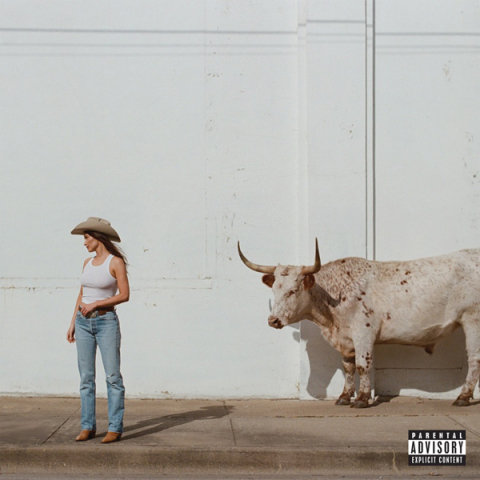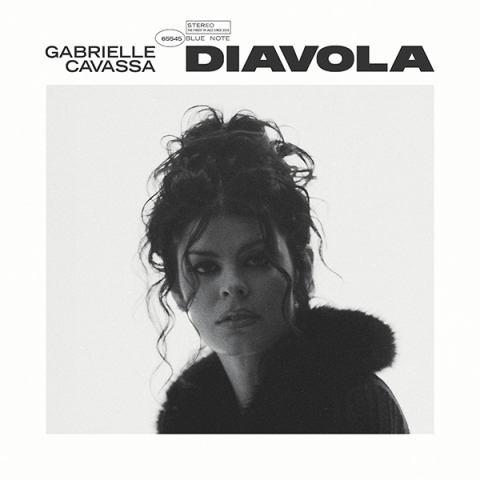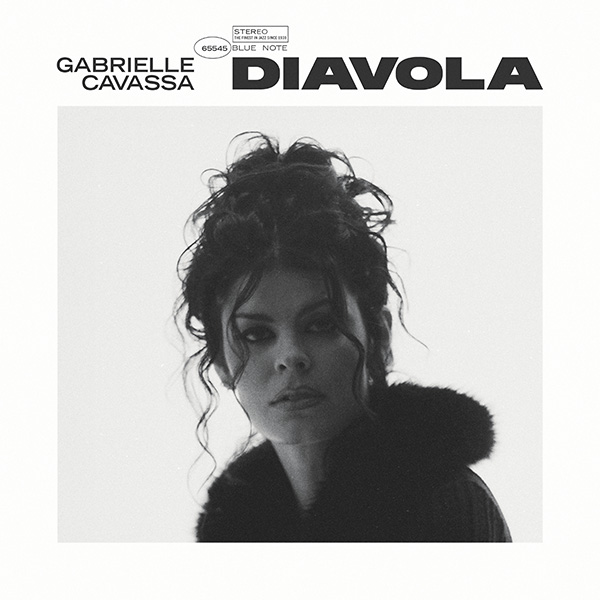
Gabrielle Cavassa: Diavola
Cavassa, vocals; Jeff Parker, guitar; Larry Grenadier, bass; Brian Blade, drums; Paul Cornish, piano; Joshua Redman, tenor saxophone
Blue Note 00602478065545 (auditioned in WAV; available as CD, LP). 2026. Joshua Redman, Don Was, prods.; Ariel Shafir, eng.
Performance ****½
Sonics ****½ Gabrielle Cavassa put out an eponymous self-released album in 2020. But it wasn't until 2023, when she appeared on Joshua Redman's Blue Note debut where are we, that word hit the street: There was a hot new singer in town. Now Cavassa has a Blue Note debut of her own. The coproducers of Diavola, Redman and Blue Note President Don Was, have wisely placed Cavassa in a setting perfect for her: an open space surrounded by a few world-class musicians. The focus is on Cavassa's intimate, nuanced, addictive voice.
The repertoire decisions for Diavola are bold. There are two originals, two songs from Italy (sung in Italian), and one from Brazil. But most of the tunes are American hits from long ago and are rarely covered by jazz musicians. Mario Lanza's grandiose, operatic version of "Be My Love" sold two million copies in 1950. Cavassa takes it dead-slow, accompanied only by the atmospheric guitar effects of Jeff Parker. It takes a singer with a special interpretive gift to turn "Be My Love" into a personal plea and whisper it in your ear. Burt Bacharach's "Raindrops Keep Falling on My Head" and Barry Manilow's "Could It Be Magic" were pop smashes in their day. Cavassa turns them into her own art.
"To Say Goodbye," by Brazilian singer/ songwriter Eduardo Lobo, will be new to many. In an album of unexpected love songs, one that deals with love in its many piercing permutations, Lobo's song (with English lyrics by Lani Hall) is perhaps the most poignant. When Cavassa sings, "There's no more to say, you're not coming back/You just close the door, leaving me alone now," her voice is identical with devastation. Gabrielle Cavassa has arrived.—Thomas Conrad
 Miroslav Vitous: Mountain Call
Miroslav Vitous, bass, six others; Czech National Symphony Orchestra
ECM 2673 (auditioned as LP; available on CD, digital). 2026. Miroslav Vitous, Manfred Eicher, prods.; Miroslav Vitous, eng.
Performance ****
Sonics *****
While a new record from Czech bassist Miroslav Vitous is always welcome, this one has a bittersweet sheen, as it is largely made up of collaborations with recently deceased partners Michel Portal and Jack DeJohnette.
DeJohnette—who had Vitous on his leader debut and later returned the favor—appears in two duets, one with orchestral sampling, and as part of a group with Bob Mintzer (bass clarinet) and members of the Czech National Symphony Orchestra for the "Evolution" suite. The unadorned duet finds DeJohnette's percolating lyricism limning Vitous's lines, while the other is darker and more atmospheric. DeJohnette appears only in the last of the suite's three movements, a cinematic fast swing following swells and declamations.
Portal participates in eight duets, ranging from under a minute to more than five minutes, all but two improvised. He and Vitous are perfectly matched, clarity of tone married to far-reaching vision within wonderfully evocative dialogues: elfin convocation; prayer service, Vitous's double stops organlike; swirling leaves. Their longest conversation, the closing title track, has different textures through resonant arco and flutter-tonguing.
The outlier is another suite, "Rhapsody," with Gary Campbell, Gerald Cleaver, and Esperanza Spalding, normally a bassist but here singing Vitous's lyrics. Its five sections are overtly jazzy, whether recalling standards or utilizing scatting, rich with blues or art song, yielding to post-bop.
The 18 tracks were recorded by Vitous in his Prague studio over an eight-year period. The programming and mostly short track times lend Mountain Call a tapas vibe, leaving one hungry for a full bass/clarinet album.—Andrey Henkin
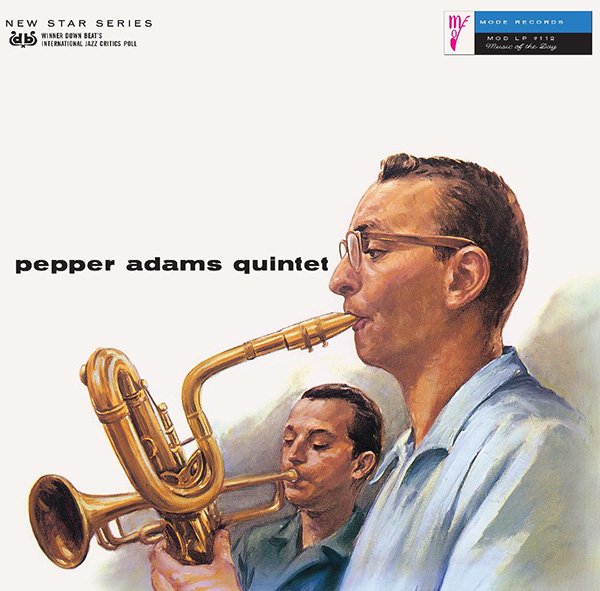 Pepper Adams Quintet
Adams, baritone saxophone; Leroy Vinnegar, bass; Mel Lewis, drums; Carl Perkins, piano; Stu Williamson, trumpet
Gammaut Records GAMMAUT 001 (LP). 2026. Philipe Berman, reissue prod.; Dayton Howe, eng.
Performance ****
Sonics ****
When an upstart label reissues a forgotten hard bop classic with design, packaging, and sound quality that rivals the major players, it demands recognition.
Pepper Adams was among the finest baritone saxophonists in jazz history, a bespectacled, lanky powerhouse who coaxed unprecedented ferocity from an instrument rarely associated with fire. He recorded three albums as leader in 1957 alone, this self-titled hard bop romp on the short-lived Mode label among them. He went on to record two dozen albums as leader and appeared on sideman dates with the Thad Jones/Mel Lewis Orchestra, Charles Mingus, and Thelonious Monk.
Pressed at 45rpm on 180gm vinyl at Gotta Groove Records, mastered by Bernie Grundman from a 15ips stereo tape copy, housed in a Stoughton tip-on gatefold jacket—every element of this exceptional Gammaut reissue serves the music.
Playing standards and originals, this swinging quintet—Stu Williamson (trumpet), Carl Perkins (piano), Leroy Vinnegar (bass), and Mel Lewis (drums)—brings breezy West Coast cool-bop assurance. "Baubles, Bangles and Beads" speeds at a juggernaut pace, Adams delivering a fleet, rip-snorting solo while Lewis prods and pokes. On the willowy "My One and Only Love," Adams winds a muscular yet serene solo like a flower stretching toward the sun.
The 45rpm disc captures a huge soundstage with excellent definition and layering. Bass is clean and tight, drums crisp and articulate. I felt I could walk onto the stage and sub for Mel. If only.
My original Mode pressing offered more intimacy and fleshier tone, but the bass was flabby and ill-defined, the horns squeezed together, the drums lacking grace. A second Gammaut reissue is in the works, so stash your funds now.—Ken Micallef
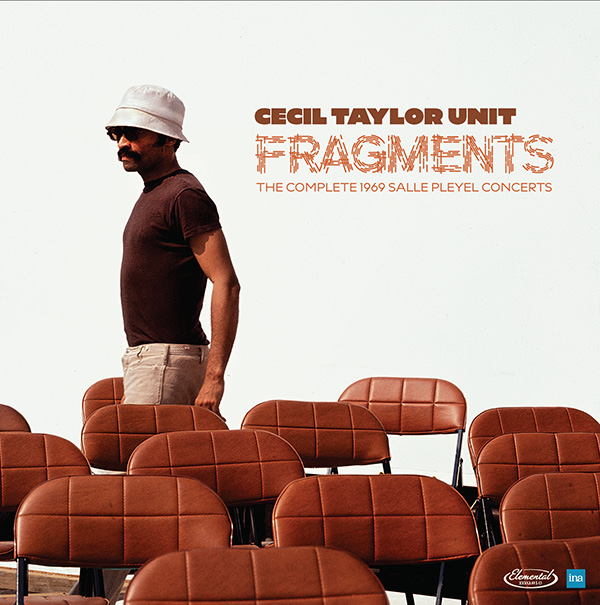 Cecil Taylor Unit: Fragments: The Complete 1969 Salle Pleyel Concerts
Taylor, piano; Jimmy Lyons, alto saxophone; Sam Rivers, tenor and soprano saxophones, flute; Andrew Cyrille, drums
Elemental 5990455 (2 CDs; available as 3 LPs). 1969/2026. Zev Feldman, Phil Freeman, prods.; Marc Doutrepont, mixing and sound restoration eng.
Performance ***
Sonics *** When you put on Fragments and get assaulted by the sonic violence of the Cecil Taylor Unit circa 1969, you wonder if we live in timid times. Perhaps in the '60s, people were more willing to accept pain in return for epiphanies. Still, even back in the day, Taylor was deeply controversial. Miles Davis once famously said of his music, "That shit ain't nothing." This two-CD/three-LP set comes from the Paris stop on a 15-city European tour. It captures two concerts on November 3, 1969. Both were played straight through without a break. The afternoon concert was 90 minutes, the evening performance 50 minutes. Alto saxophonist Jimmy Lyons and drummer Andrew Cyrille were long-term Taylor collaborators. Tenor saxophonist Sam Rivers would stay with Taylor for a year. It is the presence of Rivers that makes the music in Paris so challenging. A Taylor band with one saxophonist raising Holy Hell is daunting. Two shrieking in the same moment risks madness.
A Taylor piece does not "develop" over time. It exists in an eternal present. It is a single mass, like a Jackson Pollock painting. Taylor did not "play" the piano. When he soloed, he flooded the world with piano. It was uniquely exciting to be drowned in his gigantic deluges. Lyons and Rivers require faith. The more you listen, the more you perceive Lyons's pursuit of arcane melody. Rivers's hoarse ravings can be exhausting. Phil Freeman, in his liner note, correctly states, "It's some of the most intense music ever made by man."
The performance rating is an average. For Taylor-deniers like Miles, it rates one star. For those who have drunk the KoolAid, it rates five.—Thomas Conrad
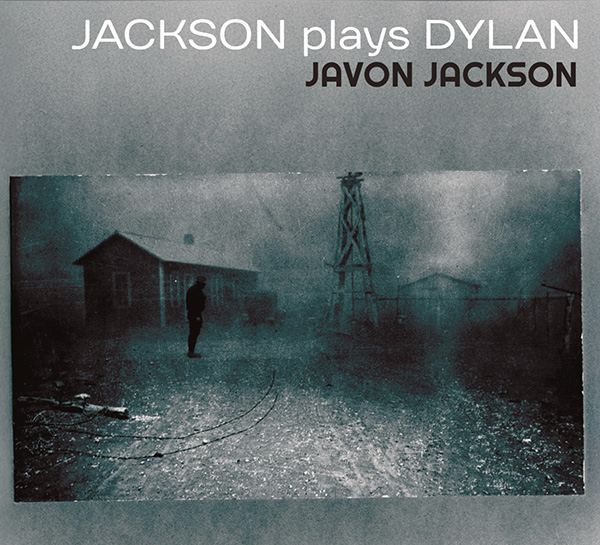 Javon Jackson: Jackson Plays Dylan
Jackson, tenor saxophone; five others
Solid Jackson SJ1010 (CD). 2026. Jackson, prod.; Marc Urselli, eng.
Performance ****
Sonics ****½
Javon Jackson's new album has a winning concept: jazz versions of Bob Dylan songs. Why not? They are some of the best-known, best-loved tunes in American culture, and most are rarely covered by jazz musicians.
Jackson does more than "cover" them. His clarion, persuasive tenor saxophone voice, backed by a concise, creative rhythm section (pianist Jeremy Manasia, bassist Isaac Levien, drummer Ryan Sands), casts them in fresh light.
Unlike so many of us, Jackson did not grow up with these songs. He became a Dylan fan late, in his 20s, mostly because of his admiration for Dylan's "ability to speak truth to power." Jackson's interpretations of protest pieces like "Blowin' in the Wind," "Hurricane," and "The Times They Are a-Changin'" draw on their messages and their historical associations and turn their familiar melodies into touchpoints within freewheeling improvisations. There are also love songs. The sensuality of "Lay Lady Lay" takes on new dimension. Jackson and Levien on electric bass pass pieces of the famous melody back and forth between them, while Manasia, on Fender Rhodes, spreads beauty, in bright colors, all around them.
Much of the album requires an adjustment, to experience instrumental versions of songs you've always heard sung. Even the two vocal tracks require an adjustment, because the singers (both of whom have Grammy awards and Grammy nominations on their resumés) are so different from Dylan. Lisa Fischer is an A-list backup singer who toured with the Rolling Stones for 25 years and was featured in the film 20 Feet from Stardom. She steps out front and, over the band's wicked groove, tells us exactly why you "Gotta Serve Somebody." Nicole Zuraitis is a rising star with a fascinating voice who knows what chops are for. She makes "Forever Young," one of Dylan's greatest songs, her own.—Thomas Conrad
Cavassa, vocals; Jeff Parker, guitar; Larry Grenadier, bass; Brian Blade, drums; Paul Cornish, piano; Joshua Redman, tenor saxophone
Blue Note 00602478065545 (auditioned in WAV; available as CD, LP). 2026. Joshua Redman, Don Was, prods.; Ariel Shafir, eng.
Performance ****½
Sonics ****½ Gabrielle Cavassa put out an eponymous self-released album in 2020. But it wasn't until 2023, when she appeared on Joshua Redman's Blue Note debut where are we, that word hit the street: There was a hot new singer in town. Now Cavassa has a Blue Note debut of her own. The coproducers of Diavola, Redman and Blue Note President Don Was, have wisely placed Cavassa in a setting perfect for her: an open space surrounded by a few world-class musicians. The focus is on Cavassa's intimate, nuanced, addictive voice.
Miroslav Vitous: Mountain CallMiroslav Vitous, bass, six others; Czech National Symphony Orchestra
ECM 2673 (auditioned as LP; available on CD, digital). 2026. Miroslav Vitous, Manfred Eicher, prods.; Miroslav Vitous, eng.
Performance ****
Sonics *****
Pepper Adams QuintetAdams, baritone saxophone; Leroy Vinnegar, bass; Mel Lewis, drums; Carl Perkins, piano; Stu Williamson, trumpet
Gammaut Records GAMMAUT 001 (LP). 2026. Philipe Berman, reissue prod.; Dayton Howe, eng.
Performance ****
Sonics ****
Cecil Taylor Unit: Fragments: The Complete 1969 Salle Pleyel ConcertsTaylor, piano; Jimmy Lyons, alto saxophone; Sam Rivers, tenor and soprano saxophones, flute; Andrew Cyrille, drums
Elemental 5990455 (2 CDs; available as 3 LPs). 1969/2026. Zev Feldman, Phil Freeman, prods.; Marc Doutrepont, mixing and sound restoration eng.
Performance ***
Sonics *** When you put on Fragments and get assaulted by the sonic violence of the Cecil Taylor Unit circa 1969, you wonder if we live in timid times. Perhaps in the '60s, people were more willing to accept pain in return for epiphanies. Still, even back in the day, Taylor was deeply controversial. Miles Davis once famously said of his music, "That shit ain't nothing." This two-CD/three-LP set comes from the Paris stop on a 15-city European tour. It captures two concerts on November 3, 1969. Both were played straight through without a break. The afternoon concert was 90 minutes, the evening performance 50 minutes. Alto saxophonist Jimmy Lyons and drummer Andrew Cyrille were long-term Taylor collaborators. Tenor saxophonist Sam Rivers would stay with Taylor for a year. It is the presence of Rivers that makes the music in Paris so challenging. A Taylor band with one saxophonist raising Holy Hell is daunting. Two shrieking in the same moment risks madness.
Javon Jackson: Jackson Plays DylanJackson, tenor saxophone; five others
Solid Jackson SJ1010 (CD). 2026. Jackson, prod.; Marc Urselli, eng.
Performance ****
Sonics ****½